

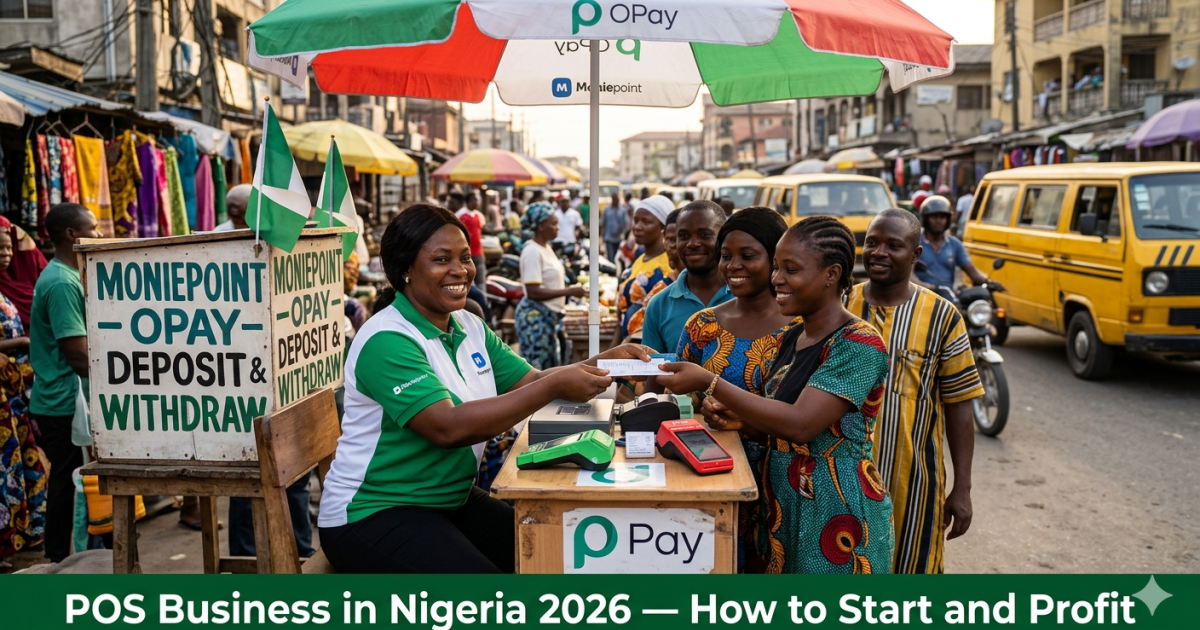
Walk down almost any street in Nigeria today — from Agege to Asokoro, from Onitsha Main Market to a rural junction in Benue State — and you will find a POS kiosk. It might be a wooden table under an umbrella, a glass-fronted mini shop, or a corner of someone’s provision store. But it will be there, and it will almost certainly be busy.
The POS business has quietly become one of the most important financial services in Nigeria. With 5.9 million active POS terminals recording a record ₦10.51 trillion in transactions in Q1 2025 alone — a 301.67% increase from Q1 2024 — this is not a small business anymore. It is a financial infrastructure. And for the entrepreneur willing to do it right, it remains one of Nigeria’s most accessible daily-income businesses in 2026.
This guide gives you the full picture: real startup costs, honest daily profit numbers, the best providers to choose from, the CBN’s major new rule that changed the game in April 2026, and the exact steps to register and launch your POS business today.
Is the POS Business Still Profitable in Nigeria in 2026?
Yes — but the landscape has changed. Here is the honest picture:
| Active POS terminals in Nigeria (March 2025) | 5.9 million (out of 8.36 million registered) |
| Q1 2025 transaction volume | ₦10.51 trillion — record high, 301.67% year-on-year increase |
| Daily earnings potential (urban, high traffic) | ₦10,000 – ₦20,000 per terminal |
| Daily earnings potential (rural areas) | ₦5,000 – ₦15,000 per terminal |
| Major 2026 regulatory change | CBN single-principal rule: agents must choose ONE provider from April 1, 2026 |
| Key drivers of growth | CBN cashless policy, limited bank branches in rural areas, ATM shortages, continued cash preference among Nigerians |
The POS business works because Nigeria has a structural gap between the demand for financial services and the supply of formal banking infrastructure. With only about 6,000 bank branches serving 200+ million people, POS agents effectively function as the banking layer for millions of Nigerians. That structural gap will not close anytime soon — making the POS business a long-term viable opportunity rather than a passing trend.
⚠️ The Major 2026 Change: CBN’s Single-Principal Rule
Critical Update for All POS Agents in Nigeria: The Central Bank of Nigeria (CBN) released new Agent Banking Guidelines on October 6, 2025, which took full effect from April 1, 2026. The most significant change: every POS agent in Nigeria must now be exclusive to ONE financial principal — one bank, fintech, mobile money operator, or microfinance bank. If you were previously running Moniepoint, OPay, and PalmPay terminals together, you must now choose just one. Operating multiple terminals from different providers is now a regulatory breach that can result in termination, blacklisting, or prosecution. This was confirmed by TechCabal, CediRates, and Dabafinance in their October 2025 coverage of the CBN circular. New agents starting in 2026 must register with only one provider from the outset.
The CBN described the overhaul as “the most comprehensive regulatory reform since agent banking began in 2013,” designed to strengthen oversight, reduce fraud, and improve service quality. Under the new rules, all agent transactions must flow through a single dedicated wallet. The new guidelines also introduce a ₦1.2 million daily withdrawal cap per agent, geo-fencing of all POS terminals to a fixed registered location, and full liability for the agent’s principal financial institution. For new agents, this means: choose your provider wisely, because switching later involves a formal process.
Realistic Startup Cost: How Much Do You Need to Start a POS Business in Nigeria?
One of the most common questions Nigerians ask before starting a POS business is: “How much do I need?” The answer depends on your setup level. Here is a realistic breakdown from budget to comfortable start:
Minimum Budget Setup (Umbrella / Table Operation)
| Item | Cost Range | Notes |
|---|---|---|
| POS machine (from provider) | ₦0 – ₦30,000 | Many providers offer free terminals to qualified agents; Moniepoint machine is ₦25,000; others range ₦15,000–₦50,000. PalmPay requires a ₦20,000–₦30,000 refundable caution deposit. |
| Float (working capital) | ₦50,000 – ₦150,000 | This is the cash you use to pay out to customers. The more float you have, the more transactions you can handle per day. Most agents recommend starting with at least ₦100,000 float. |
| Umbrella + plastic table + chair | ₦10,000 – ₦20,000 | For the simplest open-air setup |
| CAC business registration | ₦10,000 – ₦20,000 | Required by most providers and strongly recommended for accessing loans and grants later |
| Signage / branding | ₦3,000 – ₦10,000 | Banner with your business name and services offered |
| Phone (for app management) | ₦0 (use existing phone) | Most POS management apps work on any Android smartphone |
| Minimum Total (umbrella setup) | ₦73,000 – ₦230,000 | Most agents budget ₦100,000–₦150,000 for a comfortable start |
Standard Kiosk Setup
| Item | Cost Range | Notes |
|---|---|---|
| POS machine | ₦0 – ₦30,000 | As above |
| Float (working capital) | ₦150,000 – ₦300,000 | Higher float means more transactions and higher daily earnings |
| Wooden kiosk / small shop rent (monthly) | ₦10,000 – ₦50,000 | Highly location-dependent — market frontage is more expensive than a side street |
| Generator / inverter for power backup | ₦30,000 – ₦80,000 | Essential — NEPA interruptions will kill your transactions. A small generator or a power bank POS setup is critical. |
| CAC registration | ₦10,000 – ₦20,000 | — |
| Branding materials | ₦5,000 – ₦20,000 | Most major providers (Moniepoint, OPay, PalmPay) provide some branded materials for free |
| Security measures (lockable cash box, CCTV) | ₦5,000 – ₦30,000 | Small cash box minimum; CCTV if in a semi-permanent location |
| Standard Kiosk Total (excluding monthly rent) | ₦210,000 – ₦480,000 | Most operators aim for ₦250,000–₦350,000 for a solid kiosk start |
BusinessDay Nigeria, in their ground-level reporting on POS business economics, found that with a Bankly machine (available from ₦30,000) and a startup capital of at least ₦50,000 float, plus an umbrella at ₦10,000–₦15,000, new agents were earning a profit range of ₦3,000–₦5,000 per day even in their early months.
Daily Profit: How Much Can a POS Business Actually Earn in Nigeria?
This is where most guides mislead Nigerian entrepreneurs with unrealistic numbers. Here is an honest breakdown:
| Setup Level | Location Type | Daily Transactions (estimate) | Average Daily Revenue | Monthly Revenue (est.) |
|---|---|---|---|---|
| Small (umbrella, ₦100k float) | Residential street, small market | 20–40 transactions | ₦3,000 – ₦7,000 | ₦90,000 – ₦210,000 |
| Medium (kiosk, ₦200k float) | Busy market, school area, estate gate | 50–100 transactions | ₦7,000 – ₦15,000 | ₦210,000 – ₦450,000 |
| Busy (kiosk or shop, ₦300k+ float) | Major market, bus stop, hospital area | 100–200 transactions | ₦15,000 – ₦25,000 | ₦450,000 – ₦750,000 |
| Multi-service hub | High-density commercial area | 200+ transactions + bills + airtime | ₦25,000 – ₦50,000+ | ₦750,000 – ₦1,500,000+ |
What drives the range: Your actual profit depends on: (1) the volume of daily transactions, which is almost entirely determined by location; (2) how much float you maintain — low float means you run out of cash mid-day and turn customers away; (3) the additional services you offer beyond basic withdrawals; and (4) your network reliability (downtime kills revenue instantly).
The SME Mall’s 2026 business guide summarises it plainly: POS is “still one of the top 10 daily income businesses in Nigeria” but profits range from ₦3,000 to ₦15,000 per day “depending on location” — acknowledging that location is the single most important variable. Kuda Bank’s blog, which focuses on financial business education for Nigerians, noted monthly earnings potential of ₦150,000 to ₦600,000 for well-positioned agents in 2026.
How to Choose the Best Location for Your POS Business
Location is not just important for a POS business — it is everything. An agent with an average machine in a great location will always outperform an agent with the best machine in a poor location. Here is how to assess a location before committing to it:
Best Locations for POS Business in Nigeria
| Location Type | Why It Works | Competition Level | Profit Potential |
|---|---|---|---|
| Busy market (Balogun, Alaba, Onitsha, Sabon Gari) | Constant foot traffic; traders need cash for purchases; vendors need to cash out | High | ⭐⭐⭐⭐⭐ Very high |
| Bus stops and motor parks | Commuters need cash; constant movement of people; transport workers need cash payouts | High | ⭐⭐⭐⭐⭐ Very high |
| Hospital / health centre entrances | Patients and families frequently need cash urgently for medications, treatment deposits, ward fees | Low-Medium | ⭐⭐⭐⭐⭐ Excellent |
| Residential estate gates / neighbourhood entry | Residents need cash for deliveries, domestic staff, market shopping — close proximity is key | Low | ⭐⭐⭐⭐ Good |
| Near churches and mosques (especially Sundays/Fridays) | Worshippers frequently need cash for offerings, purchases after services | Very low | ⭐⭐⭐⭐ Good (especially peak days) |
| University / polytechnic / school areas | Students constantly need cash; parents remit money; students pay for materials, food, transport | Medium | ⭐⭐⭐⭐ Good |
| Rural areas with no bank branch nearby | Zero competition; community depends entirely on you; people travel specifically to your location | Very low | ⭐⭐⭐⭐ Very good for patient operators |
| Near government offices / ministries | Civil servants, contractors, visitors need cash especially on pay days | Low-Medium | ⭐⭐⭐⭐ Good |
Locations to Avoid
- Areas with multiple working ATMs nearby. If the street has three ATMs that are consistently stocked and working, your transaction volume will be very low. The POS business thrives precisely where ATMs are absent, broken, or perpetually out of cash.
- Quiet residential streets with no foot traffic. Even if you are the only POS agent on the street, zero foot traffic means zero transactions.
- Unsafe areas with a history of robberies. Cash-handling businesses are robbery targets. Assess the security situation of any potential location before investing. Talk to local business owners.
- Areas already saturated with POS agents. If every 50 metres has a POS kiosk, competition will drive transaction volume per agent too low to be profitable. Scout for underserved spots within even busy areas.
Best POS Providers in Nigeria 2026: Moniepoint vs OPay vs PalmPay vs Others
With the CBN’s new single-principal rule now in effect, choosing your provider is one of the most important decisions you will make. You cannot easily switch once registered. Here is a comparison of the major providers:
| Provider | Machine Cost | Transaction Fee (withdrawal) | Float Requirement | Best For | How to Apply |
|---|---|---|---|---|---|
| Moniepoint | ₦25,000 | ₦20 flat per transaction (all banks) | Moderate | Agents wanting low, predictable charges; high-volume operations | moniepoint.com → Agent Registration; or walk into a Moniepoint branch. A rep contacts you within 48 hours. |
| OPay | Free (after account history) | Varies by transaction type | Moderate | Agents who already have OPay account history; urban agents | Download OPay app → upgrade KYC to Level 3 → email ng-support@opay-inc.com for merchant form. Must have existing account history first. |
| PalmPay | Free machine; ₦20,000–₦30,000 refundable caution deposit | Low; bill payments are FREE | ₦20,000 minimum float | Agents who want low entry barriers; good for bill payment volume; modern Android terminals | Download PalmPartner app → sign up → complete KYC → apply for POS through the app → team contacts you |
| FirstMonie (First Bank) | Negotiable | Bank-standard | Higher (bank account required) | Agents who want the credibility of a major bank behind them; rural areas with First Bank presence | Visit nearest First Bank branch; speak with agent banking officer |
| Access Closa (Access Bank) | Varies | Bank-standard | Higher | Agents in areas where Access Bank is the dominant bank; established business owners | Visit Access Bank branch or apply via Access Bank mobile app |
| Bankly | ₦30,000 | 0.3% for withdrawals; ₦35 flat for transfers; ₦5 per ₦1,000 withdrawal | Low | Budget-conscious starters; informal sector agents; agents targeting unbanked communities | Download Bankly Agent app → create account → submit KYC → request POS device through app |
| Nomba (formerly Kudi) | Free | 0.7% flat on cash withdrawals | Low (use app first) | Beginner agents; no formal requirements to start — just the app | Download Nomba app → sign up with phone number → link to bank account → use app transactions first → then request POS |
NaijaSabi’s recommendation for new agents in 2026: Moniepoint is the most recommended starting provider for serious agents due to its transparent ₦20 flat fee structure, reliable network, strong agent support, and the fact that it has processed over a billion transactions worth ₦20 trillion since 2019. Its machine cost of ₦25,000 is reasonable, and its reputation in the market helps attract customer trust. PalmPay is the best option for agents who want a free modern Android terminal (with a refundable caution deposit) and who expect significant bill payment volume. Nomba is the easiest starting point for absolute beginners with no capital for a machine.
Step-by-Step: How to Start a POS Business in Nigeria in 2026
Step 1 — Conduct a Location Survey
Before spending a single naira, spend one to two days surveying your target location. Observe foot traffic at different times of day (morning rush, afternoon, evening). Count the number of existing POS agents within 200 metres. Talk to people in the area — ask directly if they need a POS agent and what services they need most. Identify the nearest working ATM. Assess the security situation by asking local shop owners. Only proceed with a location if: foot traffic is genuinely high, there is no more than one or two direct competitors nearby, and the security situation is acceptable.
Step 2 — Register Your Business with CAC
While some providers will give you a POS machine without a CAC registration, registering your business has multiple benefits: it is required by the major bank-backed providers (FirstMonie, Access Closa), it allows you to open a business bank account, it enables you to access SME loans and government grants later, and it makes your business look more credible to customers. A business name registration with the Corporate Affairs Commission (CAC) costs approximately ₦10,000–₦20,000 and can be done online at cac.gov.ng or through a registered CAC agent. You will also need a Tax Identification Number (TIN) from the Federal Inland Revenue Service (FIRS).
Step 3 — Choose Your Provider and Apply
Based on the comparison above, select your single provider. Remember: under the CBN’s April 2026 rule, you can only be registered with ONE provider at a time. Take this decision seriously. Apply through the provider’s official channel (website, app, or branch visit). The typical documents required across providers are:
- Valid government-issued ID (NIN slip, National ID card, Voter’s Card, or International Passport)
- Bank Verification Number (BVN)
- Utility bill (not older than 3 months) — for address verification
- Passport photograph
- CAC certificate (required by bank-backed providers; recommended for all)
- Proof of business address / location
Step 4 — Set Up Your Float
Your float is the cash you use to pay out to customers during withdrawals. Without sufficient float, you cannot process transactions. The minimum recommended starting float for a POS business is ₦100,000. This allows you to process approximately 10–20 withdrawal transactions of ₦5,000 each before needing to replenish. For a busy location, a float of ₦200,000–₦300,000 is more practical. Top up your float daily or every two days by depositing your cash earnings at your provider’s account or a bank branch and reloading your wallet.
Step 5 — Set Up Your Physical Location
Your setup does not need to be expensive, but it does need to look like a business. Even an umbrella-and-table setup should have: your business name clearly written, the fintech provider branding (most providers give you this for free), a price list showing your charges, and a small power bank or generator for backup. If you are renting a kiosk, ensure it is well-lit, clearly signposted, and has a secure area for your cash and machine. Install a lockable cash drawer as a minimum security measure. If you will regularly hold significant cash, consider a small safe.
Step 6 — Launch and Build Customer Loyalty
On your first few days, the goal is to establish yourself as reliable and fast. Every transaction that succeeds smoothly is a referral. Tell your neighbours you are open. Put up a WhatsApp status. Ask local shop owners to direct customers to you. Customer loyalty in the POS business is built almost entirely on: fast transactions, machine uptime (network reliability), fair charges, and being genuinely available during business hours. Agents who open at 7am and close at 9pm consistently outperform those with irregular hours.
Services to Add Beyond Basic Withdrawals to Increase Your Daily Income
The POS agents making the highest income are not just doing withdrawals. They have turned their kiosk into a mini financial services hub by adding:
| Additional Service | Typical Charge | Potential Daily Addition |
|---|---|---|
| Cash deposits (bank deposits for customers) | ₦100–₦300 per deposit | ₦500–₦3,000/day |
| Bank transfers | ₦100–₦200 per transfer | ₦1,000–₦5,000/day |
| DSTV / GOtv subscription payments | ₦100–₦200 per payment | ₦300–₦1,500/day |
| Electricity (NEPA) token recharge | ₦100–₦200 per recharge | ₦500–₦2,000/day (highly consistent) |
| Airtime and data top-up sales | Margin on bulk purchase (5–10%) | ₦500–₦2,500/day |
| School fees / WAEC / JAMB payments | ₦200–₦500 per payment | Seasonal spikes during exam seasons |
| Betting wallet top-ups (Bet9ja, 1xBet) | ₦100–₦200 per top-up | ₦500–₦3,000/day in high-betting areas |
| International money transfer (Western Union, etc.) | Provider commission | Variable — high value when active |
Common Challenges and How to Overcome Them
Network Downtime
Every POS agent’s nightmare: the customer is waiting, the card is inserted, and the screen shows “network error.” With the new CBN single-principal rule, you can no longer switch to another provider’s machine. The solution: choose a provider with a strong, proven network in your specific location. Test your target provider’s reliability in your area before registering. Ask other agents or local business owners in your target area which provider they have had the least downtime with. Keep your provider’s customer service number saved and respond to customer complaints professionally when downtime occurs.
Low Float Running Out Mid-Day
Running out of cash by noon on a busy market day means turning customers away — many of whom will go to a competitor and may not come back. The solution: start with as much float as you can afford (₦150,000–₦300,000 for busy locations). Keep a relationship with a nearby bank branch for quick top-ups. Consider having a family member who can bring additional cash mid-day if needed during very busy periods.
Security Risk
POS agents handle significant cash and are visible targets for theft. Risk mitigation: bank your earnings regularly — daily if possible, or at least every two days. Do not accumulate large cash balances at your kiosk. Use a lockable cash box. Consider a partner or assistant if your volume is high. Be aware of your surroundings, particularly at closing time. For higher-risk areas, CCTV is worth the ₦20,000–₦50,000 investment.
Power Supply
NEPA interruptions kill POS transactions — you cannot process cards without a powered terminal. Solution: a small generator (I-pass-my-neighbour, ₦30,000–₦50,000) or a high-capacity power bank for your POS machine is essential for any serious operation. Android POS machines (like PalmPay’s) hold a charge for extended periods. Factor the monthly cost of generator fuel (approximately ₦5,000–₦15,000 per month) into your profitability calculation.
Fraudulent Customers
Card fraud and scams targeting POS agents are real in Nigeria. Common fraud patterns: customers who claim the machine debited their card but no cash was dispensed (reversal fraud); customers who provide stolen cards; fake alerts for cash-before-transfer arrangements. Protect yourself: always confirm that your POS terminal shows a successful transaction before handing over any cash. Never accept cash from a customer and promise to process a transfer later without the POS completing the transaction first. Use only official provider apps for transaction verification — not WhatsApp screenshots of alerts, which can be faked.
Frequently Asked Questions
How much can I make from POS business per month in Nigeria?
Monthly earnings depend almost entirely on location and float size. Budget-level operators in average locations typically earn ₦90,000–₦210,000 per month. Well-positioned kiosk operators in high-traffic areas earn ₦210,000–₦600,000 per month. Operators running multiple services in premium commercial locations can earn over ₦750,000 per month. Kuda Bank’s 2026 POS business guide puts the realistic monthly range for committed agents at ₦150,000 to ₦600,000.
Can I use both Moniepoint and OPay terminals in 2026?
No. The CBN’s new Agent Banking Guidelines, which took effect on April 1, 2026, require all POS agents in Nigeria to be exclusive to a single financial principal. Operating terminals from two or more providers is now a regulatory breach that can result in contract termination, blacklisting, or prosecution. You must choose one provider and stick with it. This was confirmed by TechCabal and CediRates in their October 2025 coverage of the CBN circular.
Do I need to register with CAC to start a POS business?
Not all providers require it — Nomba, OPay, and PalmPay can be started without CAC registration. However, CAC registration is required for bank-backed providers (FirstMonie, Access Closa), is strongly recommended for establishing credibility, and is necessary if you want to access SME loans, government grants, or business banking services in the future. The cost is ₦10,000–₦20,000 and can be done online at cac.gov.ng or through a CAC agent.
How much is the Moniepoint POS machine in 2026?
The Moniepoint POS machine costs approximately ₦25,000 in 2026. This is a one-time purchase — not a monthly rental. The machine accepts Visa, MasterCard, and Verve cards and works with all Nigerian banks. Moniepoint charges a flat fee of ₦20 per transaction across all banks, which is one of the most transparent and competitive fee structures in the market.
What is the daily withdrawal cap per POS agent under the new CBN rules?
Under the CBN’s new October 2025 Agent Banking Guidelines, each POS agent terminal now has a ₦1.2 million daily withdrawal cap. This means the maximum total cash that can be withdrawn through a single agent terminal in one day is ₦1.2 million. For most small-to-medium POS operators, this cap will never be a limiting factor. It primarily affects high-volume agents at major commercial locations who were processing very large daily transaction volumes.
📋 POS Business 2026 — Quick Start Checklist
- ✅ Survey your location for 1–2 days — count foot traffic and existing competitors
- ✅ Register with CAC — ₦10,000–₦20,000 at cac.gov.ng
- ✅ Choose ONE provider — Moniepoint (recommended), PalmPay, OPay, Nomba, or bank-based
- ✅ Gather documents — valid ID, BVN, utility bill, passport photo, CAC cert
- ✅ Minimum float of ₦100,000 — ₦150,000–₦300,000 recommended for busy locations
- ✅ Set up power backup — small generator or charged power bank, essential
- ✅ Install a cash lockbox — security basics before opening
- ✅ Bank your earnings regularly — daily if possible, maximum every 2 days
- ✅ Add bill payments, airtime, data — more services = more daily income
- ✅ Be consistent — open on time, every day; customer loyalty builds on reliability
The POS business is not glamorous. It requires daily presence, cash management discipline, and the ability to serve dozens of customers patiently every single day. But it is one of the few businesses in Nigeria where you earn cash every day, your startup cost is low enough for almost anyone to manage, and the structural demand for your service is not going away anytime soon. The millions of Nigerians who still rely on cash, who live 20km from the nearest bank branch, who cannot access an ATM after 6pm — they need you. Get the location right, choose your provider wisely, and this business will pay you every single day.
Starting your POS business? Tell us your target location and provider choice in the comments — we will share specific tips for your situation. Also read our guides on How to Register a Business with CAC in Nigeria 2026 and Grants and Free Funding for Nigerian Entrepreneurs 2026.



0 Comments
No comments yet. Be the first to share your thoughts!