




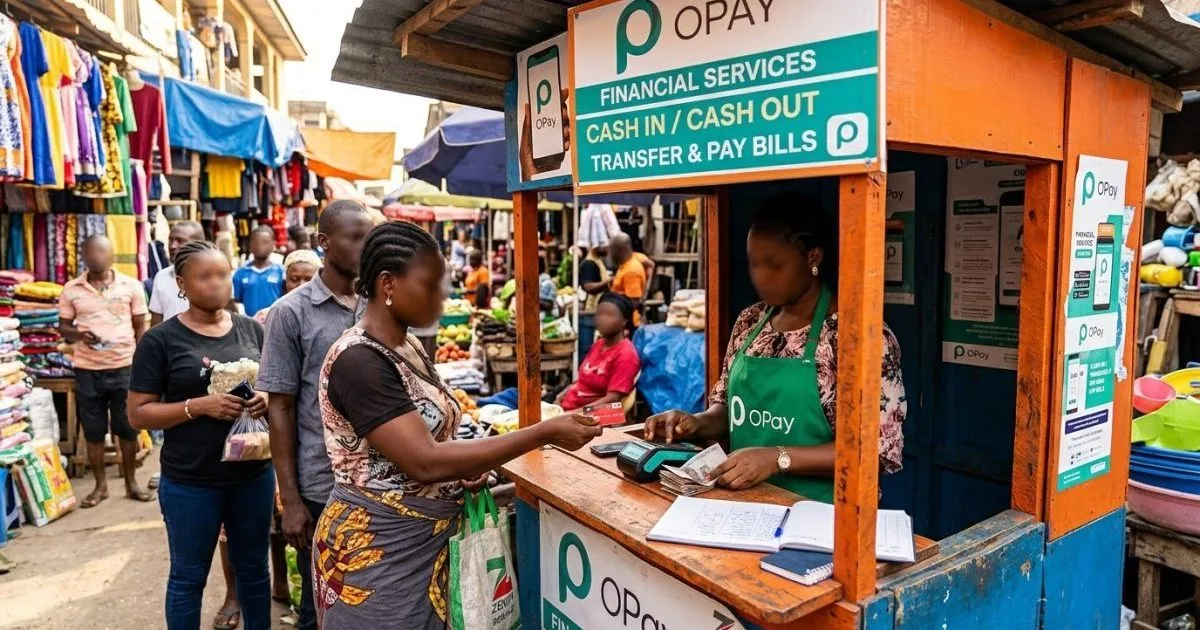
📌 Quick Summary: A POS (Point of Sale) agent banking business in Nigeria requires startup capital of ₦150,000 to ₦500,000 for a POS terminal, initial float (working capital for transactions), and location setup. POS agents earn ₦50 to ₦200 per withdrawal transaction depending on the amount, and can process 200 to 500+ transactions daily in a good location. A busy POS point earns ₦3,000 to ₦30,000 daily in transaction fees — ₦90,000 to ₦600,000 monthly. The most important factor: location — a POS point in a market, motor park, or dense residential area without nearby ATMs consistently outperforms one in a well-served commercial area. This guide covers how to become a POS agent in Nigeria 2026, which network to join (OPay, Moniepoint, Palmpay, FirstMonie), how much you can earn, and how to protect your float from fraud.
The POS agent banking business has transformed financial access in Nigeria in ways that no government programme or bank expansion strategy has matched. POS agents — operating from market stalls, shops, kiosks, and dedicated outlets across Nigeria — bring cash withdrawal, cash deposit, airtime purchase, bill payment, and money transfer services to communities that never had a bank branch and may be kilometres from the nearest ATM. In 2026, there are an estimated 1.5 to 2 million active POS agents across Nigeria, processing hundreds of millions of transactions annually. Despite the scale, the market remains far from saturated in the right locations — because the right location is everything in the POS agent business, and millions of Nigerians in dense urban and semi-urban areas still walk more than 10 minutes to find an ATM or POS point. For the entrepreneur who identifies an underserved location, sets up with adequate float, and manages operations professionally, POS agent banking remains one of the most consistently profitable entry-level financial services businesses available in Nigeria.
How POS Agent Banking Works in Nigeria
The agent banking model: a POS agent partners with a financial institution or fintech company (called the principal — Moniepoint, OPay, PalmPay, FirstMonie, GTBank’s GTAgency, etc.) and is provided with a POS terminal that connects to the principal’s payment network. When a customer wants to withdraw cash, the customer’s bank card is processed through the POS terminal, the funds are debited from the customer’s account and credited to the agent’s account (the float), and the agent gives the customer the equivalent in physical cash, charging a transaction fee. When a customer deposits cash, the reverse happens — the agent receives the cash, credits the customer’s account, and their float increases. The agent earns a commission on every transaction — a percentage of the transaction value set by the principal, typically shared between the agent and the principal. The agent’s profit is the cumulative commission on all transactions minus operating costs (rent, electricity, internet connectivity for the terminal, agent fees if staff is employed).
Choosing Your POS Network: Comparison of Major Providers
| Provider | Commission per N1,000 withdrawn | Terminal cost | Minimum float | Best For |
| Moniepoint | ₦10 – ₦15 (varies by tier) | Free to ₦15,000 (refundable deposit) | ₦50,000 – ₦100,000 | Highest transaction volume; strong agent support; best for high-traffic locations |
| OPay | ₦8 – ₦15 | ₦10,000 – ₦25,000 | ₦50,000 – ₦100,000 | Very large agent network; good brand recognition; competitive commission |
| PalmPay | ₦8 – ₦12 | ₦10,000 – ₦20,000 | ₦30,000 – ₦80,000 | Growing network; lower entry cost; good for beginners |
| FirstMonie (First Bank) | ₦10 – ₦20 | Free (for First Bank account holders) | ₦100,000 – ₦200,000 | Bank backing gives customer trust; higher commission on some transaction types |
| GTBank GTAgency | ₦10 – ₦18 | Free to low deposit | ₦100,000 – ₦200,000 | GTBank’s reputation; strong in commercial areas |
Recommendation for new agents: Moniepoint has the largest active agent network in Nigeria in 2026 and the most established support infrastructure. OPay is the most widely recognised brand at the customer level. Either is a strong starting point — compare what each offers in terms of terminal cost, minimum float requirement, and commission rate in your specific area before committing.
Location: The Single Most Important Decision
The POS agent business is almost entirely a location business — the same operator with the same float and the same terminal will generate 10 times the daily revenue in a good location versus a poor one. What makes a good POS location. High foot traffic of people who regularly need cash: markets (daily markets, periodic markets, motor parks, bus stops, church entrances on Sundays, school gates on payment days) consistently generate high POS transaction volumes. Distance from the nearest ATM or competing POS point: a POS agent 500 metres from three other POS agents and a functioning ATM will struggle. A POS agent who is the only option within a 2km radius of a dense residential area will process transactions continuously. Areas with government workers or salary earners who withdraw salary: civil servants who receive salary transfers and immediately need to withdraw cash are among the highest-value POS customers. Hospital environments, motor parks, and market clusters generate consistent, high-volume POS demand. Avoid: locations near ATM clusters that function well, locations in areas where mobile banking penetration is very high (affluent urban areas where most people transact digitally), and locations where the existing POS agent market is clearly saturated.
Float Management: The Core Operational Skill
Float is the cash in your POS agent account that backs the withdrawals your customers make. Running out of float is the most common reason POS agents lose customers and revenue — a customer who comes to withdraw ₦5,000 and finds you have no cash will not wait and may not return. Managing float requires: starting each day with sufficient cash to serve expected demand (estimate from previous days’ transaction volume), topping up float by depositing physical cash into your agent account before it runs critically low (using a bank branch, an ATM, or a float top-up from your principal’s agent network), and tracking your float balance throughout the day so you know when to top up. The right float size depends entirely on your transaction volume — a new agent might start with ₦100,000 to ₦200,000; a busy established agent might maintain ₦500,000 to ₦1,000,000+ in float to serve peak demand without interruption.
Fraud Protection: The Most Critical Risk
POS agent fraud is the most significant operational risk in the business, and Nigerian POS agents lose significant money to it. The most common fraud types. Counterfeit currency: customers pay with fake naira notes that look genuine. Mitigation: use a UV counterfeit detector for all notes above ₦500. Never accept large notes without checking. Card fraud: stolen or cloned cards used for POS transactions that are later disputed and reversed. Mitigation: require PIN entry for all transactions; be very cautious with high-value transactions from unfamiliar customers; if a transaction is disputed and reversed by the customer’s bank, you bear the loss — understand your principal’s dispute policy before starting. Fake transfer notifications: sophisticated fraudsters send fake “transfer successful” SMS notifications that mimic legitimate bank alerts. Mitigation: always verify the transaction on your POS terminal before releasing cash — do not release cash based on an SMS alert that you cannot verify on the terminal. Social engineering: fraudsters create elaborate scenarios to convince agents to release cash without proper verification. Mitigation: establish clear, non-negotiable transaction procedures that you follow regardless of the customer’s story or pressure.
How to Register as a POS Agent in Nigeria 2026
The registration process is straightforward for all major providers. Requirements common to most principals: a valid NIN (National Identity Number), BVN (Bank Verification Number), a bank account in your name with the principal’s partnered bank or the principal’s own account, a valid government-issued ID (national ID, driver’s licence, or international passport), a business address and photograph of your proposed location, and a utility bill or tenancy agreement for your proposed location. Application process: visit the nearest agent onboarding centre for your chosen principal (OPay, Moniepoint, PalmPay all have regional agent recruitment offices in major Nigerian cities and allow online application), complete the agent registration form, submit your documents, pay the terminal deposit if required, pass a brief orientation on the terminal operation and fraud prevention, and receive your terminal. Processing time: 3 to 14 days depending on the principal. Once active, the terminal and your float are the assets the business runs on.
Frequently Asked Questions
How much does a POS agent make in Nigeria per day?
A new agent in a moderate location: ₦3,000 to ₦8,000 daily. An established agent in a good location: ₦8,000 to ₦30,000 daily. The most productive POS agents in Nigeria’s busiest market and transport hub locations report daily earnings of ₦50,000 to ₦100,000+. Location and float size are the primary variables — a larger float allows larger and more numerous transactions per day.
Which POS network pays the most commission in Nigeria?
Commission rates vary by transaction type, transaction volume tier, and the specific agreement with each principal. Moniepoint and FirstMonie agents generally report competitive per-transaction commissions, but the total daily income depends more on transaction volume (location) than on per-transaction rate differences between providers. Compare the actual per-transaction commission table of each provider, not just their headline rate.
Is POS agent business still profitable in Nigeria in 2026?
Yes — the cash economy in Nigeria remains dominant for daily transactions, ATM coverage is still insufficient for Nigeria’s population density, and the transaction fee model produces reliable, recurring daily income for well-located agents. The business is more competitive than it was in 2020 to 2022 when agent banking first boomed — in many areas, the market is saturated at the neighbourhood level. New entrants need to find genuinely underserved locations rather than clustering near existing agents, or differentiate through superior float availability and customer service.
Scaling the POS Business: From Single Terminal to Multi-Location Operation
The natural growth path for a successful POS agent business in Nigeria follows the logic of any location-dependent business: identify one profitable location, optimise operations there, then replicate the model at additional locations. A single POS point generating ₦10,000 to ₦15,000 daily net income is a solid entry-level business. Three points generating ₦10,000 each daily is a ₦900,000 monthly income business that can support full-time management. The scaling challenges: finding additional good locations (the best spots are finite and competitive), managing multiple points (each location needs either a trusted employee or the owner’s direct presence), and float management across multiple terminals (each terminal needs its own adequate float, requiring more total capital). Hiring staff for additional POS locations introduces the trust dimension that is the most significant risk in scaling — a dishonest employee who pockets transaction fees, manipulates the float, or diverts customer funds can destroy a location’s profitability quickly. New staff should start with close supervision, small floats that limit potential theft exposure, and clearly documented transaction recording requirements. The POS operators who successfully scale to 5, 10, or 20 locations in Nigeria typically have developed strong hiring and supervision systems, clear daily reconciliation processes, and relationships with their principal’s agent support team that allow rapid resolution of terminal issues and disputed transactions. Scaling is possible — but it requires treating the business with the same seriousness as any other multi-location retail operation, rather than as an informal side income.
POS Agent Banking and Nigeria’s Financial Inclusion Story
The growth of POS agent banking in Nigeria represents one of the most significant financial inclusion achievements in African economic history. In 2012, an estimated 46 percent of Nigerian adults were financially excluded — they had no access to any formal financial service. By 2026, that figure has fallen dramatically, and POS agent networks are a primary reason. The Nigerian farmer in a rural Ogun community who can now receive money from a Lagos-based child through a mobile transfer and immediately withdraw it at the POS agent in his local market — without ever travelling to a city, opening a bank account, or dealing with a bank queue — is experiencing a qualitative change in financial access that has direct economic consequences. The POS agent who makes this possible earns an honest income from a genuinely valuable service. Understanding this broader context is not merely inspirational — it is commercially relevant, because it explains why the Nigerian government and Central Bank of Nigeria have consistently supported agent banking expansion through regulatory frameworks, agent banking guidelines, and financial inclusion targets that create a policy environment favourable to the POS agent business. The regulatory wind is behind this business in Nigeria in 2026, and that support is likely to continue as long as financial inclusion remains a national policy priority.
Sources
- Central Bank of Nigeria — Agent Banking Guidelines — cbn.gov.ng
- Original business guide — NaijaSabi Business Desk, September 2026
Last updated: 30 September 2026 · NaijaSabi Business Desk. Commission rates and provider terms as at September 2026 — verify current terms with each provider directly.




0 Comments
No comments yet. Be the first to share your thoughts!