




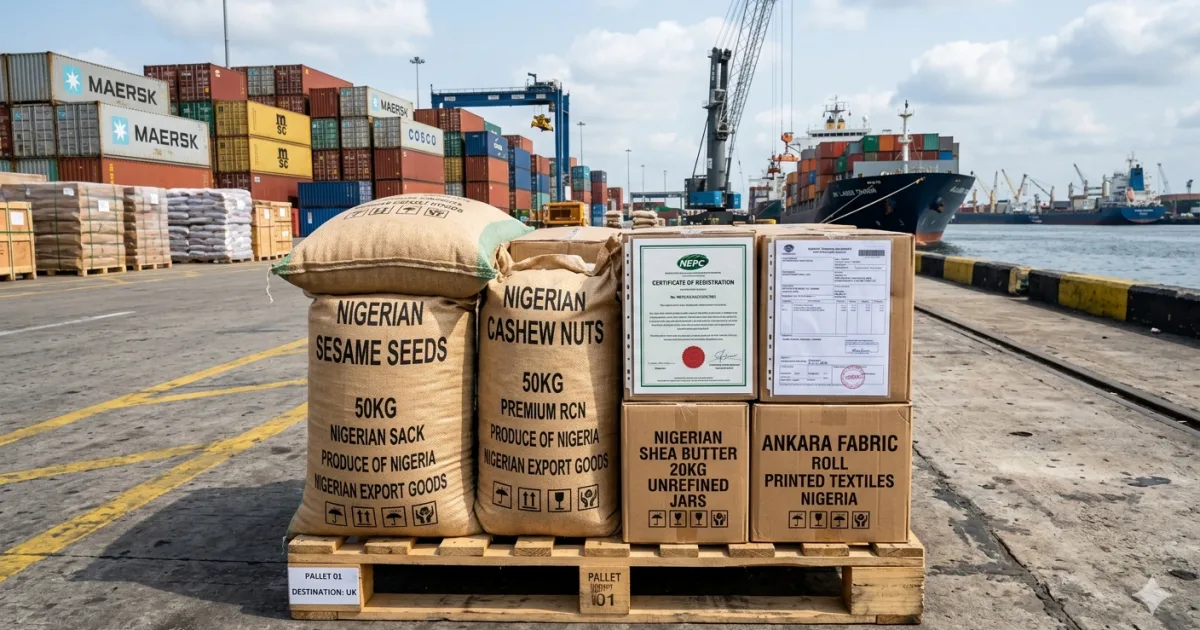
Nigeria sits on one of the most extraordinary concentrations of exportable wealth on the planet. Sesame seeds, cashew nuts, cocoa, palm oil, ginger, shea butter, leather goods, Ankara fabric, processed foods, timber — and those are only the agricultural and consumer goods. Add raw minerals, natural gas derivatives, creative sector products (Nollywood content, music, fashion), and digital services, and Nigeria’s non-oil export potential is staggering. Yet Nigeria’s non-oil exports remain a fraction of what they could be — not because the products do not exist, but because most Nigerian producers and traders do not know the process to get their goods to international markets legally, efficiently, and profitably.
In 2026, that is changing. The federal government has prioritised export diversification as a core economic strategy, and the agencies responsible for facilitating exports — the Nigerian Export Promotion Council (NEPC), the Nigeria Customs Service, the Central Bank of Nigeria — have all invested in digital systems that make the export process significantly more streamlined than it was five years ago. The e-NXP form system, NEPC’s online registration portal, and improved freight forwarding infrastructure have reduced the paperwork, reduced the in-person requirements, and reduced the time from registration to first shipment for properly prepared exporters.
This guide is the complete beginner’s roadmap to exporting goods from Nigeria in 2026 — covering what you can and cannot export, the registration requirements, the documents you must have, the step-by-step process from preparation to payment receipt, and the most common mistakes that cause first-time Nigerian exporters to lose money, have shipments delayed, or face legal complications. If you have a product that international buyers want, this guide shows you how to get it to them.
⚠️ Legal Notice: You cannot export goods from Nigeria as an individual. You must register a business (CAC) and obtain NEPC certification. Exporting without NEPC registration is illegal and can result in seizure of goods, fines, and criminal prosecution. All export proceeds must be repatriated to Nigeria within 180 days of shipment date.
📋 What This Guide Covers
- Why Exporting Is One of Nigeria’s Greatest Business Opportunities in 2026
- What Can Nigeria Export? — Most Profitable Non-Oil Export Categories
- Prohibited and Restricted Exports — What You Cannot Send
- Prerequisites — What You Must Have Before You Can Export
- Step 1: Register with NEPC — Nigeria Export Promotion Council
- Step 2: Find International Buyers for Your Products
- Step 3: Secure an Export Contract or Confirmed Order
- Step 4: Complete the NXP Form — The Most Critical Export Document
- Step 5: Pre-Shipment Inspection and Quality Certification
- Step 6: Freight Forwarding and Port Clearance
- Step 7: Getting Paid — Export Payment Methods
- Step 8: Repatriating Proceeds Within 180 Days
- Complete Export Documents Checklist
- Export Incentives Available to Nigerian Exporters
- Common Mistakes First-Time Nigerian Exporters Make
- Frequently Asked Questions
📊 Nigeria Export Business 2026 — Key Facts
- Official NEPC portal: nepc.gov.ng | NEPC e-registration: nepc.gov.ng/ereg/exporter
- NEPC registration time: 3–5 working days with correct documents
- Mandatory NXP form: All non-oil exports must have e-NXP form processed through your bank
- Proceeds repatriation deadline: 180 days from Bill of Lading date (non-oil exports)
- Export domiciliary account: Required at your processing bank; proceeds must be credited here
- Nigeria’s top non-oil exports 2026: Cashew nuts, sesame seeds, cocoa, ginger, shea butter, palm oil, leather, Liquefied Natural Gas (LNG)
- Top export destinations for Nigerian agricultural goods: India, EU (Germany, Netherlands), UK, USA, China
- NESS levy: 1% of FOB (Free on Board) value — paid to NCS at export stage
- Export Expansion Grant (EEG): Available to exporters who complete NXP — access through NEPC
- Freight forwarder: Mandatory for first-time exporters; handles port clearing, customs documentation, and shipping booking
- Cannot export as an individual: CAC registration + NEPC certificate mandatory
- Inspection agencies: NAQS (agricultural), SON (standards), NAFDAC (food/drugs), SGS/Bureau Veritas (independent quality)
Part 1: Why Exporting Is One of Nigeria’s Greatest Business Opportunities in 2026
The financial case for Nigerian export businesses in 2026 is simple and powerful: you produce in naira, you sell in dollars, euros, or pounds. Every kilogram of sesame seeds sold to an Indian buyer generates dollar income. Every tonne of cocoa shipped to a German processor earns euros. Every container of shea butter delivered to a British cosmetics company generates pounds. At the current exchange rate, this currency structure creates profit margins that purely domestic businesses cannot match — and it hedges your business against the naira depreciation that erodes purely naira-denominated income.
Nigeria’s export competitive advantage is also structural and durable. The country has an enormous agricultural sector producing commodities that global markets need — and Nigerian production costs, in dollar terms, are among the most competitive globally precisely because of the naira depreciation that hurts domestic consumers. A Nigerian cashew processor paying workers in naira, buying raw cashews in naira, and operating facilities financed in naira produces export goods whose dollar price is highly competitive in global markets. This cost advantage does not disappear — it grows every time the naira weakens against the dollar.
The government’s export diversification priority means that the support infrastructure for Nigerian exporters — grants, tax incentives, certification support, trade mission support — is better resourced in 2026 than in previous years. NEPC’s mandate to grow non-oil exports translates into practical assistance that well-prepared exporters can access, including market intelligence reports, buyer matching services, and representation at international trade fairs. The opportunity is genuine; the processes, while sometimes complex for first-timers, are navigable with the right preparation.
Part 2: What Can Nigeria Export? — Most Profitable Non-Oil Export Categories
| Category | Top Products | Primary Markets | Why It Sells Internationally |
|---|---|---|---|
| Tree Crops / Agricultural Commodities | Cashew nuts, cocoa, sesame seeds, shea butter, palm oil, groundnuts, ginger, turmeric | India (cashew), EU (cocoa), China/Asia (sesame), UK/EU (shea butter) | Nigeria is a top global producer; large volume; consistent international demand |
| Solid Minerals | Limestone, kaolin, iron ore, lead, zinc, columbite, feldspar, baryte | China, India, EU industrial markets | Nigeria’s mineral wealth largely untapped; growing global industrial demand |
| Processed Foods | Dried foods, bottled palm oil, processed pepper, packaged traditional condiments, bitter kola, ugu powder | UK, US, Canada diaspora markets + mainstream retail via ethnic food buyers | 50M+ Nigerian diaspora creates steady demand for authentic Nigerian food products globally |
| Textiles and Fashion | Ankara fabric, Aso-Oke, Aso-Ebi, traditional accessories, contemporary Nigerian fashion | UK, US, Caribbean, African diaspora globally | Growing global Afrocentric fashion movement; Nigerian brands gaining international traction |
| Leather and Crafts | Leather shoes, bags, traditional crafts, wood carvings, bronze sculptures, beaded jewellery | EU (Germany, Italy), US, UK, art and lifestyle markets globally | Unique cultural authenticity; growing global appetite for African craftsmanship |
| Cosmetics and Beauty | Shea butter-based skincare, black soap (dudu osun), natural hair care products, African herbs | EU, UK, US natural beauty market | Natural beauty movement creating premium international demand for African ingredients |
| Digital and Creative Products | Nollywood films, Afrobeats music, digital art, software, digital marketing services | Global streaming platforms, digital distribution, international clients | Nigerian creative sector has global reach; no customs, no shipping costs for digital goods |
| Timber and Forest Products | Iroko, mahogany, African hardwoods (sustainably sourced), furniture | EU, China, Middle East | Strong international market for quality African hardwoods |
For beginning exporters, the most accessible categories are processed foods for the diaspora market (lower regulatory complexity, established distribution channels, reliable payment), agricultural commodities (high volume demand, established trading infrastructure), and handmade crafts/fashion (unique cultural products with growing international premium).
Part 3: Prohibited and Restricted Exports — What You Cannot Send
Nigeria maintains a list of prohibited and restricted exports that all exporters must understand before engaging in any international trade. Attempting to export prohibited goods is a criminal offence with serious legal consequences.
| Category | Prohibited / Restricted Items | Legal Consequence |
|---|---|---|
| Prohibited (complete ban) | Raw hides and skin; timber (unprocessed logs); scrap metals (without written authorisation); raw cocoa beans (without processing value addition); cultural artefacts and artworks (without NCoMM approval) | Seizure; criminal prosecution; imprisonment |
| Restricted (requires special permit) | Wildlife and wildlife products; certain mineral exports (require MSMD permit); pharmaceutical products (NAFDAC clearance required); weapons and munitions (NPA/defence ministry permit); seeds and plant genetic materials (NAQS permit) | Seizure if exported without required permits; fines; criminal liability |
| Controlled (additional documentation) | Agricultural goods (NAQS/NAFDAC inspection); food products (NAFDAC certification); chemicals and industrial goods (SON/relevant agency certification) | Goods held at port until certification obtained; NESS penalties for delays |
Part 4: Prerequisites — What You Must Have Before You Can Export
Before beginning any export process, confirm you have these four non-negotiable prerequisites:
- CAC-registered business — Export is not possible as an individual. You must have a registered Business Name or Company (Ltd) with the Corporate Affairs Commission. This is Step 1 before everything else. (See our complete CAC registration guide for the process.)
- Tax Identification Number (TIN) — Required for NEPC registration and access to the CBN’s Trade Monitoring System (TRMS) used to process NXP forms. Your TIN is now auto-generated with CAC registration.
- Export Domiciliary Account — You must open a domiciliary account (foreign currency account) at a commercial bank and tie it to your NEPC number. All export proceeds must be credited to this account. Your bank will also process your NXP forms through this account.
- NEPC Exporter’s Certificate — Mandatory. No export can legally leave Nigeria without NEPC certification. The NEPC e-registration process is detailed in the next section.
Step 1: Register with NEPC — The Mandatory First Step
The Nigerian Export Promotion Council (NEPC) is the federal government agency responsible for promoting and regulating non-oil exports from Nigeria. The first step for any business intending to export goods from Nigeria is to register with NEPC. Obtaining an exporter registration certificate from NEPC is a mandatory requirement — without it, your goods will not be cleared for export by Customs regardless of any other documentation you have prepared.
How to Register with NEPC Online (2026)
- Visit the NEPC e-registration portal at nepc.gov.ng/ereg/exporter
- Create an account using your business email address
- Complete the online application form with your: business name (exactly as registered with CAC); RC number; TIN; proprietor/director details; intended export products (described accurately using HS Codes — Harmonised System codes that classify products internationally); intended export destinations
- Upload required documents (see document checklist below)
- Pay the NEPC registration fee online
- Upon successful verification, NEPC issues your Exporter’s Certificate — NEPC certification takes 3 to 5 working days if documents are accurate and complete.
Documents required for NEPC registration:
- CAC certificate (Business Name or Certificate of Incorporation for Ltd companies)
- Memorandum and Articles of Association (for Ltd companies)
- Tax Identification Number (TIN)
- Valid means of identification of the proprietor or directors (NIN, passport, or driver’s licence)
- Recent utility bill or bank statement as proof of business address
- Passport photograph of proprietor or managing director
- Bank account details (including the export domiciliary account details once opened)
The NEPC certificate is your primary credential as a Nigerian exporter — present it to your bank when processing NXP forms, to inspection agencies when requesting quality certification, and to freight forwarders when booking shipments. Keep multiple certified copies of it accessible.
Step 2: Find International Buyers for Your Products
Finding credible international buyers — not just interested enquirers but buyers with the financial capacity and serious commercial intent to place and pay for orders — is the most challenging part of starting an export business. The channels that consistently produce genuine international buyer relationships for Nigerian exporters include:
B2B marketplaces: Alibaba (alibaba.com) and its agricultural trade sub-platform, TradeKey, Global Sources, and the Made-in-Nigeria platform promoted by NEPC are the primary online channels for connecting with international buyers. Create a detailed, professionally presented supplier profile with high-quality product photographs, clear specifications (grade, packaging, minimum order quantity, price per unit, available volume), and your NEPC certificate number. Buyers on these platforms specifically look for verified, certified suppliers — your NEPC certification is a trust signal that differentiates you from unregistered sellers.
NEPC’s buyer-matching services: NEPC maintains relationships with international buyers and regularly facilitates buyer-seller meetings through its offices and trade missions. Register fully with NEPC and communicate your export capacity — the council has a mandate to connect Nigerian exporters with international buyers and uses its database of registered exporters to make those introductions. This is a free service that most Nigerian exporters underutilise.
International trade fairs and exhibitions: NEPC sponsors Nigerian businesses at international trade fairs in key export markets — including food and agriculture fairs in Germany (Anuga), France (SIAL), the UK (The Speciality and Fine Food Fair), and Dubai. Participating in these events — even as a visitor before you can afford a stand — provides direct access to buyers who are specifically looking for new suppliers. NEPC’s exhibition support programme subsidises participation costs for qualifying Nigerian exporters.
Nigerian diaspora business networks: For processed food exporters, the Nigerian diaspora community in the UK, US, Canada, and continental Europe represents both a direct consumer market and a network of potential distributors who understand the product and the market. Diaspora entrepreneur networks — Nigerian-British Chamber of Commerce, Nigerian-American Chamber of Commerce — connect Nigerian producers with diaspora business owners who want to supply authentic Nigerian products to their communities.
Direct outreach to import companies: Research import companies in your target market that purchase the type of goods you export. For example, a Nigerian sesame seed exporter can research Indian sesame seed importers through Indian industry directories, trade association member lists, and LinkedIn — then reach out directly with product specifications, pricing, and certification documentation. This approach requires more effort than passive listing on marketplaces, but produces more committed buyer relationships.
Step 3: Secure an Export Contract or Confirmed Order
Before incurring any significant production, packaging, inspection, or freight costs, ensure you have a written, confirmed export order from your international buyer. An export contract is an agreement between seller and buyer on the terms of export business. The contract should specify: the exact goods being exported (product name, HS code, grade/specification, quantity); the price in the agreed currency (USD, EUR, GBP); the payment terms (Letter of Credit, advance payment, or Documentary Collection — explained below); the delivery terms (Incoterms: FOB, CIF, EXW, etc.); the packaging requirements; the shipping date and destination port; and the quality standards the goods must meet.
Incoterms — International Commercial Terms — determine who bears the cost and risk of transport at each stage of the journey. The most common for Nigerian exporters:
- FOB (Free on Board): You are responsible for the goods until they are loaded onto the vessel at the Nigerian port. The buyer handles shipping, insurance, and import clearance from that point. Most common for agricultural commodities.
- CIF (Cost, Insurance, Freight): You are responsible for the goods all the way to the destination port, including shipping and insurance costs. Gives the buyer peace of mind but requires you to manage logistics more comprehensively.
- EXW (Ex Works): The buyer collects from your warehouse in Nigeria and handles all transport from there. Simplest for the exporter; shifts all logistics cost and risk to the buyer.
Step 4: Complete the NXP Form — The Most Critical Export Document
The NXP Form is a mandatory document that serves two critical functions: Government Regulation — it is a legal declaration by the exporter to the CBN that a specific export transaction is taking place, allowing the government to track and monitor the volume and value of all non-oil exports. Without a valid, bank-endorsed NXP form, your goods won’t leave the port.
The NXP (Nigeria Export Proceeds) form is now processed electronically through the CBN’s Trade Monitoring System (TRMS). Since October 2019, all NXP forms must be processed digitally — the manual paper form system no longer applies.
How to Complete the e-NXP Form
- Access the TRMS portal through your bank’s export trade desk — your bank submits the NXP on your behalf after you provide the required information and documents
- Provide: currency of transaction; estimated shipping date; destination country; HS code for your export product; price details (per unit and total); weight and measurements of the goods; consignee details (buyer’s name and address in destination country); port of departure details; means of transportation; Pre-Inspection Agency (PIA) selection
- Attach minimum supporting documents: your Proforma Invoice and your NEPC certificate
- Your bank reviews and endorses the NXP form — the processing bank shall retain the first copy and the second copy would be sent to the Central Bank of Nigeria (CBN). After extraction of relevant information, the same copy shall be forwarded to the National Maritime Authority (NMA).
- After bank approval, the form is forwarded electronically to the Nigerian Export Promotion Council (NEPC) for final approval. Once approved, the NXP Form number is sent to the Nigerian Customs Service (NCS), and your shipment is ready for clearance.
Note: you are required to register with and obtain the NEPC exporter’s registration certificate and obtain a valid Tax Identification Number (TIN) from the FIRS/JTB as the TIN shall constitute a condition for access to the TRMS website. Ensure both are in place before approaching your bank for NXP processing.
Step 5: Pre-Shipment Inspection and Quality Certification
Most Nigerian export goods require quality inspection and certification before they can be cleared for export — both to satisfy Nigerian Customs requirements and to meet the import standards of the destination country. Quality assurance documents help you to ensure your exported goods conform to safety measures as stated by international conventions and possibly agreed terms of the contract.
| Product Category | Relevant Inspection Agency | Certificate Issued |
|---|---|---|
| Agricultural products (crops, nuts, grains) | NAQS — Nigerian Agricultural Quarantine Service | Phytosanitary Certificate (confirms no pests/diseases) |
| Food and beverages (processed) | NAFDAC — National Agency for Food and Drug Administration and Control | NAFDAC product registration + export health certificate |
| Manufactured goods and standards-regulated items | SON — Standards Organisation of Nigeria | SON certification + mark of quality |
| General quality and weight verification | SGS, Bureau Veritas (international inspection agencies) | Clean Certificate of Inspection (CCI) — verifies quantity, quality, and weight as contracted |
| Solid minerals | MSMD — Ministry of Solid Minerals Development | Mineral Export Permit |
| All goods (origin certification) | NACCIMA — Nigerian Association of Chambers of Commerce, Industry, Mines and Agriculture | Certificate of Origin — confirms goods are produced in Nigeria; needed for trade agreement benefits (e.g., AGOA for US exports) |
The Certificate of Origin from NACCIMA is required for virtually all Nigerian exports — it confirms to the importing country that the goods were produced in Nigeria, which is a prerequisite for accessing preferential tariff rates under trade agreements. For example, Nigerian goods exported to the United States under AGOA (African Growth and Opportunity Act) qualify for zero or reduced tariff rates — but only with a valid Certificate of Origin. Budget time and cost for this certification; delays in obtaining it can hold your shipment at port.
Step 6: Freight Forwarding and Port Clearance
A licensed freight forwarder is your most important partner in the physical export process — particularly for your first shipments. Work with a licensed freight forwarder to handle shipping. The freight forwarder manages: booking cargo space on vessels; packing and containerisation advice; preparation of the Bill of Lading (the critical shipping document that serves as evidence of the contract of carriage and ownership of the goods); submission of the Single Goods Declaration (SGD/export entry form) to Nigeria Customs; port clearance; and coordination with inspection agencies for final certification.
The Bill of Lading (B/L) is the most important document in the shipping process — it is the receipt from the shipping company confirming they have taken possession of your goods, the contract of carriage to the destination, and the document that entitles the holder to claim the goods at the destination port. The original Bill of Lading is sent to your buyer (or their bank, under Letter of Credit terms) and is required for them to clear the goods at the destination. Never release goods before confirming the payment terms will protect you — see payment section below.
The NESS levy — Nigerian Export Supervision Scheme levy — is 1% of the FOB value of the exported goods, payable to Nigeria Customs at the time of export. This is a standard export charge that every Nigerian exporter pays; factor it into your export pricing.
Step 7: Getting Paid — Export Payment Methods
The payment method you agree with your buyer is one of the most consequential decisions in your export transaction — it determines your financial risk, your cash flow timing, and your ability to fund future production. The four primary international trade payment methods, from most secure for the seller to most risky:
| Payment Method | How It Works | Risk for Nigerian Exporter | Best For |
|---|---|---|---|
| Advance Payment (Prepayment) | Buyer transfers 100% of payment before you ship. You produce and ship after receiving funds. | Very Low — you have the money before shipping | New buyer relationships; small orders; buyers who trust you from referral |
| Letter of Credit (L/C) | Buyer’s bank guarantees payment once the exporter presents compliant shipping documents. Bank-to-bank transaction with clear document requirements. | Low — bank guarantee protects you IF all documents are compliant | Large orders; new buyers from unknown creditworthiness; recommended for first major export |
| Documentary Collection (D/C) | Your bank sends shipping documents to buyer’s bank, who releases them to buyer only when buyer pays (Documents Against Payment — D/P) | Medium — buyer could refuse to pay, leaving goods stranded at destination port | Established buyer relationships with payment history |
| Open Account | You ship goods and invoice the buyer. Buyer pays within agreed credit period (30/60/90 days). | High — buyer could default; very difficult to recover from Nigeria | Only for long-established buyer relationships with excellent payment track record |
The Letter of Credit (L/C) is the gold standard of international trade payment — it involves the buyer’s bank issuing a guarantee of payment to your bank, conditional on you presenting the specified shipping documents (Bill of Lading, commercial invoice, packing list, certificate of origin, inspection certificate) in exact compliance with the L/C terms. Work with a bank that has significant L/C experience (GTBank, Access Bank, Zenith Bank, First Bank all have trade finance departments with L/C expertise) and study the L/C terms meticulously before shipping — a single discrepancy between your documents and the L/C terms can allow the buyer’s bank to reject payment.
Step 8: Repatriating Proceeds Within 180 Days
Nigerian law requires that all export proceeds be repatriated (returned to Nigeria) and credited to the exporter’s domiciliary account within 180 days of the Bill of Lading date for non-oil exports. Proceeds should be repatriated into an export proceeds Domiciliary Account maintained with the processing bank within ninety (90) days of shipment with relevant fax or e-mail messages evidencing the receipt of the proceeds. Banks are required to certify the receipt of such proceeds to the Central Bank of Nigeria promptly.
Note: the CBN’s most current regulation specifies 180 days for non-oil exports (from First Bank’s official guidance — verify the current figure on cbn.gov.ng as this timeline is subject to regulatory updates). Failure to repatriate within the prescribed period can result in penalties and loss of access to future NXP form processing — effectively ending your ability to export legally until the violation is rectified.
Once proceeds are in your export domiciliary account, you have flexibility in how you use them: the exporter is also to sell part or all of his export proceeds in this Domiciliary Account for Naira to any Authorized Dealer at the prevailing buying rate in the Autonomous Foreign Exchange Market (AFEM). Export proceeds from Domiciliary Accounts could also be used by the exporter for imports provided the proceeds have been fully repatriated in the first instance.
Complete Export Documents Checklist
| Document | Purpose | Issued By | Required For All? |
|---|---|---|---|
| NEPC Exporter’s Certificate | Proof of legal exporter registration | NEPC | ✅ Yes |
| e-NXP Form (approved) | CBN declaration of export transaction | Your bank (via TRMS) | ✅ Yes |
| Commercial Invoice | Details of goods, quantity, price, buyer, seller | Exporter | ✅ Yes |
| Packing List | Unit packaging details and total quantity | Exporter | ✅ Yes |
| Bill of Lading (B/L) | Shipping contract and ownership document | Shipping company/agent | ✅ Yes |
| Certificate of Origin | Confirms goods are made in Nigeria | NACCIMA or Chamber of Commerce | ✅ Yes |
| Proforma Invoice | Pre-shipment price/terms confirmation for buyer | Exporter | ✅ Yes |
| Export Sales Contract | Written agreement between buyer and seller | Exporter and buyer (signed) | ✅ Yes |
| Phytosanitary Certificate | Confirms agricultural goods free from pests | NAQS | 🌱 Agricultural goods only |
| NAFDAC Certificate | Confirms food/drug products meet standards | NAFDAC | 🍎 Food/drugs only |
| Clean Certificate of Inspection (CCI) | Independent verification of quality, weight, quantity | SGS / Bureau Veritas | 📦 Often required by buyers |
| SON Certificate | Confirms manufactured goods meet Nigerian standards | SON | 🏭 Manufactured goods |
| Insurance Certificate | Proof of cargo insurance (required for CIF terms) | Insurance company | 🚢 CIF Incoterms only |
Export Incentives Available to Nigerian Exporters
The Nigerian government offers several incentive programmes to encourage non-oil exports. Most first-time exporters are unaware of these, leaving significant money on the table:
Export Expansion Grant (EEG): A federal government grant programme that provides cash grants to Nigerian exporters based on the value of their exports. The EEG is accessed through NEPC and is one of the strongest incentives for building export volume — exporters who complete all NXP documentation correctly are eligible to apply. Check nepc.gov.ng for current EEG application cycles and criteria.
Pioneer Status for Export Companies: Under the Nigerian Investment Promotion Commission (NIPC) Act, companies that process raw materials primarily for export can apply for Pioneer Status — a tax holiday of 3–5 years that significantly reduces the company’s early-stage corporate income tax burden.
AGOA (African Growth and Opportunity Act) for US-bound exports: Nigerian goods exported to the United States qualify for zero or reduced tariff rates under AGOA — a preferential trade programme. This makes Nigerian goods more price-competitive in the US market. Agricultural goods, textiles, and certain manufactured goods are particularly benefited. Visit the AGOA.info website and the NEPC’s trade agreements section for the full eligible product list.
EU EPA (Economic Partnership Agreement) for EU-bound exports: Nigeria has an EPA framework with the European Union that provides preferential market access for Nigerian goods. Check the current EPA status and eligible categories with NEPC — the agreement has evolved and the specific currently applicable terms should be verified before pricing EU-bound exports.
Common Mistakes First-Time Nigerian Exporters Make
- Shipping goods before securing payment or a confirmed Letter of Credit. The most expensive mistake in Nigerian export history — repeatedly. Never ship goods to a new international buyer without either receiving full payment in advance or having a confirmed, irrevocable Letter of Credit from the buyer’s bank. Goods shipped on trust to new buyers and lost to non-payment is a catastrophic and sadly common Nigerian export story.
- Attempting to export without NEPC registration. Goods will be seized at the port. No exceptions. NEPC registration must be obtained before any export transaction begins.
- Incorrect HS codes on export documentation. The Harmonised System (HS) code is the international classification number for your product. Using the wrong HS code — even accidentally — can cause your goods to be held at Customs, attract the wrong inspection requirements, or trigger duty assessments you did not budget for. Verify your HS codes on the Nigeria Customs website or with a licensed customs broker before completing any export documents.
- Underestimating the total cost of export. The visible product cost is only part of the export equation. Factor in: NEPC registration fees; NAQS/NAFDAC/SON inspection fees; SGS/Bureau Veritas CCI costs; Certificate of Origin fees; NXP processing costs; NESS levy (1% of FOB value); freight forwarding fees; shipping (if CIF terms); port charges; insurance; and bank charges for L/C or documentary collection. First-time exporters who price based on production cost alone frequently sell unprofitably.
- Not reading Letter of Credit terms carefully before shipping. An L/C protects you only if your documents comply exactly with its stated terms. A single discrepancy — the wrong date format on an invoice, a slight variation in product description, a certificate issued by a different body than specified — can result in payment refusal. Review every L/C term with your bank’s trade finance specialist before beginning production for that order.
- Exporting prohibited goods without realising they are prohibited. Timber (unprocessed), raw hides, scrap metal, cultural artefacts, and raw cocoa beans all have export restrictions. Verify your product’s export status on the Nigeria Customs website before investing in production or packaging.
- Failing to repatriate proceeds within the prescribed period. Export proceeds that are not repatriated within the legal timeframe create a CBN regulatory violation that can prevent future NXP form processing — effectively blocking your ability to export legally until the violation is resolved. Track every shipment’s Bill of Lading date and ensure payment is pursued actively within the repatriation window.
Frequently Asked Questions
Q: Can I export goods from Nigeria without a freight forwarder?
Technically possible for experienced exporters, but strongly not recommended for first-time exporters. The port clearance process, customs documentation, and shipping coordination involve too many moving parts and regulatory touchpoints to navigate without specialist support on your first shipment. Freight forwarding fees (typically 0.5–2% of cargo value) are worth the cost of avoiding the delays, mistakes, and potential seizure that come from first-time port navigation without professional guidance.
Q: What is the cheapest Nigerian product to start exporting?
Agricultural commodities with established international demand and relatively simple documentation requirements are generally the most accessible starting point. Dried ginger, sesame seeds, shea butter, and bitter kola have consistent international demand, relatively straightforward inspection requirements, and established trading infrastructure. Start with one product in one destination market — learn the process thoroughly before diversifying.
Q: How do I find my product’s HS code?
The Nigeria Customs Service publishes the Nigerian Customs HS code tariff schedule on customs.gov.ng. You can search by product name or description. Alternatively, consult a licensed customs broker or freight forwarder who knows the codes for your specific product category — an incorrect HS code can cause significant delays and costs.
Q: How long does the first export take from start to shipment?
For a well-prepared first-time exporter with all prerequisites in place (CAC registration, TIN, export dom account), the process from NEPC registration to first shipment typically takes 6–12 weeks — accounting for NEPC registration (3–5 days), buyer negotiation and contract (variable), inspection and certification (1–3 weeks), NXP processing (1–2 weeks), and freight arrangement (2–4 weeks). The timeline compresses significantly for subsequent exports once all registrations are in place and the process is familiar.
🌍 How to Export from Nigeria 2026 — Quick Reference Summary
- Step 1: Register CAC business + get TIN + open export domiciliary account
- Step 2: Register with NEPC at nepc.gov.ng/ereg/exporter (3–5 days; exporter certificate)
- Step 3: Find international buyers (Alibaba, NEPC buyer matching, trade fairs, diaspora networks)
- Step 4: Secure written export contract with agreed Incoterms and payment method
- Step 5: Process e-NXP form through your bank (NEPC cert + proforma invoice required)
- Step 6: Obtain inspection certificates (NAQS/NAFDAC/SON/SGS depending on product)
- Step 7: Get Certificate of Origin from NACCIMA or your Chamber of Commerce
- Step 8: Engage licensed freight forwarder for shipping, Bill of Lading, port clearance
- Step 9: Receive payment via L/C or advance payment (never open account for new buyers)
- Step 10: Repatriate proceeds to dom account within 180 days of B/L date
- Incentives: Apply for Export Expansion Grant (EEG) via NEPC; explore AGOA (US) and EPA (EU) benefits
- NESS levy: 1% of FOB value — budget this into your export pricing
- ⛔ Never ship without payment security: Advance payment or confirmed irrevocable L/C
naijasabi.com.ng/ covers business, trade, and entrepreneurship for Nigerian professionals building wealth in the local and global economy. Bookmark our Business section for regular updates on export opportunities, NEPC programmes, trade incentives, and entrepreneurship guides for Nigeria.




0 Comments
No comments yet. Be the first to share your thoughts!