




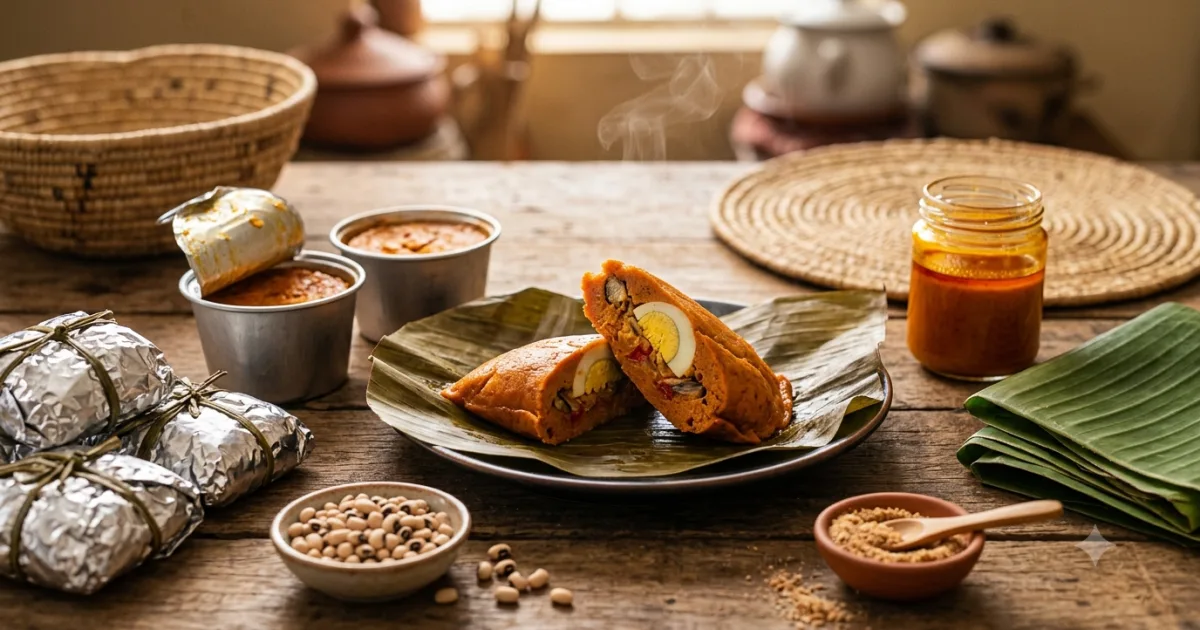
📌 Quick Summary: Moi moi is a Nigerian steamed bean pudding made from blended black-eyed peas (beans), peppers, onion, palm oil, eggs, fish, and seasonings. A batch using 3 cups of dry beans makes approximately 12 to 15 portions and serves 6 to 8 people. It can be wrapped in banana or uma leaves (traditional), aluminium foil (practical), or steamed in tins, cups, or cellophane bags. The most important steps are soaking, thorough skin removal, and blending until very smooth. This complete guide covers the full recipe, all three wrapping methods, the common mistakes that produce hard or watery moi moi, and how to store it.
Moi moi appears at virtually every Nigerian gathering of consequence. It is the side dish that arrives beside jollof rice at every owambe, the protein-rich accompaniment to pap (ogi) at breakfast, the party food that guests pile on their plates alongside fried chicken and dodo. Made from ground black-eyed peas, it is one of Nigeria’s most nutritious foods — high in protein, fibre, and complex carbohydrates — and one of its most technically demanding home cooking projects. Many Nigerian cooks make excellent jollof rice but hesitant, uncertain moi moi that sometimes comes out rubbery, sometimes watery, sometimes blandly flavoured. This guide will fix that.
Ingredients — Makes 12 to 15 Portions
| Ingredient | Quantity | Notes |
| Dry black-eyed peas (beans) | 3 cups (600g) | Standard brown or white cowpeas. Not kidney beans. Not lentils. |
| Red bell pepper (tatashe) | 2 large | Essential for colour and mild sweetness |
| Scotch bonnet pepper (atarodo) | 1 to 2 (to taste) | Adjust to heat preference |
| Onion | 1 large | Half blended with the beans, half reserved for topping (optional) |
| Palm oil | 3 to 4 tablespoons | Gives moi moi its characteristic orange-red colour and flavour. Use fresh, not bleached. |
| Eggs | 3 to 4 | One beaten into the batter for binding. Additional boiled or raw eggs placed whole inside individual portions. |
| Canned fish or fresh cooked fish | 1 can sardines in oil OR 200g cooked fish | Sardines are the most commonly used. Mackerel, tuna, or boiled chicken also work. Optional but traditional. |
| Ground crayfish | 2 tablespoons | Adds depth and umami |
| Seasoning cubes | 2 to 3 | Maggi or Knorr |
| Salt | To taste | |
| Water | As needed | For blending and adjusting batter consistency |
| Vegetable oil (for foil or cup method) | Small amount | For greasing the foil or cups to prevent sticking |
Equipment Needed
Large bowl for soaking beans. Large pot with a lid for steaming. A rack or inverted plate to elevate the moi moi portions above the boiling water. A blender — the quality of the blend determines the texture of the finished moi moi. Banana or uma leaves (for traditional method), heavy-duty aluminium foil (for foil method), or small tins/cups/cellophane bags (for tin method).
Step 1: Soak and Remove the Bean Skins
This is the most time-consuming step and the one most people shortcut — producing the coarse, slightly bitter moi moi that is the most common failure mode. Soak the dry beans in cold water for at least 4 hours, or overnight. After soaking, rub the beans vigorously between your palms in batches — the outer skin will slip off. Drain and add more water, and the loosened skins will float to the surface. Pour off the water and skins. Repeat this process — rubbing, adding water, draining skins — until all or nearly all the skins are removed and you have clean, cream-coloured bean halves. Thorough skin removal is what produces smooth, light moi moi. Skin-on blended beans produce a coarser, heavier pudding. This skin removal step is not optional for quality moi moi — it takes 15 to 20 minutes of active effort but transforms the finished product.
Step 2: Blend Until Very Smooth
Drain the de-skinned beans well. Blend in batches with the red bell peppers, scotch bonnet, onion (half), and just enough water to keep the blender moving — use as little water as possible. The batter should be thick and very smooth. Run the blender for at least 2 minutes per batch — the finer the grind, the lighter and smoother the moi moi. If your blender is not powerful enough to achieve a very smooth consistency, pass the blended batter through a fine sieve and re-blend any coarse pieces. Pour all the blended batter into a large bowl.
Step 3: Season the Batter
Add the palm oil, ground crayfish, crumbled seasoning cubes, and salt to the blended batter. Beat one raw egg into the batter — this helps bind the moi moi and produces a slightly firmer, more structured texture. Mix everything vigorously until the palm oil is fully incorporated and the batter is uniformly orange-red. Taste the batter — it should be well-seasoned, slightly salty (it will taste less salty after steaming), and balanced between the pepper and the savoury seasoning. Adjust as needed. Add just enough water to bring the batter to a consistency that pours slowly — thicker than pancake batter, thinner than dough. Too thin produces watery, unset moi moi; too thick produces dense, dry moi moi.
Step 4: Prepare Your Wrapping Method
Method A: Banana or Uma Leaves (Traditional)
Pass banana or uma leaves briefly over an open flame or dip in boiling water for 10 to 15 seconds — this softens them and makes them pliable without tearing. Wipe dry. Form each leaf into a cone shape, secure at the bottom, and fill with approximately ½ cup of batter. Add a piece of fish or sardine and a boiled egg (halved or whole) to each portion before folding the leaf over to seal. Secure with a toothpick or thin strip of leaf. The leaf-wrapped moi moi has the most authentic flavour — a subtle, slightly earthy grassiness that the leaf imparts to the pudding during steaming.
Method B: Aluminium Foil (Most Practical)
Cut heavy-duty aluminium foil into squares of approximately 30cm x 30cm. Lightly grease the centre of each square with vegetable oil. Place ½ cup of batter in the centre, add fish and egg, and fold the foil over to create a sealed parcel. Crimp the edges firmly to prevent water entering during steaming. Foil-wrapped moi moi has a clean flavour with no leaf taste — preferred by those who want the pure bean and seasoning flavour to dominate.
Method C: Tins, Cups, or Cellophane Bags
Lightly grease small tins, ceramic cups, or ramekins with vegetable oil. Fill each ¾ full with batter — not to the top, as the moi moi will expand slightly during steaming. Add fish and egg to each cup. Cover each tin or cup tightly with foil before steaming. For cellophane bag moi moi (popular in the North and East), pour batter into food-grade cellophane bags, add fillings, and tie tightly at the top. This produces the firm, cylindrical moi moi sold as street food in many Nigerian markets.
Step 5: Steam Until Set
Place a rack, inverted plate, or folded towel in the bottom of a large pot. Add enough water to come 2 to 3cm up the sides of the pot — not so much that the moi moi portions sit in water. Arrange the prepared moi moi parcels on the rack. Bring the water to a boil, then reduce to a gentle simmer. Cover the pot tightly. Steam for 45 to 60 minutes for leaf-wrapped and foil-wrapped portions, or 30 to 40 minutes for tins and cups. Test doneness by inserting a thin knife or skewer — it should come out clean with no wet batter clinging to it. If batter still clings, continue steaming in 10-minute increments. Add boiling water to the pot if the water level drops too low during steaming — never add cold water.
Common Mistakes That Ruin Moi Moi
1. Not Removing the Bean Skins Thoroughly
Skin-on moi moi is coarser, heavier, slightly bitter, and does not blend as smoothly. The 15 to 20 minutes of skin removal is what separates excellent moi moi from mediocre moi moi.
2. Batter Too Thin
Watery, unset moi moi is the most common failure. If the batter is thin enough to pour freely like water, it has too much liquid. It should flow slowly — thicker than milk, thinner than dough.
3. Underseasoning
Moi moi loses some of its seasoning intensity during steaming. Season the batter more aggressively than you would a finished soup — it should taste slightly overseasoned raw to be perfectly seasoned when cooked.
4. Not Enough Steam or Water in the Pot
Insufficient water produces unevenly cooked or dried moi moi. Check the pot water level every 20 minutes. Always top up with boiling water, never cold.
Frequently Asked Questions
What beans are used for moi moi?
Black-eyed peas (cowpeas) — the same beans used for akara. Either the brown-skinned or white-skinned variety works. Do not use kidney beans, butter beans, or lentils.
How long does moi moi take to steam?
45 to 60 minutes for leaf or foil-wrapped moi moi. 30 to 40 minutes for tin or cup portions. Test with a skewer — it should come out clean.
How do I store moi moi?
Refrigerated: 3 to 4 days. Frozen: up to 2 months. Reheat by re-steaming for 10 to 15 minutes or microwave covered with a damp paper towel.
Can I make moi moi without palm oil?
Yes — substitute with vegetable oil. The moi moi will be lighter in colour (creamy rather than orange-red) and milder in flavour but otherwise similar in texture.
Why is my moi moi hard and rubbery?
Two causes: batter too thick (add more water before steaming) or oversteamed (remove promptly when the skewer test passes — do not continue cooking beyond doneness).
Sources
- Original recipe — NaijaSabi Lifestyle Desk, September 2026
- Nigerian culinary tradition — moi moi preparation documented across Yoruba, Igbo and Hausa cooking practices
Last updated: 5 September 2026 · NaijaSabi Lifestyle Desk.
Moi Moi as a Business: What You Need to Know
Moi moi is one of Nigeria’s most overlooked small food business opportunities precisely because of its complexity — the multi-step preparation process that discourages many home cooks is the same barrier that reduces competition for those who master it. A moi moi business that produces consistently good product has a ready, loyal market: party caterers who need reliable bulk supply, offices that order weekly lunch deliveries, church and mosque event organisers, and school feeding programmes. The business model differs from puff puff and chin chin in one important way: moi moi is a fresh product with a short shelf life, which means it must be produced to order rather than in advance. This actually increases its value — freshly steamed moi moi commands significantly higher prices than the day-old versions common at roadside stalls. A batch of 50 portions using 6 cups of beans costs approximately ₦6,000 to ₦8,000 in ingredients and sells at ₦300 to ₦500 per portion — generating ₦15,000 to ₦25,000 gross revenue per batch. A business producing two batches daily for event supply and office delivery earns ₦600,000 to ₦1,000,000 monthly gross revenue before expenses. The skill requirement is the barrier to entry — which is why mastering the recipe in this guide is the competitive advantage. Caterers who can produce moi moi that consistently sets perfectly, has visible egg and fish additions in every portion, and tastes deeply seasoned and smooth — charge more and get more repeat orders than those producing unpredictable results.
Moi Moi Variations
The standard recipe above is the foundation — but successful moi moi producers in 2026 differentiate through additions and variations. Egg moi moi places a whole boiled egg in the centre of each portion — the egg visible when the leaf or foil is opened becomes a visual quality signal. Corned beef moi moi replaces fish with corned beef — popular in eastern Nigeria and among diaspora communities who grew up with this version. Vegetarian moi moi uses smoked mushrooms or additional crayfish instead of fish — increasingly popular in Lagos markets. Ofada moi moi — made with a mix of cowpeas and ofada rice flour — is a newer variation that has a heavier, more substantial texture and is beginning to appear in premium event catering menus.




0 Comments
No comments yet. Be the first to share your thoughts!