


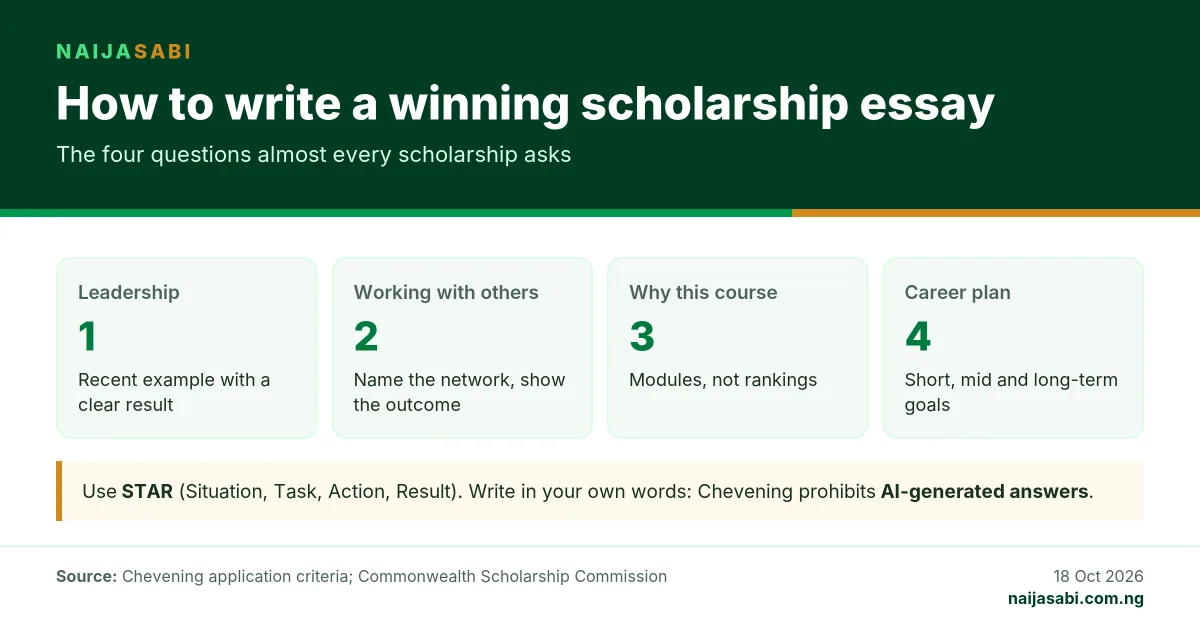
📌 Quick answer: A winning scholarship essay answers the question the funder is actually testing, with recent, specific examples that show a result. Almost every major scholarship asks about the same four things: your leadership, how you work with others, why this course, and your career plan and impact at home. Use the STAR method (Situation, Task, Action, Result), name real modules and measurable goals, and write in your own words. Chevening says it prohibits AI-generated answers and uses software to detect them, and that applying is free, so never pay anyone for a place.
Every year, strong Nigerian candidates with good degrees and real achievements are rejected because their essays do not show what they have done. They describe leadership instead of demonstrating it, list job titles instead of results, and praise a university instead of explaining why its course fits their plans. The good news is that the biggest funders publish what they are looking for. This guide uses that guidance, mainly from Chevening and the Commonwealth Scholarship Commission in the UK (CSC), to show you how to write essays that work.
A note on timing: applications for the 2027/28 Chevening Scholarships and Commonwealth Master’s Scholarships both closed on 20 October 2026. If you missed them, this is the best time to prepare for the next round, and the same method works for other awards, such as the NDDC postgraduate scholarship (closing 8 November 2026) and Hungary’s Stipendium Hungaricum, whose last round ran from 14 November 2025 to 15 January 2026.
The Four Questions Almost Every Scholarship Asks
| What they are testing | How Chevening frames it | How the Commonwealth Scholarship Commission frames it |
|---|---|---|
| Leadership | Examples of taking the lead and influencing others, with clear results | Opportunities you have had to demonstrate leadership; voluntary activities |
| Working with others | Building professional relationships that led to real, measurable outcomes | Part of your personal statement and leadership evidence |
| Course choice | How your first-choice course gives you skills to tackle challenges that matter to the UK and your home country | A detailed plan of study |
| Career plan and impact | A short, mid and long-term plan with clear, measurable goals | A four-part Development Impact statement, career plans for five years after the award and long-term plans |
Chevening says it assesses applicants on their ability to answer questions in each of these four areas. The CSC scores candidates on merit, the quality of their plans and the potential impact on their home country’s development. Different words, same idea: what have you done, what will you study, and what will you do with it at home?
Step-by-Step: How to Write Your Scholarship Essays
- Read the criteria before you write a word. For each question, write down in one line what it is testing. If you cannot say what a question tests, you will not answer it well.
- Build an evidence bank. List six to eight things you have achieved in the last few years at work, in your community or in volunteering. For each, note what you did personally and what changed: numbers served, money saved, time cut, people trained, policies adopted.
- Pick the strongest example for each question. Chevening’s reading committees say many applicants used examples from their academic life, some going back to secondary school, when recent professional examples were stronger.
- Structure each answer with STAR. Situation (one or two sentences), Task (what you had to achieve), Action (what you did, in the first person), Result (what changed, ideally with a number).
- Draft long, then cut. Write freely first, then cut to the word or character limit in the application form. Cut background and adjectives before you cut actions and results.
- Connect the four answers. Your leadership example, course choice and career plan should tell one story. A reader should be able to see how your past leads to this course, and how this course leads to your plan.
- Replace every general claim with a specific one. “I am passionate about public health” says nothing. “I coordinated a vaccination drive in 14 villages” says a lot.
- Get one honest reader. Ask someone who knows your field to check that each answer responds to the question asked, not just that the English is correct.
- Submit early. Portals slow down near deadlines, and references often take longer than candidates expect.
How to Answer Each Question, With Examples
The examples below were invented for this guide to show the difference between weak and strong answers. They are not real applications; do not copy them.
1. Leadership
Chevening says the strongest applicants give examples of driving change, improving outcomes for others, solving a specific challenge or implementing a project with tangible impact. Its readers also warn that holding a position is not proof of leadership: “explain how you successfully gained and maintained influence and what the outcome was.”
Weak: “As Head of Operations, I am responsible for a team of 12 and I have strong leadership skills. Leadership means inspiring others towards a common goal.”
Stronger: “When our clinic’s patient records were still on paper, test results were often lost and patients repeated tests they could not afford. I proposed a simple digital register, persuaded two sceptical senior nurses to pilot it with me for a month, and trained the other nine staff once the pilot worked. Within six months, repeat tests caused by lost results fell by more than half, and the state health board asked us to present the system to three other clinics.”
2. Working with others
Chevening wants examples of how you built working relationships and how that collaboration produced measurable outcomes. Its readers noticed applicants who described their “networking skills” without naming a single network or saying what it achieved. Name the people or groups (by role, if not by name), say what you did to bring them together, and finish with the result.
3. Why this course
This is where many Nigerian applicants lose marks by writing about rankings, a city’s attractions or a famous football club. Chevening’s readers specifically say not to rely on rankings or copy from university websites, and to focus on modules and assessment. Chevening’s current guidance also asks you to research your three course choices but to focus your answer only on your first choice, explaining how specific modules connect to your background and goals.
Stronger: “The module in Health Systems Financing will give me the costing methods I lacked when our pilot ran out of funds after a year, and the Digital Health Interventions module covers the evaluation techniques I need to prove to state officials that a scaled-up register is worth the investment.”
4. Career plan and impact
Chevening asks for a short, mid and long-term plan with clear, measurable goals; the CSC asks what you will do in the five years after your award and in the long term. Ambition is welcome, but the readers want to see how you will get there.
- Short term (first two years): a realistic role you can return to or move into, and one concrete project.
- Mid term (three to five years): a measurable target, for example extending a programme to a set number of local government areas.
- Long term: the bigger change you want to influence in Nigeria, and how the people you meet through the scholarship will help.
What Reading Committees Say Goes Wrong
After one selection round, Chevening published feedback from its reading committees. The most common problems were:
- Defining leadership in theory without showing an example of it.
- Listing responsibilities instead of explaining influence and outcomes.
- Describing networking without naming networks or results, and forgetting the “R” in STAR.
- Not linking the answer back to the scholarship and what its alumni network will help you achieve.
- Choosing a university for its city, attractions or football club rather than its course content.
- Ambitious career goals with no achievable plan or measurable steps.
Chevening’s list of common application errors also includes practical mistakes: not meeting the minimum work experience, entering the same job twice, claiming unrealistic working hours and submitting answers that were not in English.
Can You Use ChatGPT or Other AI Tools?
Not to write your answers. Chevening says the use of AI software to generate answers is strictly prohibited, that it uses tools to identify fraud, plagiarism and AI-generated answers, and that applicants who cannot write a competitive application in their own words should wait until they can. Beyond the rules, AI-written essays tend to sound general and identical, which is the opposite of what wins. Your own examples, in your own voice, are your advantage.
Chevening also says applying is free, and that it does not endorse or work with third parties who charge for application support. Be wary of anyone selling “guaranteed” scholarship essays or slots.
Final Checklist Before You Submit
| Check | Yes / No |
|---|---|
| Each answer responds to what the question is testing | |
| Every example is recent and ends with a result | |
| “I” statements show what you personally did | |
| Course answer names specific modules, not rankings | |
| Career plan has short, mid and long-term goals you can measure | |
| The four answers tell one connected story | |
| Within the word or character limit in the form | |
| Written in your own words, read by one honest reviewer | |
| Work history, dates and hours are accurate and not duplicated |
Frequently Asked Questions
How long should a scholarship essay be?
As long as the limit in the application form allows, and no longer. Limits differ between scholarships and can change between rounds, so always check the form itself.
What is the STAR method?
A way of structuring an example: Situation, Task, Action and Result. Chevening’s readers specifically remind applicants not to forget the Result.
Is Chevening open now?
No. Applications for 2027/28 closed on 20 October 2026. Watch chevening.org for the next round.
Can I use examples from university?
You can, but for leadership in particular, Chevening’s readers say recent professional examples are stronger than academic ones.
Should I pay someone to write my scholarship essay?
No. Chevening prohibits answers you did not write yourself, and says applying is free and that it does not work with third parties who charge for application support.
Sources
- Chevening – Application criteria (leadership, networking, course choice, career plan; AI and fees guidance) – chevening.org, checked 18 October 2026
- Chevening – “Where did I go wrong on my Chevening application? Feedback from this year’s reading committees”, 2 August 2023; and Common application errors – chevening.org
- Chevening – Apply page (2027/28 applications open until 20 October 2026) – chevening.org
- Commonwealth Scholarship Commission in the UK – Commonwealth Master’s Scholarships, 2027/28 round (selection criteria and application statements) – cscuk.fcdo.gov.uk
- Stipendium Hungaricum – application period 14 November 2025 to 15 January 2026 – stipendiumhungaricum.hu
Last updated: 24 October 2026 · NaijaSabi Education Desk. NaijaSabi is not affiliated with any scholarship body. The example answers in this guide are illustrative and were written by NaijaSabi.

0 Comments
No comments yet. Be the first to share your thoughts!