


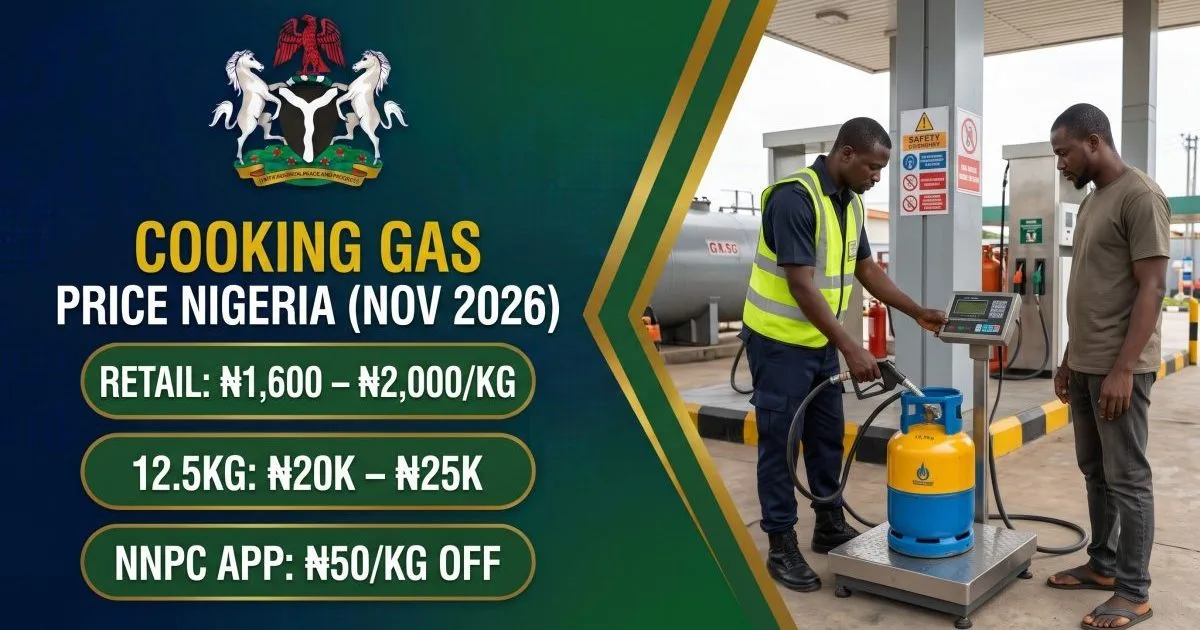


Key Takeaways: Nigeria Cooking Gas (LPG) Prices (November 2026 Live Update)
- Latest Retail Prices (Nov 22, 2026): Cooking gas has surged to ₦1,600 – ₦2,000 per kg in Abuja (FCT) and ₦1,480 – ₦1,800 per kg across Lagos, Ogun, and Enugu—driven by a 14%+ mid-November jump tied to supply bottlenecks and winter international demand.
- 12.5kg & 5kg Cylinder Refill Reality: Refilling a standard 12.5kg cylinder now costs ₦18,500 – ₦22,500 in Lagos/Ogun and ₦20,000 – ₦25,000 in Abuja, while a 5kg refill runs ₦7,400 – ₦10,000 (and a 6kg cylinder costs ₦8,880 – ₦12,000).
- Dangote vs. Private Depot Prices (20MT Wholesale): Dangote Refinery remains Nigeria’s lowest-cost wholesale LPG source—rising from ₦1,000–₦1,150/kg in early November to roughly ₦25,000,000 per 20MT (₦1,250/kg) by mid-November—compared to ₦26.4M – ₦28.1M per 20MT (₦1,320 – ₦1,405/kg) at Navgas, NIPCO, Ardova, and 11 PLC (which briefly peaked near ₦1,445–₦1,450/kg earlier in November).
- Active NNPC Retail Discount (₦50/kg Off Until Dec 31, 2026): Unlike NNPC’s ended October petrol discount, NNPC Retail’s ₦50/kg LPG cooking gas discount via the official NNPC Fuel App runs strictly until December 31, 2026—saving you ₦300 on 6kg and ₦625 on 12.5kg at participating NNPC stations.
- NMDPRA & NLNG Emergency Supply Push (Nov 21, 2026): NMDPRA Chief Executive Rabiu A. Umar and NLNG MD Adelaye Falade met at the Bonny Train 7 site in Rivers State on November 21, 2026 to prioritise boosted domestic LPG volumes to cool prices ahead of Christmas.
- Beat Scale Cheating & Cylinder Fraud: Always buy directly at licensed skid/refill plants rather than roadside decanting kiosks, verify the digital scale zeroes before filling, and check your cylinder’s embossed tare weight and 15-year expiry stamp.
Nigerian households preparing for the December festive season are waking up to an unwelcome kitchen shock. Fresh market surveys across the Federal Capital Territory and major commercial cities on Sunday, November 22, 2026 confirm that retail Liquefied Petroleum Gas (LPG)—popularly called cooking gas—has climbed to between ₦1,600 and ₦2,000 per kilogram in Abuja and ₦1,480 to ₦1,800 per kilogram across Lagos, Ogun, and Enugu. At current rates, refilling a standard 12.5kg family cylinder now wipes out ₦20,000 to ₦25,000 in a single trip—nearly a third of the ₦70,000 national minimum wage.
 Advertisement
What baffles most consumers is the yawning gap between wholesale refinery rates and what roadside dealers charge at the gate. Even though the Dangote Petroleum Refinery consistently undercuts rival coastal depots by ₦150 to ₦400 per kilogram—and despite Nigeria sitting on 210.54 trillion cubic feet of proven natural gas reserves, the largest in Africa—retailers point to surging private depot rates at Navgas, NIPCO, 11 PLC, and Ardova, haulage diesel expenses, and peak European winter heating demand tightening global LPG cargoes through December and January.
In this data-backed November 2026 market tracker, the NaijaSabi Editorial Desk breaks down exact refill costs for 3kg, 5kg, 6kg, 12.5kg, 25kg, and 50kg cylinders across Nigerian cities, compares live 20-metric-tonne (20MT) wholesale depot prices from Dangote to 11 PLC, shows you how to claim NNPC Retail’s active ₦50/kg Fuel App discount before December 31, explains the November 21 NMDPRA–NLNG supply intervention, and exposes the weighing-scale tricks dishonest gas dealers use to shortchange buyers.
1. Live November 2026 Cooking Gas Prices by City (Abuja, Lagos, Ogun & Enugu)
Cooking gas retail prices in Nigeria are no longer uniform—even within the same local government area, a licensed major-marketer skid plant can sell ₦200 to ₦350 per kg cheaper than a neighbourhood corner kiosk. Below is the verified November 2026 retail snapshot compiled from national market checks (for broader diesel, kerosene, and CNG benchmarks, check our Nigeria Fuel & Gas Price Index):
| City / State | Nov 2026 Retail Price per kg | 12.5kg Refill Cost | Key Local Market Observation |
|---|---|---|---|
| Abuja (FCT) | ₦1,600 – ₦2,000 / kg | ₦20,000 – ₦25,000 | Jumped sharply from October’s ₦1,360–₦1,700/kg band; NIPCO outlets generally sit near the lower ₦1,650–₦1,700 range while suburban retailers hit ₦1,800–₦2,000. |
| Lagos State | ₦1,480 – ₦1,800 / kg | ₦18,500 – ₦22,500 | NIPCO stations (First Gate, Trade Fair) quoted near ₦1,480/kg, Techno Oil Festac around ₦1,650/kg, and smaller street retailers up to ₦1,800/kg. |
| Ogun State (Mowe, Sango-Ota, Abeokuta) | ₦1,550 – ₦1,800 / kg | ₦19,375 – ₦22,500 | Tracks Lagos depot movements closely plus short-haul bridging costs along the Lagos–Ibadan and Sango-Ota corridors. |
| Enugu & South-East | ₦1,400 – ₦1,700 / kg | ₦17,500 – ₦21,250 | Licensed gas plants sell around ₦1,400–₦1,500/kg while neighbourhood resellers charge ₦1,600–₦1,700/kg. |
| Rivers (Port Harcourt), Kano & Northern Hubs | ₦1,500 – ₦1,900+ / kg | ₦18,750 – ₦23,750+ | Northern states face heavier long-distance bridging costs from southern coastal/Bonny terminals; check major branded plants first. |
2. Complete Cylinder Refill Calculator Table (3kg, 5kg, 6kg, 12.5kg, 25kg & 50kg)
Never rely on a gas attendant’s mental arithmetic when refilling partial or full cylinders. Use this exact November 2026 multiplier reference table to verify your bill to the last naira before tapping your ATM card or sending a bank transfer:
| Cylinder Size | At ₦1,480 / kg | At ₦1,600 / kg | At ₦1,800 / kg | At ₦2,000 / kg |
|---|---|---|---|---|
| 3 kg (Camping / Student) | ₦4,440 | ₦4,800 | ₦5,400 | ₦6,000 |
| 5 kg (Small Domestic) | ₦7,400 | ₦8,000 | ₦9,000 | ₦10,000 |
| 6 kg (Bachelor / Compact) | ₦8,880 | ₦9,600 | ₦10,800 | ₦12,000 |
| 12.5 kg (Standard Family) | ₦18,500 | ₦20,000 | ₦22,500 | ₦25,000 |
| 25 kg (Large Home / Food Vendor) | ₦37,000 | ₦40,000 | ₦45,000 | ₦50,000 |
| 50 kg (Restaurant / Bakery) | ₦74,000 | ₦80,000 | ₦90,000 | ₦100,000 |
3. Live Lagos LPG Depot Prices (Nov 2026): Dangote vs. Navgas, NIPCO, Ardova & 11 PLC
Why do retail gas plants charge ₦1,500–₦2,000/kg when Nigerians keep hearing that Dangote Refinery sells gas cheaply? Tracking the actual November 2026 wholesale movement across Lagos bulk depots (sold in standard 20-metric-tonne / 20,000 kg tanker loads) reveals the exact cost stack:
| Bulk LPG Depot (Lagos) | Early Nov 2026 Spike (Per kg) | Mid-Nov 2026 Bulk Rate (20MT Load) | Implied Ex-Depot Cost per kg |
|---|---|---|---|
| Dangote Refinery (Ibeju-Lekki) | ₦1,000 – ₦1,150 / kg | ₦25,000,000 (20MT) | ₦1,250 / kg (Lowest in Nigeria) |
| Navgas (Apapa) | ₦1,445 – ₦1,450 / kg | ₦26,400,000 (20MT) | ₦1,320 / kg |
| NIPCO (Apapa) | ₦1,390 – ₦1,445 / kg | ₦26,600,000 (20MT) | ₦1,330 / kg |
| Ardova PLC (Apapa) | ₦1,370 – ₦1,445 / kg | ₦27,200,000 (20MT) | ₦1,360 / kg |
| 11 PLC (Mobil, Apapa) | ₦1,390 – ₦1,445 / kg | ₦28,100,000 (20MT) | ₦1,405 / kg |
How Ex-Depot ₦1,330/kg Becomes ₦1,800/kg in Abuja: Once a plant operator buys a 20MT bobtail load at ₦1,330–₦1,405/kg in Apapa, they pay for pressurized LPG tanker haulage (fuelled by diesel above ₦1,200–₦3,000/L depending on regional logistics), plant generator power, staff, regulatory levies, and retail margin—easily adding ₦150–₦250/kg inside Lagos and ₦300–₦450/kg for upcountry delivery to Abuja and northern states.
4. 4 Core Reasons Cooking Gas Prices Spiked in November 2026 (And Will They Drop in December?)
Industry data from the Nigerian Association of Liquefied Petroleum Gas Marketers (NALPGAM) and downstream executives points to four converging forces driving November’s spike:
- Domestic Supply-Demand Gap & Logistics Bottlenecks: As NALPGAM noted in mid-November, even though domestic LPG output has improved, household and commercial consumption has grown faster than last-mile trucking and inland storage capacity—meaning any brief vessel discharge delay at Apapa or Bonny instantly triggers depot rationing and price spikes.
- European Winter Heating Demand (November – January): Because Nigeria still blends domestic production (NLNG + Dangote + local gas plants) with imported LPG cargoes, surging winter heating demand in Europe pushes up international Saudi Aramco CP / Mont Belvieu gas benchmarks every November through January.
- Wholesale Depot Repricing Across Apapa: Between October 30 and November 8, private coastal depots lifted wholesale rates by ₦140 to ₦345/kg in rapid succession; even Dangote adjusted its gantry floor upward from ₦925/kg to ₦1,000/kg (Nov 4) and ₦1,150–₦1,250/kg in mid-November.
- Festive Hoarding & High Retail Markups: Ahead of December holiday cooking demand, small street resellers pre-emptively widen margins—often keeping prices elevated even days after bulk depot rates begin easing.
December 2026 Price Outlook: Energy analysts warn that seasonal international pressure typically lingers into late December or early January. Meaningful retail relief down toward ₦1,250–₦1,450/kg depends on whether increased NLNG + Dangote coastal discharges arrive consistently before mid-December to break depot tightness.
5. How to Claim NNPC Retail’s Active ₦50/kg Cooking Gas Discount Before December 31, 2026
While NNPC Retail’s popular ₦66-per-litre Independence petrol promo ended on October 31, 2026 (as verified in our NNPC Fuel App Discount Status Tracker), NNPC Retail’s separate LPG Cooking Gas discount is still 100% ACTIVE nationwide until December 31, 2026!
Exact Savings Under NNPC’s “More Savings! More Value!” LPG Campaign
- Discount Rate: Flat ₦50 off every kilogram of cooking gas purchased through the official NNPC Fuel App at participating NNPC Retail LPG stations.
- Your Instant Cylinder Savings: Save ₦150 on a 3kg refill, ₦300 on a 6kg refill, ₦625 on a 12.5kg refill, and ₦2,500 on a 50kg restaurant cylinder!
- Bonus Added Advantage: NNPC Retail’s own pump/skid base rates typically sit noticeably below neighbourhood corner kiosks—meaning combining NNPC’s lower station rate with the ₦50/kg app discount can save a Lagos or Abuja family ₦2,000 to ₦4,500+ on a single 12.5kg refill.
4 Steps to Redeem the NNPC LPG Discount Safely
- Download the official NNPC Fuel App strictly from the Google Play Store or Apple App Store (confirm the publisher is NNPC—never install APK files shared on WhatsApp!).
- Register and fund your app wallet with the exact refill amount you plan to spend.
- Visit a participating NNPC Retail station with an active LPG refill skid and verify the station’s live per-kg board rate before refilling.
- Pay directly via the NNPC Fuel App prompt at checkout so the ₦50/kg discount applies automatically, and keep your digital receipt screenshot.
6. NMDPRA & NLNG Bonny Train 7 Intervention (Nov 21, 2026): What Changes Next?
On Saturday, November 21, 2026, the Authority Chief Executive of the Nigerian Midstream and Downstream Petroleum Regulatory Authority (NMDPRA), Mr. Rabiu A. Umar, led a high-level regulatory delegation to the Nigeria LNG (NLNG) Train 7 project site in Bonny, Rivers State, meeting NLNG MD/CEO Mr. Adelaye Falade to fast-track measures aimed at boosting domestic LPG supply and crashing retail cooking gas prices.
Under Nigeria’s Decade of Gas policy, NLNG already dedicates 100% of its butane/LPG output to the domestic Nigerian market—and pairing expanded NLNG domestic deliveries with consistent Dangote Refinery LPG production is the government’s primary lever to eliminate import dependence. Meanwhile, entrepreneurs looking to open licensed LPG refill skids or distribution businesses must obtain proper NMDPRA site suitability/operating licences alongside clean corporate tax records (see our 2026 Nigeria e-TCC Guide).
7. Cooking Gas vs. Charcoal vs. Electric Hotplate vs. Kerosene: 2026 Cost Comparison
With 12.5kg of cooking gas hitting ₦20,000–₦25,000, thousands of Abuja, Enugu, and Lagos households are combining gas with charcoal stoves, kerosene, or electric induction cookers. Before switching blindly, look at how each cooking fuel actually compares on monthly cost, speed, and indoor health safety in late 2026:
| Cooking Fuel / Appliance | Late-2026 Typical Cost Benchmark | Best Smart-Household Use Case |
|---|---|---|
| Cooking Gas (LPG) | ₦1,480 – ₦2,000 / kg (₦18.5k – ₦25k per 12.5kg) | Fastest, cleanest everyday cooking (stews, rice, stir-fries, quick breakfasts); zero indoor soot. |
| Electric Induction / Hotplate (Band A / Solar) | ~₦209 – ₦225 / kWh (Band A grid power) | Cheapest option for Band A homes boiling water, beans, yam, or slow-simmering soup (1 hour at 1.5kW costs only ~₦330!). |
| Charcoal (Modern Clean Charcoal Stove) | ₦8,000 – ₦16,000 per large bag (varies by city) | Budget backup strictly for outdoor long-boiling meals (beans, cow leg, stockfish). NEVER burn charcoal inside a closed room—deadly carbon monoxide risk! |
| Household Kerosene (DPK) | ~₦2,000 – ₦2,970+ / litre (NBS benchmarks) | Worst value in 2026—more expensive per meal than LPG, slower, smoky, and hazardous indoors. |
8. 7 Practical Ways to Cut Your Monthly Cooking Gas Consumption by 25%–35%
You do not need to abandon clean cooking gas to beat ₦25,000 refills. Adopting these seven science-backed kitchen habits stretches a single 12.5kg cylinder from 4 weeks to 6+ weeks cleanly:
- Use a Pressure Cooker for Beans, Beef, Goat Meat & Cow Leg: Tough proteins and beans consume up to 40% of a Nigerian household’s monthly gas bill. A good stainless-steel pressure cooker cuts cooking time from 2.5 hours down to 25–35 minutes—paying for itself in gas savings within three months.
- Pre-Soak Beans & Dried Foods Overnight: Soaking brown/honey beans in clean water for 6–8 hours before boiling slashes cooking time in half and improves digestion.
- Always Boil Water in an Electric Kettle (When NEPA/Band A Is On): Heating 2 litres of water in an electric kettle for tea, garri/eba, or parboiling rice uses pennies of electricity instead of burning high-cost LPG.
- Keep Pot Lids Tightly Covered & Match Flame Width to Pot Base: If yellow/blue flames curl up the outside walls of your pot, 30%+ of your expensive gas is escaping straight into the air. Turn the burner down to medium once water reaches a rolling boil.
- Clean Clogged Burners Immediately (Blue Flame vs. Yellow Flame): A bright crisp blue flame means complete, efficient combustion. A lazy yellow/orange flame that blackens your pot bottoms means blocked burner holes wasting gas—unplug and clean the brass burner jets with warm soapy water and a pin.
- Batch-Cook Base Stews & Soups: Cooking one large Sunday pot of tomato stew or egusi soup and portioning it in the freezer uses far less gas than reheating and cooking small pots from scratch twice daily.
- Check Regulator & Hose Micro-Leaks Monthly: Even a tiny pinhole leak at the regulator clip silently empties 1–2 kg of gas (₦1,600–₦4,000) every month—and creates a severe fire hazard.
9. Gas Plant vs. Roadside Resellers: Why You Pay ₦2,500+ Extra at Street Kiosks
Before carrying your empty 12.5kg cylinder to the nearest corner shop with five big 50kg cylinders lined up outside, understand how the two retail tiers differ:
- Licensed Bulk Gas Refilling Plants / NNPC & NIPCO Skid Stations: Buy directly from coastal depots in 20MT tankers, use calibrated digital pump dispensers or certified platform scales, enforce strict no-phone / fire-extinguisher safety perimeters, and routinely sell ₦150 to ₦350 cheaper per kg (saving ₦1,875 to ₦4,375 on every single 12.5kg fill!).
- Roadside Decanting Kiosks (Cylinder-to-Cylinder Resellers): Buy from gas plants themselves, add their own transport + profit markup, frequently operate uncalibrated analog spring scales, and perform dangerous manual gravity/hose decanting in residential streets. Only use roadside shops for emergency 1kg–2kg top-ups—always do your main 6kg or 12.5kg refill at a major licensed gas plant.
10. Mandatory Cylinder Safety Audit: Expiry Codes, Tare Weight & Leak Tests
With high prices tempting some households to buy cheap rusty second-hand cylinders, checking three physical marks on your cylinder protects both your family’s life and your wallet:
- Verify Your Cylinder’s 15-Year Expiry Date: Look inside the metallic collar/handle near the neck ring for a stamped letter + two-digit year code (e.g.,
A-28,B-27,C-31,D-30):A= Quarter 1 (Jan–Mar) |B= Quarter 2 (Apr–Jun) |C= Quarter 3 (Jul–Sep) |D= Quarter 4 (Oct–Dec).- The two digits indicate the expiry / statutory requalification year (for example,
D-26means the cylinder hits statutory requalification/expiry in October–December 2026!). Never refill an expired, deeply dented, or heavily rusted cylinder.
- Know Your Cylinder’s Embossed Tare Weight (Empty Weight): Printed clearly on the cylinder shoulder (for example,
T.W. 14.5 kgor15.2 kgfor a standard 12.5kg steel cylinder). When your empty cylinder is fully refilled with 12.5kg of gas, the digital scale must readTare Weight + 12.5 kg(e.g.,14.5 + 12.5 = 27.0 kg)! - Never Test Leaks With a Matchstick or Lighter: Mix liquid dish soap with water in a small cup and brush it onto the cylinder valve, regulator seal, and hose joints. If soap bubbles inflate, turn off the valve immediately, open all kitchen windows, do not flip electrical switches, and replace the rubber O-ring, hose, or regulator before lighting the stove.
11. Anti-Scam Warning: How Dishonest Dealers Cheat Customers on Digital Scales
Official Consumer Alert: 4 Ways Unscrupulous Gas Vendors Shortchange Nigerian Buyers
- The “Pre-Loaded Scale / No-Zero” Trick: An attendant places your cylinder on a scale that was never reset to
0.00 kg(or subtly rests a foot/hose weight on the platform)—making you pay for 12.5kg while receiving only 10kg (stealing ₦4,000–₦5,000 in seconds). Always watch the display read0.00before your cylinder goes on, and verifyEmpty Weight + Ordered Kg = Final Weight! - Ignoring Leftover Gas Inside Your Cylinder: If you bring a cylinder that still has 1.5kg of gas left and ask the attendant to “fill it up,” shady operators charge you for a full 12.5kg even though only 11kg went in. Always weigh your cylinder before filling and subtract the pre-fill weight from the final weight—pay strictly for the net kilograms added!
- Rigged “Low Per-Kg Board Price” Bait-and-Switch: A roadside vendor advertises “₦1,400/kg” while genuine plants down the street sell for ₦1,600/kg—then rigs their scale by 20% so you actually get far less gas per naira. Stick to calibrated, NMDPRA-licensed major skid plants.
- Fake “NNPC Fuel App Discount” WhatsApp Links: Never pay an online agent or click random SMS/WhatsApp links claiming to unlock “half-price NNPC gas vouchers.” Download the official NNPC Fuel App strictly from Google Play or the Apple App Store, and report suspected scale tampering to the Federal Competition and Consumer Protection Commission (FCCPC) (fccpc.gov.ng) or NMDPRA (nmdpra.gov.ng).
12. Frequently Asked Questions (FAQs)
1. How much is 1kg and 12.5kg of cooking gas in Nigeria in November 2026?
As of November 22, 2026, retail cooking gas sells for ₦1,600 – ₦2,000 per kg in Abuja (FCT) and ₦1,480 – ₦1,800 per kg across Lagos, Ogun, and Enugu. Refilling a standard 12.5kg cylinder costs ₦18,500 – ₦22,500 in Lagos/Ogun and ₦20,000 – ₦25,000 in Abuja, while a 5kg cylinder costs ₦7,400 – ₦10,000.
2. How much is Dangote Refinery selling cooking gas (LPG) at the depot in November 2026?
Dangote Refinery remains Nigeria’s lowest-cost wholesale LPG supplier. After raising its gantry floor from ₦925/kg to ₦1,000–₦1,150/kg in early November, mid-November bulk 20MT Lagos depot trackers quoted Dangote at roughly ₦25,000,000 per 20MT (₦1,250/kg)—still significantly cheaper than rival Apapa depots (Navgas, NIPCO, Ardova, and 11 PLC) quoting ₦26.4M to ₦28.1M per 20MT (₦1,320 – ₦1,405/kg).
3. Is the NNPC Fuel App cooking gas discount still active in November and December 2026?
Yes. While NNPC’s ₦66/litre petrol discount ended on October 31, 2026, NNPC Retail’s ₦50-per-kg cooking gas (LPG) discount runs from October 26 through December 31, 2026 via the official NNPC Fuel App at participating NNPC Retail stations—saving you ₦300 on a 6kg refill and ₦625 on a 12.5kg refill.
4. Why did cooking gas prices jump in November 2026, and will prices drop before Christmas?
NALPGAM and downstream analysts attribute the surge to tight domestic supply-and-logistics bottlenecks, higher private depot costs at Apapa, and seasonal European winter heating demand pushing up global LPG cargo prices. On November 21, 2026, NMDPRA and NLNG met at Bonny Train 7 to prioritise increased domestic supply, though analysts caution that seasonal upward pressure can linger through late December unless vessel discharges stay uninterrupted.
5. How can I verify that a gas attendant actually gave me a full 12.5kg of cooking gas?
Check the embossed Tare Weight (empty weight) stamped on your cylinder’s metal collar (typically 14kg–15.5kg for a 12.5kg steel cylinder), watch the digital scale read 0.00 kg before placing your cylinder on it, note the starting weight (in case residual gas remains inside), and verify that the final reading equals Starting Weight + Kilograms Paid For before disconnecting the nozzle.
Editorial Verification Note: Compiled and fact-checked by the NaijaSabi Editorial Desk on November 22, 2026, referencing live November 2026 Nigerian market reports (Premium Times/NAN, Vanguard, Guardian Nigeria, Petroleumprice.ng, and Lagos 20MT depot trackers), official NNPC Retail promotional schedules, and regulatory updates from NMDPRA (nmdpra.gov.ng) and FCCPC (fccpc.gov.ng). LPG retail prices fluctuate weekly by location and depot stock—always confirm the live per-kg board rate at licensed stations before refilling.
L
Get the NaijaSabi Morning Brief
Verified daily Naira FX rates, fuel & food prices, and open Nigerian job portals — zero spam, unsubscribe anytime.





0 Comments
No comments yet. Be the first to share your thoughts!