


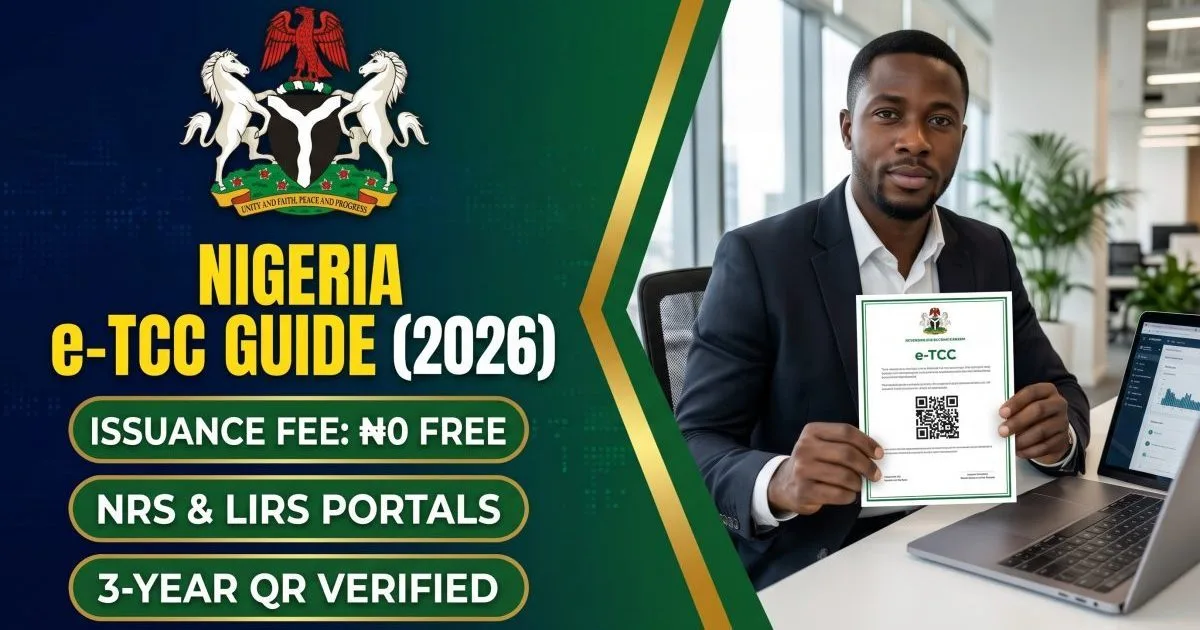


Key Takeaways: Nigeria Tax Clearance Certificate (e-TCC) in 2026
- Issuance Fee Is ₦0 (Free): Neither the Nigeria Revenue Service (NRS) (transitioned from FIRS under the Nigeria Tax Act 2025) nor State Internal Revenue Services (such as LIRS and FCT-IRS) charge a statutory application fee to issue an e-TCC. You only pay the actual taxes, returns, or arrears legally assessed on your income or company.
- Two Separate Authorities — Know Which One You Need: Apply to your State IRS (e.g., Lagos via etax.lirs.net or Abuja via fctirs.gov.ng) for a Personal / Individual e-TCC (PAYE employees, freelancers, sole proprietors). Apply to the federal NRS / TaxPro-Max portal (taxpromax.firs.gov.ng) for a Corporate / Limited Company e-TCC.
- 3-Year Coverage Rule: A 2026 TCC certifies your tax compliance for the three immediately preceding years of assessment (2023, 2024, and 2025)—or from incorporation/commencement for newly registered entities.
- 0% Tax Still Requires Annual Filing: Under the Nigeria Tax Act 2025, small companies with annual turnover of ₦100 million or less (0% CIT) and exempt minimum-wage/low-income earners still must file annual returns every year to qualify for an e-TCC.
- Statutory 2-Week Issuance Rule: Once returns and payments reconcile cleanly, Nigerian tax law requires the tax authority to issue your TCC within 14 days (2 weeks)—though digital e-TCCs on LIRS eTax and TaxPro-Max frequently generate within 24 to 72 hours.
- Instant QR Verification Kills Fake Certificates: Every authentic 2026 e-TCC carries a scannable QR code and unique verification number. Banks, embassies, MDAs, and land registries verify certificates live online—submitting a forged TCC triggers automatic rejection and criminal liability.
Whether you are bidding for a Federal Government contract, applying for a commercial bank or BOI business loan, perfecting Governor’s Consent on a Lagos property, or submitting a self-employed visa application at an embassy, one document stops more Nigerian deals in their tracks than almost any other: the Tax Clearance Certificate (e-TCC). Every year—and especially during the Q4–Q1 compliance rush—thousands of salaried workers, business owners, and company directors lose contracts, miss visa appointments, or pay unauthorized middlemen ₦50,000 to ₦250,000 for fake certificates simply because they do not know which tax authority issues their TCC or how the self-service portals work.
In 2026, Nigeria’s tax compliance landscape looks significantly different from five years ago. Following the enactment and rollout of the Nigeria Tax Act 2025 and accompanying tax administration reforms—including the institutional transition from FIRS to the Nigeria Revenue Service (NRS), the expanded ₦100 million small-company Corporate Income Tax (CIT) exemption, and unified Tax ID integration—tax clearance issuance has moved almost entirely online. Both corporate taxpayers on TaxPro-Max and Lagos/Abuja residents on state eTax portals can now apply for, download, and verify QR-coded e-TCCs without setting foot inside a crowded tax office, provided their underlying returns are up to date.
In this comprehensive, anti-scam 2026 guide, the NaijaSabi Editorial Desk breaks down the exact difference between Personal and Corporate e-TCCs, the verified documents required for PAYE employees, freelancers, and limited companies, step-by-step LIRS eTax and NRS/TaxPro-Max walkthroughs, how small companies and exempt earners claim a ₦0 tax TCC legally, how to verify any Nigerian TCC QR code in 30 seconds, and how to fix the five most common portal rejections.
1. Personal e-TCC vs. Corporate e-TCC: Which Tax Authority Issues Yours?
The single most common mistake Nigerian applicants make is visiting the wrong tax office—for example, a Lagos salaried employee walking into a federal NRS/FIRS office asking for a personal TCC, or a Limited Liability Company (LTD) trying to use a Director’s personal LIRS certificate to bid for a federal contract. Under Nigeria’s constitutional division of taxing powers, your legal structure and state of residence determine who issues your e-TCC.
| Taxpayer Category | Issuing Tax Authority | Primary Portal / Channel | Underlying Taxes Verified |
|---|---|---|---|
| Salaried Employees (PAYE) | State IRS where you reside (e.g., LIRS, FCT-IRS, RIRS, OGIRS) | State eTax portal (e.g., etax.lirs.net) |
3 years of PAYE remitted by employer + annual employee returns (Form A) + state development levy. |
| Freelancers, Sole Proprietors & CAC Business Names (BN) | State IRS where you reside (Direct Assessment) | State eTax portal or nearest State IRS Tax Station | 3 years of Personal Income Tax (Direct Assessment) returns filed on or before March 31 annually. |
| Limited Liability Companies (LTD / PLC) | Nigeria Revenue Service (NRS) (formerly FIRS) | TaxPro-Max (taxpromax.firs.gov.ng / active NRS portal) |
3 years of Corporate Income Tax (CIT), Development/Education Levy, VAT, and WHT compliance. |
| FCT Residents, Armed Forces, Police & Foreign Affairs Staff | FCT-IRS (Abuja residents) / Federal Authority for designated statutory personnel | fctirs.gov.ng / Federal tax office |
Personal Income Tax (PAYE or Direct Assessment) for preceding 3 years. |
Crucial Residence Rule for Border Commuters: If you work in Victoria Island, Lagos, but sleep and reside in Mowe, Magboro, or Sango-Ota (Ogun State), your employer is legally required to remit your PAYE to the Ogun State Internal Revenue Service (OGIRS)—not LIRS—because Nigerian Personal Income Tax follows your principal place of residence, not your office address. Always check which state holds your PAYE remittance receipts before opening a TCC application.
2. 12 Transactions Where a Tax Clearance Certificate Is Legally Required in Nigeria
Under Nigerian tax administration statutes, federal ministries, state agencies, commercial banks, and regulatory bodies are legally empowered to demand a valid 3-year TCC before processing high-value transactions. In 2026, you will almost certainly need a verifiable e-TCC for:
- Federal & State Government Contracts / BPP Bidding: Mandatory alongside PenCom, ITF, NSITF, and BPP Interim Registration Report (IRR) for any Limited Company tendering for public contracts.
- Commercial Bank, BOI & Development Finance Loans: Required for corporate credit facilities, asset finance, and institutional SME loans.
- Land & Property Title Perfection: Lagos State Land Bureau (Alausa) and Abuja Geographic Information Systems (AGIS) require a valid personal or corporate e-TCC before approving Governor’s Consent, C of O transfers, or deeds of assignment.
- Embassy Visa Applications (Self-Employed & Business Owners): UK, Schengen, US, Canadian, and South African visa officers increasingly request a verifiable 3-year Personal or Company TCC to prove legitimate taxable income—especially if you are funding relocation plans mapped out on our NaijaSabi Japa Cost Planner or preparing international travel documents alongside your Official Nigeria e-Yellow Card.
- Application for Government Licences & Permits: Import/export licences, firearms permits, mining/oil-sector permits (NUPRC/NCDMB), and specialized industry approvals.
- Appointment or Election to Public Office: Screening requirement for political candidates, board appointees, and statutory commission nominees.
- Foreign Exchange & Central Bank Trade Allocations: Certain commercial cross-border remittance and trade-finance windows require active corporate tax clearance.
- Corporate Distributorships & Major Vendor Onboarding: Multinationals, telcos, and oil-and-gas operators require supplier e-TCCs before adding Nigerian companies to their vendor portals.
- Change of Ownership / Registration of Commercial Vehicles (State-Specific): Required in several states for commercial fleet registration.
- State Scholarships, Bursaries & Public Institution Subsidies: Lagos and several other states require a parent’s or guardian’s verifiable e-TCC to access state-subsidized education and social support schemes.
- Plot Allocation & Government Housing Schemes: Federal Housing Authority (FHA) and state housing corporation allocations.
- Application for Certificates of Occupancy & Building Plan Approvals: Mandatory in Lagos (LASPPPA) and FCT development control approvals for commercial and residential projects.
3. Mandatory Requirements & Documents Checklist (PAYE, Direct Assessment & Companies)
Gathering clean, matching records before logging onto any tax portal cuts processing time from weeks down to hours. Check the exact list for your category below:
A. Salaried Employees (PAYE Personal e-TCC)
- Valid Tax Identification Number (TIN) / Payer ID: For Lagos residents, your unique LIRS Payer ID (usually prefixed
N-) plus your National Identification Number (NIN) / JTB TIN. - Proof of 3 Years of PAYE Remittances (2023, 2024, 2025): Confirm that your employer actually filed their Annual Employer Returns (Form H1) by January 31 each year and tagged payments to your exact Payer ID.
- Annual Employee Individual Tax Return (Form A): Under Nigerian tax law, even PAYE employees must file an annual declaration of total income (including any side income and statutory reliefs such as pension, NHF, and eligible rent relief) on or before March 31 every year.
- Development Levy Receipt: Where applicable in your state (for example, the nominal annual Lagos State Development Levy, typically ₦100 per year).
- Recent Passport Photograph & Valid Means of ID: NIN Slip, International Passport, or Driver’s Licence for portal KYC validation.
B. Freelancers, Sole Proprietors & Business Names (Direct Assessment e-TCC)
- Active Personal TIN / State Payer ID: Linked to your NIN and BVN.
- 3-Year Statement of Income & Expenses (2023–2025): Summary of gross annual revenue, allowable business expenses, and net taxable profit.
- Evidence of Annual Self-Assessment Filing & Tax Payment Receipts: Official state bank/Remita payment receipts settling your Direct Assessment notices for the past 3 years.
- Utility Bill / Proof of Residence: Confirms jurisdiction under your State IRS.
- CAC Business Name Certificate (If Registered): Note that a CAC Business Name (
BN) is taxed in the owner’s personal name at the State IRS—not as a limited company at NRS.
C. Limited Liability Companies (Corporate e-TCC via NRS / TaxPro-Max)
- Active Corporate TIN & CAC Certificate of Incorporation (RC Number): Registered and mapped to your assigned Tax Office on TaxPro-Max.
- Up-to-Date Audited Financial Statements (AFS): Properly signed by external auditors for the three preceding accounting years (note: qualifying small companies under the statutory threshold follow simplified financial statement filing rules where applicable).
- 3 Years of Filed Corporate Income Tax (CIT) Returns: Filed within 6 months after your financial year-end (for December 31 year-end companies, the statutory filing deadline is June 30 every year).
- Evidence of Settlement of All Assessed Taxes: CIT, Education/Development Levy, Capital Gains Tax (if applicable), and zero unresolved Value Added Tax (VAT) or Withholding Tax (WHT) penalty defaults.
- Zero Open Audit or Undisputed Tax Arrears: Any open portal liability or unallocated payment credit will automatically block e-TCC generation until reconciled.
4. Step-by-Step: How to Apply for a Personal e-TCC on LIRS eTax (Lagos Residents)
Lagos State operates Nigeria’s most mature digital individual tax platform through the LIRS eTax Portal. If you reside in Lagos and have your Payer ID ready, you do not need to visit Alausa or pay an agent. Follow these seven steps:
- Create or Log Into Your LIRS eTax Profile: Visit etax.lirs.net (verify the official link via lirs.gov.ng). If you do not yet have a Payer ID, click “Register” → “Individual” and authenticate with your NIN and BVN to generate your
N-Payer ID automatically. - Verify Your 3-Year Payment Ledger First: On your eTax dashboard, open “Payment History” and “Employer Remittances.” Confirm that your 2023, 2024, and 2025 PAYE deductions (or Direct Assessment payments) appear under your Payer ID. If your employer deducted PAYE from your salary but your ledger is empty, contact your HR/Payroll team immediately—they likely remitted under a bulk code or failed to file Form H1 with your Payer ID.
- File Outstanding Individual Annual Returns (Form A): Navigate to “Returns” → “Individual Annual Returns.” Complete and submit any pending annual declarations for the three preceding tax years, claiming legitimate reliefs (such as verified pension contributions and eligible statutory reliefs under the current tax framework).
- Settle Any Minor Balance or Development Levy: If the system flags an unpaid annual Development Levy (e.g., ₦100/year for 3 years = ₦300) or a small Direct Assessment balance, generate the official Bill Reference right inside eTax and pay online via bank transfer, USSD, or debit card. Never send money to a personal account.
- Submit Your Online e-TCC Request: From the left-hand menu, click “TCC” → “Apply for TCC.” Select the assessment year (2026, covering 2023–2025), confirm your residential address and employment/business status, upload any requested supporting document (such as a recent passport photograph or employment letter if prompted), and click Submit.
- Track Approval Status on Your Dashboard: Your assigned LIRS Tax Station reviews your 3-year ledger digitally. You can monitor status updates (Pending Review → Approved or Queried) directly on eTax and via SMS/email notifications.
- Download & Print Your QR-Coded e-TCC: Once marked Approved, download the PDF certificate straight from your eTax dashboard. The electronic certificate carries an embedded QR code and unique TCC number and is legally valid for banks, embassies, and government agencies nationwide.
5. Step-by-Step: How to Get a Corporate e-TCC Online via NRS / TaxPro-Max
Limited Liability Companies (LTD and PLC) obtain their Tax Clearance Certificate from the federal tax authority—the Nigeria Revenue Service (NRS) (transitioned from FIRS)—through the self-service TaxPro-Max digital platform. Follow this verified workflow:
- Log Into TaxPro-Max With Your Company Credentials: Access the official federal portal at taxpromax.firs.gov.ng (always check firs.gov.ng or official NRS announcements for any federal domain migration notice). Log in using the registered company email and password tied to your Corporate TIN.
- Audit Your “Taxes Due” & Filing Dashboard: Before clicking the TCC button, inspect the “Taxes Due” and “Returns” tabs. Confirm that your company has filed all mandatory monthly VAT/WHT returns (including Nil returns for inactive months) and annual CIT returns for the last three assessment years (2023, 2024, and 2025).
- Reconcile Unapplied Payments & WHT Credit Notes: If your company paid taxes via Remita or suffered Withholding Tax (WHT) deductions from corporate clients, ensure those WHT credit notes are claimed and offset against your CIT assessment inside TaxPro-Max so your balance reads ₦0.00.
- Navigate to “My Requests” → “Request for TCC”: On the main navigation menu, select “TCC” (or “Request for Tax Clearance Certificate”). Verify that your company’s legal name, RC number, registered address, and line of business match your CAC records exactly.
- Select the Qualifying Assessment Years & Submit: Confirm the 3-year window (e.g., 2023, 2024, 2025) and submit the application. The TaxPro-Max validation engine runs an automated compliance check across CIT, VAT, WHT, and penalties.
- Resolve Any Automated Query (If Triggered): If the system flags a missing month’s VAT return or an unpaid late-filing penalty, file the missing return and settle the Remita Payment Reference Number (PRN) generated inside TaxPro-Max. Once cleared, re-submit or notify your assigned Tax Controller via the portal messaging tab.
- Download Your Electronic Corporate TCC: Once approved by your assigned Tax Office, your verifiable PDF e-TCC becomes immediately downloadable from the “Approved TCC” section of TaxPro-Max, complete with a federal QR code and unique verification reference.
6. How to Get a Personal e-TCC in Abuja (FCT-IRS), Rivers (RIRS) & Other States
If you live outside Lagos, your application goes strictly to your state’s Internal Revenue Service. While portal designs differ slightly by state, the underlying legal requirements (3 years of returns + verified tax receipts + TIN/NIN) are identical across Nigeria:
- Abuja (FCT Residents — FCT-IRS): Visit the official FCT Internal Revenue Service portal at fctirs.gov.ng or any FCT-IRS office (Wuse, Garki, Gwarinpa, Utako, Maitama, or Kubwa). Register/validate your FCT TIN, file annual personal returns (Form A) by March 31, confirm 3-year PAYE or Direct Assessment payments via Remita, and apply for your e-TCC online or at your designated district tax office.
- Rivers State (Port Harcourt & Eleme/Onne — RIRS): Register for your Rivers State TIN/Payer ID via the official Rivers State Internal Revenue Service (RIRS) self-service portal or visit your nearest RIRS Tax Station (such as Moscow Road HQ, Trans-Amadi, GRA, or Eleme/Onne area offices). Ensure your employer’s PAYE schedules or your Direct Assessment receipts for 2023–2025 are captured digitally before submitting your e-TCC request.
- Ogun, Oyo, Kano, Enugu, Delta & Other States: Always confirm your state’s official
.gov.ngInternal Revenue Service website (for example, OGIRS in Ogun, OYIRS in Oyo, KIRS in Kano, or ESIRS in Enugu). Confirm your JTB TIN status first at tinverification.jtb.gov.ng before walking into your nearest State Tax Station to avoid duplicate TIN profiles.
7. Official Cost, Statutory Timeline & How Back-Year Assessments Work
One of the biggest misconceptions in Nigeria is the phrase “How much does a Tax Clearance Certificate cost?” Strictly speaking, the certificate itself costs ₦0. What people mistake for “the cost of a TCC” is actually their unpaid back-year Personal Income Tax or Corporate Income Tax liability—plus late-filing penalties if they ignored tax returns for three years until the week they needed a visa or contract.
| Fee / Timeline Component | Official Statutory Position (2026) | What to Expect in Practice |
|---|---|---|
| e-TCC Issuance / Application Fee | ₦0 (Completely Free) | Both NRS (TaxPro-Max) and LIRS (eTax) issue e-TCCs free of charge once taxes and returns are up to date. |
| Underlying 3-Year Tax Liability | Based on Actual Taxable Income / Profit | Already settled via monthly PAYE for compliant employees; assessed on declared profit for freelancers/Direct Assessment taxpayers and limited companies. |
| State Development Levy (Where Applicable) | Nominal Statutory Fee (e.g., ₦100/yr in Lagos) | Paid strictly via official portal-generated Bill Reference / Remita RRR—never in cash. |
| Statutory Issuance Timeline | Maximum 2 Weeks (14 Days) | Clean automated accounts often receive PDF approval in 24–72 hours; accounts needing manual audit reconciliation take 5–14 working days. |
| Validity Period of Issued e-TCC | Valid Until December 31 of the Current Year | A TCC issued in 2026 (covering 2023–2025) remains valid through December 31, 2026; renew in early 2027 once 2026 returns are filed. |
First-Time Direct Assessment Reality Check: If you have been freelancing or running an unregistered side business for years without filing Personal Income Tax returns and suddenly need a 3-year TCC for a visa or land purchase, your State IRS will raise a Best of Judgment (BOJ) or self-assessment bill covering the missing three years (2023–2025) based on your bank inflows, declared income, or presumptive tax bands. You have the legal right to provide verifiable expense records and negotiate an accurate assessment rather than paying arbitrary cash demands.
8. 2026 Tax Reform Rules: Small Companies (≤₦100M), Freelancers & Exempt Earners
With the Nigeria Tax Act 2025 completing its first full operational tax year in 2026, three major compliance traps are catching small business owners and salaried workers off guard when applying for an e-TCC:
1. Small Companies Earning ₦100 Million or Less (0% CIT Trap)
Under the reformed corporate tax thresholds, qualifying small companies (with annual gross turnover not exceeding ₦100 million and meeting the statutory fixed-asset criteria) enjoy a 0% Corporate Income Tax (CIT) rate. However, 0% tax payable does NOT mean 0% filing! If your company fails to file its annual CIT return on TaxPro-Max by June 30 (for December year-end companies), the portal will still hit you with statutory late-filing penalties and block your corporate e-TCC. File your annual exempt/Nil return on time to unlock a ₦0 corporate TCC.
2. Minimum-Wage & Tax-Exempt Low-Income Earners
Employees whose annual taxable income falls below the statutory Personal Income Tax exemption threshold pay ₦0 in PAYE. Even if zero tax was deducted from your monthly payslip, you are still entitled to a Personal e-TCC—provided your employer included your details in their Annual Employer Return (Form H1) and you file your Individual Annual Return (Form A) confirming exempt status. When claiming the 2026 Rent Relief (20% of annual rent paid, capped at ₦500,000), retain tenancy agreements and rent receipts in case your State IRS audits your return before releasing your TCC.
3. Newly Incorporated Companies (Under 18 Months Old)
If you registered a new Limited Liability Company with the CAC in 2026 and need a corporate e-TCC immediately for a contract bid, you do not have to wait three years. Register your TIN on TaxPro-Max, confirm your tax office, file your required monthly VAT/WHT returns (even Nil returns if you have not yet invoiced), and apply for a New Company TCC—the certificate will validly reflect “Newly Incorporated / No Tax Due Yet” for the relevant commencement period.
9. How to Verify Any Nigerian e-TCC Online Using QR Code or TCC Number
Before submitting your e-TCC to an embassy, bank, or tender board—or before accepting a vendor’s or seller’s TCC during a property or business transaction—always verify its live status online in under 30 seconds:
- Scan the Printed QR Code: Point your smartphone camera at the QR code printed on the bottom or top corner of the e-TCC PDF.
- Confirm the Official Government Verification Domain:
- For Lagos Personal e-TCCs, the QR code must resolve strictly to an official LIRS domain (
etax.lirs.netorlirs.gov.ng). You can also enter the TCC number manually on the LIRS eTax verification tool. - For Corporate e-TCCs (NRS / FIRS), the QR code must resolve strictly to the official federal verification portal (
taxpromax.firs.gov.ng/ official federal.gov.ngverification endpoint), displaying the company name, TIN, RC number, and covered years (2023–2025).
- For Lagos Personal e-TCCs, the QR code must resolve strictly to an official LIRS domain (
- Cross-Check Every Detail Line-by-Line: Confirm that the online verification screen matches the printed PDF identically: exact legal name, TIN/Payer ID, total income/turnover figures, taxes paid, issue date, and validity expiry (December 31, 2026).
- Red Flag Alert: If scanning the QR code opens a blank page, a Google Drive image, a random
.com/.xyzclone website, or returns “Record Not Found,” the certificate is forged or unactivated. Do not submit it to any embassy or bank.
10. 5 Common Reasons e-TCC Applications Get Delayed or Rejected (And Exact Fixes)
If your portal status has been stuck on Pending or returned Queried, one of these five exact bottlenecks is almost always responsible:
- Employer Deducted PAYE but Never Filed Form H1 (Or Used Wrong Payer ID): This is the #1 blocker for Lagos and Abuja employees. Fix: Request your employer’s official PAYE remittance receipts and Form H1 filing schedule from HR/Finance, then upload or present them at your assigned State IRS station for manual ledger mapping.
- Duplicate TIN or Unlinked NIN/RC Profile: Applying with an old JTB TIN while your employer remitted under a newer state Payer ID splits your 3-year history across two profiles. Fix: Request a Payer ID / TIN Merger through your State IRS helpdesk or Tax Controller so all 3 years consolidate under one active ID.
- Unfiled “Nil” Monthly VAT or WHT Returns (Companies): Even if your company made ₦0 revenue in March or August, skipping monthly VAT filing on TaxPro-Max accrues automatic late-filing penalties that lock the TCC module. Fix: File every overdue Nil return, pay any statutory penalty via official Remita PRN, and re-trigger your TCC request.
- Unclaimed Withholding Tax (WHT) Credit Notes: Corporate clients deducted 5% or 10% WHT from your invoices, leaving your CIT balance looking “unpaid” on TaxPro-Max. Fix: Confirm your clients remitted the WHT against your exact Corporate TIN, then log into TaxPro-Max to utilize your available WHT credit notes against your CIT assessment.
- Mismatch Between Personal Form A Income and Employer Payroll Figures: Declaring arbitrary numbers on your annual individual return that contradict your employer’s submitted payroll triggers an automatic compliance query. Fix: Always copy your exact gross emoluments, pension, and NHF deductions from your employer’s annual tax card/payslips before submitting Form A.
11. Anti-Scam Alert: Why “Express Agent TCCs” Fail Embassy, Bank & BPP Checks
Official Anti-Fraud Warning: Avoid Fake “Oluwole” & WhatsApp TCC Syndicates
- Zero Personal Account Transfers: All legitimate Nigerian tax payments (PAYE, Direct Assessment, CIT, VAT, Development Levy) are paid strictly via official portal-generated Remita RRR / PRN or state revenue Bill References into government TSA accounts—never to a consultant’s or “tax officer’s” personal bank, OPay, or PalmPay account.
- 10-Year Visa Bans & Contract Blacklisting: Foreign embassies (especially UKVI, IRCC Canada, US Consulates, and Schengen missions) routinely scan QR codes and email Nigerian tax authorities directly to authenticate TCCs. A doctored PDF triggers an automatic deception ban (up to 10 years for UK visas) and permanent BPP contract blacklisting.
- Criminal Liability Under Nigerian Law: Forging or procuring a fraudulent Tax Clearance Certificate is a criminal offence punishable by heavy statutory fines and imprisonment upon conviction—and it does not erase your underlying unpaid tax debt.
- Hiring a Legitimate Tax Consultant? If you use a Chartered Accountant (ICAN/ANAN) or CITN-licensed tax practitioner to prepare your audited accounts and file returns, insist on receiving the official portal Bill Reference / Remita RRR so you pay the government directly and verify your issued e-TCC QR code yourself.
12. Frequently Asked Questions (FAQs)
1. How much does it cost to get a Tax Clearance Certificate (e-TCC) in Nigeria in 2026?
The official issuance of a Tax Clearance Certificate is ₦0 (completely free) at both the federal level (Nigeria Revenue Service / TaxPro-Max) and state level (such as LIRS eTax and FCT-IRS). You are only required to have filed your returns and paid any actual income tax, corporate tax, or nominal state development levy legally assessed on you for the preceding three years.
2. Can I get a Tax Clearance Certificate online in Nigeria without visiting a tax office?
Yes. Lagos residents can register, file Form A, confirm 3-year PAYE/Direct Assessment payments, apply, and download their QR-coded Personal e-TCC 100% online via etax.lirs.net. Similarly, Limited Liability Companies nationwide can file returns and download their Corporate e-TCC entirely online through TaxPro-Max, provided there are no unresolved audit queries or duplicate TIN issues requiring in-person reconciliation.
3. Do small companies earning under ₦100 million still need to file returns to get an e-TCC in 2026?
Yes. Although qualifying small companies under the Nigeria Tax Act 2025 pay 0% Corporate Income Tax (CIT), tax exemption does not exempt you from filing annual returns. You must still submit your annual CIT return (and any applicable monthly returns) on TaxPro-Max by the statutory deadline to generate a valid ₦0 corporate e-TCC without late-filing penalties.
4. How long does it take to get an e-TCC approved in Nigeria?
Under Nigerian tax law, a tax authority is required to issue a Tax Clearance Certificate within two weeks (14 days) of receiving a compliant application—or notify you in writing of the exact reason for refusal. On automated portals like LIRS eTax and TaxPro-Max, accounts with clean 3-year payment records frequently receive approval within 24 to 72 hours.
5. How can I verify if a Nigerian Tax Clearance Certificate is genuine?
Scan the QR code printed on the e-TCC using your smartphone camera and confirm that it redirects directly to an official government verification domain (such as etax.lirs.net / lirs.gov.ng for Lagos personal TCCs, or the official federal TaxPro-Max / .gov.ng verification page for corporate TCCs). Always verify that the taxpayer’s name, TIN/Payer ID, covered years (2023–2025), and status match the PDF identically.
Editorial Verification Note: Compiled by the NaijaSabi Editorial Desk on November 19, 2026, referencing statutory procedures under the Nigeria Tax Act 2025 framework, LIRS eTax (etax.lirs.net), FCT-IRS (fctirs.gov.ng), Joint Tax Board TIN verification (tinverification.jtb.gov.ng), and federal TaxPro-Max (taxpromax.firs.gov.ng). Always confirm live portal notices and state-specific filing deadlines directly with your relevant tax authority.
Get the NaijaSabi Morning Brief
Verified daily Naira FX rates, fuel & food prices, and open Nigerian job portals — zero spam, unsubscribe anytime.




0 Comments
No comments yet. Be the first to share your thoughts!