


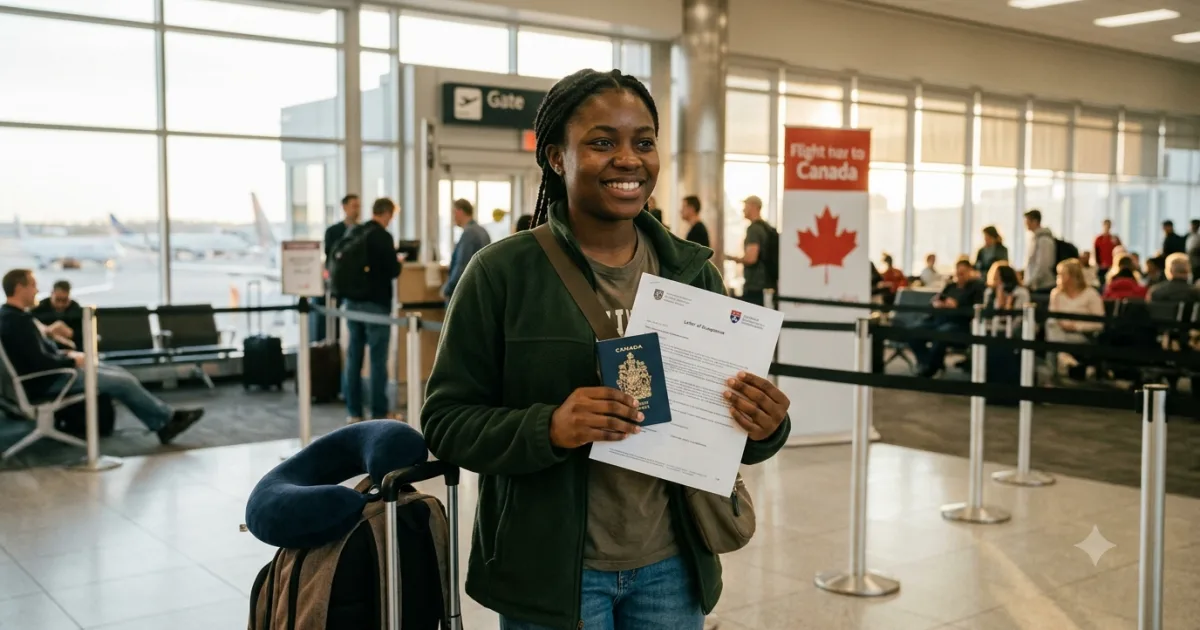
📌 Quick Summary: Canada is the top Japa destination for Nigerian students in 2026. To study in Canada, you need a Canada Study Permit issued by IRCC (Immigration, Refugees and Citizenship Canada). The fast-track Student Direct Stream (SDS) was discontinued in November 2024 — all Nigerian applicants now go through the regular stream, which takes 8–16 weeks. The study permit costs CAD 150 (approximately ₦150,000) plus CAD 85 for biometrics. You must prove CAD 22,895 in living expenses plus your first year’s tuition. A Provincial Attestation Letter (PAL) from your province is now required before you apply. Biometrics are submitted at VFS Global centres in Lagos or Abuja. This NaijaSabi guide covers every step of the 2026 Canada study permit process specifically for Nigerians — including the real naira costs, the proof of funds challenge, and what IRCC is watching most closely on Nigerian applications.
Canada has become the number one Japa destination for Nigerian students. More Nigerians applied for Canadian study permits in the past three years than in any previous period in history — and the reasons are clear. Canada offers world-class universities, a Post-Graduate Work Permit (PGWP) that allows graduates to work in Canada after finishing their studies, a pathway to permanent residency through Express Entry, and a growing Nigerian community in cities like Toronto, Calgary and Edmonton that makes the transition less daunting. But getting the study permit right — particularly in 2026 when IRCC has introduced stricter documentation requirements — requires preparation, accurate information and time. This NaijaSabi guide gives you everything Nigerians need to know about the 2026 Canada study permit process.
| Fact | Detail |
| Document name | Canada Study Permit (not a visa — it is a permit to study) |
| Issued by | IRCC — Immigration, Refugees and Citizenship Canada |
| Application portal | canada.ca/en/immigration-refugees-citizenship (IRCC online portal) |
| Student Direct Stream (SDS) | Discontinued November 8, 2024 — all Nigerians now apply via regular stream |
| Processing time (2026) | 8–16 weeks from biometrics submission |
| Study permit fee | CAD 150 (~₦150,000 at ₦1,000/CAD) |
| Biometrics fee | CAD 85 (~₦85,000) |
| Proof of funds — living expenses | CAD 22,895 minimum (~₦22.9 million) outside Quebec |
| Proof of funds — Quebec | CAD 24,617 minimum (~₦24.6 million) |
| First year tuition also required | Yes — must prove living expenses PLUS full first year tuition |
| PAL required? | Yes — Provincial Attestation Letter required since January 2024 |
| Biometrics location in Nigeria | VFS Global centres in Lagos and Abuja |
| Exchange rate reference (2026) | Approximately ₦1,000 per CAD 1 — confirm at CBN or xe.com before applying |
Big 2026 Change Nigerians Must Know — The SDS Is Gone
For several years, Nigerians had access to the Student Direct Stream (SDS) and the Nigeria Student Express (NSE) — fast-track visa programmes that processed Canadian study permits in approximately 20 days for qualifying Nigerian applicants. These programmes were a significant advantage for Nigerian students who met the requirements.
On November 8, 2024, IRCC officially discontinued both the SDS and the NSE. This is the single most important update for any Nigerian researching Canada study visas in 2026. There is no longer a fast-track option. Every Nigerian study permit applicant now goes through the regular stream, which takes 8–16 weeks from the date biometrics are submitted at a VFS Global centre in Lagos or Abuja. Plan accordingly — if your programme starts in September 2027, you should be submitting your study permit application no later than April or May 2027.
The discontinuation of SDS also means the previously relaxed financial checks associated with the SDS Guaranteed Investment Certificate (GIC) route are no longer in play. IRCC now applies the same rigorous financial scrutiny to every Nigerian application. Nigeria’s classification as a country with foreign exchange controls — where the CBN regulates how much money can be moved internationally — means IRCC officers pay particular attention to whether Nigerian applicants’ funds are genuinely accessible and can legally be transferred to Canada.
What You Need Before You Even Start — 5 Prerequisites
Before visiting the IRCC portal, you need five things in place. Do not apply without all five — a missing prerequisite is the most common cause of Nigerian study permit delays and rejections in 2026.
1. A Letter of Acceptance (LOA) from a Designated Learning Institution (DLI)
A Designated Learning Institution is a Canadian school approved by a provincial or territorial government to host international students. Your acceptance letter must be from a DLI — not just any Canadian institution. Search the full list of DLIs at the IRCC website (canada.ca). Top Nigerian-preferred DLIs include University of Toronto, University of British Columbia, McGill University, University of Alberta, Toronto Metropolitan University, Humber College, Centennial College and Seneca College.
2. A Provincial Attestation Letter (PAL)
Since January 22, 2024, most post-secondary study permit applicants must include a PAL — a letter from the province or territory where their school is located, confirming their place within the province’s international student allocation. Your school requests the PAL on your behalf — you do not apply for it directly. However, most schools only begin the PAL request process after you have accepted your offer of admission and paid a tuition deposit. This adds 2–4 weeks to your pre-application timeline. Factor this into your planning — if your school tells you the PAL will take 3 weeks, your application timeline is already 3 weeks longer before you have even logged into IRCC.
3. English Language Test Results
Most Canadian universities require proof of English proficiency for admission and for the study permit. IELTS Academic is the most widely accepted test. Minimum scores vary by institution and programme level:
- Undergraduate: 6.0–6.5 overall
- Postgraduate Master’s: 6.5–7.0 overall
- MBA: 6.5–7.0 (often 7.0 for top programmes)
- PhD: 7.0+
- College diploma: 6.0
TOEFL iBT, PTE Academic and Duolingo English Test are also accepted by many Canadian institutions. Check your specific school’s requirements before booking your test.
4. Proof of Funds
This is the most challenging requirement for Nigerian applicants in 2026. IRCC requires you to prove you can financially support yourself throughout your studies. For 2026, you must show:
- Living expenses: CAD 22,895 minimum (~₦22.9 million at ₦1,000/CAD) for one person outside Quebec
- Quebec: CAD 24,617 (~₦24.6 million)
- Full first year tuition: Varies by programme — undergraduate typically CAD 25,000–45,000 (~₦25m–₦45m), college diploma CAD 15,000–22,000 (~₦15m–₦22m)
This means a Nigerian student applying for an undergraduate programme in Ontario must demonstrate approximately CAD 47,895–67,895 in total available funds — equivalent to roughly ₦47–68 million. This is the financial reality of the Canada study permit in 2026. Many Nigerian families fund this through a combination of personal savings, family contributions, sponsor funds, educational loans and scholarships.
What IRCC accepts as proof of funds:
- Bank statements covering at least 6–12 months showing consistent account activity
- A Guaranteed Investment Certificate (GIC) from a participating Canadian financial institution — even though SDS is gone, a GIC is still strong evidence of funds
- Scholarship or award letters
- Educational loans from a recognised Nigerian financial institution
- Sponsor letters with their own bank statements and evidence of their relationship to you
Critical warning for Nigerian applicants: IRCC flags “lump sum” deposits — large amounts that appear suddenly in a bank account without a clear explanation. If your family transferred a large sum into your account to boost the balance before applying, IRCC will notice the unusual deposit and may reject your application or request a detailed explanation. Prepare a clear paper trail for all funds — employment records, business income, property sale receipts, loan agreements — whatever explains where the money came from.
5. A Valid Nigerian Passport
Your passport must be valid for the entire duration of your programme plus at least 6 months beyond. If your passport expires before your programme ends, renew it before applying for your study permit. Apply for passport renewal at the Nigeria Immigration Service portal (immigration.gov.ng) — allow 4–8 weeks for renewal in 2026.
Step-by-Step Canada Study Permit Application Process for Nigerians in 2026
- Get your Letter of Acceptance (LOA) from a DLI. Apply to Canadian institutions well in advance — most have application deadlines in November–January for September intake and June–August for January intake. Accept your offer and pay your deposit to trigger the PAL process
- Wait for your Provincial Attestation Letter (PAL). Your school requests this from the provincial government. It can take 2–6 weeks. You cannot apply for your study permit without it — wait
- Complete your medical examination if required. Most study permits lasting 6 months or longer require a medical examination. In Nigeria, IRCC-approved panel physicians are available in Lagos and Abuja — check the full list on the IRCC website. Complete your medical exam before submitting your application to avoid delays
- Obtain your Nigerian Police Clearance Certificate. Apply through the POSSAP portal at possap.npf.gov.ng — see NaijaSabi’s complete Police Clearance Certificate guide for the full process. Allow 2–6 weeks for processing
- Create your IRCC account and complete the online application. Go to canada.ca/en/immigration-refugees-citizenship and create an account. Select “Study Permit” and complete the IMM 1294 application form. Upload all required documents — LOA, PAL, passport, photos, proof of funds, medical exam results, police clearance certificate, English test results, Statement of Purpose
- Pay the study permit fee. CAD 150 for the study permit plus CAD 85 for biometrics — total CAD 235 (~₦235,000). Pay online through the IRCC portal using an international Visa or Mastercard, or through a Nigerian bank with international transfer capability
- Submit biometrics at VFS Global in Lagos or Abuja. After submitting your application, you will receive a biometrics instruction letter. Book an appointment at your nearest VFS Global Canada Visa Application Centre — Lagos (5 Mambilla Street, Abuja Zone, Maitama… no, Lagos location) or Abuja. Attend your appointment with your biometrics letter and passport. IRCC does not start your processing clock until biometrics are received — this step is urgent
- Track your application. Log in to your IRCC account to track your application status. Processing takes 8–16 weeks from biometrics submission. You may receive a request for additional documents (AOR) — respond promptly
- Receive your Port of Entry (POE) letter and travel. When your permit is approved, you receive an approval letter. Your actual study permit is issued at the Canadian border when you arrive. Present your LOA, PAL, approval letter and passport to the border officer
VFS Global Centres in Nigeria — Where to Submit Biometrics
| City | Address | Booking |
| Lagos | VFS Global Canada VAC — Plot 1678 Olakunle Bakare Close, Victoria Island, Lagos | vfsglobal.com/canada/nigeria |
| Abuja | VFS Global Canada VAC — 5 Mambilla Street, Off Aso Drive, Maitama, Abuja | vfsglobal.com/canada/nigeria |
Book your biometrics appointment as soon as you receive your biometrics instruction letter — appointments fill up quickly at the Lagos VAC. Bring your passport, biometrics instruction letter and the fee payment receipt.
Realistic Cost Breakdown for a Nigerian Applying for Canada Study Permit in 2026
| Cost Item | Amount (CAD) | Amount (₦ at ₦1,000/CAD) |
| Study permit application fee | CAD 150 | ₦150,000 |
| Biometrics fee | CAD 85 | ₦85,000 |
| Medical examination (Lagos/Abuja panel physician) | CAD 200–400 equivalent | ₦200,000–₦400,000 |
| IELTS test fee (Nigeria) | — | ₦137,000–₦160,000 |
| Police clearance certificate (POSSAP) | — | ₦30,000 |
| Passport renewal (if needed) | — | ₦15,000–₦75,000 |
| Document translation/notarisation (if needed) | — | ₦20,000–₦80,000 |
| Total application process costs | — | ~₦637,000–₦980,000 |
| Proof of funds required (living expenses only) | CAD 22,895 | ~₦22,900,000 |
| First year tuition (college diploma) | CAD 15,000–22,000 | ₦15m–₦22m |
| First year tuition (undergraduate) | CAD 25,000–45,000 | ₦25m–₦45m |
Exchange rate of ₦1,000/CAD used for illustration. The actual rate fluctuates — check the current rate at xe.com or the CBN website before making any financial commitments.
Why Canada Study Permit Applications Are Rejected — The Top Reasons for Nigerians
Canada study permit refusal rates for Nigerian applicants have been higher than the global average in recent years. These are the most common reasons — and how to avoid them:
- Insufficient or unverifiable proof of funds. Your funds must be sufficient, liquid, accessible and legally transferable. A high naira balance in a Nigerian bank account without evidence of how it can be converted to CAD under CBN regulations is not convincing. Include a letter from your Nigerian bank confirming the balance and that the funds are available for transfer
- Lump-sum deposits with no explanation. Large sudden deposits before application are a major red flag. If you received a large sum legitimately — from a property sale, business proceeds, family gift — document it fully with receipts, letters and transaction records. Never transfer money from multiple relatives into one account just before applying without a clear paper trail
- A weak Statement of Purpose (SOP). Your SOP must convince the visa officer that you genuinely intend to study, that your chosen programme makes sense for your career goals, and that you have genuine ties to Nigeria that will bring you back after graduation. A generic SOP that could belong to anyone is a red flag. Write yours specifically — your background, why this programme at this school in this province, your career plan and why you will return to Nigeria
- Missing or incorrect PAL. Since January 2024, the PAL is mandatory for most post-secondary applicants. Applications submitted without a valid PAL are returned or refused. Get it from your school before submitting
- Expired or near-expiry passport. Your passport must cover your full programme duration. Apply with a passport that expires mid-programme and IRCC may refuse or issue a permit shorter than your programme
After Your Studies — Post-Graduate Work Permit (PGWP)
One of the biggest reasons Nigerian students choose Canada over the UK or Australia is the Post-Graduate Work Permit (PGWP). After graduating from most DLIs, Nigerian graduates can apply for a PGWP that allows them to work anywhere in Canada for up to 3 years. This work experience then qualifies them for Permanent Residency through Express Entry — Canada’s points-based immigration system. The pathway is: Nigerian student → PGWP → Canadian work experience → Express Entry PR application. This pathway is the reason Canada has become the most popular Japa destination among Nigerian graduates in 2026.
Frequently Asked Questions — Canada Study Visa Nigeria 2026
How do I apply for a Canada study visa from Nigeria in 2026?
Apply online through the IRCC portal at canada.ca/en/immigration-refugees-citizenship. You need a Letter of Acceptance from a Designated Learning Institution, a Provincial Attestation Letter (requested by your school), proof of funds (CAD 22,895 living expenses + first year tuition), English test results, a valid passport, medical examination results and a Nigerian Police Clearance Certificate. Submit biometrics at VFS Global in Lagos or Abuja after submitting your application. Processing takes 8–16 weeks from biometrics submission. The Student Direct Stream fast-track was discontinued in November 2024 — all Nigerians now apply through the regular stream.
How much does a Canada study permit cost in Nigeria in 2026?
The IRCC study permit application fee is CAD 150 (~₦150,000) plus a biometrics fee of CAD 85 (~₦85,000) — total approximately ₦235,000 in government fees. Additional costs include the medical examination (~₦200,000–₦400,000), IELTS test (~₦137,000–₦160,000), police clearance certificate (₦30,000) and any document preparation costs. Total application process costs typically run ₦637,000–₦980,000 for most Nigerian applicants, excluding tuition and living expenses.
How much money do I need to show for a Canada study permit from Nigeria?
IRCC requires proof of at least CAD 22,895 (~₦22.9 million) in living expenses for one person studying outside Quebec, plus proof of full first year tuition. For an undergraduate programme costing CAD 30,000, you need to show approximately CAD 52,895 in total available funds — roughly ₦52.9 million. Nigerian applicants face additional scrutiny because of CBN foreign exchange controls, so funds must be demonstrably accessible and legally transferable. Bank statements covering 6–12 months, a Guaranteed Investment Certificate (GIC) and sponsor documentation all strengthen your application.
Is the SDS Student Direct Stream still available for Nigerians in 2026?
No — the Student Direct Stream (SDS) and Nigeria Student Express (NSE) were officially discontinued by IRCC on November 8, 2024. All Nigerian study permit applicants now go through the regular stream, with processing times of 8–16 weeks. There is no fast-track option available to Nigerian applicants in 2026. Apply at least 4–6 months before your programme’s start date to allow sufficient processing time.
Can I work in Canada while studying on a student permit?
Yes — most Canadian study permit holders are eligible to work up to 24 hours per week off-campus during their academic session, and full-time during scheduled breaks (summer, winter holidays). On-campus work is typically unlimited. This on-campus and part-time work helps Nigerian students in Canada supplement their income during their studies. After graduating, the Post-Graduate Work Permit (PGWP) allows full-time work in Canada for up to 3 years — an important pathway toward permanent residency.
Where do I submit biometrics for Canada study visa in Nigeria?
Biometrics (fingerprints and photograph) are submitted at VFS Global Canada Visa Application Centres in Nigeria — located in Victoria Island, Lagos and Maitama, Abuja. Book your appointment at vfsglobal.com/canada/nigeria as soon as you receive your biometrics instruction letter from IRCC. Do not delay — the Lagos VAC appointments fill up quickly. IRCC does not begin processing your study permit until your biometrics are received, so this step starts your 8–16 week processing clock.
Sources
- IRCC — Canada Study Permit official requirements — canada.ca/en/immigration-refugees-citizenship
- IRCC — SDS discontinuation notice, November 8, 2024 — canada.ca
- IRCC — Proof of funds requirements, updated September 2025 — canada.ca
- IRCC — Provincial Attestation Letter requirement, January 2024 — canada.ca
- VFS Global Nigeria — Canada VAC biometrics appointment — vfsglobal.com/canada/nigeria
Last updated: 15 September 2026 · NaijaSabi Education Desk. Immigration Requirements, Fees and processing times change frequently. Always confirm current details directly at canada.ca/en/immigration-refugees-citizenship before submitting any application. This article is for informational purposes only and does not constitute immigration advice.

0 Comments
No comments yet. Be the first to share your thoughts!