





📌 Quick answer (checked 13 October 2026): Renewing a Nigerian passport costs the same as a new one: ₦100,000 for the 32-page, 5-year booklet and ₦200,000 for the 64-page, 10-year booklet in Nigeria, or US$150 and US$230 abroad. These fees have not changed since 1 September 2025. You apply and pay online, your NIN is compulsory, and the NIS aims to issue passports three to six weeks after biometric capture. Nigerians in many countries abroad can renew without visiting a mission through the NIS Mobile app.
Renewing a Nigerian international passport has, for years, been a byword for frustration — endless queues, mysterious “facilitation” fees, touts swarming the gates of passport offices, and booklets that never seemed to arrive on time. The good news in 2026 is that the Nigeria Immigration Service (NIS) has genuinely modernised the process: applications are now fully online, a mobile app even allows eligible applicants to complete biometrics contactlessly, and the steps are clearer than ever. The less good news is that the fees roughly doubled in September 2025.
Whether you are renewing an expiring passport, replacing a damaged one, or helping a family member abroad, this guide walks you through exactly how it works in 2026 — the current fees, the official NIS portal and mobile app, the contactless renewal option, the documents you need, realistic timelines, and how to sidestep the touts who still prey on confused applicants. It is written for Nigerians at home and in the diaspora alike.
📌 Important: Passport fees, processing options and requirements are set by the NIS and can change. Always confirm current details on the official portal at passport.immigration.gov.ng. Pay only through the official online channels — never hand cash to a “facilitator” or tout.
Nigerian Passport Fees in 2026
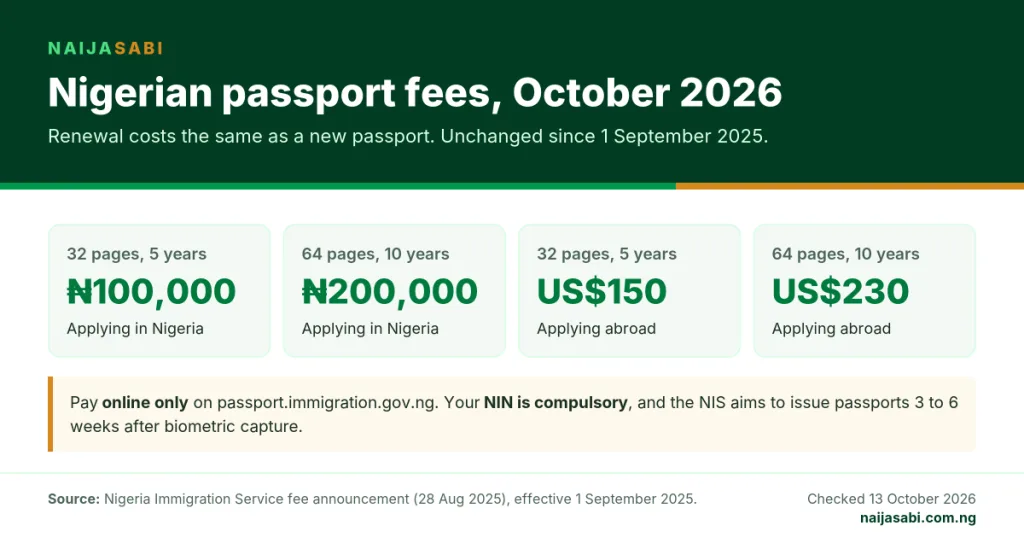
Following the Federal Government’s fee review effective 1 September 2025, the cost of a Nigerian passport roughly doubled. These are the current domestic fees in 2026:
| Passport Type | Validity | Domestic Fee (₦) |
|---|---|---|
| 32-page booklet | 5 years | ₦100,000 |
| 64-page booklet | 10 years | ₦200,000 |
For context, these prices were ₦50,000 and ₦100,000 under the August 2024 schedule, and ₦35,000 and ₦70,000 before that — a steep climb that drew public criticism, given how it compares to the national minimum wage. The NIS has noted that while the 32-page (5-year) and 64-page (10-year) fees are standard nationwide, the charge for a 64-page (5-year) booklet may vary slightly by processing location.
For Nigerians applying abroad (diaspora):
| Passport Type | Validity | Fee (USD) |
|---|---|---|
| 32-page booklet | 5 years | US$150 |
| 64-page booklet | 10 years | US$230 |
A crucial point: renewal costs exactly the same as a new passport. There is no discounted “renewal” rate. Express or expedited processing, where offered, may attract an additional fee — confirm current express charges on the portal.
A key reality check on the fee: all payments are made online only, through the official NIS portal. You cannot, and should not, pay cash at a passport office. Anyone asking for cash is operating outside the system.
The Single Most Important Requirement: Your NIN
Before anything else, understand this: a National Identification Number (NIN) is now mandatory for every passport application and renewal in Nigeria, with no exceptions. The NIS made NIN compulsory for all passport processing, and the portal will simply not let you proceed without a verified NIN.
Even more importantly, the portal pulls your personal details (name, date of birth, etc.) directly from your NIMC record once your NIN is verified. Your passport will be printed with whatever data the NIMC system holds. So if your name is misspelt or your date of birth is wrong in your NIMC record, you must fix it at a NIMC office before you apply — otherwise the error will be printed permanently into your new passport.
This single step prevents the most common and most painful passport problem: a booklet printed with wrong details that then causes visa and travel complications for years.
Passport Categories: Which Booklet Do You Need?
The NIS issues several passport categories, but for ordinary international travel, the relevant one is the Standard Passport (green cover):
- 32-page, 5-year booklet (₦100,000) — suitable for those who travel less frequently or prefer to renew more often.
- 64-page, 10-year booklet (₦200,000) — better for frequent travellers and anyone who would rather not repeat the process for a decade.
The Official (blue) and Diplomatic (red) passports are reserved for government officials and diplomats and are not part of this standard cost structure.
For most people, the 64-page 10-year booklet offers the best value over time — fewer renewals, fewer fees in the long run, and more visa pages for active travellers.
How to Renew Your Nigerian Passport: Step-by-Step (2026)
The entire process now begins online. There is no paper application option anymore.
Step 1 — Go to the official NIS portal. Visit passport.immigration.gov.ng. From the homepage, select “Apply for Renewal/Re-issue” (or “Apply for Fresh Passport” if it is a first-time application).
Step 2 — Sign in and verify your NIN. Create or sign in to your account, then enter your NIN for verification. The system confirms your eligibility and pulls your biodata from NIMC. Review every detail carefully — if anything is wrong, stop and correct it at NIMC first.
Step 3 — Enter your current passport details and choose your options. Provide details from your existing passport, select your preferred processing centre (NIS office, embassy or consulate where you will appear), choose your booklet size (32 or 64 pages), and upload your passport photograph and supporting documents. Provide your contact address and next-of-kin information.
Step 4 — Pay online. Make payment according to the current fee structure through the portal’s official payment channel. Note your Application ID and Reference Number — you will need them.
Step 5 — Complete biometrics. This is where 2026 offers two routes:
- Contactless biometric enrolment (via the NIS Mobile app) — eligible applicants, especially in the diaspora, can now complete enrolment without visiting an office. Download the NIS Mobile app, create and activate a profile, use the Passport Application Services tab, choose self-enrolment, and check your contactless eligibility with your Application ID and Reference Number.
- In-person biometric appointment — if you are not eligible for contactless enrolment, schedule and attend an appointment at your chosen NIS office, embassy or consulate to capture fingerprints and photograph.
Step 6 — Submit your old passport for verification/cancellation. Your expiring or current passport is verified and cancelled as part of issuing the new one.
Step 7 — Collect or receive your new passport. Once processed, collect it at your processing centre — or, where available, choose home delivery to have it sent to your address.
Documents You Will Typically Need
For a standard renewal, prepare:
- Your NIN (slip or number) — mandatory
- Your current/old passport (data page)
- A recent passport photograph meeting NIS specifications
- Proof of payment (generated online)
- Birth certificate or declaration of age (may be requested)
- Local government / state of origin identification (may be requested)
- Marriage certificate (if you have changed your name)
- Police report (if renewing due to a lost passport)
For minors, every child needs their own individual booklet — you cannot add a child to a parent’s passport. A minor’s application typically requires the child’s birth certificate, both parents’ passports/IDs, and parental consent.
Special case: if you became a Nigerian citizen through naturalisation, registration, adoption or surrogacy, you can only process your application at the NIS Headquarters in Abuja, not at a state command or other processing centre.
How Long Does It Take?
The NIS says it aims to issue passports three to six weeks after biometric capture, provided there are no problems with your application or NIN details; actual times vary by processing centre and booklet availability. In August 2026 the NIS sent a passport intervention team to the UK to clear a backlog there. For status enquiries, the NIS contact centre is on 09121900655, 09121556359 or 09121477092 (Monday to Friday, 9am to 6pm), or support@immigration.gov.ng. Express or expedited processing, where offered, can be faster but is not instant — no passport is issued same-day, despite what touts may claim. Apply well ahead of any planned travel; leaving it to the last minute is the most common cause of stress.
The 2026 Modernisation: Online and Contactless
The biggest change in recent years is how much of the process now happens without queuing:
- Fully online applications — no paper forms, no physical application submission.
- The NIS Mobile app — enables eligible applicants to renew and even complete biometrics contactlessly, a genuine game-changer for the diaspora and for busy applicants.
- Diaspora rollout — the online renewal service was progressively expanded to Nigerians in Canada, the UK, the US, Italy and beyond, allowing renewals from abroad with delivery to a home address.
- Home delivery — applicants can opt to have the finished passport delivered rather than collecting it in person.
This is a meaningful improvement on the old system. The remaining friction is mostly around biometric capture (still in-person for those not eligible for contactless) and processing times during peak demand.
How to Avoid Touts and Scams
Despite the digital overhaul, touts and fake “facilitators” still cluster around passport offices and online. Protect yourself and your money:
- Apply yourself on the official portal (passport.immigration.gov.ng) and the official NIS Mobile app. The process is designed to be self-service.
- Pay only online, through the official channel. All legitimate payments are electronic. Anyone demanding cash is a tout.
- No one can “fast-track” you for a bribe legitimately. Promises of same-day passports or guaranteed express for cash are scams or corruption — avoid them.
- Never share your login, payment details, or NIN carelessly. Use only the official site and app.
- Fix your NIMC data yourself at a NIMC office; do not pay an agent to “sort” your biodata.
- Be wary of look-alike websites. Scammers clone the NIS portal. Check the URL carefully.
Doing it yourself is not only cheaper — it is usually faster and safer than handing your documents to a stranger.
FAQ: Nigerian Passport Renewal 2026
1. How much does it cost to renew a Nigerian passport in 2026?
The same as a new one: ₦100,000 for a 32-page (5-year) booklet and ₦200,000 for a 64-page (10-year) booklet domestically. For diaspora applicants, US$150 and US$230 respectively.
2. Can I renew my Nigerian passport online?
Yes. Applications start fully online at passport.immigration.gov.ng, and eligible applicants can complete biometrics contactlessly via the NIS Mobile app. Those not eligible for contactless enrolment still attend an in-person biometric appointment.
3. Is NIN compulsory for passport renewal?
Yes, absolutely. A verified NIN is mandatory, and the portal will not let you proceed without one. Your passport is printed with the biodata held in your NIMC record.
4. How long does passport renewal take?
The NIS aims for three to six weeks after biometric capture, but it varies by centre and booklet availability. No passport is issued the same day; apply well ahead of travel.
5. Do I pay cash at the passport office?
No. All payments are online only, through the official NIS portal. Anyone asking for cash is a tout — do not pay.
6. What documents do I need to renew?
Your NIN, current passport, a compliant passport photo, proof of payment, and possibly a birth certificate, state-of-origin ID, marriage certificate (for name changes) or police report (for a lost passport).
7. Can I renew my Nigerian passport from abroad?
Yes. The online renewal service covers Nigerians in many countries (Canada, UK, US, Italy and others), with the option of home delivery. Eligible applicants may also use the contactless option via the NIS Mobile app.
8. Is the renewal cheaper than a new passport?
No. Renewal costs exactly the same as a fresh passport. There is no discounted renewal rate.
9. What if my name or date of birth is wrong?
Fix it at a NIMC office before applying. The passport prints whatever data NIMC holds, so any error must be corrected at the NIMC level first — not on the passport portal.
10. Should I use an agent?
You don’t need to. The process is self-service online. Touts and “facilitators” add cost and risk. Apply yourself, pay only through official channels, and verify your NIMC data personally.
The Bottom Line
Renewing your Nigerian passport in 2026 is more expensive than ever — ₦100,000 for five years, ₦200,000 for ten — but the process itself is genuinely better than it used to be. It is fully online, increasingly contactless, available to the diaspora, and can end with your new booklet delivered to your door.
The two things that matter most: sort your NIN and NIMC data first (because your passport prints exactly what NIMC holds), and do it yourself through official channels rather than paying touts who add cost, delay and risk. Choose the 64-page 10-year booklet if you travel often — it is the better long-term value — and apply well ahead of any trip, since nothing here happens overnight.
Your passport is your key to the world. Renew it properly, keep your data clean, and you spare yourself the headaches that have haunted Nigerian travellers for far too long.
Related reading on NaijaSabi:
- How to Apply for NIN in Nigeria 2026 — your NIN is now mandatory for passports
- African Passport Ranking 2026: Visa-Free Destinations — where your Nigerian passport can take you
- US B1/B2 Visa Interview from Nigeria 2026 — your next step after getting the passport
Sources & References
- Nigeria Immigration Service (NIS) — official passport information. Available at: immigration.gov.ng
- NIS E-Passport Application Portal. Available at: passport.immigration.gov.ng
- Federal Government of Nigeria — Services Portal, NIS Renewal of International Passport. Available at: services.gov.ng
- National Identity Management Commission (NIMC) — NIN information. Available at: nimc.gov.ng
Editorial standards. This article is independently researched and compiled from official Nigeria Immigration Service and Federal Government sources, plus current reporting. Passport fees, processing options and requirements are set by the NIS and can change — always confirm current details on the official portal at passport.immigration.gov.ng before applying. Pay only through official channels and avoid touts. If you spot an error or have a correction, please write to editorial@naijasabi.com.ng.
Last updated: 13 October 2026 · NaijaSabi. Fees confirmed against the NIS announcement of 28 August 2025; contact numbers from the NIS notice of 29 September 2025. For the full fee guide, see how much is a Nigerian passport in 2026.




0 Comments
No comments yet. Be the first to share your thoughts!