




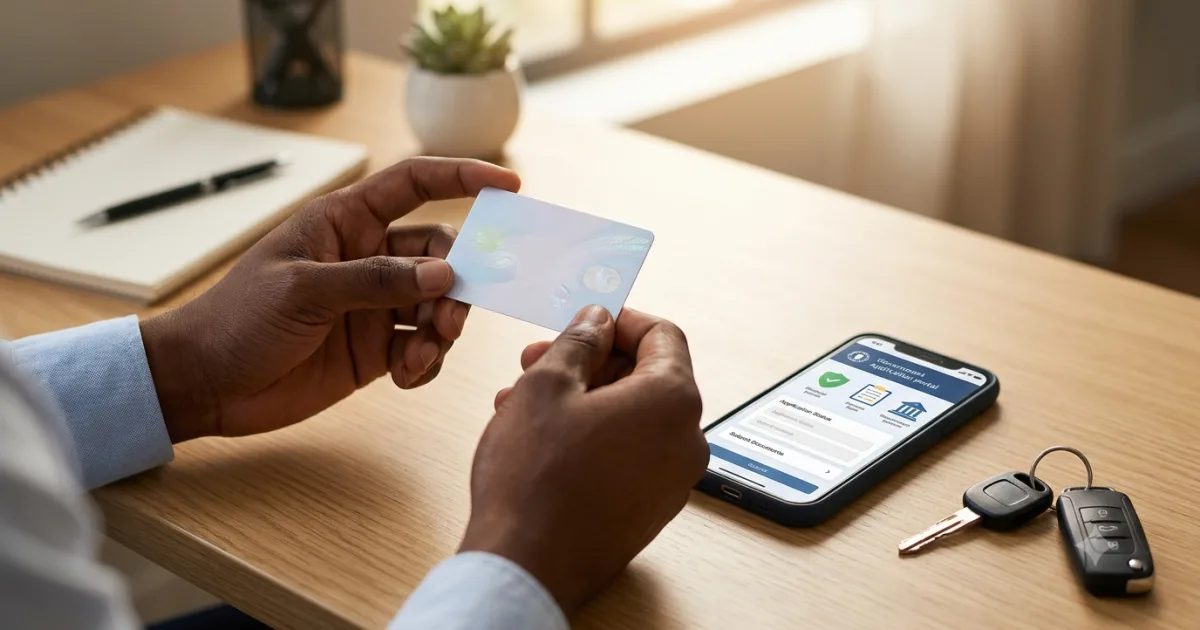
📌 Quick answer (checked 13 October 2026): Renewing a car driver’s licence costs ₦15,000 for 3 years or ₦21,000 for 5 years (tricycle licences ₦7,000 and ₦11,000), the fees set by the Joint Tax Board from 8 June 2025. You start online at the FRSC licence portal, pay with the portal’s payment reference, then do biometric capture at a Drivers Licence Centre. The FRSC has introduced contactless biometric capture with on-the-spot printing, linked to your NIN, which replaces the temporary licence at centres where it is running.
A Nigerian driver’s license is more than the credit-card-sized document you flash at a checkpoint. It is your official record inside a national system run by the Federal Road Safety Corps (FRSC) — your driving-school certificate, your test results, your biometrics, your data. Drive without a valid one and you are committing a traffic offence under the National Road Traffic Regulations. Yet every year, millions of Nigerian drivers either let their licenses lapse or get fleeced by touts charging inflated fees for a process they could complete themselves.
This guide fixes that. It walks you through exactly how to renew (and how to first obtain) a Nigerian driver’s license in 2026 — the official FRSC portal, the current fees, the step-by-step renewal and first-time processes, the agencies involved, the license classes, realistic timelines, the International Driver’s Permit, and how to avoid the touts who prey on drivers unfamiliar with the official system.
📌 Important: Driver’s license fees, processing options and requirements are set by the FRSC and its partner agencies and can change. Always confirm current details on the official portal at nigeriadriverslicence.frsc.gov.ng. Only pay through official payment references generated by the portal — if someone asks you to pay without one, you are not yet in the real process.
Driver’s License Fees in Nigeria (2026)
These are the official fees set by the Joint Tax Board, in force since 8 June 2025:
| License Type | 3 Years | 5 Years |
|---|---|---|
| Motor vehicle (car) | ₦15,000 | ₦21,000 |
| Tricycle / motorcycle | ₦7,000 | ₦11,000 |
This official fee covers the application, biometric capture, learner’s permit and the license card itself. The same fees apply whether you are applying fresh or renewing.
For first-time applicants, the total is higher once you include the compulsory costs that come before the licence fee: accredited driving school, the driving test, and medical and eye checks. Driving school prices vary by city and school, so get quotes. These are separate from, and additional to, the FRSC license fee.
A practical note on choosing validity: the 5-year license costs more upfront (₦21,000 vs ₦15,000) but saves you a renewal cycle and is better value over time for established drivers. The 3-year option suits those who prefer lower upfront cost or expect their details to change.
The Three Agencies Behind Your License
Renewing or obtaining a license touches three bodies, which is why the process has several steps:
- FRSC (Federal Road Safety Corps) — oversees the scheme, captures your biometrics, and produces the card.
- VIO (Vehicle Inspection Office) — conducts the driving test and issues the certificate of proficiency (for new applicants).
- BIR (Board of Internal Revenue) — the state revenue body that endorses the application and is often where the permanent card is collected.
Understanding this three-way structure explains why you cannot simply pay online and receive a card by post — the in-person endorsement and biometric steps are built into the system.
How to Renew Your Driver’s License: Step-by-Step (2026)
Renewal is the simpler path, since you already exist in the system. Here is the process:
Step 1 — Find your existing license number on your old card.
Step 2 — Go to the official portal. Visit nigeriadriverslicence.frsc.gov.ng and click “Renew Driver’s Licence.”
Step 3 — Search your record. Enter your license number and date of birth, then search to pull up your existing record.
Step 4 — Confirm and update your data. Review and update your address, phone number and next-of-kin details as needed.
Step 5 — Choose your DLC and validity. Pick the Drivers Licence Centre (DLC) where you will do your biometric capture, and select your 3-year or 5-year option.
Step 6 — Generate a payment reference and pay. The portal generates an official payment reference; pay through the approved channel (such as Remita or a bank). This official reference is the proof you are genuinely in the process.
Step 7 — Print your acknowledgement.
Step 8 — Visit the DLC for biometric refresh. Attend your chosen centre to update your photograph and fingerprints.
Step 9 — Get your card. At centres using the FRSC’s new contactless capture and instant printing, announced in October 2025, your permanent licence is printed on the spot. Elsewhere you may still receive a temporary licence valid for 60 days while the permanent card is produced.
Step 10 — Collect the permanent card. When the FRSC notifies you (usually within 1–2 weeks of biometric capture), collect your new card.
How to Get a Driver’s License for the First Time
First-time applicants must build their record from scratch, which adds a few mandatory steps before the FRSC ones:
Step 1 — Complete accredited driving school training. This is compulsory for first-time applicants; you receive a driving school certificate. There is no legitimate way to skip it.
Step 2 — Pass the VIO driving test. The Vehicle Inspection Office assesses your competence and issues a certificate of proficiency.
Step 3 — Apply online at nigeriadriverslicence.frsc.gov.ng and complete the application form (also fillable at the DLC).
Step 4 — Pay the license fee online or at a bank via the official payment reference; keep your receipt.
Step 5 — Get your application endorsed by the BIR officer and VIO at the DLC.
Step 6 — Complete biometric data capture with the FRSC officer (photograph and fingerprints).
Step 7 — Receive your 60-day temporary license.
Step 8 — Collect your permanent card when notified (typically a few weeks).
Nigerian Driver’s License Classes
FRSC uses class letters tied to the type of vehicle you are authorised to drive. The main ones include:
- Class A — Motorcycles (up to 200cc).
- Class B — Cars, minivans and light-duty vehicles (the most common class for everyday drivers).
- Class C — Light commercial / goods vehicles.
- Class E — Larger commercial vehicles and buses.
- Class F / G — Heavy-duty trucks, articulated vehicles and special categories.
Most private motorists hold Class B. Apply for the class that matches the vehicles you actually drive; commercial and heavy-vehicle classes carry additional requirements.
How Long Does It Take?
- Renewal: usually processed within 1–2 weeks of biometric capture.
- First-time: a few weeks, given the additional driving-school and test steps.
- Temporary license: you drive legally on the 60-day temporary license while the permanent card is produced.
- Premium/VIP service: FRSC offers a faster premium service (for example, through a Premium Drivers Licence Centre) that can deliver the permanent card much more quickly, at a higher official fee. This is legitimate when paid through official channels — but it is not the same as a tout promising a shortcut.
Apply or renew well before your license expires; driving on an expired license is an offence, and last-minute renewals risk a gap in valid coverage.
The International Driver’s Permit (IDP)
If you plan to drive abroad, you may need an International Driver’s Permit — an official translation of your Nigerian license recognised in over 150 countries under the 1949 Geneva and 1968 Vienna conventions. Key points for 2026:
- Your Nigerian license must be valid first. The FRSC will not issue an IDP on an expired or problematic license — renew the local license first.
- The IDP is valid for the same period as your national license, or one year, whichever comes first.
- Documents needed: your valid Nigerian license (original and copy), an international passport (data page), two recent passport photographs (white or red background), and proof of payment.
- Fee: confirm the current fee with the FRSC before applying.
- Apply through the official FRSC channel; some authorised agents add service fees.
How to Avoid Touts and Inflated Fees
Unofficial agents thrive on drivers who do not know the official process, charging inflated fees for steps you can do yourself. Protect your money:
- Start only at the official portal — nigeriadriverslicence.frsc.gov.ng. That is where the genuine process begins.
- Demand an official payment reference. Legitimate payment always uses a reference generated by the portal (e.g. via Remita). If someone wants cash without one, you are not in the real process — you are paying a tout.
- The driving school and test are unavoidable for first-timers. Anyone offering a license without them is selling a fraudulent or invalid document that won’t hold up in the national system.
- Use the official premium service if you need speed — not a tout’s “connection.”
- Keep your own receipts and references. Track your application through the official portal.
- Beware clone websites. Confirm you are on the genuine FRSC domain before entering data or paying.
Doing it yourself through the portal is cheaper, safer, and ensures your record is genuinely captured in the national system — which is the whole point of the license.
Why Your Data Matters More Than the Card
A subtle but important point: the plastic card is only the visible part. What truly matters is that your driving-school certificate, test results, biometrics and personal data are correctly stored in the FRSC national system. A card obtained through a shortcut, with no proper enrolment behind it, is effectively worthless — it can fail verification at checkpoints, during insurance claims, or when applying for an IDP. This is exactly why going through the official process, with proper biometric capture, is worth the small extra effort.
FAQ: Driver’s License Renewal Nigeria 2026
1. How much does it cost to renew a driver’s license in Nigeria in 2026?
The official FRSC fee is ₦15,000 for a 3-year license and ₦21,000 for a 5-year license for motor vehicles (₦7,000 and ₦11,000 respectively for motorcycles/tricycles). The fee covers application, biometric capture and the card.
2. Where do I renew my driver’s license online?
At the official FRSC portal, nigeriadriverslicence.frsc.gov.ng — click “Renew Driver’s Licence,” enter your license number and date of birth, update your data, pay via official reference, then visit a DLC for biometric refresh.
3. Can I renew completely online without visiting an office?
No. You apply, update data and pay online, but you must visit a Drivers Licence Centre for a biometric refresh (photograph and fingerprints). The card is collected or issued after that.
4. How long does renewal take?
Usually 1–2 weeks after biometric capture. You receive a 60-day temporary license to drive legally while the permanent card is produced.
5. How much does a first-time license cost in total?
More than the licence fee alone, because first-timers must also pay for compulsory driving school, the driving test and medical and eye checks. Driving school prices vary by city.
6. Is driving school compulsory for first-time applicants?
Yes. First-time applicants need an accredited driving school certificate and must pass the VIO driving test. There is no legitimate shortcut.
7. What are the driver’s license classes in Nigeria?
FRSC uses class letters: Class A (motorcycles), Class B (cars and light vehicles — the most common), and higher classes (C, E, F, G) for commercial and heavy vehicles.
8. What is the temporary driver’s license?
A document valid for 60 days, issued after biometric capture, that lets you drive legally while your permanent card is being produced.
9. Can I get an International Driver’s Permit?
Yes, if your Nigerian license is valid. The IDP is an official translation valid in 150+ countries, has its own fee (confirm it with the FRSC), and is valid for the same period as your national license or one year, whichever is shorter.
10. How do I avoid driver’s license scams?
Start only at nigeriadriverslicence.frsc.gov.ng, pay only via official payment references, never pay cash to a “facilitator” without one, complete the mandatory steps yourself, and verify you are on the genuine FRSC website.
The Bottom Line
Renewing your Nigerian driver’s license in 2026 is straightforward once you know the official route: ₦15,000 for three years or ₦21,000 for five, started at nigeriadriverslicence.frsc.gov.ng, paid via an official reference, finished with a biometric refresh at a DLC, and collected within a week or two. First-timers simply add the compulsory driving-school and VIO-test steps first.
The two rules that save you money and trouble: start at the official portal, and pay only through official references — never cash to a tout. The plastic card matters less than the data behind it being properly captured in the national system, which only the genuine process guarantees.
Whether you are renewing before a trip, getting your first license, or adding an International Driver’s Permit for travel abroad, do it properly. It is cheaper, safer, and gives you a license that actually works when it counts — at the checkpoint, on the insurance claim, and at the border.
Related reading on NaijaSabi:
- Nigerian Passport Renewal 2026: NIS Portal, Fees, Timelines — your other essential travel document
- How to Apply for NIN in Nigeria 2026 — your national ID number
- How to Spot Online Scams in Nigeria 2026 — avoiding licensing touts
Sources & References
- Federal Road Safety Corps (FRSC) — official website. Available at: frsc.gov.ng
- FRSC National Drivers Licence portal (official application and renewal). Available at: nigeriadriverslicence.frsc.gov.ng
- Federal Government of Nigeria — Services Portal, FRSC Driver’s Licence services. Available at: services.gov.ng
- National Road Traffic Regulations / FRSC Establishment Act — legal framework. Available at: frsc.gov.ng (legal framework)
Editorial standards. This article is independently researched and compiled from official Federal Road Safety Corps and Federal Government sources, plus current reporting. Driver’s license fees, processing options and requirements are set by the FRSC and partner agencies and can change — always confirm current details on the official portal at nigeriadriverslicence.frsc.gov.ng before applying. Pay only through official payment references and avoid touts. If you spot an error or have a correction, please write to editorial@naijasabi.com.ng.
Last updated: 13 October 2026 · NaijaSabi. Fees from the Joint Tax Board schedule effective 8 June 2025, as reported by Nairametrics; instant printing from the FRSC’s announcement of 20 October 2025, reported by IT Edge News.



0 Comments
No comments yet. Be the first to share your thoughts!