

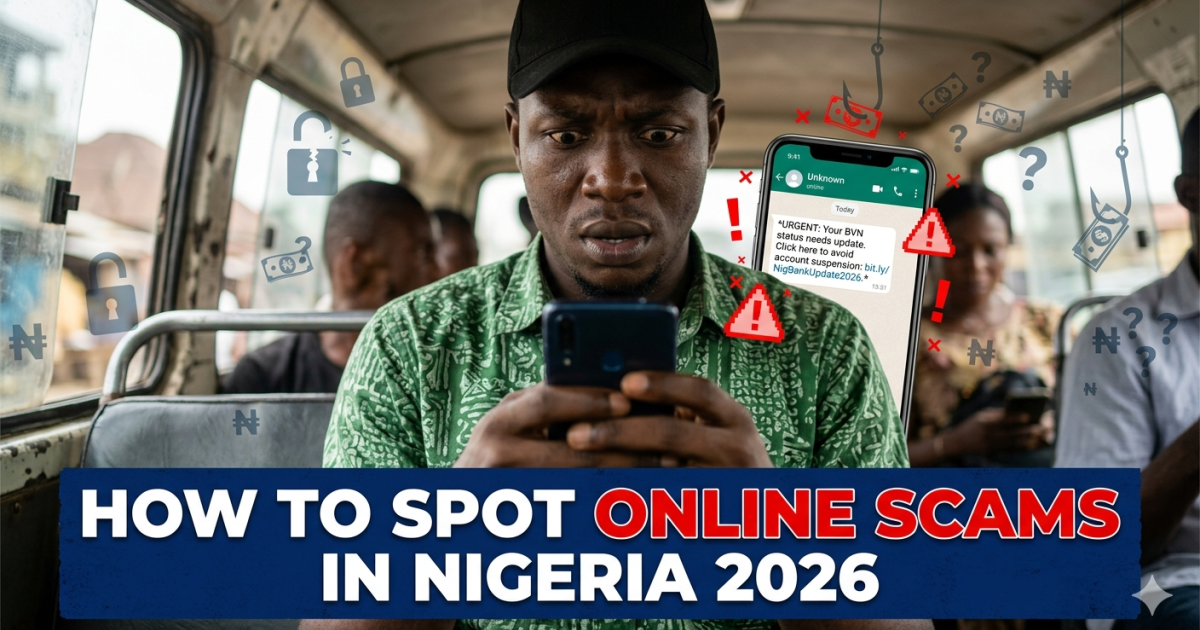
Online scams in Nigeria are evolving faster than most people’s awareness of them. The FBI Internet Crime Report has ranked Nigeria among the top 20 countries most affected by cybercrime globally, as Thrive Online Nigeria’s cybercrime analysis confirms. But the more alarming development in 2026 is the integration of AI into scam operations — deepfake videos impersonating Nigerian celebrities and public figures, AI-generated voice calls from “bank officials,” and sophisticated Ponzi investment platforms that look entirely legitimate.
Africa Check’s February 2026 scam trends guide documented specific Nigerian cases: Ibukun Awosika (business executive) debunked AI-generated videos of her promoting investment platforms in January 2026. Ngozi Okonjo-Iweala (WTO Director-General) also warned Nigerians of an AI-generated video showing her promoting a fake investment opportunity in February 2026. These are not one-off incidents — they are the new face of Nigerian online fraud.
This guide covers every major online scam category targeting Nigerians in 2026, with specific warning signs and the protection steps that actually work.
The Biggest Online Scams Targeting Nigerians in 2026
1. Deepfake AI Celebrity Investment Scams — The Newest and Most Dangerous
⚠️ Danger level: VERY HIGH — AI-generated; looks entirely real; targets Nigerian trust in celebrities
Africa Check’s 2026 scam trends guide documents this emerging threat comprehensively: “A deepfake is when someone is impersonated using AI tools to make it look like they are saying or doing something they haven’t. Celebrities and public officials are often targeted because they are seen as credible. This trend shows no signs of slowing in 2026.” Specific 2026 cases documented by Africa Check include fake videos of Aproko Doctor (health content creator), Taiwo Ajai-Lycett (actor), Ibukun Awosika (business executive), and Ngozi Okonjo-Iweala — all used without consent to promote investment platforms that do not exist.
Warning signs: A video of a Nigerian celebrity or public figure “recommending” an investment platform you’ve never heard of. The video may look and sound almost completely real — AI voice cloning is now sophisticated enough to fool untrained ears. The investment “opportunity” promises unusually high returns. You were shown the video on WhatsApp, Facebook, or TikTok rather than finding it on the celebrity’s own verified channels.
Protection: If a celebrity appears to be recommending an investment in a video you received via WhatsApp or social media, go directly to that person’s verified social media accounts (Instagram, Twitter/X) and check whether they have posted about it. Real endorsements appear on their own channels. Never invest based on a video received via messaging apps.
2. Phishing — Fake Bank, EFCC, and Government Messages
⚠️ Danger level: HIGH — most common scam in Nigeria; targets bank account access
Nigerian Search Guide’s online scams protection guide identifies phishing as “among the most common online frauds in Nigeria.” The pattern: scammers send SMS messages, emails, or WhatsApp messages appearing to be from your bank (GTBank, Access, UBA, Zenith, Opay, Kuda), EFCC, FIRS, or NIN/BVN authorities. The messages create urgency: “Your account will be blocked,” “Your BVN needs verification,” “You have a tax alert.” A link leads to a fake website that looks identical to your bank’s login page. You enter your details — and the scammer now has your credentials.
Pulse Nigeria’s 2025 scam guide describes the bank debit alert variation: “Fraudsters send messages claiming debit alerts or payment confirmations from your bank. A link to ‘view details’ leads to a counterfeit login page where credentials are harvested and used to empty real accounts while victims believe they only clicked a routine notification.”
Warning signs: Urgent language (“your account will be blocked immediately”); unsolicited messages you were not expecting; links that do not go to the official bank website (check the URL carefully — scammers use URLs like “gtbank-verify.com” instead of “gtbank.com”); requests for your ATM PIN, BVN, or password (legitimate banks NEVER ask for these via SMS or email).
Protection: Nigerian Search Guide advises: “Banks will never ask for sensitive information via email or SMS. Any message demanding your ATM PIN, BVN, or password is fraudulent. Always confirm with your bank before acting on such messages — call the official customer service number on the back of your card.”
3. Fake Investment Platforms (Ponzi/Forex/Crypto Schemes)
⚠️ Danger level: VERY HIGH — Nigerians lose billions annually to fake investment platforms
Thrive Online Nigeria’s cybercrime analysis identifies fake investment platforms as a major category: “Ponzi-style schemes promising ‘double your money’ returns — scammers create convincing websites promising huge returns from forex, crypto, or real estate investments.” Nigerian Search Guide adds: “This scam involves fraudsters pretending to be financial experts or crypto investors. They take weeks or months to build trust before convincing victims to invest large sums into fake platforms. Once a significant amount is deposited, the scammer vanishes.”
Warning signs: Guaranteed returns of 50%, 100%, or more per month; pressure to invest quickly before an “offer closes”; testimonials from people you don’t know personally; no SEC Nigeria registration number; no physical office address; investment platform only accessible via Telegram or WhatsApp; the platform cannot tell you clearly how the returns are generated.
Protection: Before investing in any platform, verify registration with the Securities and Exchange Commission (SEC Nigeria) at sec.gov.ng. No legitimate investment platform in Nigeria operates without SEC registration. Check for a physical address, a real phone number, and staff identifiable on LinkedIn.
4. Fake Job Offers (Work-From-Home and Oil Company Scams)
⚠️ Danger level: HIGH — specifically targets unemployed graduates and job seekers
Pulse Nigeria’s scam guide describes the pattern: “Offers for high-paying remote jobs arrive via social media and messaging apps. Applicants pay for training materials or registration before starting. Once fees are paid, the ’employer’ disappears and no work or wages materialise, leaving hopeful candidates out of pocket.” In 2026, this scam has expanded to include impersonation of Shell, TotalEnergies, Chevron, UNICEF, WHO, and federal government agencies — with fake “offer letters” and “appointment letters” that look authentic.
Warning signs: You receive a job offer you never applied for; the “company” communicates only via WhatsApp or personal Gmail/Yahoo email rather than a corporate domain; you are asked to pay a “processing fee,” “registration fee,” “training fee,” or “security deposit” before starting work; the salary offer is unrealistically high for the stated role; the email domain is not the company’s official domain (e.g., “shell.recruitment@gmail.com” instead of “@shell.com”).
Protection: Legitimate employers never charge fees to apply for or start a job. Shell, TotalEnergies, Chevron, UNICEF, and all legitimate major employers confirm this explicitly in their own recruitment materials. Always verify job offers by calling the company’s official phone number found on their official website — not a number provided in the suspicious message.
5. Fake E-Commerce Websites and Social Media Shops
⚠️ Danger level: HIGH — targeting online shoppers; very common on Instagram and TikTok
Pulse Nigeria’s scam analysis explains: “Cyber criminals replicate top online stores with identical layouts and pricing. Shoppers place orders and pay with cards or bank transfers only to receive nothing in return. The fake sites vanish before authorities can trace them, and buyers lose both products and funds.” In 2026, this has expanded heavily to Instagram and TikTok shops selling electronics, sneakers, designer goods, and fashion items at suspiciously low prices.
Warning signs: Prices dramatically lower than established retailers (e.g., iPhone 15 for ₦150,000 when market price is ₦700,000+); no verifiable physical address; no customer service phone number or only a WhatsApp number; the Instagram or TikTok account was created recently (check the account creation date); no independent reviews outside the seller’s own page; payment requested via direct bank transfer to a personal account rather than escrow or established payment platform.
6. Sextortion / Romance Scams
⚠️ Danger level: HIGH — rising rapidly; deeply psychologically damaging; targets all age groups
About the Author

Related Stories

Best Budget Laptops for Students & Work in Nigeria 2026: What to Buy and What to Avoid
The best budget laptops for students and work in Nigeria 2026 — what specs actually matter, realistic price…

How to Start a Tech Career in Nigeria from Scratch in 2026: The Complete Beginner’s Roadmap
Complete guide to starting a tech career in Nigeria from scratch in 2026 — 8 career paths with…

Starlink vs MTN vs Glo vs Airtel Nigeria 2026: Which Internet Is Best for You?
Share: WhatsApp Facebook X Telegram Copy 1 shares Nigeria’s internet landscape has changed dramatically since Starlink arrived in…
0 Comments
No comments yet. Be the first to share your thoughts!