


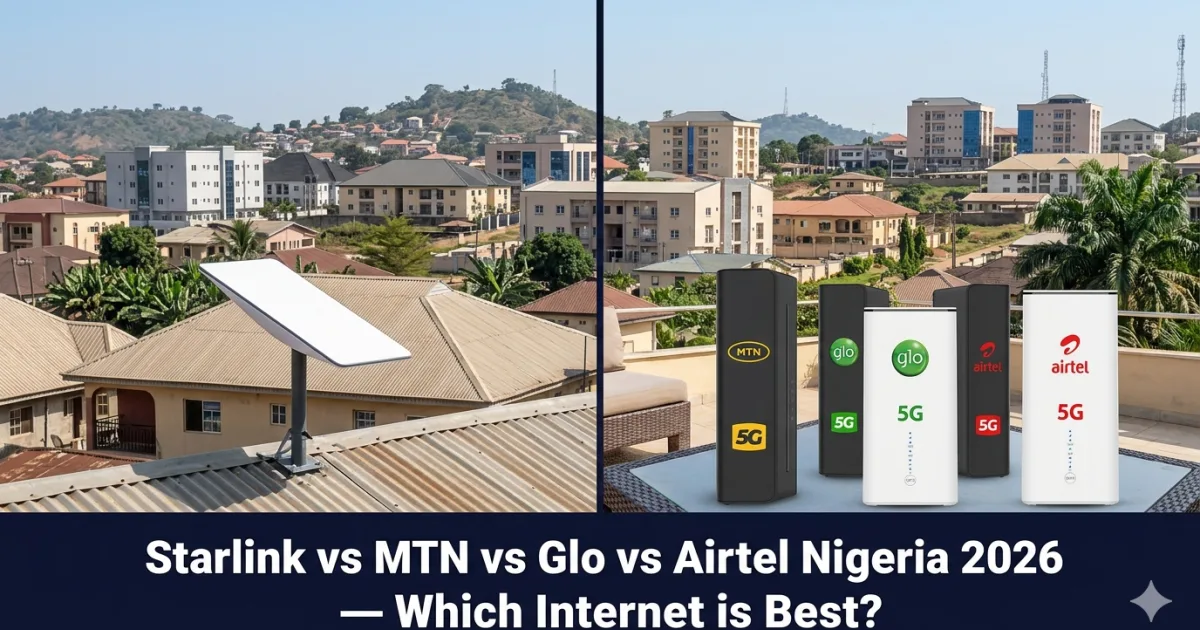
Nigeria’s internet landscape has changed dramatically since Starlink arrived in 2023, the NCC approved a 50% tariff hike in January 2025, and 5G started becoming genuinely usable in more Nigerian cities. In 2026, you have more internet options than ever — and more reasons to be confused about which one is actually worth your money. This guide cuts through the marketing to give you real prices, real speeds, and the specific answer to the question every Nigerian is asking: should I stay on MTN/Glo/Airtel, or is it time to switch to Starlink?
The Nigerian Internet Market in 2026: What Changed
Two events reshaped Nigeria’s internet pricing in 2025 that every user needs to understand. First, the Nigerian Communications Commission (NCC) approved a 50% tariff increase for telecom operators in January 2025 — the first such adjustment in over a decade, driven by naira devaluation, inflation, and rising operational costs. This pushed up prices across MTN, Airtel, Glo, and T2 Mobile (formerly 9mobile) significantly. Second, Starlink responded with its own 50% price increase, raising its residential monthly fee from ₦38,000 to ₦57,000, according to Space in Africa’s reporting on the April 2025 announcement.
Also in early 2026: Amazon’s satellite internet service (Amazon LEO/Project Kuiper) received a seven-year landing permit from the NCC effective February 28, 2026 — making it the first credible potential competitor to Starlink in Nigeria’s satellite internet market. However, Mobility Nigeria’s analysis confirmed that Amazon still needs additional ISP and gateway licences before it can actually offer service to Nigerian consumers. Do not expect Amazon LEO to be available yet — but its arrival will likely put pressure on Starlink’s pricing.
Starlink Nigeria 2026: Prices, Plans, and Reality
Official Starlink Nigeria Pricing (March 2026 — confirmed by Zawya, Mobility Nigeria, TheFamousNaija):
| Standard Kit hardware | ₦590,000 (one-time purchase) |
| Mini Kit hardware | ₦318,000 (one-time purchase) |
| Residential Plan (monthly) | ₦57,000/month — unlimited, no data caps |
| Roam Regional Plan (monthly) | ₦38,000/month — portable across Nigeria |
| Business Priority Plan (monthly) | ₦159,000/month — for offices, high-capacity users |
| Speed (Residential) | 50–250 Mbps download; 5–20 Mbps upload |
| Latency | 25–60ms (significantly better than older satellite internet) |
| Data caps | None on Residential — PlanetWeb confirms “no monthly data caps or throttling” |
Starlink Availability Alert for Lagos and Abuja
⚠️ Capacity Warning: As of February–March 2026, Starlink residential sign-ups are paused or on waitlist in high-demand zones including Victoria Island, Ikoyi, Lekki, Lagos Island, Surulere (Lagos), and parts of Abuja. In these congested areas, new customers can only access the Business Priority Plan at ₦159,000/month — not the ₦57,000 residential plan. Always enter your exact address at starlink.com/ng to confirm current availability before purchasing any hardware. Used Starlink kits linked to existing residential plans are selling for ₦700,000–₦1,000,000 on the grey market, above the official ₦590,000 price, because they let buyers access the residential plan in closed areas.
What Starlink Is Actually Like in Nigeria
PlanetWeb Solutions’ real-world business review describes Starlink’s speeds as “80–150 Mbps handles full team operations without degradation. It doesn’t go down because someone’s digging in your street.” Vibena Lifestyle’s 30-day test comparison found Starlink provides “consistent speeds more than enough for remote work, video conferencing (Zoom, Google Meet, Teams), streaming, and online gaming.” The key weakness: heavy rainfall causes temporary speed drops (satellite signal passes through rain). Not a dealbreaker in most cases, but worth knowing if you are in a high-rainfall area.
The Roam plan (₦38,000/month) is genuinely useful for Nigerians who travel frequently between cities. TechCabal notes that some users try to use the Roam plan as a cheaper residential substitute, but “Starlink can detect when you are doing this and may switch your account to the Roam plan permanently.” Use the plan designed for your actual use case.
MTN Nigeria 2026: Data Plans, 5G, and FibreX
MTN remains Nigeria’s largest telecom operator by subscriber count and has the widest 4G coverage. In 2026, MTN offers three distinct internet products worth comparing against Starlink:
MTN Mobile Data Plans (4G)
| Plan | Data | Price | Notes |
|---|---|---|---|
| Daily micro plan | 75MB | ₦75 | Entry-level daily plan |
| Daily 1GB | 1GB | ₦350 | Good value for light daily use |
| Weekly plan | Varies | Varies | Check MTN app for current offerings |
| Monthly 250GB | 250GB | ₦55,000 | High-volume mobile plan |
MTN 5G HyNetFlex (Home Router)
| Plan | Data | Price | Notes |
|---|---|---|---|
| 200GB HyNetFlex | 200GB | ₦37,500/month | TechCabal pricing data |
| 260GB + 2GB daily top-up | 260GB+ | ₦45,000/month | After 260GB exhausted, 2GB daily added |
| Hardware (5G Router) | — | ₦60,000–₦80,000 (one-time) | Lower than Starlink hardware cost |
| Speed (5G coverage) | — | Up to 800 Mbps advertised | Users typically get 50–200 Mbps where 5G is available |
MTN FibreX (Home Fibre Broadband)
MTN FibreX is MTN’s fibre home broadband product. Gizmosum’s February 2026 review confirms a ₦0 setup cost for FibreX and describes it as “the undisputed king of home broadband” for urban Nigerians. Entry plan starts at approximately ₦25,000/month for a 50 Mbps plan. FibreX offers significantly lower latency than Starlink — important for gaming and real-time applications. However, it is only available in urban areas where MTN has laid fibre cables, and it requires NEPA/inverter power like all fibre routers (goes dark during power outages unlike Spectranet which has battery backup).
Glo (Globacom) Nigeria 2026: The Volume Champion
Glo’s positioning in 2026 is clear: if you want the most data for the least money on a mobile connection, Glo wins. Mobility Nigeria’s February 2026 data guide confirms: “If you’re purely counting gigabytes per naira, Glo is the winner in 2026. Their ₦1,500 weekly plan gives you 7GB — no other network comes close at that price point.” Glo also offers generous night data bonuses that significantly increase the effective data you receive monthly beyond what the headline plan advertises.
| Glo Plan | Data | Price | Notes |
|---|---|---|---|
| Weekly 7GB plan | 7GB | ₦1,500 | Best value weekly plan in Nigeria per Mobility Nigeria 2026 |
| Monthly 10.5GB | 10.5GB | ₦3,000 | Highest volume monthly mobile plan (Shelaf March 2026 data) |
| Night data bonuses | Varies | Included | Free data during off-peak hours significantly boosts effective monthly data |
Glo’s weakness: network quality and speed are lower than MTN and Airtel, particularly for 4G. Intelpoint’s analysis put Glo’s average mobile speed at 8.70 Mbps compared to Airtel at 22.42 Mbps and MTN at 21.71 Mbps (though these are 2023 baseline figures — current performance may differ by location). Glo is best for users on tight budgets who primarily need data for social media, messaging, and occasional video rather than heavy streaming or remote work.
Airtel Nigeria 2026: Speed and Value
Airtel consistently ranks as Nigeria’s fastest mobile data network by speed tests and has expanded its 5G coverage significantly. Shelaf’s March 2026 data guide notes that “Airtel wins the weekly category (5GB + 2GB YouTube for ₦1,500)” — matching Glo’s price point while adding YouTube-specific bonus data. For unlimited mobile data, Mobility Nigeria confirms “Airtel’s ₦10,000-range” plan for unlimited mobile data as among the most competitive unlimited mobile options.
| Airtel Plan | Data | Price | Notes |
|---|---|---|---|
| Monthly 25GB | 25GB | ₦8,000 | TechCabal comparison data |
| Weekly 5GB + 2GB YouTube | 7GB effective | ₦1,500 | Shelaf’s top weekly pick 2026 |
| 5G Router device | — | ~₦60,000 | — |
| 5G Unlimited plan | Unlimited (FUP applies) | ₦20,000/month | Techparley data; speeds up to 20 Mbps reported on unlimited plan |
| Airtel Fibre SmartOffice | Unlimited | From ₦275,000/year (~₦23,000/month) | PlanetWeb: truly unlimited fibre; ₦35,000 install + ₦20,000 x 12 |
| Mobile speed (4G) | — | — | 22.42 Mbps average — fastest Nigerian mobile network (Intelpoint) |
Important caveat on “unlimited” plans: PlanetWeb’s business analysis specifically warns: “Not all unlimited plans are actually unlimited in Nigeria.” Airtel 5G SmartConnect reportedly drops to 64 Kbps after a 2GB daily cap on some plans. MTN 5G plans throttle after a Fair Usage Policy threshold. Only Starlink’s residential plan is genuinely unlimited with no speed reduction after any threshold — confirmed by PlanetWeb: “You can use 100GB or 5TB without speed reductions.” Always read the fair usage policy before subscribing to any “unlimited” plan from a Nigerian carrier.
Master Comparison: Starlink vs MTN vs Glo vs Airtel Nigeria 2026
| Factor | Starlink | MTN FibreX/5G | Airtel 5G | Glo 4G |
|---|---|---|---|---|
| Monthly cost | ₦57,000 (Residential) | ₦25,000–₦45,000 | ₦8,000–₦20,000 | ₦1,500–₦3,000 |
| Hardware cost | ₦590,000 (one-time) | ₦60,000–₦80,000 (router) | ~₦60,000 (router) | None (use SIM) |
| Year-one total | ~₦1.27 million+ | ~₦360,000–₦620,000 | ~₦300,000–₦360,000 | ~₦18,000–₦36,000 |
| Download speed | 50–250 Mbps | 50–800 Mbps (5G varies) | 20–200 Mbps (5G varies) | 5–15 Mbps (4G) |
| Latency | 25–60ms | 10–30ms (fibre); 20–50ms (5G) | 20–50ms (5G) | 40–80ms |
| Truly unlimited? | ✅ Yes — no caps or throttling | ❌ FUP applies after threshold | ❌ FUP / daily cap on some plans | ❌ Data caps apply |
| Rural availability | ⭐⭐⭐⭐⭐ Anywhere in Nigeria | ❌ Urban areas only | ❌ Urban/suburban only | ⭐⭐⭐ Wide but variable |
| Rain reliability | Drops slightly in heavy rain | ✅ Unaffected | ✅ Unaffected | ✅ Unaffected |
| Power outage resilience | Needs mains power (no battery) | Needs mains power | Needs mains power | Mobile — works on phone battery |
| Best for | Rural areas, remote workers, businesses needing reliability | Urban home broadband, gamers, heavy streamers | Urban daily use, fastest mobile speeds | Budget users, social media, messaging |
Which Internet Is Right for You? — By Situation
| Your Situation | Best Choice | Why |
|---|---|---|
| Remote worker in Lagos/Abuja with access to fibre | MTN FibreX or Airtel Fibre | Lower latency, lower monthly cost than Starlink; no weather sensitivity; more cost-effective year-round |
| Remote worker or business in a rural/semi-urban area | Starlink (Residential ₦57,000) | Only option with reliable fast internet where fibre and 5G don’t reach |
| Nigerian freelancer on a budget | Airtel 5G or MTN 5G router | ₦20,000–₦45,000/month for good speeds; hardware under ₦80,000; adequate for most remote work |
| Maximum data volume for minimum naira | Glo 4G | Best data-per-naira ratio; 7GB weekly for ₦1,500; night data bonuses |
| Business with 5–10+ staff needing reliable internet | Starlink Business Priority (₦159,000) or MTN FibreX premium | Starlink for rural/semi-urban; FibreX for urban offices with consistent power |
| Gamer who needs low ping | MTN FibreX or Airtel Fibre | Lower latency than Starlink (10–30ms vs 25–60ms); unaffected by weather |
| Frequent traveller between Nigerian cities | Starlink Roam (₦38,000) or Airtel/MTN 4G SIM | Starlink Roam works anywhere in Nigeria; mobile SIM is cheaper and more portable |
| Student on a tight budget | Glo 4G monthly plan | ₦3,000/month for 10.5GB is the most affordable usable data in Nigeria in 2026 |
Spectranet — The Under-Rated Alternative Worth Knowing
No comparison of Nigerian internet options is complete without mentioning Spectranet. Nigeria’s most subscribed ISP with over 103,000 users (PlanetWeb data), Spectranet offers 4G LTE/5G home routers with one major advantage over all other Nigerian internet providers: Spectranet routers have internal battery backup. When NEPA takes light, your Spectranet internet stays on for several hours — a massive practical advantage over fibre routers (which go dark instantly), Starlink dishes (which require mains power), and 5G home routers. For Nigerian homes with frequent power outages, this single feature makes Spectranet worth considering seriously. Vibena Lifestyle specifically recommends: “Power-challenged area + moderate speeds okay → Choose Spectranet.” Monthly plans start from approximately ₦15,000 for 60GB. The main limitation: data caps on all plans (60GB to 1TB depending on tier) and speed throttling after the cap.
Frequently Asked Questions
How much is Starlink in Nigeria in 2026?
As of March 2026, confirmed by Zawya, Mobility Nigeria, and TheFamousNaija: the Starlink Standard Kit costs ₦590,000 (one-time hardware) and the Mini Kit costs ₦318,000. Monthly subscriptions are: Residential Plan ₦57,000/month (unlimited, no data caps), Roam Regional Plan ₦38,000/month, and Business Priority Plan ₦159,000/month. In high-demand areas of Lagos and Abuja, only the Business Priority Plan is available to new customers — verify your specific address at starlink.com/ng before purchasing hardware.
Is Starlink worth it in Nigeria in 2026?
For most urban Nigerians with access to fibre or reliable 5G, Starlink is not worth the cost premium — MTN FibreX or Airtel Fibre delivers comparable or better speeds for significantly less money. For Nigerians in rural or semi-urban areas where fibre and 5G are unavailable, Starlink is the only option for truly fast, reliable internet, and is worth the cost if your work or business depends on it. Vibena Lifestyle’s year-one cost analysis found Starlink costs over 4 times more in the first year than traditional fibre ISPs — the question is whether the reliability and rural coverage justify that premium for your specific situation.
Which is the cheapest data plan in Nigeria in 2026?
For mobile data, Glo offers the best value by volume. Shelaf’s March 2026 analysis confirms Glo’s ₦1,500 weekly 7GB plan as “the best value weekly plan” and their ₦3,000 monthly 10.5GB as the highest volume monthly mobile plan. For home broadband, MTN FibreX starts at approximately ₦25,000/month with no setup cost, making it the most cost-effective high-speed home internet for urban Nigerians.
Is MTN 5G available everywhere in Nigeria?
No — MTN 5G coverage in Nigeria in 2026 is primarily concentrated in Lagos, Abuja, and a few other major cities. Even within covered cities, 5G signal is not uniform — in areas without 5G signal, MTN’s 5G router falls back to 4G automatically. If you are considering an MTN 5G router, test the signal quality at your specific location before committing to the hardware purchase. A 5G router in a 4G coverage area delivers 4G speeds, not 5G speeds.
Will Amazon Kuiper compete with Starlink in Nigeria?
Amazon’s satellite internet service (officially Amazon LEO) received a seven-year NCC landing permit on February 28, 2026, making it the first authorised Starlink competitor in Nigeria’s low-Earth orbit satellite internet market. However, Mobility Nigeria confirmed that Amazon still needs additional ISP and International Access Gateway licences from the NCC before it can actually sell service to Nigerian consumers. These approvals had not been secured as of April 2026. Amazon LEO’s entry into Nigeria will eventually increase competition and likely put downward pressure on Starlink’s pricing — but it is not imminent.
📡 Nigeria Internet 2026 — Quick Verdict
- Best for rural Nigeria: Starlink Residential (₦57,000/month + ₦590,000 hardware) — the only option that works everywhere
- Best for urban home broadband: MTN FibreX or Airtel Fibre — lower cost, lower latency, unaffected by rain
- Best for value mobile data: Glo — 7GB weekly for ₦1,500; best GB-per-naira ratio
- Fastest mobile network: Airtel (22.42 Mbps average — Intelpoint data)
- Only truly unlimited internet in Nigeria: Starlink Residential — no data caps, no throttling at any usage level (PlanetWeb confirmed)
- Best for power-outage areas: Spectranet — battery-backed router stays on when NEPA goes
- Beware fake “unlimited”: MTN and Airtel unlimited plans throttle after FUP limits — always read the fine print
- Big news: Amazon LEO received NCC landing permit Feb 28, 2026 — Starlink’s first satellite competitor in Nigeria
- Check availability first: Always verify your address at starlink.com/ng before buying hardware
The answer to “which internet is best in Nigeria” in 2026 is not one-size-fits-all — it depends on where you live, what you use the internet for, and how much you can spend. The guide above gives you the specific answer for your situation. Whatever you choose, check current pricing directly on the provider’s official website before subscribing — prices in Nigeria’s internet market have been moving fast and will continue to shift.
Which internet do you currently use in Nigeria, and what has your experience been? Share in the comments. Also read our guide on Best Solar Panels for Your Home in Nigeria 2026.



0 Comments
No comments yet. Be the first to share your thoughts!