


Every Nigerian with a smartphone has been there. You buy data, it finishes before the day is done, and by the time you figure out which plan actually gives you value, the network has already changed the prices. The NCC approved a 50% tariff hike in January 2025, and all four mobile networks adjusted their prices almost overnight — making most of the information floating around online stale. Choosing an internet service provider in Nigeria in 2026 requires navigating a landscape that has shifted significantly in the past 12 months, with higher prices, new players (Starlink forcing local providers to upgrade), expanding 5G coverage, and a broadband fibre sector that has quietly become a genuinely competitive alternative to mobile data for home and office use.
This guide gives you everything you need to make a genuinely informed decision about your internet in 2026. We compare MTN, Airtel, Glo, and T2 Mobile (formerly 9mobile) across every relevant dimension — speed, coverage, price, data plans, and customer service. We then cover the growing alternatives: Starlink, FiberOne, Spectranet, Smile, ipNX, and Swift Networks — the options that are increasingly making mobile data obsolete for home and office use in major Nigerian cities. And we close with category-specific recommendations, because the best network for a remote worker in Lagos Island is not the same as the best network for a student in Nsukka.
📋 What This Guide Covers
- Nigeria’s Internet Landscape in 2026 — What Has Changed
- Overall Head-to-Head: MTN vs Airtel vs Glo vs T2 Mobile
- MTN Nigeria — Complete Review 2026
- Airtel Nigeria — Complete Review 2026
- Glo (Globacom) — Complete Review 2026
- T2 Mobile (formerly 9mobile) — Complete Review 2026
- Data Plan Comparison — Prices and Value Across All Networks
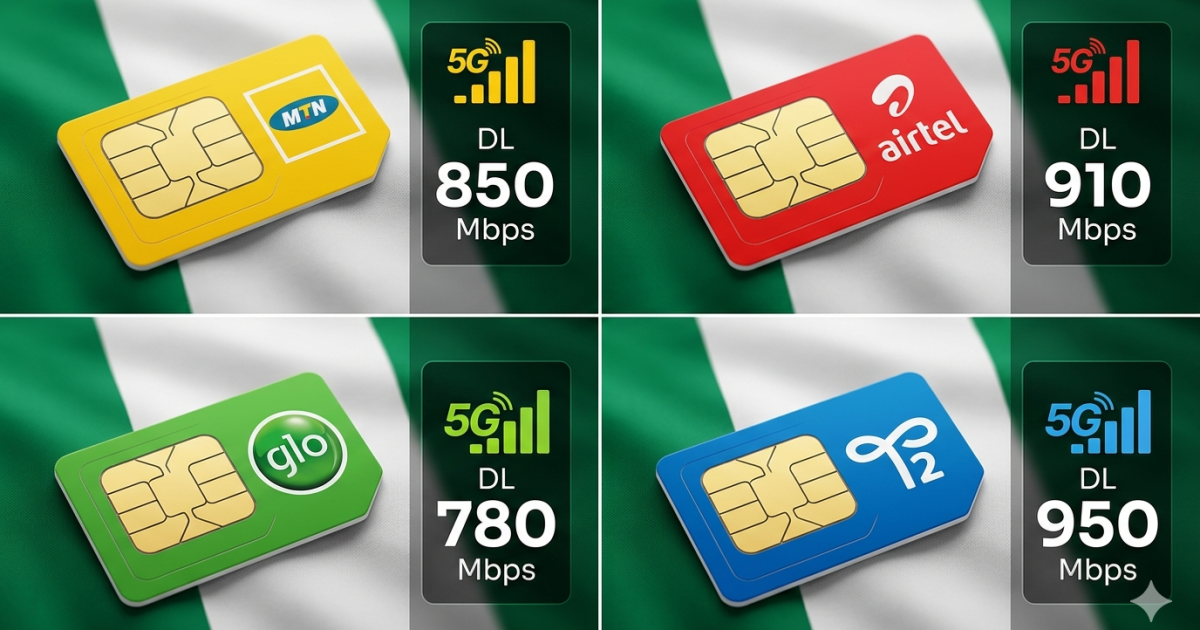
- 5G in Nigeria 2026 — Who Has It and Who Needs It
- Starlink Nigeria 2026 — Is It Worth ₦75,000/Month?
- Fibre and Fixed Broadband — FiberOne, Spectranet, ipNX, Smile
- Best Network by Use Case — Remote Work, Streaming, Gaming, Students
- The Dual-SIM Strategy — How Smart Nigerians Use Two Networks
- Mobile Number Portability — How to Switch Without Changing Your Number
- Data Saving Hacks — Make Your Data Last Longer
- Frequently Asked Questions
📊 Nigeria Internet 2026 — Key Facts
- Nigeria overall internet speed (Ookla Speedtest): 46.78 Mbps download average (national)
- MTN average download speed: 36.5 Mbps — fastest mobile network nationally
- Airtel average download speed: 25.77 Mbps (some reports: 17.2 Mbps with 117ms latency)
- Glo average download speed: 8.57 Mbps — cheapest data; slowest speeds
- T2 Mobile / 9mobile average download speed: 9.55 Mbps — best in class where available
- NCC tariff hike: 50% increase approved January 2025 — current prices significantly higher than pre-2025
- 5G coverage in 2026: MTN and Airtel leading; now in Lagos, Abuja, PH, Kano, Ibadan, Owerri, Onitsha
- Glo best value: 30–40% more data per naira vs MTN; ₦1,500 weekly = 7GB (best value weekly)
- Starlink Nigeria residential: ~₦75,000/month + ₦280,000 hardware; unlimited high-speed
- FiberOne home fibre: From ₦13,807/month for 25Mbps; no Fair Use Policy
- Mobile Number Portability: Fully functional in 2026; takes 48 hours; must have been on current network 90+ days
- 9mobile rebranded as: T2 Mobile (2025–2026)
Part 1: Nigeria’s Internet Landscape in 2026 — What Has Changed
The Nigerian internet market in 2026 is measurably different from what it was two years ago — changed by three forces that are reshaping the competitive landscape in ways that affect every Nigerian smartphone user and home internet subscriber.
The 2025 NCC tariff hike. The Nigerian Communications Commission approved a 50% increase in telecom tariffs in January 2025 — the first significant upward adjustment in telecom pricing in over a decade, reflecting the economic reality of naira depreciation and rising operational costs. All four major mobile networks adjusted their prices accordingly. Nigerians who had grown accustomed to the pre-2025 pricing found their monthly data costs effectively doubled in many cases. This price shock has made network comparisons more important than ever — because the gap between the best and worst value networks at any price point is now measured in thousands of naira per month.
5G expansion beyond Lagos and Abuja. In 2026, 5G coverage has expanded from the initial pilot cities to include economic hubs like Kano, Ibadan, Owerri, and Onitsha — making the technology relevant to a much wider population of Nigerian data users. 5G is no longer a novelty in 2026; it is the standard in major cities. The NCC has also enforced stricter Quality of Service guidelines, shifting the competitive conversation from “who has coverage?” to “who has capacity?” — a question that matters for users in dense urban areas during peak hours.
Starlink’s competitive pressure. The presence of Elon Musk’s Starlink has forced local mobile network providers to step up their game, particularly in the broadband sector. Starlink’s residential service — available in Nigeria at approximately ₦75,000 per month with unlimited data at speeds of 100–250 Mbps — has given Nigerian home and office internet users a genuine alternative to fixed-line ISPs and mobile data. This competition has produced better router deals, more competitive fibre pricing, and a general improvement in the quality of fixed broadband offerings that makes 2026 the best time in Nigerian history to be evaluating home internet options.
Part 2: Overall Head-to-Head — MTN vs Airtel vs Glo vs T2 Mobile
| Factor | MTN | Airtel | Glo | T2 Mobile (9mobile) |
|---|---|---|---|---|
| Overall verdict | 🏆 Best reliability and coverage | 🏆 Best balance of speed + price | 🏆 Most data per naira | Best urban quality where available |
| Network coverage | 90%+ population; widest rural reach | ~70%; strong in cities; growing | ~80%; 2nd widest; weaker 4G in rural | ~60%; excellent in covered areas |
| Average download speed | 36.5 Mbps (fastest nationally) | 17.2–25.77 Mbps | 8.57 Mbps | 9.55 Mbps (fast in-coverage) |
| 5G rollout | Leading — Lagos, Abuja, PH, Kano, Ibadan and beyond | Strong — major cities covered | Rolling out; behind MTN/Airtel | Focused on 4G optimisation |
| Data pricing | Most expensive; bonus data and promotions | Mid-range; best value for speed | Cheapest — 30–40% more data/₦ | Competitive; limited plan variety |
| Data consistency | Most consistent; handles peak congestion | Stable in urban areas | Inconsistent; slower during congestion | Stable and fast in covered areas |
| Night data bonus | Limited night promos | Some plans have night bonus | Most plans — 12am–5am bonus data | Some plans include |
| Customer service | Good; multichannel support; 180 | Good; social media responsive; 111 | Average; improving | Small team; inconsistent |
| Best for | Remote workers; rural areas; travel; reliability | Urban users; streaming; social media; balance | Budget-conscious; heavy downloaders; students | Urban professionals; stable voice calls |
| USSD data code | *131# | *141# / *312# | *777# / *312# | *200# (T2: *200#) |
| App | myMTN App | MyAirtel App | Glo Café App | T2 Mobile Website/App |
Part 3: MTN Nigeria — Complete Review 2026
📶 Avg speed: 36.5 Mbps | 🗺️ Coverage: 90%+ population | ⚡ 5G: Widest rollout | 💰 Pricing: Most expensive | 🏆 Best for: Remote workers, rural areas, reliability | 📞 Customer care: 180
MTN Nigeria is Nigeria’s largest telecommunications company by subscriber count, revenue, and geographic coverage — and in 2026, its dominance in the key metrics that matter most for data quality is uncontested. MTN has the fastest download speed of 36.5 Mbps average, and its network consistently handles congestion better than competitors during peak hours — the critical difference between a network that works at 8pm in Lagos and one that crawls.
MTN has the widest network coverage in Nigeria, covering over 90% of the country’s population. For Nigerians who travel regularly between cities, live in peri-urban or rural areas, or work in locations outside major metropolitan centres, MTN’s coverage advantage is the deciding factor — no other mobile network can reliably provide data service across as wide a geographic footprint.
The significant trade-off is cost. MTN data plans are generally the most expensive. Post-tariff-hike pricing means that a Nigerian who prioritises cost efficiency will find better value at Glo or Airtel. MTN compensates with personalised offers, bonus data for loyal subscribers, and the myMTN App’s “Deal Zone” which provides individual-specific data promotions that sometimes rival Glo’s prices — but these deals require active monitoring and are not guaranteed.
MTN’s standout 2026 offering — HyNetflex: MTN’s home broadband product provides near-unlimited internet for home users through a dedicated router. For households in MTN-covered areas that have given up on fibre availability, HyNetflex provides an accessible broadband alternative that outperforms standard mobile data plans for home use. Check coverage at mtnonline.com.
Summary verdict: MTN is the right choice if you prioritise reliability and coverage over price — particularly for remote workers who cannot afford connection drops during client calls, travellers, and those outside major cities. MTN Nigeria currently holds the title for the fastest average download and upload speeds, largely due to their extensive 5G infrastructure.
Part 4: Airtel Nigeria — Complete Review 2026
📶 Avg speed: 17.2–25.77 Mbps | 🗺️ Coverage: ~70%; strong urban | ⚡ 5G: Strong in major cities | 💰 Pricing: Mid-range; best urban value | 🏆 Best for: Urban professionals; streaming; social media | 📞 Customer care: 111
Airtel Nigeria is Nigeria’s second-largest mobile operator and, for most urban Nigerians in 2026, the strongest all-round choice when price and performance are both considerations. For balanced pricing and performance, Airtel stands out. Where MTN leads in absolute coverage breadth, Airtel often matches or exceeds it for actual user experience in Lagos, Abuja, Port Harcourt, and other major cities — at a lower price per gigabyte.
Airtel is often praised for fast browsing and smooth streaming, especially in urban areas. Many users report that Airtel feels faster than MTN for everyday internet use. The subjective feel of network speed matters as much as the Ookla average: an Airtel subscriber in Ikeja or Victoria Island will often experience their data as faster and more consistent than an MTN subscriber during peak browsing hours, because Airtel’s urban tower density in these areas is comparable to MTN’s while serving a smaller subscriber base.
Airtel’s pricing structure in 2026 is competitive, particularly for users who need an unlimited option. For unlimited mobile data, Airtel’s ₦10,000/month plan is currently the most accessible option. The Social Bundles — specifically designed for Instagram, TikTok, WhatsApp, and YouTube — offer targeted data value for social-media-heavy users who do not need to browse extensively beyond these platforms.
Airtel often provides promotions for new subscribers and convenient daily or weekly packages. If you are planning a short trip and need a good balance between quality and price, the operator does a great job. The cheapest Airtel monthly package starts at approximately ₦1,500 for 2GB — competitive at the entry level. Call rates are currently 25 kobo/second following the 2025 NCC tariff adjustment.
Summary verdict: Airtel is the best choice for urban Nigerians who want strong speeds at a price below MTN’s premium. It is particularly suited for streaming, video calls, social media, and online work in Lagos, Abuja, PH, and similar major cities. The coverage limitation makes it a less reliable choice for frequent inter-city travel or rural use.
Part 5: Glo (Globacom) — Complete Review 2026
📶 Avg speed: 8.57 Mbps | 🗺️ Coverage: ~80%; strong 3G rural | ⚡ 5G: Rolling out | 💰 Pricing: Cheapest — 30–40% more data/₦ | 🏆 Best for: Budget users; heavy downloaders; students; night owls | 📞 Customer care: *121#
Globacom (Glo) has built and maintained its Nigerian market position on a single, consistent proposition: more data for less money. In 2026, that proposition remains valid and unmatched. If you’re purely counting gigabytes per naira, Glo (Globacom) is the winner in 2026. Their ₦1,500 weekly plan gives you 7 GB — no other network comes close at that price point.
Glo consistently offers 30–40% more data volume for the same price compared to MTN. For a cost-conscious Nigerian who needs to maximise the amount of content they can consume on a fixed monthly budget, Glo’s value proposition is arithmetically compelling. Their “Berekete” tariff offers massive voice bonuses on every recharge. Glo has surprisingly robust 3G coverage in deep rural areas where 4G towers are scarce, making them a lifeline for inter-state travelers.
The critical Glo advantage that many users overlook is the night data bonus. A standout feature of virtually all Glo data plans is a bonus night data allowance usable between 12 AM and 5 AM — making Glo especially appealing for students, night workers, and anyone downloading large files. For students who download lecture materials, professionals who run large file backups, or anyone who streams high-quality video content, scheduling downloads and heavy consumption during the 12am–5am bonus window effectively doubles the value of a Glo data plan compared to its face value.
The equally critical Glo limitation is speed consistency. The phrase “Glo Network” is often used colloquially to describe slow internet. While they have improved in 2026, they still struggle with high latency and slow upload speeds. It is great for downloading movies overnight but can be frustrating for Zoom calls or online gaming. For remote workers who need reliable video call connectivity, this is a potentially career-affecting limitation. A Zoom call that drops or pixelates during a client presentation on a Glo connection is not recoverable by citing the data plan’s value.
Summary verdict: Glo is the right choice for data-heavy, budget-conscious users who are tolerant of speed inconsistency — students downloading large files, movie lovers, and anyone whose internet use is dominated by passive consumption rather than real-time communication. Use the night data bonus aggressively and schedule heavy downloads for off-peak hours.
Part 6: T2 Mobile (formerly 9mobile) — Complete Review 2026
📶 Avg speed: 9.55 Mbps | 🗺️ Coverage: ~60%; strong in major cities | ⚡ 5G: 4G LTE focus | 💰 Pricing: Competitive | 🏆 Best for: Urban professionals; uncongested data; voice calls | 📞 Data code: *200#
Nigeria’s fourth mobile network, formerly known as 9mobile (originally Etisalat), has been rebranded as T2 Mobile — a change that reflects new ownership and a renewed strategic positioning. 9mobile (formerly Etisalat) has a smaller market share, but they have turned this into an advantage. They position themselves as the network for quality voice calls and uncongested data.
The uncongested data advantage is T2 Mobile’s most genuine differentiator in 2026. Because it has significantly fewer subscribers than MTN, Airtel, or Glo, its towers in the cities it covers experience substantially less peak-hour congestion. Urban T2 Mobile subscribers in Lagos, Abuja, and Port Harcourt frequently report that their browsing speed during the 7pm–10pm peak period — when MTN and Airtel towers are heavily loaded — remains stable and fast. This real-world speed advantage for urban subscribers who use data during peak hours is a genuine competitive differentiator that average Ookla speed metrics do not fully capture.
T2 Mobile’s limitation is geographic. With approximately 60% population coverage, it is less useful outside major cities. Nigerians who travel regularly between urban and rural areas will experience frequent signal loss in areas where T2 Mobile has no towers. For urbanites who rarely leave major cities, this limitation is less relevant — but for anyone with regular inter-state travel needs, T2 Mobile works best as a secondary network on a dual-SIM phone rather than a primary connection.
Summary verdict: T2 Mobile is a solid choice for urban professionals in covered cities who want uncongested, fast data for work during peak hours. Its best use case in 2026 is as a secondary SIM on a dual-SIM phone paired with MTN (for coverage) or Glo (for budget data) — providing the fast, reliable urban data experience that the higher-subscriber networks struggle to maintain during peak hours.
Part 7: Data Plan Comparison — Prices and Value in 2026
Data plan pricing in Nigeria in 2026 is significantly higher than pre-2025 levels following the NCC tariff adjustment. All prices below are approximate as of March 2026 — always verify current prices through USSD codes or network apps, as plans change frequently.
Daily Plans (₦100–₦500)
| Network | Price | Data | Validity | Value |
|---|---|---|---|---|
| MTN | ₦75 | 75 MB | 1 day | Low price entry; very limited volume |
| MTN | ₦350 | 1 GB | 1 day | Good for one-day heavy use |
| Airtel | ₦100 | 100 MB | 1 day | Basic emergency data |
| Glo | ₦100 | 200 MB | 1 day | Best daily volume at ₦100 price point |
| T2 Mobile | ₦200 | 200 MB | 1 day | Adequate for light daily use |
Weekly Plans (₦1,000–₦3,000)
| Network | Price | Data | Night Bonus | Best For |
|---|---|---|---|---|
| Glo | ₦1,500 | 7 GB | Yes (12am–5am) | 🏆 Best weekly value nationally |
| T2 Mobile | ₦1,500 | 7 GB + 100 MB | Some plans | Best urban weekly value (where covered) |
| Airtel | ₦1,500 | 3–4 GB | Some plans | Reliable urban weekly data |
| MTN | ₦1,500 | 2–3 GB | Limited | Most reliable but least volume at this price |
| Glo | ₦2,500 | 15 GB | Yes (12am–5am) | Best weekly volume for heavy users |
Monthly Plans (₦3,000–₦30,000+)
| Network | Price | Data | Notes |
|---|---|---|---|
| MTN | ₦1,000 | 1–1.5 GB | Entry monthly; data rollover if renewed before expiry |
| Glo | ₦1,000 | 3.9 GB | Best ₦1,000 monthly value; + night bonus |
| Airtel | ₦1,500 | 2 GB | Plus YouTube Night and social media bonuses |
| MTN | ₦5,000 | 10–15 GB | Check Deal Zone in myMTN App for personalised offers |
| Glo | ₦5,000 | 20–25 GB + night bonus | Best ₦5,000 monthly value |
| Airtel | ₦10,000 | Unlimited (with Fair Use Policy) | Most accessible unlimited mobile plan 2026 |
| MTN | ₦20,000 | 75 GB | Was ₦16,000 pre-hike; heavy user monthly plan |
| Glo | ₦30,000 | 225 GB | Best volume for home/office heavy use |
Part 8: 5G in Nigeria 2026 — Who Has It and Who Needs It
5G is no longer a novelty in 2026; it is the standard in major cities. Coverage: 5G networks now cover not just Lagos, Abuja, and Port Harcourt, but have expanded to economic hubs like Kano, Ibadan, Owerri, and Onitsha.
MTN and Airtel are the 5G leaders in Nigeria in 2026. Both operators have made significant infrastructure investments following their 5G spectrum licences, and their 5G networks are genuinely fast and functional in the cities where they are deployed — capable of download speeds of 100–400 Mbps in optimal conditions, compared to the 20–50 Mbps typical of 4G in the same cities.
The practical question for most Nigerian smartphone users is whether they actually need 5G now. The honest answer: for most users, the bottleneck is not mobile network speed — it is the phone they use (most Phones Under ₦200,000 are 4G only), the applications they run (WhatsApp, YouTube, and social media perform perfectly on 4G), and the consistency of 4G coverage during peak hours. 5G becomes meaningfully valuable for remote workers running video calls and large file transfers in 5G-covered areas, for mobile gamers who need low latency, and for power users who consume very large quantities of high-resolution video.
If you are buying a new phone in 2026 and plan to use it for three or more years, choosing a 5G-capable model (even an affordable one like the Samsung Galaxy A06 5G) future-proofs your connectivity as 5G coverage expands. If you are not planning a new phone purchase, your existing 4G device remains adequately supported by all four networks.
Part 9: Starlink Nigeria 2026 — Is It Worth ₦75,000/Month?
🛰️ Type: Satellite broadband | 📶 Speed: 100–250 Mbps download | 💰 Monthly cost: ~₦75,000 | 🔧 Hardware cost: ~₦280,000 (one-time) | 🌍 Coverage: Nationwide (no terrestrial infrastructure needed) | ✅ Best for: Rural areas; home offices; remote workers without fibre access
Starlink has changed the Nigerian internet conversation in ways that go far beyond its direct subscriber base. Even for Nigerians who cannot or will not pay ₦75,000 per month for residential Starlink, the competition it has introduced has forced local ISPs to improve their offerings, accelerate fibre rollout, and price more competitively. The indirect effect of Starlink’s presence is better internet for all Nigerians.
For Nigerians who can absorb the cost, Starlink offers something the mobile networks and most fixed broadband providers cannot: truly unlimited data at genuinely fast speeds with no Fair Use Policy throttling, available anywhere in Nigeria regardless of how far from a mobile tower or fibre cable the location is. This makes Starlink uniquely valuable for:
- Rural and peri-urban households where 4G coverage is weak or absent
- Home offices and remote workers who need reliable 100+ Mbps for video calls and large file transfers
- Small businesses with critical internet dependency who cannot afford the downtime of mobile network congestion
- Agricultural and mining operations in remote locations where no terrestrial option exists
The ₦75,000 monthly cost and ₦280,000 hardware investment is prohibitive for most Nigerian households — but for the use cases above, the total cost is competitive with what businesses currently pay for less reliable fixed broadband alternatives. If residential Starlink is unavailable in your area (especially Lagos), consider joining the waitlist. As SpaceX continues launching satellites, residential capacity is expected to expand. Amazon Kuiper may also bring competition and lower prices when it fully launches in Nigeria.
Part 10: Fibre and Fixed Broadband — FiberOne, Spectranet, ipNX, Smile
For home and office use in the major Nigerian cities where they are available, fibre and fixed broadband providers offer the most reliable, highest-speed, and — for heavy users — most cost-effective internet available in Nigeria in 2026. Sure, mobile data is convenient, but have you noticed how quickly it finishes? Millions of Nigerians are growing tired of unreliable mobile internet and are now turning to more reliable, faster alternatives.
| Provider | Type | Speed | Monthly Cost | FUP? | Coverage | Best For |
|---|---|---|---|---|---|---|
| FiberOne | Fibre optic | From 25 Mbps | From ₦13,807 | ❌ No FUP | Lagos, Abuja, expanding | 🏆 Best home fibre value; unlimited |
| Spectranet | 4G LTE fixed wireless | 10–50 Mbps | ₦15,000–₦35,000 | Some plans | Lagos, Abuja, PH, Ibadan | Home broadband where fibre unavailable |
| ipNX | Fibre optic | 10–100 Mbps | ₦15,000–₦50,000+ | FUP on some | Lagos focus | Home and business fibre in Lagos |
| Smile | 4G LTE fixed wireless | 5–30 Mbps | ₦10,000–₦30,000 | FUP applies | Major cities | Budget fixed wireless alternative |
| Swift Networks | WiMAX / LTE fixed | 10–50 Mbps | ₦15,000–₦40,000 | FUP applies | Lagos, Abuja, PH | Home and SOHO office |
| Starlink | Satellite | 100–250 Mbps | ~₦75,000 | ❌ No FUP | Nationwide | Rural; serious remote work; no fibre areas |
The most important rule for fixed broadband in Nigeria: Verify coverage at your specific address before paying anything — especially installation fees. The same ISP may serve one street in Lekki and not another half a kilometre away. Call the provider, give them your specific address, and confirm active coverage in writing before signing any agreement or paying an installation fee. Doing this saves thousands of naira in installation costs for providers that turn out not to cover your location.
Part 11: Best Network by Use Case
| Use Case | Recommended Network | Why |
|---|---|---|
| Remote worker (video calls, file uploads) | MTN or Airtel (urban) | Starlink / FiberOne (home) | Reliability and upload speed are critical; Glo’s upload consistency cannot be trusted for professional calls |
| Student (social media + downloads) | Glo | Most data per naira; night bonus for large downloads; cost efficiency when income is limited |
| Heavy video streamer | Glo (with night bonus) or Airtel Unlimited | Glo’s large monthly bundles and night bonus enable Netflix/YouTube without data anxiety; Airtel ₦10k unlimited for consistent streaming |
| Mobile gamer | MTN or Airtel | Gaming requires low latency and consistent upload — Glo’s high latency makes online gaming frustrating |
| Social media addict | Airtel (Social Bundles) | Airtel’s social media-specific bundles offer targeted value for Instagram, TikTok, WhatsApp heavy users |
| Business user (reliability above all) | MTN primary + Starlink/FiberOne for office | No downtime tolerance; MTN for mobile; fixed broadband for office operations |
| Frequent traveller (Lagos to upcountry) | MTN primary | Coverage in rural and peri-urban areas is unmatched; Airtel and T2 Mobile lose signal outside major cities |
| Urban professional (peak-hour reliability) | T2 Mobile as secondary SIM | Uncongested towers in major cities; reliable during 7pm–10pm peak period when MTN/Airtel are loaded |
| Home internet (fibre-covered area) | FiberOne / ipNX / Spectranet | Fixed broadband provides better speed, reliability, and unlimited data than mobile plans for home use |
| Rural or remote location | MTN for mobile | Starlink for home broadband | MTN’s rural coverage leads; Starlink provides broadband where no fibre or 4G tower exists |
Part 12: The Dual-SIM Strategy — How Smart Nigerians Use Two Networks
The majority of Nigerian smartphones support two SIM cards simultaneously — and the most sophisticated Nigerian internet users leverage this capability to access the best of two different networks simultaneously. Pair a reliability network (MTN) with a volume network (Glo/Airtel) to ensure you are never offline.
The most effective dual-SIM strategies in 2026:
- MTN + Glo: MTN for professional use (video calls, work uploads, reliability-critical tasks); Glo for bulk consumption (streaming, downloads, social media) where speed consistency matters less than volume
- Airtel + Glo: Airtel for fast, reliable urban browsing; Glo for cheap overnight downloads using the night bonus
- MTN + T2 Mobile: MTN for rural and travel coverage; T2 Mobile for fast, uncongested peak-hour urban browsing
- Any mobile SIM + Fixed broadband: Home/office fibre for primary work internet; mobile SIM as backup and for use outside the home
Part 13: Mobile Number Portability — How to Switch Without Losing Your Number
Mobile Number Portability is fully functional in 2026. You can move your phone number from Glo to MTN (or vice versa) without changing your digits. The porting process usually takes 48 hours. Restriction: You must have stayed on your current network for at least 90 days before you can port.
The Mobile Number Portability (MNP) process in Nigeria:
- Confirm you have been on your current network for at least 90 days
- Visit any approved MNP centre — typically at any network service centre or authorised dealer of your target network
- Bring your original NIN card and a valid means of identification
- Complete the MNP request form
- Your number transfers to the new network within 48 hours while retaining the same digits
MNP is particularly useful for Nigerians who have been loyal to a network for years but are receiving consistently poor service and want to transfer to a better performer without the disruption of changing a well-established number that contacts, employers, and financial institutions use.
Part 14: Data Saving Hacks — Make Your Data Last Longer
Given the significant price increases following the 2025 NCC tariff adjustment, data conservation strategies are more financially meaningful than ever for Nigerian smartphone users:
- Use night data for large downloads. If you subscribe to a Glo, Spectranet, or Airtel plan with night data bonuses, schedule large downloads, streaming, and backups during off-peak hours (typically midnight to 5 AM) to make your day data last longer.
- Activate data rollover before your plan expires. MTN allows unused data to roll over if you renew within the grace period. Airtel supports up to 50% rollover on select plans when renewed before expiry. Never let your data plan expire without checking your balance.
- Set video apps to Data Saver mode. Faster networks (5G) allow apps to auto-play videos in higher resolution (4K/HD). This consumes data rapidly. Set your video apps to “Data Saver” mode. YouTube’s data saver mode can reduce video data consumption by 70% without a perceptible quality drop on a smartphone screen.
- Enable “Download over Wi-Fi only” for streaming apps. Configure Netflix, Spotify, and YouTube to download content only when on Wi-Fi — preventing background downloads from consuming mobile data unexpectedly.
- Check your data balance before purchasing new plans. Buying a new plan before checking remaining balance wastes any unused data from the previous plan. Always check balance first: MTN *131*4#, Airtel *140#, Glo *127*0#, T2 Mobile *228#.
- Use lite/optimised versions of social media apps. WhatsApp Business, Facebook Lite, and Twitter Lite consume significantly less data than the standard versions while providing most core functionality.
- Monitor background data usage. In Android Settings → Network → Data Usage, identify which apps consume data in the background and restrict background data for apps you rarely use actively.
Part 15: Frequently Asked Questions
Q: Which is the best network for data in Nigeria in 2026?
There is no single best answer — it depends on your priorities. MTN is the best for coverage and reliability. Airtel is the best balance of speed, value, and everyday performance. Glo is the best for cheap data and large bundles. Your location and usage pattern matter more than brand loyalty. If forced to give one recommendation for a Lagos-based professional: Airtel for primary data use, with Glo as a secondary SIM for bulk downloads.
Q: Is Starlink better than MTN in Nigeria?
For home use in covered areas, Starlink’s 100–250 Mbps unlimited data significantly outperforms MTN’s mobile data in both speed and volume. For mobile use (outside the home), MTN is necessary — Starlink is a fixed broadband service requiring a satellite dish, not a mobile SIM. The correct comparison is Starlink vs fixed broadband providers (FiberOne, Spectranet, ipNX), not vs mobile networks.
Q: Has 9mobile closed down?
No — 9mobile was rebranded as T2 Mobile in 2025–2026 under new ownership. The network continues to operate and serve subscribers. Existing 9mobile SIM cards continue to work on the T2 Mobile network. Check t2mobile.ng for current service and plan information.
Q: Why does my Glo data finish quickly even though the plan shows a lot of GBs?
Glo’s large data bundles come with a Fair Use Policy that may throttle speeds after a certain volume, and the night data bonus (usable 12am–5am only) inflates the total advertised volume but cannot be used during the day. Ensure you are using day data for streaming and browsing — and scheduling heavy downloads for the 12am–5am window to maximise the plan’s actual value.
📶 Best Internet Providers Nigeria 2026 — Quick Reference
- 🏆 Best overall reliability: MTN — 36.5 Mbps avg; 90%+ coverage; best for remote workers and travellers
- 🏆 Best balance of speed + price: Airtel — 17–26 Mbps; strong urban; ₦10k unlimited mobile plan
- 🏆 Most data per naira: Glo — 30–40% more GBs; best weekly (7GB for ₦1,500); night bonus 12am–5am
- 🏆 Best uncongested urban data: T2 Mobile — fewer subscribers = less congestion at peak hours
- 🏆 Best home fibre (no FUP): FiberOne — 25 Mbps from ₦13,807/month
- 🏆 Best rural broadband: Starlink — ₦75,000/month; unlimited; 100–250 Mbps nationwide
- 📊 Dual-SIM strategy: MTN (reliability) + Glo (volume) = best of both worlds
- 📱 5G leaders: MTN and Airtel — now in Lagos, Abuja, PH, Kano, Ibadan, Owerri, Onitsha
- 🔄 Number portability: Fully functional; takes 48 hours; need 90 days on current network
- 💡 Best data hack: Use Glo’s night bonus (12am–5am) for large downloads and streaming
- ⚠️ Price warning: All plans increased ~50% after January 2025 NCC tariff adjustment — verify current prices via USSD before purchasing
NaijaSabi.com.ng covers tech, internet, phones and everything Nigerians need to stay connected efficiently. Bookmark our Tech section for regular data plan updates, network reviews, and internet tips for Nigerian users.




0 Comments
No comments yet. Be the first to share your thoughts!