


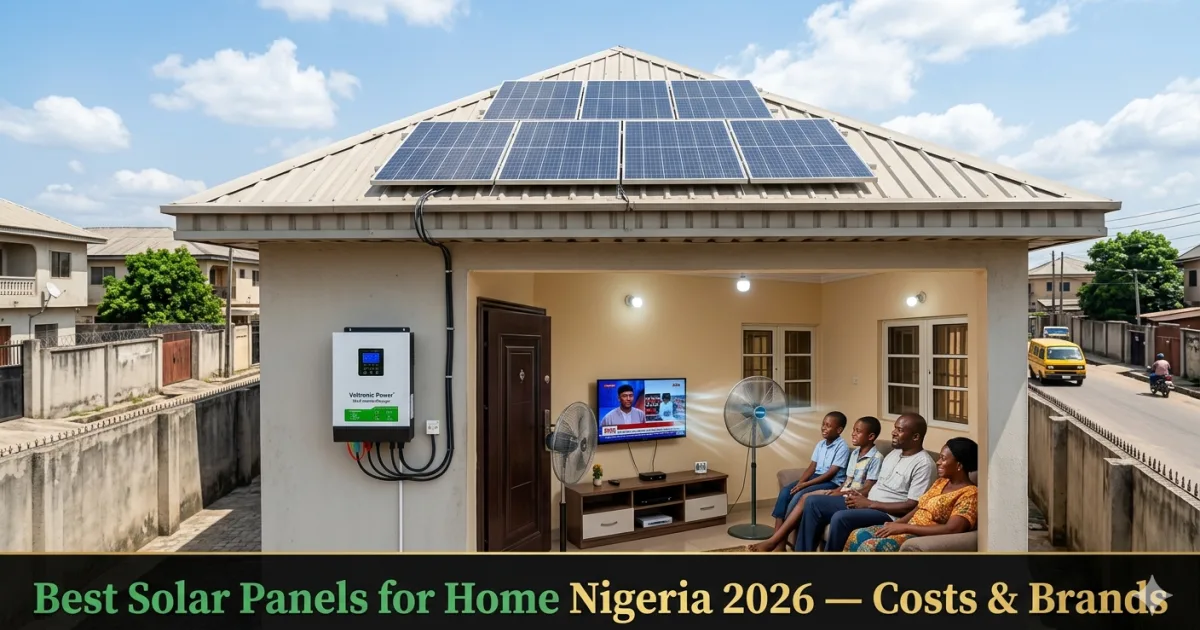
Solar energy is no longer aspirational for Nigerian homes — it is a practical, increasingly necessary investment. With NEPA supply remaining unreliable across most of Nigeria and generator fuel costs rising, solar has crossed the threshold from luxury to financial sense for millions of Nigerian households. 9jaDirectory’s February 2026 solar guide confirms the market reality: “Solar is no longer a luxury. For thousands of Nigerian homes, SMEs, schools, and factories, it is the most practical decision they have made in years.” This guide covers what to buy, what it costs in 2026, and how to avoid the pitfalls that trip up most Nigerian solar buyers.
Understanding a Solar System: What You’re Actually Buying
A complete home solar system has four main components. SolarEnergySupplyStores confirms: “Solar systems generally include panels, inverters, batteries, controllers, and wiring.” Understanding each helps you avoid being sold unnecessary components or undersized equipment:
- Solar panels: Convert sunlight to DC electricity. The number and wattage determines how much power you generate daily.
- Inverter: Converts DC from panels (and battery) to AC electricity for home appliances. The inverter’s kVA rating determines what loads you can run simultaneously. Hybrid inverters also manage grid/generator input.
- Battery bank: Stores solar energy for use at night or during cloudy periods. Lithium (LiFePO4) batteries are increasingly preferred over lead-acid for their longer lifespan and depth of discharge.
- Charge controller (MPPT): Regulates the power flowing from panels to batteries. Most modern hybrid inverters include a built-in MPPT controller.
Best Solar Panel Brands in Nigeria 2026
9jaDirectory’s 2026 solar companies guide confirms: “Jinko Solar is consistently rated the most popular brand in Nigeria for residential and commercial use.” TeezaBaz’s February 2026 solar brands ranking notes: “Safe, widely available, proven solar panel brands in Nigeria in 2026 include Jinko, Canadian Solar, Trina, LONGi, and JA Solar.” Earthbond’s 2026 top-10 solar brands guide adds important detail on each brand’s specific strengths for the Nigerian market:
| Brand | Origin | Best For | Price Range (550W panel) | Why Nigerians Choose It |
|---|---|---|---|---|
| Jinko Solar | China | All residential and commercial use | ₦80,000–₦150,000 | Most popular in Nigeria; widely available; good efficiency; consistent quality (9jaDirectory) |
| LONGi Solar | China | High efficiency in limited roof space | ₦90,000–₦160,000 | Leading global manufacturer; Hi-MO series popular in Nigeria; excellent panel efficiency |
| Canadian Solar | Canada/China | Reliability and brand trust | ₦90,000–₦170,000 | Strong track record; widely available through Nigerian solar distributors; good warranty |
| Trina Solar | China | Commercial and large residential | ₦80,000–₦150,000 | Consistently in top 5 globally; good efficiency; competitive pricing in Nigeria |
| JA Solar | China | Budget-conscious buyers wanting quality | ₦75,000–₦140,000 | Very competitive pricing; solid performance; increasingly available in Nigeria |
| SunPower | USA | Premium coastal properties (Lekki, VI, Lagos Island) | ₦200,000–₦400,000+ | Earthbond: “SunPower uses Maxeon cells practically immune to salt air corrosion — 40-year warranty”; premium positioning |
| Felicity Solar | China/Nigeria | Budget builds; ecosystem compatibility | ₦60,000–₦120,000 | Earthbond: “Buy the full Felicity stack (Panel + Inverter + Battery) to simplify warranty claims — competitive pricing for the Nigerian market” |
| itel Solar | Nigeria brand | Mid-range all-in-one systems | System from ₦105,600 (portable) to ₦5.87M (6kW full home) | ConnectNigeria 2026 review: Nigerian brand; monocrystalline panels; competitive hybrid inverters (4kW at ₦404,300) |
Solar Panel Prices in Nigeria 2026 (Panels Only)
SolarEnergySupplyStores’ 2026 solar panel price guide notes: “Entry-level 100W panels start from around ₦20,000, while high-efficiency 500W panels can go as high as ₦150,000 or more.” TeezaBaz’s February 2026 brand guide adds: “You’ll commonly see 550W panels anywhere from roughly ₦80,000 to ₦180,000+ in the market.” Key context: “Most panels are imported from China, making prices sensitive to exchange rates” — prices shift with the naira/dollar rate.
| Panel Capacity | Price Range (2026) | Best Use |
|---|---|---|
| 100W monocrystalline | ₦20,000–₦35,000 | Phone charging, small lights — starter/minimal systems |
| 200W monocrystalline | ₦35,000–₦65,000 | Kara confirms: “1kW array is the sweet spot for many Nigerian households — runs TV, fans, lights, refrigerator during peak sun hours” |
| 400W monocrystalline | ₦65,000–₦120,000 | Kara: “Going straight to 400W modules saves money on wiring long-term if you have roof space” |
| 550W monocrystalline | ₦80,000–₦180,000+ | Most efficient panel for full home systems; best watts-per-square-metre |
Complete Solar System Costs for Nigerian Homes 2026
A complete solar system (panels + inverter + batteries + installation) costs significantly more than the panels alone. 9jaDirectory’s February 2026 guide gives the most current complete system price ranges:
| System Size | What It Powers | Complete Cost (2026) | Best For |
|---|---|---|---|
| 1–2 kVA (basic) | Fans, lights, TV, phone charging, small refrigerator | ₦850,000–₦1,200,000 | Small apartments; studios; essential backup power only |
| 3–4 kVA (mid-range) | Above + full refrigerator, water pump, multiple rooms | ₦2,000,000–₦3,000,000 | Medium family home; most popular system size in 2026 |
| 5 kVA+ (full backup) | Above + 1 air conditioner (daytime solar hours), washing machine | ₦2,000,000–₦5,000,000 | Larger homes; home offices; comprehensive power independence |
| 6 kVA (whole home) | Comprehensive whole-home coverage including AC | ₦5,871,600 (itel Solar’s confirmed price — ConnectNigeria) | Full-sized family homes; businesses |
| Commercial (10 kVA+) | Small businesses, offices, schools | From ₦7,000,000 | SMEs, commercial properties (9jaDirectory) |
Best Inverter Brands for Nigerian Homes 2026
The inverter is the brain of the solar system and the most critical component to get right. SolarEnergySupplyStores’ inverter guide lists the most trusted brands in the Nigerian market:
- Luminous: “One of the most trusted inverter brands in Nigeria — widely used in homes and small businesses.” Very large market presence; extensive service network; good spare parts availability.
- Felicity Solar: “Offers hybrid and non-hybrid inverters ideal for medium to large-scale installations” — popular for its ecosystem approach (panel + inverter + battery from same brand).
- Growatt: ConnectNigeria’s itel Solar review notes Growatt as a strong competitor in the mid-range; widely used in Nigeria; good hybrid inverter options.
- Deye: Growing fast in Nigeria for hybrid inverters; competitive pricing against Growatt equivalents.
- Victron: “A premium European brand used in commercial solar systems” (SolarEnergySupplyStores) — excellent quality but significantly more expensive; used by premium installations.
- PowMr: PowMr’s Nigeria guide confirms their 6.2kW hybrid inverter at ₦457,000 as one of the competitive mid-range options — “handles complete household loads including 1–2 ACs during daytime solar hours.”
- itel Solar (Nigerian brand): ConnectNigeria’s April 2026 review confirms 4kW hybrid inverter at ₦404,300 — “competitive with Growatt and Deye equivalents.”
Mistakes to Avoid When Going Solar in Nigeria
- Under-buying panels. TeezaBaz’s 2026 brand guide is specific: “Under-buying panels means the battery never gets fully charged, so you blame the inverter.” Always size your panel array to fully charge your battery bank on an average sun day — get a professional load audit before purchasing.
- Buying fake or clone panels. The Nigerian solar market has significant counterfeit panel problems. TeezaBaz warns: “Don’t buy because of name alone — confirm authenticity and warranty.” Always buy from reputable solar distributors and demand the original manufacturer warranty document. Ask for installation photos of previous projects.
- Skipping proper earthing and lightning protection. TeezaBaz specifically flags: “Skipping proper earthing/lightning protection is very important in many Nigerian areas.” Nigeria’s high lightning frequency makes this a genuine safety issue, not a luxury.
- Using an uncertified installer. 9jaDirectory’s guide recommends: “Get installation from a certified technician to avoid wiring faults and poor battery-inverter pairing.” Ask installers for certification, previous client contacts, and warranty documents for their work.
- Ignoring the battery chemistry question. Lithium LiFePO4 batteries have longer lifespans and can be discharged more deeply than lead-acid batteries — ConnectNigeria’s itel Solar review confirms this distinction. The higher upfront cost of lithium typically produces better long-term value in Nigerian conditions.
☀️ Solar Nigeria 2026 — Quick Reference
- Most popular panel brands: Jinko Solar (#1 in Nigeria — 9jaDirectory), LONGi, Canadian Solar, Trina, JA Solar
- Premium coastal choice: SunPower — 40-year warranty, salt-air resistant (Earthbond)
- Budget ecosystem brand: Felicity Solar — buy full panel+inverter+battery stack for warranty simplicity
- Nigerian brand to watch: itel Solar — competitive pricing; 6kW whole-home from ₦5.87M
- 550W panel price: ₦80,000–₦180,000+ (exchange rate dependent)
- Complete system costs: 1–2kVA: ₦850k–₦1.2M | 3–4kVA: ₦2M–₦3M | 5kVA+: ₦2M–₦5M
- Best inverter brands: Luminous (most trusted), Felicity, Growatt, Deye, Victron (premium), PowMr
- Battery preference: Lithium LiFePO4 over lead-acid for longevity in Nigerian conditions
- Critical mistakes to avoid: Under-buying panels; fake brands; no earthing; uncertified installer
- Prices fluctuate with naira/dollar rate — get fresh quotes before purchasing
Also read our tech guide on Starlink vs MTN vs Glo vs Airtel Nigeria 2026 and our finance guide on How to Live on ₦150,000 Monthly in Lagos 2026.


0 Comments
No comments yet. Be the first to share your thoughts!