




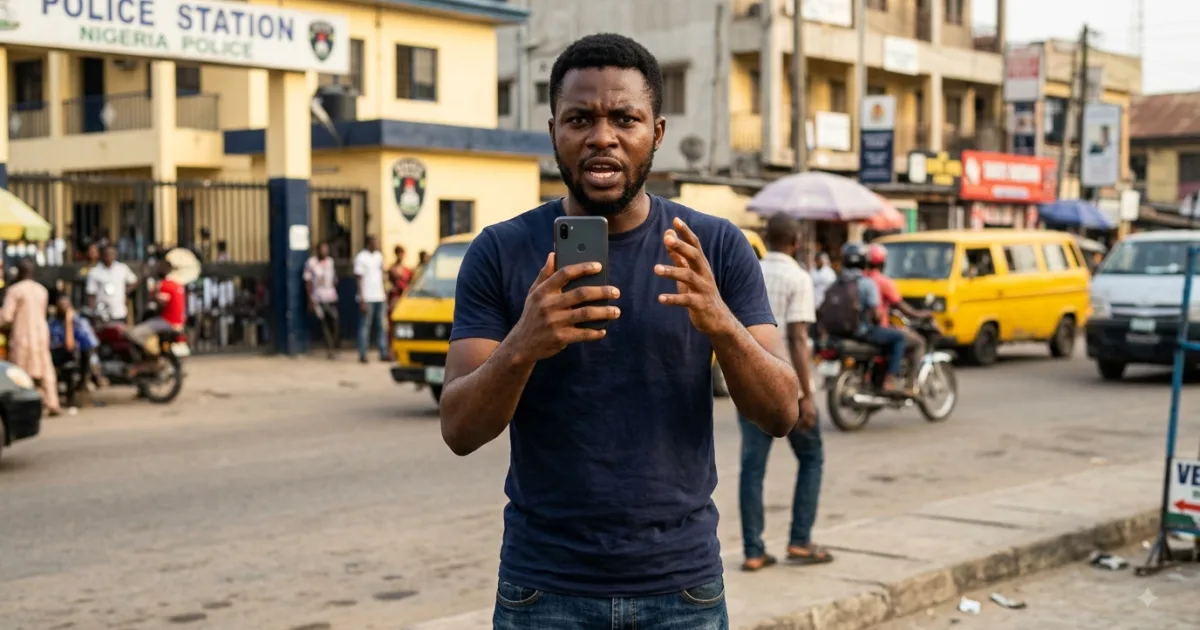
📌 Quick Summary: VeryDarkMan (VDM) publicly challenged the Nigerian Police over their official press release about his meeting with AIG Jimoh Moshood, stating he was there to “debunk falsehoods and lies.” The confrontation has reignited a national debate about police accountability in Nigeria.
If you follow Nigerian social media, you already know that Martins Vincent Otse — better known as VeryDarkMan or simply VDM — does not do things quietly. Since he burst into national consciousness through his fearless video commentaries on issues from banking fraud to celebrity scandals to government policy failures, he has built one of the most loyal and politically engaged audiences of any Nigerian content creator. So when the Nigerian Police Force released what he described as a misleading official statement about his interaction with AIG Jimoh Moshood, the response was not a private correction. It was a full, public, documented pushback — broadcast directly to millions of Nigerians.
Who Is VeryDarkMan?
Martins Vincent Otse, popularly known as VeryDarkMan (VDM), is a Nigerian content creator and activist whose social commentary videos consistently trend nationally. Unlike most Nigerian influencers who focus on lifestyle, entertainment, or comedy, VDM has built his platform on confrontational accountability journalism — calling out institutions, celebrities, businesses, and politicians by name, with evidence, and without apology. His following spans multiple platforms including TikTok, Instagram, and X (Twitter), where his videos routinely accumulate millions of views within hours of posting. He is polarising — his critics accuse him of sensationalism and recklessness; his supporters see him as one of the few voices willing to say publicly what most Nigerians discuss only in private.
What Is the Ratel Movement?
The Ratel Movement is the informal but increasingly organised movement of Nigerians who subscribe to VDM’s activist philosophy — accountability, confrontation of institutional abuse, and the use of social media as a tool of civic pressure. Ratels are not a political party, a registered organisation, or a formal membership body. They are a community of Nigerians who have coalesced around VDM’s specific brand of digitally-driven civic activism. Their collective power is demonstrated most clearly when VDM calls attention to a specific issue and the combined weight of millions of followers generates enough pressure to produce a visible institutional response — which has happened multiple times across banking fraud, hospital negligence cases, and police misconduct stories.
The AIG Jimoh Moshood Confrontation: What Happened
AIG Jimoh Moshood is a senior figure in the Nigeria Police Force. The sequence of events that brought him and VDM into a public confrontation began with a police invitation — VDM was invited to meet with senior police officers for reasons that were not made fully public before the meeting. After the meeting, the Nigeria Police Force released an official press statement describing the encounter in terms that VDM characterised as false, misleading, and designed to create the impression that he had cooperated with or endorsed a police position that he explicitly rejected.
VDM’s response was immediate and unambiguous. He released a detailed video publicly contradicting the police statement, explaining his actual position, and challenging the AIG to correct the official record. “I was there to debunk falsehoods and lies,” he stated — a direct and unambiguous reframing of the meeting that contradicted the official narrative point by point. The video circulated at extraordinary speed across Nigerian social media, accumulating millions of views and reigniting a national debate about how Nigerian police and government institutions use official press releases to shape public perception of their interactions with citizens and activists.
Why This Matters Beyond VDM
The VDM vs AIG Jimoh Moshood confrontation is significant for reasons that extend well beyond the personal conflict between one content creator and one police official. It illustrates a structural tension that is playing out across Nigerian civic life in 2026: the collision between institutions that have historically controlled information through official channels and a new generation of citizens who have the platform, the audience, and the willingness to provide an immediate counter-narrative. In the past, a police press release would be the dominant — and often the only accessible — version of any interaction between the force and a private citizen. Today, a content creator with millions of followers can release a detailed, documented, and widely watched contradiction within hours. The power dynamic has shifted. Institutions have not yet fully adapted to that shift, and the gap between what they say and what their interlocutors say publicly is becoming one of the defining tensions of Nigerian civic communication.
The Oluwo of Iwo’s Suggestion: From Activism to Politics?
One of the most interesting subplots of VDM’s recent public profile was the intervention of the Oluwo of Iwo, a prominent traditional ruler, who during a visit by VDM and members of the Ratel Movement urged them to transition from social media activism into active electoral politics. “The tools you have built are powerful,” the royal father reportedly said, “but the most lasting change comes through the structures of government, not the structures of social media.” The suggestion landed with significant weight on Nigerian social media — generating debate about whether VDM’s specific talent for accountability and confrontation is better deployed inside the political system or outside it, and whether the institutional pressures of politics would blunt or amplify the kind of impact the Ratel Movement has achieved through digital channels.
VDM has not publicly committed to a political run. His position — consistent across multiple interviews and videos — is that accountability work is most effective when it is not constrained by political affiliation or electoral calculation. But the Oluwo’s suggestion has resonated because it identifies something real: Nigeria’s digital activists have built genuine civic infrastructure, and the question of how that infrastructure interfaces with the formal political system is one that 2027’s election cycle may force into sharper focus.
Nigerian Police Accountability in 2026: The Broader Picture
The VDM-police confrontation does not exist in isolation. It reflects a broader pattern of growing tension between Nigerian civil society — increasingly organised and increasingly digital — and security institutions whose opacity, impunity, and resistance to public accountability remain consistent complaints across every demographic of Nigerian life. The #EndSARS movement of October 2020 produced the most significant mass mobilisation against police brutality in Nigerian history. Its aftermath — the Lekki tollgate shooting, the government commissions that largely failed to produce accountability, and the eventual disbandment of SARS only for similar abuses to continue under different unit names — generated a lasting institutional mistrust that VDM’s platform channels and amplifies. When he confronts a police official publicly and generates millions of views doing it, he is not operating in a vacuum. He is operating in an environment where millions of Nigerians have personal or close-hand experience of police abuse, impunity, and the asymmetric power that official press releases historically maintained over individual accounts.
Frequently Asked Questions
Who is VeryDarkMan (VDM)?
VeryDarkMan (real name Martins Vincent Otse) is a Nigerian content creator and activist known for his accountability-focused social commentary videos that consistently trend across Nigerian social media platforms.
What is the Ratel Movement?
The Ratel Movement is an informal community of Nigerians who support VDM’s activist philosophy of digital accountability and institutional confrontation.
What happened between VDM and AIG Jimoh Moshood?
VDM was invited to meet with AIG Jimoh Moshood of the Nigeria Police Force. After the meeting, the police released an official statement that VDM publicly characterised as false. He released a detailed video contradicting the statement, saying he was there “to debunk falsehoods and lies.”
Is VDM going into politics?
VDM has not publicly committed to a political run. The Oluwo of Iwo urged him and the Ratel Movement to transition from activism into electoral politics during a July 2026 palace visit.
Sources
- NaijaSabi research from Nigerian social media and news sources — August 2026.
Last updated: 9 August 2026 · NaijaSabi News Desk.
Nigeria’s Digital Accountability Revolution: VDM in Context
VeryDarkMan did not emerge from a vacuum. His rise as Nigeria’s most confrontational accountability content creator reflects a broader generational shift in how young Nigerians relate to institutions — police, banks, government agencies, celebrities — that have historically operated with minimal public accountability. The combination of widespread smartphone penetration, affordable mobile data, and platforms like TikTok and X that algorithmically reward confrontational and emotionally resonant content has created the conditions for a new kind of Nigerian civic actor: not a journalist bound by editorial norms, not a politician constrained by electoral calculation, but a citizen with a camera and an audience of millions who is willing to say exactly what he sees. VDM represents the most visible current expression of that type in Nigeria, but he is not alone. Across Nigerian social media, dozens of smaller creators operate on similar principles of public accountability — calling out local government failures, exposing consumer fraud, documenting police misconduct. VDM’s scale is unique; his approach is not. It is the approach of a generation that has decided that the most powerful tool available to ordinary Nigerians is the phone in their hand and the audience they can build around it.
The AIG Jimoh Moshood confrontation is significant because it shows that this approach can work even at senior institutional levels. A police press release that would previously have stood as the unchallenged public record of an event has instead been publicly contested by an individual citizen with access to the same audiences that national newspapers reach. The institutional response — the speed with which the police moved to issue a statement and the attention the confrontation generated — demonstrates that digital accountability has real consequences. Whether those consequences produce lasting institutional change is the question that Nigeria’s next decade will answer.
Nigeria’s Digital Accountability Revolution: VDM in Context
VeryDarkMan did not emerge from a vacuum. His rise reflects a broader generational shift in how young Nigerians relate to institutions that have historically operated with minimal public accountability. The combination of widespread smartphone penetration, affordable mobile data, and platforms like TikTok and X that reward confrontational content has created conditions for a new kind of Nigerian civic actor — not a journalist bound by editorial norms, not a politician constrained by electoral calculation, but a citizen with a camera and millions of followers willing to say what most Nigerians discuss only in private. VDM’s confrontation with AIG Jimoh Moshood is significant because it shows that digital accountability works even at senior institutional levels. A police press release that would previously have stood unchallenged has been publicly contested by an individual citizen with access to the same audiences that national newspapers reach. Whether this translates into lasting institutional change is the question Nigeria’s next decade will answer.
What Nigerian Youth Activism Looks Like in 2026
VDM represents one model — the individual creator as accountability journalist. But Nigerian youth activism in 2026 operates across multiple registers: the Ratel community’s digital-first approach, civil society organisations that emerged from EndSARS and continue advocating for police reform, young Nigerians who decided change requires operating inside the political system, and economic activists building parallel financial systems — cooperative savings groups, digital lending platforms, creator economy income streams — that reduce dependence on institutions they distrust. VDM’s confrontation with AIG Jimoh Moshood is one data point in a much larger story of a generation that has decided it will not simply inherit Nigeria’s institutional failures but will document, challenge, and where possible route around them entirely. The outcome of that decision — across politics, economics, and civic life — will define Nigeria’s next decade more than any single election or policy announcement. Follow NaijaSabi’s Civic section for continuous coverage of Nigerian accountability stories as they develop.
Follow NaijaSabi for More
Nigeria’s biggest stories are breaking every day across entertainment, civic affairs, finance, education, and lifestyle. NaijaSabi covers them all with the depth, speed, and Nigerian perspective that our audience deserves. Bookmark naijasabi.com.ng/, subscribe to our Morning Brief newsletter that reaches over 52,000 subscribers daily, and follow us on all social media platforms to ensure you never miss the stories that matter most to Nigeria. Whether it is a trending celebrity moment, a breaking political development, an economic policy change that affects your daily life, or an education update that determines your academic future — NaijaSabi is where Nigeria comes to understand what is happening and why it matters. Our editorial team works around the clock to bring you accurate, well-researched, and genuinely useful content across every category that Nigerian audiences care about. Share this article with someone who needs to see it, drop your thoughts in the comments section below, and come back for our next update on this developing story. NaijaSabi — Nigeria’s most trusted independent digital publication.



0 Comments
No comments yet. Be the first to share your thoughts!