




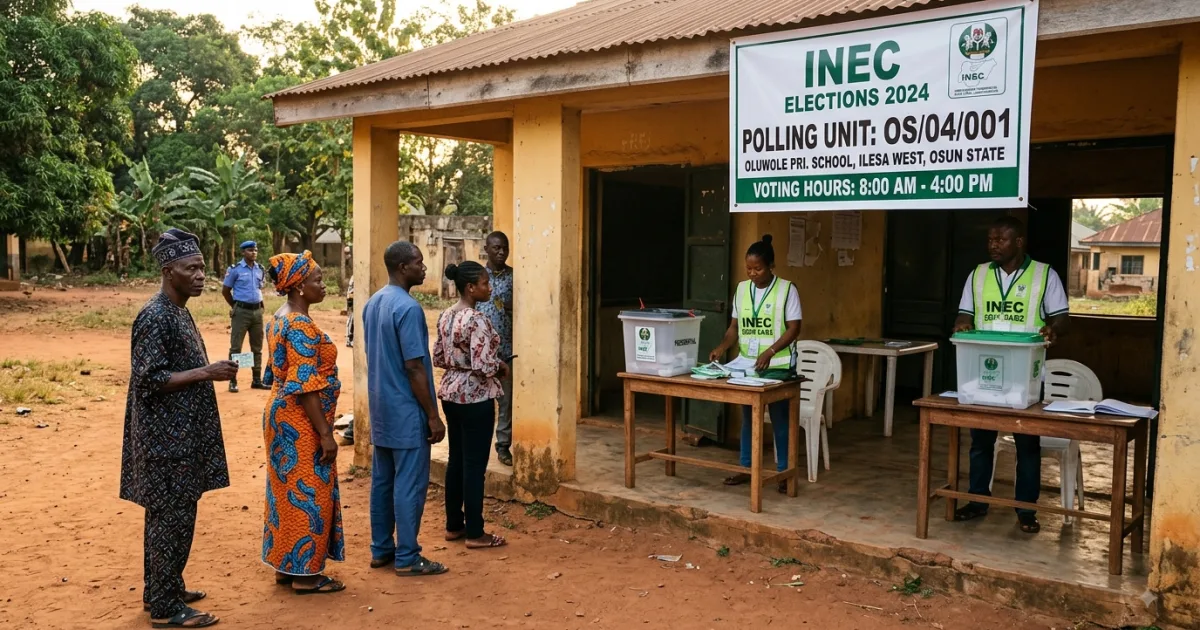
📌 Quick Summary: The Osun State governorship election holds on Saturday, 15 August 2026. Governor Ademola Adeleke faces strong opposition, the EFCC froze the state account 10 days before the poll, Davido has publicly weighed in, and the police are deploying four officers per polling unit. Here is everything you need to know before election day.
On Saturday, 15 August 2026, Osun State — one of Nigeria’s most politically contested states — goes to the polls for a governorship election that has already generated more drama, controversy, and national attention than any state election since Anambra 2021. At the centre of it is Governor Ademola Adeleke, the incumbent PDP governor popularly known as the “Dancing Senator,” whose term has been defined by dramatic legal battles, administrative controversy, and a personal profile that transcends conventional Nigerian politics. Challenging him is the APC candidate in what analysts are calling one of the most consequential state elections of 2026.
Key Election Facts
| State | Osun State, Southwest Nigeria |
| Election Date | Saturday, 15 August 2026 |
| Incumbent | Governor Ademola Adeleke (PDP) |
| Conducting Body | Independent National Electoral Commission (INEC) |
| Police Deployment | Minimum 4 officers per polling unit |
| EFCC Action | Osun State Government account frozen 10 days before election |
Who Is Governor Adeleke?
Senator Ademola Adeleke is one of Nigeria’s most distinctive political figures — a man whose public profile was built as much on his extraordinary dancing ability as his political record. A member of the Adeleke family dynasty that produced billionaire music mogul Sunday Adeleke and artist Davido (David Adedeji Adeleke), the governor has maintained a high-visibility personal brand throughout his tenure. He won the governorship in a keenly contested election and has since governed amid persistent legal challenges from the opposition, controversies about his academic qualifications, and administrative disputes that have occasionally paralysed state government functions.
The EFCC Account Freeze: What It Means
Ten days before the election, the Economic and Financial Crimes Commission (EFCC) froze the Osun State Government’s account. The timing of this action — in the critical pre-election period when state governments typically need access to funds for administrative operations — has generated enormous controversy. The PDP and Governor Adeleke’s camp have characterised it as a politically motivated act designed to destabilise the state government and undermine the incumbent’s electoral chances by creating administrative paralysis at the worst possible moment. The EFCC has maintained its standard position that its actions are investigation-driven and operationally independent. The opposition has welcomed the freeze.
The key question — which Nigerian political watchers are debating intensely — is whether the EFCC’s action represents legitimate anti-corruption enforcement or the weaponisation of financial regulation for electoral purposes. Nigeria’s history with the EFCC across multiple political cycles includes instances of both. The timing, alone, makes it impossible to separate the investigation from the political context.
Davido’s Involvement: Family, Politics, and Social Media
Davido, the global Afrobeats superstar whose uncle is Governor Adeleke, has been publicly drawn into the political battle around the Osun election. After former presidential spokesperson Bashir Ahmad made public comments implying Governor Adeleke faces defeat on August 15, Davido responded on X with characteristic directness — defending his uncle, challenging the narrative, and demonstrating once again that Nigeria’s celebrity culture and political landscape are inseparable in the social media era. The exchange trended nationally, generating millions of impressions and demonstrating the extent to which the Adeleke family’s political fortunes are now permanently intertwined with one of Africa’s biggest music stars.
Security Deployment: 4 Officers Per Polling Unit
The Nigerian Police Force has confirmed it will deploy a minimum of four officers per polling unit for the Osun election — a significant security commitment that reflects both the electoral volatility the state has historically experienced and the broader concerns about violence and disruption that surround any high-stakes Nigerian governorship contest. The Inspector General of Police has issued specific directives prohibiting vote-buying, thuggery, and the intimidation of voters or electoral officials. Whether those directives translate to on-the-ground enforcement is the question that Nigerian election observers — both domestic and international — will be watching closely on August 15.
What the Osun Election Means Nationally
State governorship elections in Nigeria are rarely only about the state. They are tests of party strength, previews of 2027 positioning, and indicators of the APC-PDP balance of power that will shape federal politics for the next election cycle. A PDP victory in Osun would consolidate the party’s hold on the state and provide momentum for its 2027 presidential strategy. An APC victory would represent a significant recapture of a state that has been central to Southwest political identity since the party’s formation. The stakes, therefore, extend well beyond Governor Adeleke’s personal political future.
How to Check Osun Election Results on 15 August
INEC will collate and announce results from each local government area as they arrive. The most reliable sources for real-time results are the official INEC website (inec.gov.ng), the INEC Result Viewing Portal (irev.inec.gov.ng), and the major Nigerian news organisations including NAN, Channels Television, and Arise News. NaijaSabi will be providing live updates throughout Election Day on our website and across our social media platforms.
Frequently Asked Questions: Osun Election 2026
When is the Osun governorship election?
The Osun State governorship election holds on Saturday, 15 August 2026.
Who is the incumbent governor of Osun State?
Governor Ademola Adeleke of the Peoples Democratic Party (PDP) is the incumbent. He is the uncle of superstar Davido.
Why did the EFCC freeze Osun State’s account?
The EFCC froze the Osun State Government account 10 days before the election as part of an ongoing investigation. The timing has generated political controversy, with the PDP alleging it is politically motivated.
Is Davido involved in the Osun election?
Davido has publicly defended his uncle Governor Adeleke on social media, firing back at former presidential aide Bashir Ahmad who implied the governor would lose the election.
Sources
- NaijaSabi research from Nigerian news and social media sources — August 2026.
Last updated: 12 August 2026 · NaijaSabi News Desk.
The Stakes for Nigeria’s 2027 Federal Election
State elections in Nigeria are never only about the state. The Osun governorship contest on 15 August 2026 carries implications for the national political positioning that will shape the 2027 federal election cycle. APC’s ability to recapture Osun — a state that was central to its Southwest coalition in the 2015 and 2019 presidential elections — would strengthen the party’s claim that it can rebuild its regional base ahead of the presidential race. PDP’s ability to retain the state under Adeleke, despite the EFCC account freeze and the legal battles that have characterised the tenure, would demonstrate that incumbent advantage and family brand recognition (the Adeleke-Davido connection) can overcome institutional pressure. For political strategists on both sides, August 15 is as much a 2027 preview as it is a 2026 state election.
INEC has committed to deploying its BVAS (Bimodal Voter Accreditation System) technology for the Osun election — the same system that was credited with improving the credibility of the 2023 general election. Whether BVAS functions reliably under the field conditions of an Osun election — with its history of electoral tension and the pressure of both parties’ national significance attached to the result — will itself be a test of whether Nigeria’s electoral technology has genuinely embedded itself as a credibility-enhancing infrastructure or remains dependent on the political goodwill of security personnel and local officials to function as designed. NaijaSabi will be providing live updates on Election Day, 15 August 2026. Follow our Civic section for real-time coverage.
INEC Technology: Will BVAS Perform in Osun?
INEC has committed to deploying its Bimodal Voter Accreditation System (BVAS) for the Osun election — the technology credited with improving 2023 general election credibility. BVAS uses fingerprint and facial recognition to verify voters, reducing impersonation and multiple voting. In 2023 it performed well in urban areas but struggled in rural locations with poor connectivity. Osun’s mix of urban centres in Osogbo, Ilesa, and Ile-Ife alongside dozens of rural local governments presents a genuine test. INEC has pre-loaded local verification datasets to reduce real-time connectivity dependence. Whether this proves sufficient across all 3,763 polling units in the state will be one of the key Election Day stories.
Historical Context: Osun’s Difficult Election History
Osun State has been at the centre of Nigeria’s most contested gubernatorial elections. The 2018 election decided by a Supreme Court ruling and the 2022 election that brought Adeleke to power both generated lengthy legal proceedings. The pattern reflects Osun’s importance as a swing state in Southwest politics — too significant for either party to concede without a fight. The 2026 election adds the EFCC dimension: an anti-corruption agency action in the pre-election window is unprecedented in Osun’s recent history and introduces legal and financial complications that neither party’s playbook fully anticipated. Whatever the August 15 result, legal challenges from the losing side are considered extremely likely by political analysts tracking the race. NaijaSabi will provide live Election Day updates across our website and social media platforms — follow us for real-time results coverage from the first collated results through to the final declaration.
Follow NaijaSabi for More
Nigeria’s biggest stories are breaking every day across entertainment, civic affairs, finance, education, and lifestyle. NaijaSabi covers them all with the depth, speed, and Nigerian perspective that our audience deserves. Bookmark naijasabi.com.ng/, subscribe to our Morning Brief newsletter that reaches over 52,000 subscribers daily, and follow us on all social media platforms to ensure you never miss the stories that matter most to Nigeria. Whether it is a trending celebrity moment, a breaking political development, an economic policy change that affects your daily life, or an education update that determines your academic future — NaijaSabi is where Nigeria comes to understand what is happening and why it matters. Our editorial team works around the clock to bring you accurate, well-researched, and genuinely useful content across every category that Nigerian audiences care about. Share this article with someone who needs to see it, drop your thoughts in the comments section below, and come back for our next update on this developing story. NaijaSabi — Nigeria’s most trusted independent digital publication.
Why This Story Matters to Every Nigerian
Every story NaijaSabi covers exists within a larger context — the daily reality of millions of Nigerians navigating a country of extraordinary complexity, energy, and potential. Whether the subject is celebrity culture, political accountability, economic policy, entertainment, or education, the thread connecting our coverage is always the same: how does this affect ordinary Nigerians, and what do they need to know to navigate it intelligently? This story is no different. The details matter — the specific facts, the confirmed information, the verified sources — but the larger meaning is what we want our readers to carry away. Nigeria in 2026 is a country in motion. Its music is shaping global culture. Its young people are building businesses, creating content, and demanding accountability from institutions that have historically operated without it. Its economy is generating both extraordinary wealth and extraordinary hardship simultaneously, and the gap between those two realities is the central political and social challenge of the decade. NaijaSabi exists to cover that complexity honestly — without the partisan distortion that makes so much Nigerian media unreliable, and without the sensationalism that prioritises clicks over understanding. We are an independent publication, funded by display advertising and loyal to our readers alone. Every article we publish is researched, verified to the best of our capacity, and written with the genuine intention of informing rather than manipulating. If this article has been useful to you — if it has given you information you needed, context you lacked, or a perspective you had not considered — please share it with someone else who would benefit. Nigerian media grows stronger when Nigerians choose quality. We appreciate your readership, and we will keep earning it.
Nigeria’s stories are moving fast. NaijaSabi covers every major development across entertainment, civic affairs, finance, education, and lifestyle — with speed, accuracy, and the Nigerian perspective our audience deserves. Bookmark naijasabi.com.ng/ and subscribe to our Morning Brief newsletter. Share this article, drop your thoughts in the comments, and return for our next update. NaijaSabi — Nigeria’s most trusted independent digital publication, serving over 52,000 newsletter subscribers daily and millions of monthly readers across the country and in the Nigerian diaspora worldwide. From Lagos to London— wherever Nigerians are, NaijaSabi is the publication that keeps them connected to what is happening at home and why it matters.



0 Comments
No comments yet. Be the first to share your thoughts!