



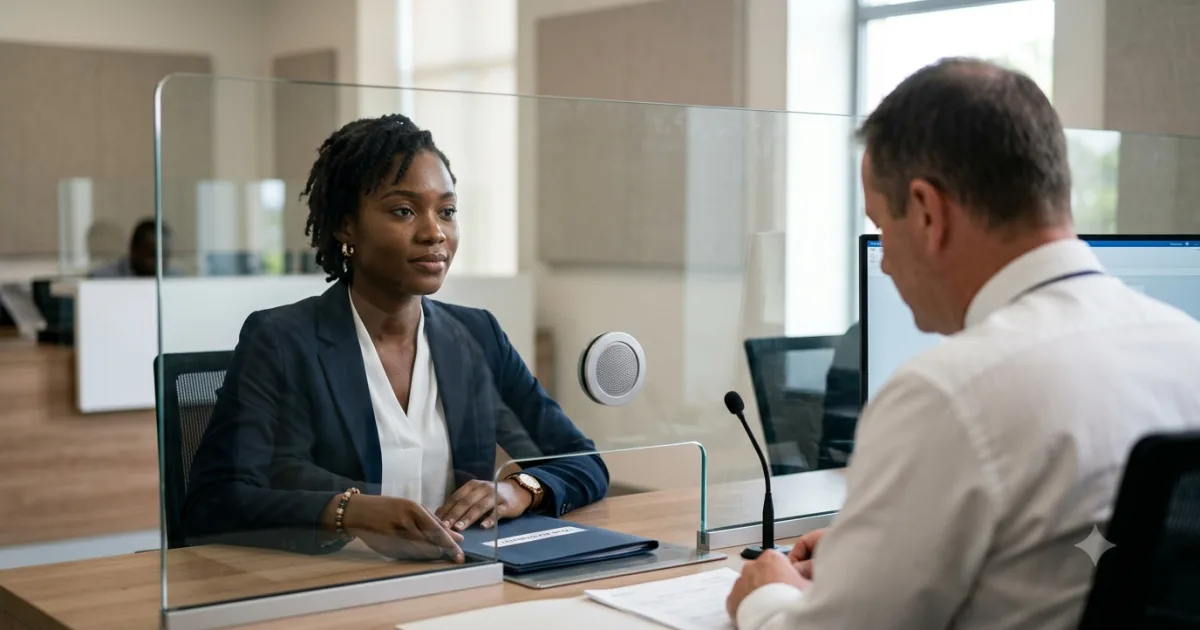
Few experiences cause Nigerians more anxiety than the US visa interview. You spend money on the fee, gather a mountain of documents, rehearse for weeks — and then a consular officer decides your fate in under two minutes, often handing back a single slip citing “Section 214(b)” with no detailed explanation. With Nigeria’s B1/B2 refusal rate hovering around 45 per cent — among the highest in the world — that fear is well founded.
But here is the truth most “visa agents” will not tell you: the interview is not a lottery, and it is not personal. It follows a logic. Officers are answering one question above all others — will this person come back to Nigeria? — and most refusals come down to applicants failing to convincingly answer it, not to bad luck or a bad officer. Understand that logic, prepare honestly, and you dramatically improve your odds.
This guide explains the US B1/B2 visa interview specifically for Nigerians in 2026: the questions you will actually be asked, the real reasons applicants get refused, the major 2025–2026 rule changes you must know, the fees, and exactly how to prepare. It will not teach you to game the system — that is how people get permanently banned. It will teach you to present a true, strong case well.
⚠️ Important: This is general information, not legal advice. US visa rules, fees and validity change frequently and are set by the US government — always verify on travel.state.gov and ng.usembassy.gov. Never submit false documents or lie to a consular officer. Misrepresentation can result in a permanent, lifelong visa ban that no amount of money can fix.
B1 vs B2: What This Visa Actually Is
The B1/B2 is the United States’ nonimmigrant visitor visa, almost always issued as a combined B1/B2:
- B1 (Business) — for short business activities: attending conferences, meetings, negotiating contracts, training. Not for working or being employed in the US.
- B2 (Tourism) — for tourism, visiting family or friends, and medical treatment.
It is a temporary visitor visa. It does not permit you to work, study long-term, or settle in the US. Misusing it — working illegally, overstaying — leads to deportation and future bans.
The One Thing That Decides Everything: Section 214(b)
If you understand nothing else, understand this. Under Section 214(b) of US immigration law, every B1/B2 applicant is presumed to be an intending immigrant — someone who wants to move to the US permanently — until they prove otherwise. The entire interview exists for you to overcome that presumption.
You overcome it by demonstrating strong ties to Nigeria — compelling reasons you will return home after your visit. A 214(b) refusal simply means the officer was not convinced your ties are strong enough. It is the most common refusal for Nigerians, and crucially:
- It is not a finding that something is “wrong” with you. It is an assessment that you did not sufficiently prove non-immigrant intent.
- It is not permanent. It applies only to that application. You can reapply — but you should only do so when something material has genuinely changed.
- It is different from inadmissibility (Section 212(a)), which is far more serious and can involve fraud or criminal grounds.
Everything below flows from this single principle: prove you will come back.
The Major 2025–2026 Rule Changes You Must Know
The US visa landscape shifted significantly, and out-of-date advice is dangerous. Key changes:
Interview waivers (“dropbox”) were drastically cut. As of 1 October 2025, the interview waiver is essentially only available to renewal applicants whose prior visa expired within the last 12 months and was issued at full validity. First-time applicants no longer qualify for any waiver — including children and the elderly, whose age-based exemptions were eliminated. In practice, almost every Nigerian applicant now attends an in-person interview.
Visa validity for Nigerians has been subject to reciprocity changes. US visa validity and entry terms for Nigerian applicants have been adjusted under visa-reciprocity policy in recent years, and the validity period a Nigerian receives may be shorter than the historic norm. Do not assume a long multiple-entry validity — confirm the current reciprocity schedule for Nigeria on travel.state.gov before you plan.
Even “eligible” cases can be called in. Consular officers always retain discretion to require an in-person interview regardless of waiver eligibility.
The Interview: What Actually Happens
The interview itself is short — often decided within a minute or two. The officer has already reviewed your DS-160 application before you reach the window. They are testing whether your answers are consistent, credible, and demonstrate ties.
Three questions are asked in nearly every single interview:
- “What will you do in the US?” — your purpose.
- “Why are you travelling now?” — your timing.
- “Who is paying for your trip?” — your funding.
Have clear, honest, specific, consistent answers to these three before anything else.
Common US Visa Interview Questions (and How to Answer Honestly)
Below are the real categories of questions, with guidance on answering truthfully and well. The golden rule: every answer must match your DS-160 exactly. Inconsistency is a top refusal trigger.
Purpose of travel
- “Why do you want to visit the United States?”
- “What exactly will you do there?”
Answer specifically and truthfully: “I’m attending a three-week training conference in Atlanta,” not a vague “to see America.”
Trip details
- “How long will you stay?”
- “Where will you stay?”
- “Have you booked anything yet?”
Be concrete and consistent with your plans and finances.
Funding
- “Who is sponsoring your trip?”
- “What do you do for a living?”
- “How much do you earn?”
Be honest about who pays. If self-funded, your finances must credibly support the trip. If sponsored, be clear about the sponsor and relationship.
Ties to Nigeria (the most important category)
- “Are you married? Do you have children?”
- “What is your job? How long have you worked there?”
- “Do you own property or a business in Nigeria?”
- “What will make you return?”
This is where you win or lose. Demonstrate employment, family, property, business, and other commitments that compel your return.
Travel history
- “Have you travelled abroad before?”
- “Have you been to the US before?”
Honest, lawful travel history (with timely returns) helps enormously. You can check your US entry records at the CBP I-94 website.
US connections
- “Do you have family or friends in the US?”
Be completely honest. Concealing relatives in the US — and being caught — is a fast refusal, and lying about it is far worse.
Prior refusals
- “Have you been refused a US visa before?”
Officers can see your entire refusal history. Acknowledge it openly and explain what has genuinely changed since (promotion, higher income, new family circumstances, property). Never deny a past refusal — that is misrepresentation.
Why Nigerians Get Refused: The Real Reasons
Nigeria’s roughly 45 per cent refusal rate is not random. These are the recurring reasons:
- Weak ties to Nigeria. Young, single, unemployed or low-asset applicants struggle to prove they will return. This is the number-one reason.
- Unconvincing or vague trip purpose. “I just want to tour” with no specifics raises doubt.
- Inconsistent answers vs the DS-160. Any mismatch suggests something is being hidden.
- Insufficient or suspicious finances. Funds that suddenly appear before the interview, or that don’t match your stated income, are red flags.
- Concealing US relatives or friends. Especially close family who immigrated.
- Misrepresenting prior refusals or history. This can escalate from a 214(b) to a far more serious — and permanent — misrepresentation finding.
- A genuine impression of immigrant intent. Selling assets, quitting a job, or a one-way mindset all signal you may not return.
- Poor or evasive communication. Nervousness alone won’t sink you, but evasiveness or rehearsed-sounding contradictions can.
Notably, even high earners get refused. A foreign tech professional earning the equivalent of tens of millions of naira a year, with a young child at home, was reportedly refused in under a minute — proof that income alone is not the same as convincingly demonstrated ties and intent.
What to Bring to Your Interview
Officers may not ask for documents — the conversation matters most — but you must have them ready:
- Valid international passport (and old passports with prior visas)
- DS-160 confirmation page
- Appointment confirmation and visa fee receipt
- One recent passport photograph (per specifications)
- Proof of funds: bank statements, salary slips, tax documents
- Employment letter / proof of business ownership
- Evidence of ties: property documents, family records, business registration
- For family visits: invitation letter, the relative’s proof of US status, and proof of relationship
- Travel itinerary or plans (don’t over-commit to non-refundable bookings before approval)
Organise them so you can produce any item instantly if asked.
How to Apply: The Process Step by Step
- Complete the DS-160 online at the official Consular Electronic Application Center. Answer truthfully and keep a copy — your interview answers must match it.
- Pay the visa application (MRV) fee. The B1/B2 MRV fee is US$185. Additional fees (such as a visa integrity fee introduced under recent US legislation) may apply to certain applicants — verify current fees on the official site.
- Create a profile and schedule your interview at the US Embassy in Abuja or the US Consulate General in Lagos. Wait times vary — book early.
- Attend your interview with your documents. Be early, calm, honest and concise.
- Receive the outcome: approved (passport retained for visa printing), refused under 214(b) (passport returned with a slip), or placed in 221(g) administrative processing (additional review or documents needed — not a denial).
- If approved, your visa is printed into your passport. Remember: the visa validity controls how long you may seek entry; your I-94, issued by CBP on arrival (typically up to six months), controls how long you may stay. Check it at the CBP I-94 site and never overstay.
If You Are Refused
A 214(b) refusal is disappointing but not the end:
- You can reapply, but only do so when your circumstances have genuinely strengthened — a better job, higher and stable income, new family ties, property, a clearer purpose. Reapplying the next week with nothing changed usually yields the same result.
- Address the specific weakness. If your ties were thin, build them before trying again.
- Never resort to fake documents. A 214(b) is recoverable. A misrepresentation finding (for fraud or fake papers) can bar you for life.
- 221(g) is not a refusal — it means more processing or documents. Respond promptly and completely.
Beware Visa Scams
US visa fraud targeting Nigerians is rampant. Protect yourself:
- No agent can guarantee a US visa. Only a consular officer decides, at the interview. Anyone promising “100% approval,” a “connection at the embassy,” or a guaranteed visa for a fee is a fraudster.
- The US government does not use paid “agents” to grant visas. Pay official fees only through official channels.
- Never buy fake bank statements, employment letters, or documents. This is the single most dangerous thing you can do — it converts a recoverable refusal into a permanent ban for fraud.
- You can do the DS-160 and booking yourself. The process is designed to be self-service via official sites.
- Verify everything on travel.state.gov and ng.usembassy.gov. Treat contradictory “agent” claims as false.
FAQ: US B1/B2 Visa Interview Nigeria 2026
1. What is the US visa approval rate for Nigerians?
Roughly 45–55%, meaning around 45% of B1/B2 applications from Nigeria are refused — one of the higher refusal rates globally, driven mostly by Section 214(b) concerns about ties and intent.
2. What is a 214(b) refusal?
It means the consular officer was not convinced you would return to Nigeria after your visit — that you did not overcome the legal presumption of immigrant intent. It is the most common refusal and is not permanent; you can reapply when your circumstances genuinely change.
3. What questions are asked at the US visa interview?
Almost always: what you will do in the US, why you are travelling now, and who is paying. Plus questions on your job, finances, ties to Nigeria, travel history, US connections, and any prior refusals.
4. How much is the US B1/B2 visa fee in 2026?
The MRV application fee is US$185. Additional fees may apply to some applicants under recent US legislation — verify the current total on the official site before paying.
5. Can I still use the dropbox/interview waiver?
Mostly no. Since 1 October 2025, the waiver is essentially limited to renewals whose prior visa expired within the last 12 months at full validity. First-time applicants no longer qualify, so nearly all Nigerians now attend an in-person interview.
6. How do I prove strong ties to Nigeria?
Through stable employment, business or property ownership, family responsibilities (spouse, children), financial assets, and a clear, time-bound reason to return. The stronger and more verifiable, the better.
7. Should I mention relatives in the US?
Yes — always be honest. Officers can discover undisclosed US relatives, and concealment leads to refusal. Honesty about family is far safer than being caught hiding it.
8. Can I reapply immediately after a 214(b) refusal?
You can, but it is usually pointless unless something material has changed. Wait until your ties or circumstances genuinely strengthen, then reapply addressing the previous weakness.
9. How long can I stay in the US on a B1/B2 visa?
The visa validity is how long you can seek entry; how long you can stay is set by CBP on your I-94 (typically up to six months per visit). Always check your I-94 and depart before it expires.
10. Is it worth using a visa agent?
No agent can guarantee approval, and many are scams. You can complete the official process yourself. Never pay anyone promising a guaranteed visa, and never buy fake documents — fraud causes permanent bans.
The Bottom Line
The US visa interview feels arbitrary, but it runs on one clear principle: the officer must believe you will come home to Nigeria. Nigeria’s high refusal rate reflects how hard that is to prove for many applicants — not a conspiracy against Nigerians. Your job is to present a true, strong, consistent case that you have real reasons to return.
So prepare properly. Know your three core answers cold. Make sure everything matches your DS-160. Build and document genuine ties. Be honest about everything — relatives, refusals, finances — because honesty is not just ethical, it is strategically the safest path. And never, ever touch fake documents or “guaranteed visa” agents; a 214(b) is recoverable, but a fraud ban is forever.
A US visa is a privilege granted at the officer’s discretion, not a right. But for well-prepared, honest Nigerian applicants with genuine ties and a clear purpose, it is very much attainable. Walk in calm, truthful and ready — and let your real story do the work.
Related reading on NaijaSabi:
- How to Get a UK Visa from Nigeria 2026 — the UK route compared
- Canada Express Entry for Nigerians 2026 — if you’re thinking long-term migration
- How to Spot Online Scams in Nigeria 2026 — avoiding fake visa agents
Sources & References
- US Department of State — Visitor Visas (B-1/B-2), official. Available at: travel.state.gov
- US Mission Nigeria — Nonimmigrant Visas. Available at: ng.usembassy.gov
- US Department of State — Visa Denials and Section 214(b). Available at: travel.state.gov (visa denials)
- US Customs and Border Protection — I-94 records (length of stay). Available at: i94.cbp.dhs.gov
- US Department of State — Interview Waiver Update (effective 1 October 2025). Available at: travel.state.gov (interview waiver)
- US Department of State — Visa Wait Times and Fees. Available at: travel.state.gov (wait times)
Editorial standards. This article is independently researched and compiled from official US Department of State and US Mission Nigeria sources, and current immigration reporting. US visa rules, fees and validity change frequently and are set by the US government — always verify current details on travel.state.gov and ng.usembassy.gov before acting. This is general information, not legal advice; never submit false information, as misrepresentation can cause a permanent visa ban. If you spot an error or have a correction, please write to editorial@naijasabi.com.ng.
Last reviewed and updated: 20 May 2026 · NaijaSabi · Next scheduled review: August 2026 (US visa rules change frequently).



0 Comments
No comments yet. Be the first to share your thoughts!