


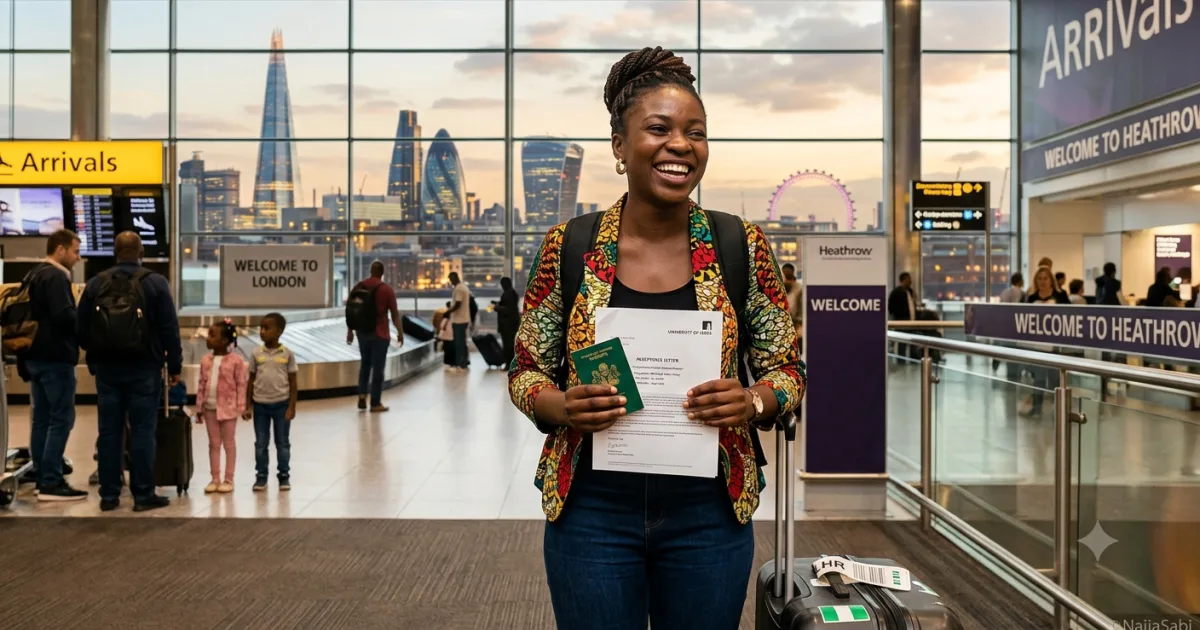
📌 Quick Summary: The UK Student Visa (Student Route) allows Nigerians to study at a UK university or college. To apply, you need a Confirmation of Acceptance for Studies (CAS) from a UKVI-licensed UK institution, proof of English proficiency (usually IELTS for UKVI), proof of funds held for 28 consecutive days, and a TB test certificate from a UKVI-approved clinic in Nigeria. The visa fee is £524 (~₦524,000) plus an Immigration Health Surcharge of £776 per year of study (~₦776,000/year), paid upfront for the full course. Processing takes 15 working days after your biometrics appointment at VFS or TLS centres in Lagos (Ikeja or Victoria Island) or Abuja. After graduating, the UK Graduate Route allows Nigerians to work in the UK for 2 years (3 years for PhD graduates) — one of the most valuable post-study work rights available globally.
The United Kingdom remains one of the top three Japa destinations for Nigerian students in 2026 — behind Canada but ahead of most other options — because of the combination of world-class universities, shorter course durations than the US and Canada (most UK undergraduate degrees are 3 years, Masters degrees are 1 year), and the UK Graduate Route: a post-study work visa that lets Nigerian graduates stay and work in the UK for 2 years after completing their course. That 2-year work right, combined with the possibility of switching to skilled worker status and eventually settling in the UK, is why tens of thousands of Nigerians apply for UK student visas every year. This NaijaSabi guide walks you through the entire 2026 UK student visa process specifically for Nigerians — from CAS to TB test to biometrics — with real costs in naira.
| Fact | Detail |
| Visa name | UK Student Visa (Student Route) — formerly Tier 4 |
| Issued by | UK Visas and Immigration (UKVI), Home Office |
| Application portal | gov.uk/student-visa |
| Visa fee | £524 from outside UK (~₦524,000 at ₦1,000/£) |
| Immigration Health Surcharge (IHS) | £776 per year of course — paid upfront for full duration |
| Proof of funds — outside London | £1,136/month × up to 9 months = up to £10,224 + first year tuition |
| Proof of funds — London | £1,483/month × up to 9 months = up to £13,347 + first year tuition |
| 28-day rule | Funds must be held continuously in account for 28 days, ending no more than 31 days before applying |
| TB test | Mandatory for Nigerians — chest X-ray at UKVI-approved clinic only — cost ₦30,000–₦80,000 |
| Processing time | 15 working days after biometrics appointment |
| Biometrics/application centres in Nigeria | Lagos (Ikeja, Victoria Island), Abuja |
| Post-study work right | UK Graduate Route — 2 years (3 years for PhD) |
| Exchange rate reference | ~₦1,000/£1 — confirm at CBN or xe.com before applying |
Why Nigerian Students Choose the UK in 2026
Before the process, the reason. Nigerian students choose the UK for several specific reasons that make it worth the cost and complexity of the application:
- Shorter course durations: A UK Bachelor’s degree takes 3 years (not 4 as in Nigeria or the US). A UK Master’s degree takes 1 year (not 2 as in most countries). This means you spend less time and money on tuition and living costs compared to other Anglophone study destinations
- UK Graduate Route: After graduating from most UK universities, you can apply for a 2-year post-study work visa (3 years for PhD graduates) that allows you to work in any job, anywhere in the UK, without needing a job offer in advance. This is significantly more flexible than many countries’ post-study rules
- Pathway to UK settlement: After working in the UK on the Graduate Route and then switching to a Skilled Worker visa, the path to UK Indefinite Leave to Remain (ILR — permanent residency) becomes available after 5 years of continuous residence. This makes the UK one of the more accessible settlement pathways available to Nigerian graduates
- Nigerian community: The UK has one of the world’s largest Nigerian diaspora communities — particularly in London, Manchester, Birmingham and Leeds. This built-in community reduces the isolation that many Nigerian students experience in less familiar countries
- WAEC and NECO accepted: Many UK universities accept WAEC and NECO A-C grades for undergraduate entry — reducing or eliminating the need for additional foundation programmes
Step 1 — Get Your IELTS for UKVI Result
English language proficiency is one of the first requirements to organise — and for the UK student visa, the test you take matters. UKVI requires a Secure English Language Test (SELT) from an approved provider. The most commonly accepted test is IELTS for UKVI Academic — note that this is different from standard IELTS Academic and must be sat at a UKVI-approved test centre in Nigeria.
Minimum score requirements:
- Undergraduate entry: 5.5–6.0 overall (your university’s requirement will likely be higher than the visa minimum)
- Postgraduate Master’s entry: 6.0–6.5 overall
- PhD entry: 6.5–7.0 overall
Check your specific university and programme’s English requirement — the visa minimum (5.5 overall) is lower than most university admission requirements. Aim for your university’s requirement, not just the visa floor. IELTS for UKVI costs approximately ₦130,000–₦160,000 in Nigeria in 2026. British Council and IDP Nigeria both offer IELTS for UKVI at centres in Lagos, Abuja and other Nigerian cities. Some UK universities accept WAEC English, a medium of instruction letter or an internal English test in lieu of IELTS — confirm with your specific university.
Step 2 — Secure Your University Offer and CAS
Your CAS — Confirmation of Acceptance for Studies — is a 14-digit reference number issued by your UK university that is the foundation of your student visa application. Without a CAS, you cannot apply for the visa. Here is how the CAS process works:
- Apply to and receive an unconditional offer from a UKVI-licensed UK university or college — sometimes called a “licensed Student sponsor.” Only institutions on the UKVI’s official register can issue CAS. Check the register at gov.uk/tier-4-general-visa before applying to any institution
- Accept your offer and pay any required tuition deposit the university specifies
- Meet any remaining conditions on your offer — if your offer was conditional on IELTS results, submit them to the university
- The university issues your CAS — typically 6–12 weeks before your programme start date. Universities cannot issue CAS more than 6 months before the start date. If you apply to a January intake, expect your CAS in November–December. For September intake, expect CAS in July–August
- Your CAS confirms your admission status, course details, tuition fees, start and end dates, and the university’s sponsor licence details — all information that UKVI uses in your visa assessment
Important Nigerian-specific note: The quality and reputation of your university significantly affects your visa success rate. UKVI pays attention to your reasons for choosing your specific institution — a weak Statement of Purpose that cannot convincingly explain why you chose a lesser-known institution over stronger options raises officer concerns. Choose your university carefully — not just for visa purposes, but because a credible institution with strong graduate outcomes is a better investment in your future.
Step 3 — Complete Your TB Test at a UKVI-Approved Clinic
Nigeria is on the UK Home Office’s list of countries requiring a tuberculosis (TB) test for student visa applications lasting 6 months or more. This is a mandatory requirement — there are no exceptions for Nigerian applicants. You must be tested at a UKVI-approved clinic only — a certificate from a general hospital or non-approved clinic will result in automatic refusal.
UKVI-approved TB test clinics in Nigeria (confirmed February 2026):
| City | Clinic | Address/Contact |
| Abuja | IOM Migration Health Assessment Centre (MHAC) | No. 55 Hassan Musa Katsina Road, Asokoro, Abuja — +234 (0) 201 465 6600 — nigeria.iom.int |
| Lagos | IOM Nigeria — Lagos | Contact via nigeria.iom.int for current Lagos location details |
| Lagos | Q-Life Family Clinic | Lagos — fees updated August 2025 — confirm current details at gov.uk/tuberculosis-test-visa |
| Lagos | The Consultants Practice | Lagos — confirm current details and booking at gov.uk/tuberculosis-test-visa |
| Benin City | IOM MHAC Benin | For applicants in Edo State — contact via nigeria.iom.int |
Always verify the current approved clinic list at: gov.uk/government/publications/tuberculosis-test-for-a-uk-visa-clinics-in-nigeria — the list is updated periodically and clinic details (fees, addresses, contact numbers) change.
Key facts about the TB test:
- The test is a chest X-ray reviewed by an approved radiologist — not a skin test or blood test
- You receive a certificate confirming no evidence of active TB
- Processing takes 2–3 business days at most clinics
- The certificate is valid for 6 months — time your test carefully. If your visa is delayed beyond the 6-month window, you must retest
- Cost: approximately ₦30,000–₦80,000 depending on the clinic — confirm current fees directly with your chosen clinic before booking
- Book early — popular periods (June–August for September intake, October–November for January intake) are busy and appointment slots fill up
Step 4 — Prepare Your Proof of Funds
The 28-day funds rule is the most common reason Nigerian UK student visa applications are refused. UKVI requires you to show that the following amounts have been held continuously in a bank account — yours or your parent/sponsor’s — for 28 consecutive days, with the last day of that 28-day period falling no more than 31 days before the date of your visa application.
How much you must show:
- Living costs outside London: £1,136 per month × up to 9 months = maximum £10,224 (~₦10.2 million)
- Living costs in London: £1,483 per month × up to 9 months = maximum £13,347 (~₦13.3 million)
- Plus: The full outstanding first year tuition fee as stated on your CAS (minus any amount already paid to the university)
- If your university has already charged you for accommodation, up to £1,334 of this can be deducted from the living costs requirement
Example for a Nigerian student at Manchester (outside London), tuition £15,000:
- Living costs: £10,224
- First year tuition: £15,000
- Total required: £25,224 (~₦25.2 million) — held for 28 consecutive days
Example for a Nigerian student at University College London, tuition £20,000:
- Living costs (London): £13,347
- First year tuition: £20,000
- Total required: £33,347 (~₦33.3 million) — held for 28 consecutive days
What UKVI accepts as proof of funds:
- Bank statements in your name showing the required amount held for 28 consecutive days
- Parent or guardian’s bank statements with a signed consent letter and proof of relationship (birth certificate)
- An official scholarship or sponsorship award letter that explicitly states amounts and duration — replaces bank statement if funds are covered
- A student loan letter from a government or government-approved lender
Critical warning on the 28-day rule for Nigerians: UKVI officers are specifically trained to spot large deposits that appear suddenly in accounts shortly before the 28-day window — a pattern very common in Nigerian visa applications where families pool money just before applying. A sudden large inflow followed by the 28-day hold is a red flag. Ideally, funds have been in the account for months with clear and explainable transactions. If your funds come from a property sale, business proceeds, foreign remittance or family contribution, prepare documentation explaining the source clearly — bank transfer records, sale agreements, business financial statements. Unexplained sudden deposits are one of the top refusal reasons for Nigerian applicants.
Step 5 — Complete the Online Visa Application
- Go to gov.uk/student-visa and click “Apply now”
- Create or log in to your UK Visas and Immigration online account
- Complete the online application form — personal details, passport details, CAS reference number, travel history, financial details, course details
- Upload your supporting documents — passport bio page, CAS details, proof of funds bank statements, TB test certificate, IELTS result, academic certificates, English language evidence
- Pay the visa application fee: £524 (~₦524,000) — paid online by card
- Pay the Immigration Health Surcharge (IHS): £776 per year of your visa — for a 3-year course the IHS is £2,328 (~₦2.3 million), paid upfront in full. The IHS gives you full access to NHS services during your stay in the UK
- Pay the biometrics appointment fee: £76.50 (~₦76,500) for the visa application centre appointment
- Select your preferred visa application centre in Nigeria and book your biometrics appointment
Step 6 — Attend Your Biometrics Appointment in Nigeria
UK student visa biometrics appointments in Nigeria are handled at visa application centres (VAC) operated by VFS Global or TLS Contact. The current Nigeria locations are:
| City | Locations | Booking |
| Lagos | Ikeja VAC and Victoria Island (VI) VAC | vfsglobal.com or tlscontact.com — confirm which operates your preferred Lagos location at the time of booking |
| Abuja | Abuja VAC | vfsglobal.com or tlscontact.com |
At your appointment bring: your passport, your appointment confirmation, the documents you uploaded online in their original form, your TB test certificate (original), your IELTS Test Report Form (original) and your CAS letter or printout. Biometrics are fingerprints and a photograph — the appointment typically takes 20–40 minutes. Book as early as possible — VAC appointment slots in Lagos fill up particularly during peak application periods.
Step 7 — Wait for Your Decision and Collect Your BRP
After your biometrics appointment, UKVI processes your application. Standard processing in Nigeria takes 15 working days. You can pay for priority processing (5 working days) or super-priority (next working day) where available — at additional cost. Track your application status through your UKVI online account.
When approved, your passport is returned with a visa vignette (sticker) — valid for travel to the UK. Within 10 days of arriving in the UK, collect your Biometric Residence Permit (BRP) from the post office named in your visa decision letter. Your BRP is your ID card for the duration of your studies in the UK.
Full Cost Breakdown for a Nigerian Applying for UK Student Visa 2026
| Cost Item | Amount (£) | Amount (₦ at ₦1,000/£) |
| Student visa fee | £524 | ~₦524,000 |
| IHS — 1-year course (Masters) | £776 | ~₦776,000 |
| IHS — 3-year undergraduate | £2,328 | ~₦2,328,000 |
| Biometrics/VAC appointment fee | £76.50 | ~₦76,500 |
| TB test (Nigeria) | — | ₦30,000–₦80,000 |
| IELTS for UKVI Academic (Nigeria) | — | ₦130,000–₦160,000 |
| Nigerian Police Clearance (if required) | — | ₦30,000 |
| Passport renewal (if needed) | — | ₦15,000–₦75,000 |
| Total application costs (Masters, excl. funds) | — | ~₦1.5m–₦1.7m |
| Proof of funds required (Manchester, £15k tuition) | £25,224 | ~₦25.2 million |
| Proof of funds required (London, £20k tuition) | £33,347 | ~₦33.3 million |
Exchange rate of ₦1,000/£1 used for illustration. Confirm current rate at xe.com or CBN before making any financial commitments.
After You Graduate — The UK Graduate Route
The UK Graduate Route is one of the biggest reasons Nigerian students choose the UK over other destinations. After completing your degree at a participating UK university, you can apply for the Graduate Route visa — a post-study work visa that allows you to:
- Stay in the UK for 2 years after graduating (3 years for PhD graduates)
- Work in any job at any salary — no minimum salary requirement, no sponsorship needed
- Switch to a Skilled Worker visa if you find a job that meets the skilled worker criteria during your Graduate Route stay
The Graduate Route application costs £822 and is applied for from within the UK before your student visa expires. This 2-year window of unrestricted UK work rights is the pathway many Nigerian graduates use to gain UK work experience, save money and eventually qualify for long-term UK residency.
Frequently Asked Questions — UK Student Visa Nigeria 2026
How do I apply for a UK student visa from Nigeria in 2026?
Apply online at gov.uk/student-visa. You need a CAS from a UKVI-licensed UK institution, IELTS for UKVI Academic results, a TB test certificate from a UKVI-approved clinic in Nigeria (IOM Lagos/Abuja, Q-Life Family Clinic Lagos, or The Consultants Practice Lagos), proof of funds held for 28 consecutive days, a valid Nigerian passport and academic documents. Pay the £524 visa fee and £776/year Immigration Health Surcharge online, then book and attend a biometrics appointment at VFS or TLS centres in Lagos (Ikeja or Victoria Island) or Abuja. Processing takes 15 working days after biometrics.
How much does a UK student visa cost in Nigeria in 2026?
The UK student visa costs £524 (~₦524,000) in application fees, plus an Immigration Health Surcharge of £776 per year of your course — paid upfront for the full course duration (a 3-year undergraduate degree costs £2,328 in IHS, ~₦2.3 million). The biometrics/VAC appointment costs £76.50 (~₦76,500). Additional costs include the TB test (₦30,000–₦80,000), IELTS for UKVI (₦130,000–₦160,000) and any document preparation costs. Total application costs typically run ₦1.5–₦1.7 million for a Masters applicant, excluding the proof of funds requirement.
Do Nigerians need a TB test for a UK student visa?
Yes — Nigeria is on the UK Home Office’s list of countries requiring a mandatory tuberculosis (TB) test for visa applications lasting 6 months or more. Nigerians must be tested at a UKVI-approved clinic only — a certificate from a general hospital or non-approved clinic causes automatic refusal. Approved clinics in Nigeria include IOM Migration Health Assessment Centres in Abuja (Asokoro) and Lagos, Q-Life Family Clinic in Lagos and The Consultants Practice in Lagos. The test is a chest X-ray reviewed by an approved radiologist. The certificate costs approximately ₦30,000–₦80,000 and is valid for 6 months. Always confirm the current approved clinic list at gov.uk/government/publications/tuberculosis-test-for-a-uk-visa-clinics-in-nigeria.
How much money do I need to show for a UK student visa from Nigeria?
You must show your full first year tuition fee plus living costs: £1,136 per month (outside London) or £1,483 per month (London) for up to 9 months. For a Nigerian student at a university outside London with £15,000 annual tuition, the total required is approximately £25,224 (~₦25.2 million). These funds must be held continuously in a bank account — yours or your parent/sponsor’s — for 28 consecutive days, ending no more than 31 days before you submit your visa application. A large sudden deposit just before the 28-day window without clear explanation is a common refusal reason for Nigerian applicants.
Can I work in the UK while studying on a student visa?
Yes — UK student visa holders can work up to 20 hours per week during term time and full-time during official vacation periods. This part-time work right helps Nigerian students supplement their income during studies. After graduating, the UK Graduate Route allows 2 years of unrestricted full-time work in the UK (3 years for PhD graduates) without needing a job offer in advance — one of the most generous post-study work rights available globally.
Sources
- UK Visas and Immigration (UKVI) — Student visa official guidance 2026 — gov.uk/student-visa
- UK Home Office — Tuberculosis test clinics Nigeria, updated 16 February 2026 — gov.uk/government/publications/tuberculosis-test-for-a-uk-visa-clinics-in-nigeria
- Scholarships for Africans — UK Student Visa Guide for African Students 2026 — scholarshipsforafricans.com
- Flydestinations Nigeria — UK Study Visa from Nigeria 2026 Approval Guide — flydestinations.com.ng
- MastersPortal — How to Get a Student Visa for the UK in 2026 — scholarshipportal.eu
Last updated: 20 September 2026 · NaijaSabi Education Desk. UK visa requirements, fees and processing times change frequently. Always confirm current details directly at gov.uk/student-visa before submitting any application. This article is for informational purposes only and does not constitute immigration advice.

0 Comments
No comments yet. Be the first to share your thoughts!