




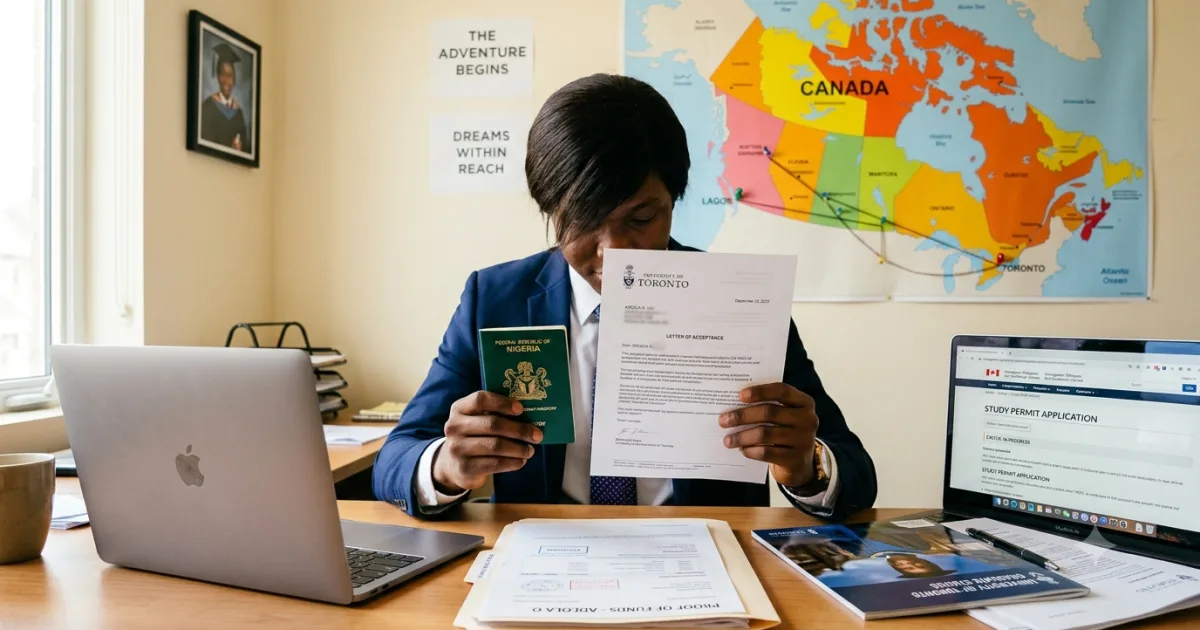
📌 Quick answer (checked 20 October 2026): A Nigerian applying for a Canadian study permit pays IRCC CAD $150 for the permit plus CAD $85 for biometrics (CAD $235 in total; IRCC fee list). For applications made on or after 1 September 2026, you must show at least CAD $23,448 a year for living costs as a single student outside Quebec, on top of first-year tuition and travel. Most applicants also need a provincial or territorial attestation letter (PAL/TAL), but master’s and PhD students at public institutions have been exempt since 1 January 2026. Nigerians staying more than six months need an immigration medical exam. The Nigeria Student Express fast-track ended on 8 November 2024, so everyone now applies through the regular stream. Check current processing times on IRCC’s own tool before you plan travel.
Canada is still one of the most popular study destinations for Nigerians, but the rules have changed a lot since 2024: a cap on new study permits, the PAL requirement, a higher proof-of-funds figure every September and the end of the Nigeria Student Express. This guide sets out what Immigration, Refugees and Citizenship Canada (IRCC) asks for today, using IRCC’s own pages, so you can build an application that answers the officer’s questions before they are asked.
Canada study permit 2026: key facts
| Item | What IRCC says (checked 20 October 2026) |
|---|---|
| Who issues it | Immigration, Refugees and Citizenship Canada (IRCC) |
| Study permit fee | CAD $150 per person (also applies to extensions) |
| Biometrics fee | CAD $85 per person; CAD $170 maximum for a family of two or more applying together |
| Proof of funds (living costs) | CAD $23,448 a year for one person outside Quebec, for applications on or after 1 September 2026, plus tuition and travel |
| PAL/TAL | Usually required; master’s and doctoral students at public institutions exempt from 1 January 2026 |
| Medical exam | Required for stays over six months if you have lived in Nigeria for six months or more in a row in the past year |
| How to apply | Online through an IRCC secure account (paper only for limited exceptions) |
| Fast-track stream | Nigeria Student Express ended 8 November 2024; all applications use the regular stream |
| Work while studying | Up to 24 hours a week off campus during term; unlimited hours during scheduled breaks |
Study permit and visa: what you actually receive
The study permit is the document that lets you study in Canada. It is not a travel document on its own. Nigerian passport holders also need a temporary resident visa to board a flight to Canada. You do not make a separate visa application: when IRCC approves a study permit application made from outside Canada, it issues the documents you need to travel, including a visa where your nationality requires one. The study permit itself is printed and handed to you by a border officer when you land, using the letter of introduction IRCC sends with your approval.
If your study programme is six months or shorter, you generally do not need a study permit. Most degree and diploma programmes are longer, so this guide assumes you need one. If you only want to visit Canada, see our Canada visitor visa guide for Nigerians.
Who can apply
To be eligible, IRCC expects you to:
- hold a letter of acceptance from a designated learning institution (DLI), a school approved by a provincial or territorial government to host international students;
- include a PAL or TAL unless you are exempt (see below);
- prove you have enough money for tuition, living costs and return travel;
- have no criminal record and provide a police certificate if asked;
- be in good health and complete a medical exam if required;
- satisfy the officer that you will leave Canada when your authorised stay ends.
Before paying any deposit, check that your school is on IRCC’s list of designated learning institutions. Only a DLI letter of acceptance can support a study permit.
The provincial attestation letter (PAL/TAL)
Since 2024 Canada has limited the number of new study permits, and each province or territory receives a share. Schools issue PALs (or TALs in the territories) within that share. IRCC says a PAL/TAL is “usually required” and must come from the school you plan to attend. For 2026, PALs are valid from 1 January to 31 December 2026 unless the letter shows an earlier expiry date.
Who does not need a PAL/TAL
| Exempt group | Notes |
|---|---|
| Master’s and doctoral students at a public DLI | Exempt from 1 January 2026, including students moving from another post-secondary programme into such a degree |
| Preschool, primary and secondary (up to grade 12) students | Exempt |
| Exchange students who pay no tuition to the Canadian school | Exempt |
| Holders of a Global Affairs Canada scholarship | Exempt |
| Some people already in Canada | For example, those extending at the same school and level of study |
If you are exempt, IRCC still asks you to show proof of the exemption, for example your letter of acceptance showing a master’s programme at a public university. Students heading to Quebec generally also need a Quebec Acceptance Certificate (CAQ), even if they do not need a PAL.
Proof of funds: the amounts that apply now
IRCC raises the living-cost figure each year. For applications received on or after 1 September 2026, outside Quebec, you must show the amounts below in addition to your first-year tuition and transportation costs.
| People coming to Canada (including you) | Living costs you must show per year (CAD) |
|---|---|
| 1 | $23,448 |
| 2 | $29,192 |
| 3 | $35,888 |
| 4 | $43,572 |
| 5 | $49,419 |
| 6 | $55,736 |
| 7 | $62,054 |
| Each extra person beyond 7 | $6,318 |
Source: IRCC, “Proof of financial support”, page modified 28 August 2026. Quebec sets its own figures through its immigration ministry.
Worked example
Ada has an offer for a two-year college diploma in Ontario. Her letter of acceptance shows first-year tuition of CAD $18,000 (this figure is only an example; use the exact figure on your own letter). She will travel alone.
| Item | Amount (CAD) |
|---|---|
| First-year tuition (from her letter of acceptance) | 18,000 |
| Living costs, one person (IRCC minimum) | 23,448 |
| Return travel (her own airline quote) | Add the actual quote |
| Minimum she must show | 41,448 plus travel |
If she brought her spouse, the living-cost line would rise to CAD $29,192. If she has already paid part of her tuition, a receipt from the school counts towards the tuition line.
Documents IRCC accepts
IRCC lists these as examples (not a complete list):
- a receipt from your DLI showing tuition and housing paid for the first year;
- a student or education loan from a bank;
- proof of a scholarship or a Government of Canada-funded programme;
- a Canadian guaranteed investment certificate (GIC) from a participating bank;
- proof of a Canadian bank account in your name if you have moved money to Canada;
- bank statements for the past six months, Canadian or foreign, that include the month of your application or the month before and show the source of the money;
- a letter from the person or school giving you money, stating their job, relationship to you, dependants and the amount, with proof of the relationship and their photo ID or business registration;
- recent pay slips, pension documents or proof of rental income.
IRCC also notes that where a country has foreign-exchange controls, you must show that the money can actually be moved out of the country. For Nigerian applicants, that means keeping evidence that your bank or sponsor can remit the funds abroad.
What makes funds convincing
- A visible source. IRCC asks for six months of statements that show where the money came from. A large deposit just before you apply, with no salary, business or sale record behind it, invites questions.
- A sponsor’s paper trail. If a parent is paying, include their letter, proof that they are your parent (for example a birth certificate) and evidence of their income.
- Consistency. The amounts in your study plan, sponsor letter and bank statements should agree.
Medical exam for Nigerian applicants
IRCC requires an immigration medical exam for temporary residents, including students, who plan to stay more than six months and who have lived in or travelled to a listed country for six months or more in a row in the year before they come to Canada. Nigeria is on that list. The exam must be done by an IRCC-approved panel physician; you pay the clinic directly, and IRCC does not set that price. Results are valid for 12 months, and the expiry date appears on your letter of introduction. If you do not travel within that period, you may need another exam.
You can do an “upfront” exam before you apply, so the results are ready, or wait for IRCC’s instructions after you submit. Doing it upfront can avoid delays later.
Step-by-step: how to apply from Nigeria
- Get your letter of acceptance from a DLI. Confirm the school is on IRCC’s DLI list.
- Get your PAL/TAL from the school, unless you are exempt. Keep proof of any exemption.
- Gather your documents. Valid international passport, letter of acceptance, PAL/TAL, proof of funds, academic records, a study plan or letter explaining your choice of programme, and any police certificate or medical results you have. If your passport is due to expire, see our Nigerian passport renewal guide first. For a police certificate, see our police clearance certificate guide.
- Read IRCC’s instruction guide (IMM 5269) and answer the online questions to get your personal document checklist.
- Create an IRCC secure account, upload documents and pay the CAD $150 permit fee and CAD $85 biometrics fee by credit or debit card. IRCC advises paying the biometrics fee when you submit to avoid delays.
- Give biometrics. IRCC will send a biometric instruction letter. You have 30 days from the date on that letter to give your fingerprints and photo at a visa application centre. Most people need to give biometrics only once every 10 years.
- Do the medical exam if you have not done it upfront.
- Wait for a decision. Processing starts after IRCC receives your biometrics. IRCC will contact you through your account if it needs more information.
- Travel. If approved, you receive a letter of introduction and your visa. Carry your letter of acceptance, proof of funds and the letter of introduction when you fly.
Processing times
IRCC does not publish a fixed processing time on its application pages. It publishes a processing-times tool that is updated regularly and shows the current estimate for study permits by country of application. Check it on the day you apply, and leave yourself a margin before your programme starts, because the clock only starts once IRCC has your biometrics. The Nigeria Student Express, which offered faster processing to Nigerians who met extra conditions, ended at 2 p.m. Eastern Time on 8 November 2024; applications received after that go through the regular stream.
Common reasons for refusal and how to avoid them
When IRCC refuses an application it sends a letter explaining why. The grounds below come from the eligibility rules above, so each one is something you can prepare for.
| Refusal ground | How to address it |
|---|---|
| Not satisfied you will leave Canada at the end of your stay | Show ties to Nigeria (family, job, property, business) and a clear plan for after your studies |
| Not satisfied with your financial resources | Meet the 1 September 2026 figures, show the source of funds, and prove the money can be moved abroad |
| Purpose of visit unclear | Explain why this programme, at this school, fits your education and career history |
| Missing PAL/TAL | Get the letter from your school, or include proof of exemption |
| Incomplete application | Use IRCC’s personal checklist and upload every document it lists |
If you are refused, read the letter carefully, fix the specific issue and reapply with stronger evidence rather than resubmitting the same file.
Working while you study
If your study permit allows it, you can work off campus up to 24 hours a week during regular terms, and you may combine more than one job to reach that total. During scheduled breaks such as summer and winter holidays you can work unlimited hours. You must remain enrolled and meet your study permit conditions. Do not plan to fund your studies from part-time work: IRCC wants to see the money before you arrive.
Bringing family
The proof-of-funds table rises with each family member. Whether your spouse can get an open work permit, and whether your children can study, depends on your level of study and current IRCC rules, so check IRCC’s family pages for your programme before you plan. For the wider costs of moving, our Japa cost planner lets you build a budget.
Frequently Asked Questions
How much is the Canada study permit fee for Nigerians?
CAD $150 for the study permit plus CAD $85 for biometrics, according to IRCC’s fee list checked on 20 October 2026. A family applying together pays a maximum of CAD $170 for biometrics. Medical exams, police certificates and visa application centre services are paid to those providers separately.
How much proof of funds do I need for a Canada study permit in 2026?
For applications on or after 1 September 2026, outside Quebec, a single student must show CAD $23,448 a year for living costs, plus first-year tuition and travel. The figure rises with each family member coming with you.
Do I need a PAL for a master’s degree in Canada?
Not if it is a degree-granting master’s or doctoral programme at a public designated learning institution. IRCC removed the PAL/TAL requirement for these students from 1 January 2026. You still need to show proof that you are exempt.
Is the Nigeria Student Express still available?
No. IRCC ended the Nigeria Student Express and the Student Direct Stream on 8 November 2024. All study permit applications now go through the regular stream.
Do Nigerians need a medical exam for a Canada study permit?
Yes, if you plan to stay more than six months and have lived in Nigeria for six months or more in a row in the year before you travel. Nigeria is on IRCC’s list of countries that trigger this requirement. Results are valid for 12 months.
How long does a Canada study permit take from Nigeria?
IRCC publishes a processing-times tool rather than a fixed figure, and the estimate changes. Check it when you apply and remember that processing begins only after your biometrics are received.
Can I work while studying in Canada?
If your permit allows off-campus work, up to 24 hours a week during term and unlimited hours during scheduled breaks.
Sources
- Immigration, Refugees and Citizenship Canada, “Fee list”, page modified 21 September 2026
- Immigration, Refugees and Citizenship Canada, “Proof of financial support” (study permit), page modified 28 August 2026
- Immigration, Refugees and Citizenship Canada, “Provincial attestation letter (PAL) or territorial attestation letter (TAL)”, page modified 2 September 2026
- Immigration, Refugees and Citizenship Canada, “Medical exam requirements for temporary residents” and country list, pages modified 4 August and 16 July 2026
- Immigration, Refugees and Citizenship Canada, “End of the Student Direct Stream and Nigeria Student Express”, notice, 8 November 2024
Last updated: 20 October 2026 · NaijaSabi.





0 Comments
No comments yet. Be the first to share your thoughts!