




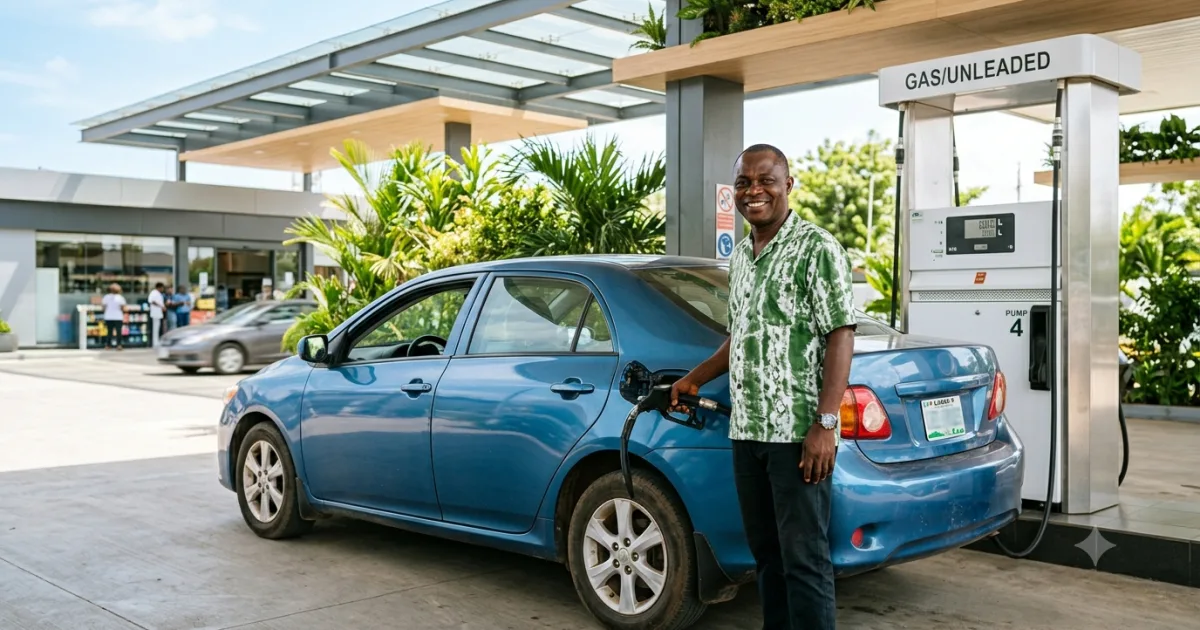
📌 Quick answer (checked 13 October 2026): CNG sells for about ₦380 per standard cubic metre (SCM) for cars and buses (₦450 for heavy trucks), while petrol costs about ₦1,355 a litre at NNPC stations in Lagos. Converting a petrol car costs roughly ₦650,000 to ₦2.5 million, depending on the vehicle and kit, and since April 2026 some drivers can spread the cost with loans from 9%. More than 120,000 vehicles have been converted at 400+ certified centres, but there are only about 90 refuelling stations, so check your routes first.
CNG vs Petrol: The Price Gap
- CNG: about ₦380 per SCM for cars and passenger buses, and ₦450 for heavy-duty vehicles, according to the National Automotive Design and Development Council (NADDC) in August 2026. Some Abuja stations were charging less (₦200 to ₦250) in August.
- Petrol: ₦1,355 a litre at NNPC stations in Lagos (8 October 2026). See our fuel price guide for every state.
One SCM of CNG gives a car roughly the same distance as a litre of petrol, so at these prices gas costs well under half as much per kilometre. The NADDC’s Director-General gave the example of a motorist whose fuel cost for a Jigawa–Kano journey fell from more than ₦200,000 on petrol to about ₦40,000 on CNG.
What Conversion Costs
Costs depend on the vehicle, engine, kit brand and cylinder size, so always get more than one quote from certified centres:
- Recent reporting puts conversion of a petrol car at about ₦750,000 to ₦2.5 million (Premium Times, October 2026).
- An Abuja commercial driver told Nairametrics in August 2026 that he paid ₦650,000.
- Larger vehicles, buses and premium kits cost more. Prices move with the exchange rate because kits and cylinders are largely imported.
Paying for It: Free Conversions and 9% Loans
- Commercial transport operators: the Federal Government has run free and subsidised conversion for members of transport unions through accredited centres. Ask your union and check pci.gov.ng for the current phase.
- Loans: in April 2026, Pi-CNG signed an agreement with the Nigerian Consumer Credit Corporation (CREDICORP), Moniepoint Microfinance Bank and the National Credit Guarantee Company to finance conversions. CREDICORP said rates start as low as 9%, with higher-risk borrowers paying 20% to 24%, repaid over about six months. It is aimed first at lower-income and last-mile transport users such as keke operators.
Is It Worth It? The Simple Maths
Work out what you spend on petrol each month. If CNG cuts that by half or more, divide the conversion cost by your monthly saving to see how many months it takes to pay back. A taxi or bus driver who spends ₦200,000 a month on petrol might save ₦100,000 or more and recover a ₦650,000 conversion in about six or seven months. A private car used mainly at weekends takes much longer. The deciding factor for many people is whether there is a CNG station on their regular routes.
Where to Convert and Refuel
- Conversion centres: more than 400 certified centres nationwide, according to the information minister on 12 October 2026. Use the map on pci.gov.ng to find one.
- Refuelling: about 90 stations, with around 180 more in development, and 81 companies licensed to retail CNG. Stations are concentrated in Lagos, Abuja, Kano and along major corridors, and some do not open 24 hours.
- Dual fuel: converted cars can still run on petrol, so you can switch back when there is no station nearby.
The Conversion Process
- Check your car is suitable. Most petrol (spark-ignition) cars can be converted; diesel engines are not simple conversions.
- Choose a certified centre from the Pi-CNG map and get a written quote.
- Installation: a high-pressure cylinder is fitted, usually in the boot, with a regulator and controls. A car usually takes a day or less.
- Testing and tuning: leak tests and tuning before you drive away. Keep your certificate and receipts.
Living With CNG
- Boot space: the cylinder takes up much of it in a small car.
- Power: expect slightly less power on gas.
- Maintenance: regular leak checks and filter changes, and periodic cylinder inspection and testing as your installer specifies.
Safety First
CNG ignites at a higher temperature than petrol and disperses upwards if it leaks, so a properly installed system is safe. The danger is bad installation and uncertified cylinders. Use only certified centres and approved kits, keep to the inspection schedule, refuel at licensed stations, and if you smell gas, switch to petrol and have the system checked straight away.
Frequently Asked Questions
How much does CNG conversion cost in Nigeria?
Roughly ₦650,000 to ₦2.5 million in 2026, depending on the vehicle, engine and kit. Get quotes from at least two certified centres.
What is the price of CNG per SCM?
About ₦380 per SCM for cars and passenger buses and ₦450 for heavy-duty vehicles, according to the NADDC in August 2026. Some stations charge less.
Is CNG conversion free in Nigeria?
The Federal Government has offered free and subsidised conversions to commercial transport operators through their unions. Private car owners usually pay, but can use the CREDICORP and Moniepoint loan scheme from 9%.
How many CNG stations are there in Nigeria?
About 90, with around 180 more in development, according to the information minister in October 2026.
Will my car still run on petrol?
Yes. Conversions are dual-fuel, so you can switch between CNG and petrol.
Is CNG safe?
Yes, when installed at a certified centre with approved parts and properly maintained. Roadside installations are the real risk.
Related reading on NaijaSabi:
Sources
- Premium Times, “120,000 vehicles converted under Tinubu’s CNG initiative – Minister”, 12 October 2026.
- Brand Spur, “Nigeria licenses 81 CNG retailers as fuel alternative sells from N380 per SCM”, 28 August 2026 (NADDC).
- Nairametrics, “FG promised cheaper transport with CNG, but fares remain high across Nigeria”, 21 August 2026.
- NAN, “Pi-CNG partners financial institutions to ease vehicle conversion financing”, 23 April 2026.
- Pi-CNG & EV, 2026 term report and centre map.
Last updated: 13 October 2026 · NaijaSabi. The petrol price in this article updates automatically from the NaijaSabi Price Index.




0 Comments
No comments yet. Be the first to share your thoughts!