




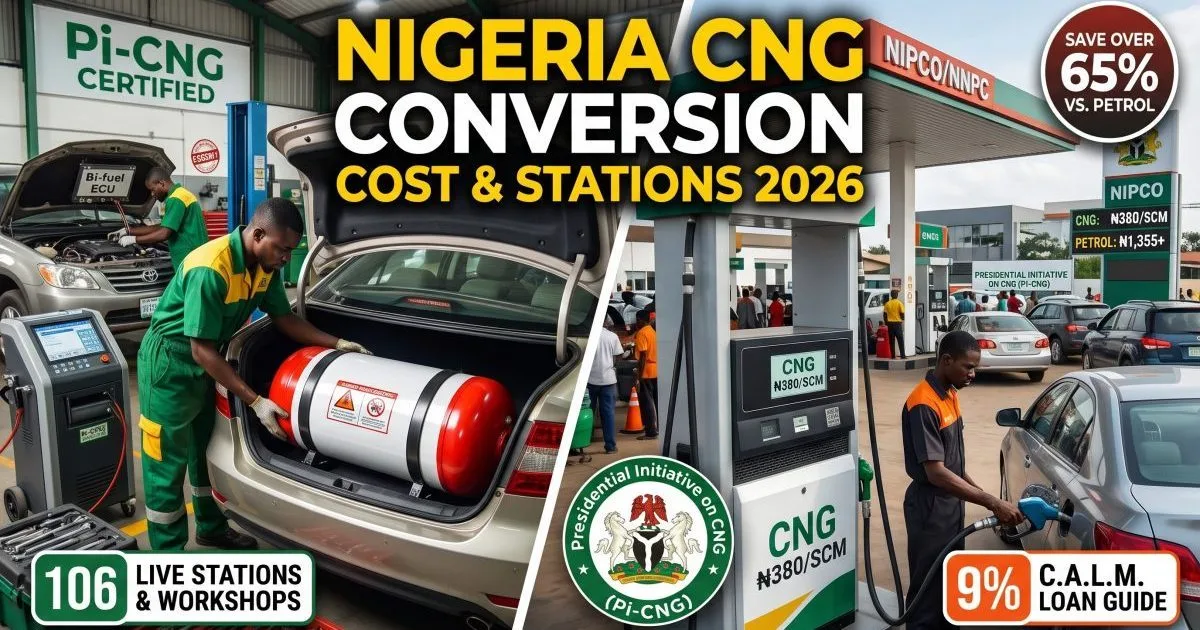
Key Takeaways: Nigeria CNG Conversion Cost & Stations (November 2026 Update)
- 2026 Conversion Cost Range: Converting a petrol vehicle to Compressed Natural Gas (CNG) currently costs between ₦650,000 and ₦2,500,000 depending on your vehicle category (4-cylinder sedan, 6-cylinder SUV, commercial minibus, or heavy-duty truck) and cylinder size.
- CNG vs. Petrol Pump Price: According to the National Automotive Design and Development Council (NADDC), CNG sells at roughly ₦380 per Standard Cubic Metre (SCM) for cars and buses (with select Abuja stations charging ₦200 to ₦250/SCM and heavy-duty trucks paying ₦450/SCM), compared to petrol at ₦1,355+ per litre.
- 106 Live Stations & $2.6B Investment: As of November 2026, Nigeria has hit 106 operational CNG refuelling stations (with 170 more under construction and 500 new MDGIF infrastructure units ordered by President Bola Tinubu), alongside 400+ certified conversion centres and over 120,000 converted vehicles.
- Free Conversions & 9% C.A.L.M. Loans: Commercial drivers registered under recognized transport unions qualify for free or heavily subsidised conversions, while private car owners and salary earners can finance conversions through the 9% interest Project C.A.L.M. Loan (powered by MOFI, CREDICORP, Pi-CNG, and Moniepoint).
- Dual-Fuel Flexibility: Converted vehicles remain bi-fuel (dual-fuel)—allowing you to switch seamlessly between CNG and petrol at the tap of a dashboard button whenever you drive outside a gas-station corridor.
With retail petrol (PMS) prices hovering around ₦1,355 per litre across Nigerian filling stations in late 2026, households, ride-hailing drivers, commercial transporters, and haulage companies are turning to Compressed Natural Gas (CNG) in record numbers. Driven by the Federal Government’s Presidential Initiative on Compressed Natural Gas and Electric Vehicles (Pi-CNG & EV), what began as a pilot policy following fuel subsidy removal has evolved into a massive nationwide automotive transition—attracting over $2.6 billion in private-sector capital and surpassing 120,000 converted vehicles across the federation.
In November 2026, Nigeria’s gas mobility network crossed a major infrastructure threshold as the number of live, operational CNG refuelling stations hit 106 nationwide, punctuated by the inauguration of a new CNG Integrated Refuelling Unit (IRU) at a formerly abandoned petrol station at the State House in Abuja—a joint venture between the State House, Pi-CNG & EV, and Rolling Energy Limited capable of refuelling 150 vehicles and converting 12 cars daily. Furthermore, with 170 additional stations currently under development and President Bola Tinubu ordering another round of 500 gas dispensing infrastructure units through the Midstream and Downstream Gas Infrastructure Fund (MDGIF), the era of scarce gas refuelling points is rapidly receding.
Yet before handing your car keys over to a conversion workshop, you need hard numbers and verified facts. How much does a complete sequential CNG kit and cylinder installation cost in November 2026 for a 4-cylinder sedan versus a V6 SUV? How many months does it take to recover a ₦650,000 conversion bill? Where are the 106 live refuelling hubs and 400+ certified workshops located, and how do you apply for the CREDICORP / MOFI Project C.A.L.M. loan to spread the cost? This exhaustive pillar guide answers every financial, technical, and safety question surrounding CNG conversion in Nigeria.
Table of Contents
- Executive Summary Table: 2026 Nigeria CNG Conversion & Fuel Metrics
- Inside the November 2026 Milestone: 106 Live Stations, $2.6B Capital & 500 MDGIF Units
- Complete 2026 CNG Conversion Cost Breakdown by Vehicle Category & Engine Size
- The Real Savings Math: CNG (₦380/SCM) vs. Petrol (₦1,355/L) & Break-Even Timeline
- How to Pay for Conversion: Free Union Subsidies & the 9% Project C.A.L.M. Credit Scheme
- State-by-State Directory of Active CNG Refuelling Stations & 400+ Conversion Centres
- Step-by-Step Guide: How to Convert Your Vehicle Safely at a Pi-CNG Certified Centre
- Living With a Dual-Fuel Car: Boot Space, Engine Power & Switching Between Gas and Petrol
- Mandatory SON & NADDC Safety Standards: Why Roadside Quack Conversions Are Deadly
- Navigating Current Bottlenecks: Beating Refuelling Queues & Mobile CNG Dispensers
- Official Pi-CNG Portals, CALM Loan Links & Regulatory Contacts
- Frequently Asked Questions (FAQs)
1. Executive Summary Table: 2026 Nigeria CNG Conversion & Fuel Metrics
Review the verified national benchmarks governing vehicle conversion pricing, gas tariffs, and station infrastructure across Nigeria as of November 2026:
| Industry Parameter | Official Verified Details (November 2026) |
|---|---|
| Coordinate Federal Agency | Presidential Initiative on Compressed Natural Gas & Electric Vehicles (Pi-CNG & EV) |
| Technical & Safety Regulators | NADDC, Standards Organisation of Nigeria (SON), and NMDPRA |
| 2026 Conversion Cost Range | ₦650,000 to ₦2,500,000 (varies by cylinder capacity, engine cylinders, and vehicle class) |
| Official CNG Price per SCM | ₦380/SCM for cars & buses (₦200–₦250 at select FCT outlets; ₦450/SCM for heavy-duty trucks) |
| Comparative Petrol (PMS) Price | ₦1,355+ per litre at major NNPC and independent retail stations |
| Operational CNG Refuelling Stations | 106 Live Stations nationwide (with 170 more in active construction & 500 MDGIF units ordered) |
| Certified Conversion Workshops | 400+ Pi-CNG Certified Centres across 24+ states and the FCT |
| Total Converted Vehicles | Over 120,000+ vehicles converted under the Pi-CNG framework |
| Private Sector Capital Attracted | $2.6 Billion USD in private downstream gas and mobility investments |
| Government Credit & Loan Scheme | Project C.A.L.M. Fund (MOFI + CREDICORP + Pi-CNG) & Moniepoint loans starting from 9% interest |
2. Inside the November 2026 Milestone: 106 Live Stations, $2.6B Capital & 500 MDGIF Units
For the first 18 months of Nigeria’s gas-to-mobility rollout, sceptics argued that converting a car to run on compressed natural gas was impractical because drivers had nowhere to refuel. As of November 2026, that narrative has shifted dramatically as public-private partnerships move from proof-of-concept into aggressive nationwide scaling.
On Friday, November 6, 2026, the Federal Government underscored this momentum by reopening a formerly abandoned petrol filling station inside the State House complex in Abuja, newly converted into a high-capacity CNG Integrated Refuelling Unit (IRU) and conversion hub through a joint venture between the State House Management (led by Permanent Secretary Mr. Temitope Fashedemi), Pi-CNG & EV, and private operator Rolling Energy Limited. The newly commissioned facility boasts the capacity to refuel 150 vehicles per day and convert 12 vehicles daily, with 10 State House JAC utility vehicles and Villa staff shuttle buses already operating as CNG hybrids.
Speaking on the national expansion milestone, the Pi-CNG leadership confirmed four major developments that every Nigerian motorist and investor should note:
- 106 Operational Refuelling Stations Live: In less than two years, Nigeria has scaled from a handful of pilot depots in Lagos and Edo to 106 active CNG dispensing stations across the federation, with another 170 stations currently in various stages of construction and licensing.
- $2.6 Billion in Private Investment: Private energy firms—including NIPCO Gas, NNPC Gas Marketing Ltd (NGML), Rolling Energy, Bovas, Greenville LNG/CNG, Tetracore, and Axxela—have committed over $2.6 billion into mother-stations, daughter-booster stations, virtual gas pipelines, and conversion centres.
- 500 New Infrastructure Units via MDGIF: To eliminate dry gas corridors in the South-East, North-East, and North-West, President Bola Tinubu has ordered a fresh wave of 500 gas infrastructure units funded through the Midstream and Downstream Gas Infrastructure Fund (MDGIF), targeting deployment across existing PMS retail outlets.
- AKK Pipeline Feedgas Boost: With the Nigerian National Petroleum Company Limited (NNPC Ltd) confirming that the Ajaokuta–Kaduna–Kano (AKK) Gas Pipeline is scheduled to commence gas delivery to Abuja and northern industrial corridors before the end of 2026, northern CNG mother-stations will soon transition from trucked virtual pipelines to direct pipeline feedgas—further crashing operating costs.
3. Complete 2026 CNG Conversion Cost Breakdown by Vehicle Category & Engine Size
How much will you actually pay at a certified workshop in late 2026? Because sequential conversion kits, Electronic Control Units (ECUs), high-pressure regulators, and seamless steel or composite cylinders are predominantly imported, retail conversion prices fluctuate with the foreign exchange rate. In October and November 2026, unsubsidised commercial quotes at certified centres range from ₦650,000 for a standard 4-cylinder passenger car to ₦2,500,000 for heavy-duty commercial buses and articulated trucks.
Below is the detailed 2026 cost breakdown across vehicle classes, including kit hardware, cylinder sizing, and certified labour charges:
| Vehicle Class & Engine Type | Recommended Cylinder Size | 2026 Private Market Cost (₦) | Union / Subsidised Scheme Rate |
|---|---|---|---|
| 1. Tricycles (Keke NAPEP / Marwa) (Single-Cylinder Spark Ignition) |
25L – 30L Water Capacity (~5–6 SCM) | ₦350,000 – ₦480,000 | Free or 50% subsidised via registered Keke unions |
| 2. 4-Cylinder Sedans & Hatchbacks (Toyota Corolla, Camry, Honda Civic, Hyundai Accent) |
60L – 75L Water Capacity (~12–15 SCM) | ₦650,000 – ₦850,000 | Free/Subsidised for union taxis; 9% CALM loan for private cars |
| 3. 6-Cylinder (V6) SUVs & Minivans (Toyota Sienna, Highlander, Lexus RX350, Honda Pilot) |
75L – 100L (or Twin 50L Cylinders; ~15–20 SCM) | ₦850,000 – ₦1,200,000 | 50% discount for inter-state union minivans; 9% CALM loan |
| 4. 14–18 Seater Commercial Buses & V8 SUVs (Toyota Hiace Hummer Bus, Nissan Urvan, Lexus GX/LX) |
100L – 140L Multi-Cylinder Rack (~20–28 SCM) | ₦1,100,000 – ₦1,650,000 | Priority free/subsidised batching via NURTW, NARTO & RTEAN |
| 5. Heavy-Duty Haulage Trucks & Mass Transit Buses (Dual-Fuel Diesel-CNG / Dedicated Gas Engines) |
400L – 800L Cascade Cylinder Pack (~80–160 SCM) | ₦1,800,000 – ₦2,500,000+ | Corporate fleet financing & MDGIF/NARTO credit lines |
Pro-Tip Before Paying Any Workshop: Always request written, itemized quotes from at least two different Pi-CNG certified conversion centres in your city. Confirm whether the quoted price includes the high-pressure seamless steel cylinder, the sequential fifth-generation ECU kit, the fabricated trunk bracket/stand, the refuelling NGV1/NGV2 nozzle adapter, and the official NADDC/Pi-CNG safety certificate.
4. The Real Savings Math: CNG (₦380/SCM) vs. Petrol (₦1,355/L) & Break-Even Timeline
Why are commercial drivers and daily commuters willing to invest ₦650,000 to ₦900,000 upfront to convert their vehicles? The answer lies in the massive spread between the pump price of petrol and the regulated retail tariff of compressed natural gas, combined with superior thermal efficiency.
In Nigeria, petrol is dispensed by the Litre (L), whereas CNG is dispensed by the Standard Cubic Metre (SCM). In terms of energy content and road mileage, 1 SCM of CNG delivers roughly the same driving distance as 1.15 to 1.25 litres of petrol. According to figures confirmed by the National Automotive Design and Development Council (NADDC), licensed CNG retailers sell gas at approximately ₦380 per SCM for passenger cars and buses (and ₦450 per SCM for heavy-duty trucks, while subsidized stations in Abuja dispense as low as ₦200 to ₦250 per SCM). By contrast, petrol at NNPC retail outlets in Lagos and across the states sells for roughly ₦1,355 to ₦1,400+ per litre.
Look at the real-world monthly and annual savings calculation below for three typical Nigerian vehicle owners:
| Driver Profile | Monthly Petrol Spend (@ ₦1,355/L) | Equivalent Monthly CNG Spend (@ ₦380/SCM) | Monthly Savings (₦) | Time to Recover ₦650k Conversion |
|---|---|---|---|---|
| 1. Uber / Bolt / City Taxi Driver (Drives 120–150 km daily; ~15L/day) |
₦528,450 / month | ₦133,380 / month | ₦395,070 / month | 1.6 to 2 Months! |
| 2. Moderate Commercial / Delivery Driver (Spends ~₦200,000 monthly on petrol) |
₦200,000 / month | ₦51,000 – ₦85,000 / month | ₦115,000 – ₦149,000 / month | 4.5 to 6 Months |
| 3. Daily Office Commuter (Private Car) (Drives 40 km daily to work; ~45L/week) |
₦243,900 / month | ₦61,560 / month | ₦182,340 / month | 3.5 to 4 Months |
| 4. Weekend-Only Private Car Owner (Light local errands; ~15L/week) |
₦81,300 / month | ₦20,520 / month | ₦60,780 / month | 10.5 to 11 Months |
As industry experts note, for heavy-duty haulage trucks transporting food and manufactured goods across state lines, switching to gas-powered trucks cuts total haulage fuel costs by at least 40% to 60%, while passenger car drivers save between 60% and 75% on every full tank refill.
5. How to Pay for Conversion: Free Union Subsidies & the 9% Project C.A.L.M. Credit Scheme
If you do not have ₦650,000 sitting idle in your bank account, you do not have to pay out-of-pocket upfront. The Federal Government has structured three distinct financial pathways to help Nigerians convert their vehicles:
Pathway 1: Free & 50%-Subsidised Conversions for Commercial Unions (CIP)
Under the Conversion Incentive Programme (CIP) managed by Pi-CNG, commercial mass-transit vehicles operating under recognized transport associations—including the National Union of Road Transport Workers (NURTW), Road Transport Employers Association of Nigeria (RTEAN), Nigerian Association of Road Transport Owners (NARTO), and registered e-hailing associations (Uber/Bolt/LagRide)—qualify for free conversion kits or a 50% government subsidy. Vehicles are nominated in batches through union leadership and inspected at designated CIP conversion parks across the states.
Pathway 2: Project C.A.L.M. Fund (MOFI + CREDICORP + Pi-CNG) — From 9% Interest
For private vehicle owners, civil servants, corporate workers, and independent entrepreneurs, the Federal Government launched the ₦10 Billion Project C.A.L.M. (Credit Access for Light and Mobility) Fund. Operated jointly by the Ministry of Finance Incorporated (MOFI), the Nigerian Consumer Credit Corporation (CREDICORP), and Pi-CNG, alongside participating financial institutions like Moniepoint, Credit Direct, and Wema Bank, Project C.A.L.M. provides low-interest consumer loans (starting around 9% interest) to cover 100% of your CNG conversion cost.
- How the Repayment Works: Instead of paying ₦650,000 upfront, the participating lender pays the certified Pi-CNG conversion workshop directly. Your weekly or monthly fuel savings (the 60%–80% you save by buying gas at ₦380/SCM instead of petrol at ₦1,355/L) comfortably pays off the loan over 4 to 6 months, after which you pocket 100% of the fuel savings permanently.
- How to Apply for the C.A.L.M. CNG Loan Online: Visit the official CREDICORP C.A.L.M. portal at https://www.credicorp.ng/initiatives/calm-fund (or
blog.credicorp.ng/calm), select “CNG Conversion” as your loan product, input your name, phone number, residential address, occupation category (Federal/State Civil Servant, Private Company Staff, Entrepreneur/Trader, or Student), monthly income band, and your car’s make and model (e.g., Toyota, Honda, Ford, Lexus), and submit.
Pathway 3: Corporate Fleet & Civil Servant Conversion Financing
Following the November 6, 2026 launch of the State House CNG station in Abuja, federal ministries, departments, and agencies (MDAs) are rolling out structured payroll-deduction conversion packages with partners like Rolling Energy Ltd so civil servants can convert their personal vehicles at work and repay seamlessly over several months.
6. State-by-State Directory of Active CNG Refuelling Stations & 400+ Conversion Centres
Before converting your vehicle, the single most important rule is to confirm that there is a live CNG refuelling station along your daily driving route. With 106 stations now live and over 400 certified conversion workshops operating across 24+ states and the FCT, here is the regional directory of major operational refuelling corridors and conversion hubs:
| State / Metropolitan Hub | Key Operational CNG Refuelling Stations (Among the 106 Live Hubs) | Major Pi-CNG Certified Conversion Centres |
|---|---|---|
| 1. Abuja (FCT) | State House / Rolling Energy IRU (Asokoro/Karu), NIPCO Airport Road (Chika/Lugbe), NNPC Mega Station (Central Area/Kubwa), Bovas & NIPCO Dei-Dei / Dutse corridors | Rolling Energy Conversion Centre (State House/Karu), ऑटो/NIPCO Idu &Airport Road Hubs, NADDC/Pi-CNG Utako & Kugbo Centres |
| 2. Lagos State | NIPCO Ibafo/Berger (Lagos-Ibadan Exp.), NIPCO Lateef Jakande Rd (Agidingbi, Ikeja), NNPC/NGML Marina, Mushin, Oyingbo, Lekki-Epe Expressway & Apapa corridors | Femadec Express (ki/Surulere), GAC Motors Conversion Hub, Autogig (Gbagada), Mezovest, Luкеm, and 60+ accredited Lagos garages |
| 3. Ogun & Oyo States (South-West Corridor) | NIPCO Mowe/Ibafo Mother Station, Sagamu Interchange CNG Hub, Abeokuta NNPC/NIPCO Outlets, Bovas & NIPCO Toll-Gate / Ring Road / Ojoo stations (Ibadan) | NIPCO Ibafo Conversion Workshop, RT Briscoe / Pi-CNG Ibadan Hubs, Abeokuta Mechanic Village Accredited Centres |
| 4. Edo & Delta States (Benin–Warri Hub) | Over 12 long-standing NIPCO CNG stations across Benin City (Auchi Rd, Sapele Rd, Lagos-Benin Bypass, Sakponba Rd) & Warri/Effurun outlets | NIPCO Benin Central Conversion Workshops (Auchi Rd & Sapele Rd)—Nigeria’s oldest commercial CNG cluster |
| 5. Rivers State (Port Harcourt) | Fescyp Oil Station (Aba Road), Ivan Oil & Gas (Obi Wali Road, Rumuigbo), Trans-Amadi & East-West Road gas corridors | Arus CNG Rivers, Ken Saro-Wiwa Polytechnic Skills Centre (Bori), Port Harcourt Accredited Pi-CNG Centres |
| 6. Enugu, Anambra & Imo (South-East) | NIPCO Abakpa Nike & Shafa Energy 9th Mile (Enugu), AA Rano (Enugu-PH Exp.), Juhel Awka, Pamtech & PQ Oils (Port Harcourt Rd, Owerri) | Innoson Vehicle Manufacturing (IVM) Nnewi CNG Hub, DriveGreen CNG Hub (Enugu & Owerri), Arus CNG Enugu |
| 7. Kaduna, Kano & Kwara (Northern Corridor) | Greenville / Pinnacle Stations (Nnamdi Azikiwe Bypass, Kaduna), NU Synergy Stations (Kano), Rolling Energy & Bovas Stations (Ilorin, Kwara) | Kuru Energy International (Kakuri, Kaduna), Faidah Auto Diagnostic, Ilorin Pi-CNG Conversion Parks |
7. Step-by-Step Guide: How to Convert Your Vehicle Safely at a Pi-CNG Certified Centre
Converting an internal combustion engine to operate on high-pressure natural gas (stored at roughly 200 bar / 2,900 psi) is a precision engineering procedure. Never allow an unaccredited mechanic to tamper with your fuel system. Follow this 6-step official workflow:
Step 1: Verify Engine Compatibility (Pre-Inspection)
Almost all fuel-injected petrol (spark-ignition) vehicles in good mechanical condition can be seamlessly converted using a 5th-generation sequential CNG kit. However, if your engine currently suffers from severe misfires, worn piston rings, blown head gaskets, or faulty ignition coils, you must fix those mechanical faults before converting—because natural gas has a higher ignition temperature than petrol and will immediately expose weak spark plugs or coils. (Note: Diesel engines are compression-ignition and cannot use simple passenger petrol kits; they require specialized heavy-duty dual-fuel diesel-gas systems.)
Step 2: Select Two Accredited Workshops from the Pi-CNG Map
Visit the official Pi-CNG conversion directory at https://pci.gov.ng/conversion-centers.html (or download the NGVMS / Pi-CNG app) to find certified centres in your state. Visit at least two centres for an OBD-II diagnostic scan and collect written quotes specifying the kit brand, cylinder volume, and warranty duration.
Step 3: Under-Bonnet Sequential Kit & ECU Installation
Once booked in, certified technicians install the under-bonnet components without removing your existing petrol system: a multi-stage high-pressure gas regulator (reducer) connected to the engine’s coolant loop, a low-pressure gas filter, a sequential gas injector rail mounted near the intake manifold, a dashboard fuel-selector switch/gauge, and a dedicated CNG Electronic Control Unit (ECU) that communicates with your car’s factory computer.
Step 4: High-Pressure Cylinder Mounting in the Boot
A heavy-duty, seamless steel (Type-1) or composite fibre-wrapped (Type-2/Type-3) CNG cylinder is bolted securely onto a welded steel cradle inside your vehicle’s boot (or underneath the chassis on select high-clearance SUVs and buses), fitted with an automatic solenoid shut-off valve and burst-disc safety relief valve.
Step 5: High-Pressure Nitrogen/Gas Leak Testing & ECU Mapping
Before you drive out (typically within 5 to 8 hours for a standard passenger car), technicians pressurize the stainless-steel fuel lines, test every joint with electronic gas-sniffer probes to guarantee zero leaks, and use laptop calibration software to map the gas fuel-trim curve across idle, city cruising, and highway acceleration.
Step 6: Collect Your Official Conversion Certificate & Compliance Sticker
Ensure the centre issues your Pi-CNG / NADDC Conversion Certificate, your cylinder hydro-test serial record, and your windshield compliance sticker. Without this certificate and sticker, licensed CNG stations are strictly prohibited from dispensing gas into your vehicle.
8. Living With a Dual-Fuel Car: Boot Space, Engine Power & Switching Between Gas and Petrol
Before converting, every car owner should understand the realistic day-to-day trade-offs of driving a CNG-converted vehicle on Nigerian roads:
- 1. Automatic Petrol-to-CNG Switching (Keep 10–15 Litres of Petrol in Your Tank!): Even after converting to CNG, never run your petrol tank completely dry. Sequential 5th-generation systems always start the engine on petrol for the first 30 to 90 seconds until the engine coolant warms the gas regulator to ~40°C, at which point it switches automatically to CNG. Keeping at least quarter-tank of petrol also cools and lubricates your electric fuel pump and gives you instant backup range if you run out of gas between cities.
- 2. Boot Space Reduction: In a compact sedan (such as a Toyota Corolla or Hyundai Elantra), a 65-litre or 75-litre cylindrical tank will occupy roughly 40% to 50% of your luggage boot space. SUVs, station wagons, and minivans handle cylinder placement much more comfortably.
- 3. Slight Power Difference on Steep Hills: Because natural gas displaces a small fraction of intake air in a naturally aspirated petrol engine, you may notice a minor 5% to 8% dip in peak torque when climbing steep hills with a full passenger load and the air-conditioner running. Simply tapping the dashboard switch back to petrol restores 100% factory torque whenever needed.
- 4. Cleaner Engine Oil & Longer Engine Life: Because CNG burns cleanly as a dry gas with an octane rating around 120–130 RON ( eliminating engine knocking and carbon soot deposits), your engine oil stays golden-clean much longer, and cylinder wall wear from unburned liquid fuel wash is eliminated.
- 5. Scheduled Maintenance Rules: Replace your low-pressure CNG gas filter every 10,000 to 15,000 km, use healthy iridium or platinum spark plugs, and have your conversion centre inspect high-pressure fittings every 6 months.
9. Mandatory SON & NADDC Safety Standards: Why Roadside Quack Conversions Are Deadly
Life-Saving Safety Warning: Never Use LPG (Cooking Gas) Cylinders or Welded Tanks for CNG!
Every isolated cylinder rupture incident reported in Nigeria has been traced by SON, NMDPRA, and Pi-CNG investigators to illegal roadside fabrication. Understand the physics before anyone touches your car:
- 200 Bar (CNG) vs. 7–15 Bar (Cooking Gas / LPG): Compressed Natural Gas is stored at an extreme pressure of 200 Bar (nearly 3,000 PSI)—more than 15 times higher than household LPG cooking gas cylinders or air-conditioner refrigerant tanks. Installing a welded, seamed, or repurposed LPG tank for CNG will cause the cylinder to explode like a bomb during refuelling.
- Only ISO 11439 & SON Certified Seamless Cylinders Are Legal: Genuine automotive CNG cylinders are forged from a single piece of thick, high-tensile chromium-molybdenum steel with zero weld seams anywhere on the body, certified to ISO 11439 and Standards Organisation of Nigeria (SON) standards.
- Check the Cylinder Expiry & Hydro-Test Stamp: Every legal CNG cylinder has its manufacturing date, working pressure (`200 BAR`), test pressure (`300 BAR`), and 15-to-20-year expiry date permanently stamped into the metal shoulder of the cylinder, requiring periodic hydro-static re-testing every 3 to 5 years.
- Why CNG Is Safer Than Petrol When Installed Properly: Unlike liquid petrol, which pools on the ground and ignites violently in a crash, natural gas is lighter than air (dissipating rapidly upward into the atmosphere if a leak occurs) and requires an ignition temperature above 540°C (twice as high as petrol).
10. Navigating Current Bottlenecks: Beating Refuelling Queues & Mobile CNG Dispensers
While the expansion to 106 live refuelling stations in November 2026 has dramatically improved access in Abuja, Lagos, Ogun, Edo, Oyo, and Rivers, rapid adoption by over 120,000 vehicles means drivers still encounter queues at busy urban daughter-stations during peak hours. Here is how experienced CNG motorists beat the wait times—and how the government is fixing the gap:
- Refuel at Mother Stations vs. Daughter Stations: “Mother stations” (connected directly to high-pressure natural gas pipelines, such as NIPCO Ibafo, Ikeja Agidingbi, or Benin Bypass) maintain constant compressor pressure and fill a car in 3 to 5 minutes. “Daughter stations” rely on tube-skid trailers trucked in from mother stations; once the trailer pressure drops, filling slows down. Prioritize pipeline-fed mother stations or newly installed Integrated Refuelling Units (IRUs) whenever possible.
- Use Off-Peak Refuelling Windows: Commercial buses and taxis typically queue between 7:00 AM–10:00 AM and 4:00 PM–8:00 PM. Topping up your cylinder late at night or early in the morning cuts waiting times to near zero.
- Deployment of Mobile CNG Refuelling Units & 500 MDGIF Stations: As confirmed in November 2026, Pi-CNG and private partners are rolling out Mobile CNG Dispensing Units alongside the 170 stations under construction and the 500 new MDGIF-backed infrastructure units ordered by the President for deployment across existing petrol filling stations nationwide.
11. Official Pi-CNG Portals, CALM Loan Links & Regulatory Contacts
Bookmark and use only these verified Federal Government and partner web portals to locate certified conversion centres, verify active refuelling stations, or apply for conversion financing:
| Platform / Programme | Official Web Portal / Access Channel | Primary Function |
|---|---|---|
| 1. Presidential CNG Initiative (Pi-CNG) | https://pci.gov.ng/ | Master portal for policy updates, union incentives & accreditation |
| 2. Certified Conversion Centres Map | pci.gov.ng/conversion-centers.html | Directory of all 400+ Pi-CNG approved conversion workshops by state |
| 3. Project C.A.L.M. Fund (CREDICORP / MOFI) | credicorp.ng/initiatives/calm-fund | Apply for 9% low-interest consumer loans for CNG conversion & solar |
| 4. Direct C.A.L.M. Loan Application Form | blog.credicorp.ng/calm | Online application form for civil servants, private workers & traders |
| 5. National Automotive Council (NADDC) | https://naddc.gov.ng/ | Technical training standards, kit certification & tariff monitoring |
12. Frequently Asked Questions (FAQs) About Nigeria CNG Conversion in 2026
1. How much does it cost to convert a car to CNG in Nigeria in 2026?
In late 2026, converting a vehicle to CNG at a certified workshop costs between ₦650,000 and ₦2,500,000 depending on the vehicle class, number of engine cylinders, and storage tank capacity. Standard 4-cylinder passenger cars typically cost between ₦650,000 and ₦850,000, while 6-cylinder SUVs and commercial minibuses range from ₦850,000 to ₦1.65 million.
2. What is the price of CNG per SCM compared to a litre of petrol in Nigeria?
According to the National Automotive Design and Development Council (NADDC), compressed natural gas sells for approximately ₦380 per Standard Cubic Metre (SCM) for passenger cars and buses (with some Abuja stations charging ₦200 to ₦250/SCM, and heavy-duty trucks paying ₦450/SCM). By comparison, petrol sells for around ₦1,355+ per litre—allowing CNG drivers to save 60% to 75% on fuel costs.
3. How many live CNG refuelling stations are currently operating in Nigeria?
As of November 2026, Nigeria has 106 operational CNG refuelling stations nationwide, backed by $2.6 billion in private investment. An additional 170 stations are currently under development, alongside 500 new infrastructure units ordered by President Bola Tinubu through the Midstream and Downstream Gas Infrastructure Fund (MDGIF).
4. How can private car owners get the 9% Federal Government loan for CNG conversion?
Private vehicle owners, salary earners, and small business operators can apply for low-interest conversion financing (starting from 9%) through Project C.A.L.M. (Credit Access for Light and Mobility)—a partnership between MOFI, CREDICORP, Pi-CNG, and lenders like Moniepoint—by visiting credicorp.ng/initiatives/calm-fund.
5. Will my car still use petrol after being converted to CNG?
Yes. All standard Pi-CNG passenger conversions are bi-fuel (dual-fuel) systems. Your vehicle starts on petrol to warm the regulator before automatically switching to CNG, and you can press a button on your dashboard at any time to switch back to petrol if your gas cylinder runs empty on a highway without a nearby CNG station.
6. Is a CNG cylinder in the car boot safe in hot Nigerian weather or rear-end collisions?
Yes, provided the conversion is performed at one of the 400+ Pi-CNG certified centres using an ISO 11439 / SON-approved seamless high-pressure steel or composite cylinder. Certified CNG cylinders are engineered with thick seamless walls tested to 300 Bar and equipped with automatic thermal/pressure relief valves. Danger only arises when illegal roadside mechanics weld or repurpose low-pressure LPG cooking gas tanks.


0 Comments
No comments yet. Be the first to share your thoughts!