




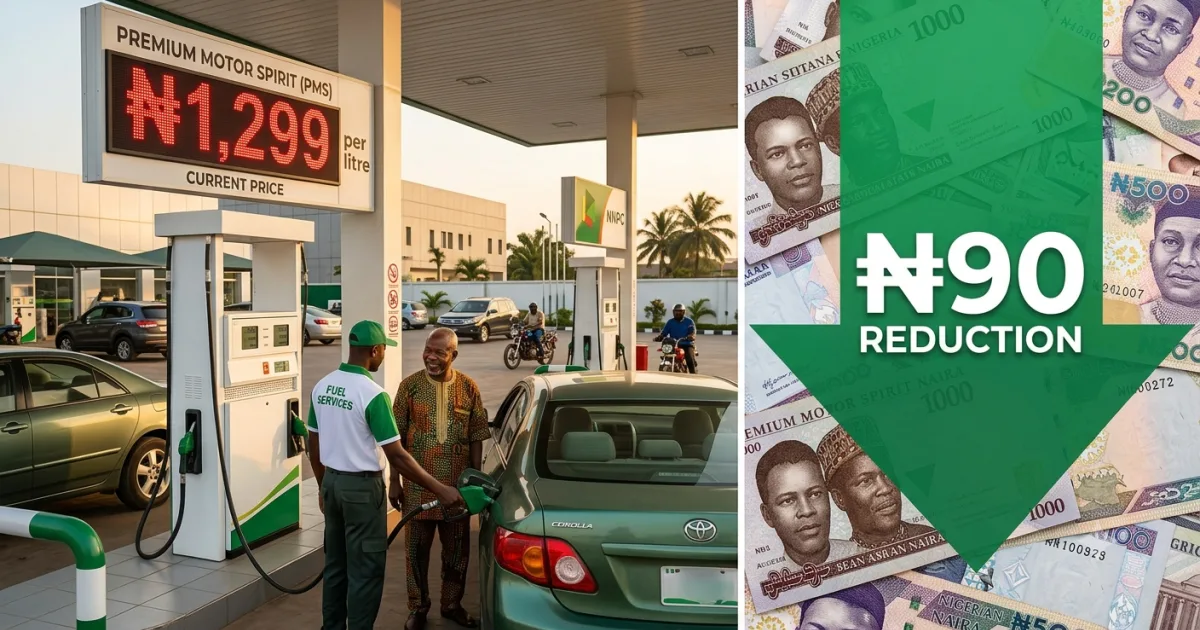
📌 Quick Summary: Nigerian filling stations have cut petrol (PMS) prices by a cumulative ₦90 per litre over three weeks — from a high of ₦1,389 to the current ₦1,299 at NNPC stations, with independent marketers following suit. The Dangote Petroleum Refinery’s naira-denominated pricing and increased domestic production are driving the reduction. Here is the state-by-state price tracker, how much you are saving per tank, and whether prices will fall further.
Three weeks ago, filling your tank in Lagos cost ₦90 more per litre than it does today. That is not a rounding error — it is the most significant sustained fuel price reduction in Nigeria since the era of government-subsidised pricing ended. Between late July and 19 August 2026, Nigerian filling stations cut the pump price of Premium Motor Spirit (PMS) by a cumulative ₦90 per litre — driven by a combination of Dangote Petroleum Refinery’s switch to naira pricing, NNPC’s decision to pass on refinery savings to the pump, and the growing competitive pressure that domestic refining is finally beginning to exert on Nigeria’s long-dysfunctional fuel supply chain. This is the complete tracker — current prices by state, how much you are saving, and what comes next.
The ₦90 Drop: Timeline of the Price Reduction
| Date | NNPC Pump Price | Key Driver |
| Late July 2026 | ₦1,389/litre | Baseline before Dangote naira switch |
| Early August 2026 | ₦1,335/litre | First NNPC reduction — ₦54 cut |
| 4 August 2026 | ₦1,299/litre | Second NNPC reduction — further ₦36 cut |
| Mid August 2026 | ₦1,299/litre | Price held — independent marketers adjusting |
| Total reduction | ₦90/litre | Cumulative over 3 weeks |
The mechanism is straightforward. Dangote Petroleum Refinery — which began supplying Nigerian marketers in naira rather than dollars — removed the currency risk premium that had been embedded in every litre of petrol sold through independent marketers. When marketers pay for fuel in naira at a known, stable price rather than in dollars at a fluctuating exchange rate, they can price at the pump with confidence rather than building in currency risk buffers. NNPC, responding to the competitive and political pressure from Dangote’s entry into domestic supply, cut its own price twice in rapid succession. The market followed.
Current Fuel Prices by State — August 2026 Tracker
| State / Region | NNPC Price | Independent Marketers | Cheapest Available |
| Lagos | ₦1,299 | ₦1,300–₦1,350 | ₦1,299 (NNPC stations) |
| Abuja (FCT) | ₦1,299 | ₦1,299–₦1,340 | ₦1,299 (NNPC stations) |
| Port Harcourt | ₦1,299 | ₦1,300–₦1,370 | ₦1,299 |
| Oyo / Ibadan | ₦1,299 | ₦1,310–₦1,360 | ₦1,299–₦1,310 |
| Ogun | ₦1,299 | ₦1,310–₦1,370 | ₦1,299–₦1,320 |
| Kano | ₦1,299 | ₦1,340–₦1,430 | ₦1,299 (select NNPC) |
| Kaduna | ₦1,299 | ₦1,350–₦1,450 | ₦1,299 (select NNPC) |
| Enugu | ₦1,299 | ₦1,320–₦1,400 | ₦1,299–₦1,320 |
| Owerri / Imo | ₦1,299 | ₦1,320–₦1,420 | ₦1,320 |
| Benin City / Edo | ₦1,299 | ₦1,310–₦1,380 | ₦1,299–₦1,310 |
| Maiduguri / Northeast | ₦1,299 | ₦1,450–₦1,650 | ₦1,450 (logistics premium) |
| Remote rural areas | Varies | ₦1,500–₦1,800 | ₦1,500+ (last-mile cost) |
Prices are indicative as of 21 August 2026. Fuel prices change frequently — verify at the pump before filling. NNPC stations offer the most consistent adherence to the official ₦1,299 price.
How Much Are You Actually Saving?
The ₦90 per litre reduction sounds significant — and it is. Here is what the cumulative cut means for real Nigerian fuel consumers:
| Vehicle Type | Typical Tank Size | Savings Per Full Tank | Monthly Savings (2 fill-ups) |
| Small car (Corolla, Civic, Camry) | 50–60 litres | ₦4,500–₦5,400 | ₦9,000–₦10,800 |
| SUV / Jeep (Hilux, Fortuner, Prado) | 70–90 litres | ₦6,300–₦8,100 | ₦12,600–₦16,200 |
| Commercial bus (18-seater) | 80–100 litres | ₦7,200–₦9,000 | ₦43,200–₦54,000 (3x/week) |
| Petrol generator (I-pass-my-neighbor) | 5–10 litres per fill | ₦450–₦900 | ₦3,600–₦7,200 (daily use) |
| Large diesel truck / tanker | 300–400 litres | ₦27,000–₦36,000 | Significant logistics cost relief |
For the average Lagos commuter filling a 55-litre tank twice a month, the ₦90 reduction saves approximately ₦9,900 per month — nearly 15% of Nigeria’s minimum wage. For a commercial bus driver filling up three times per week, the cumulative monthly saving approaches ₦50,000. These are real, material improvements in household and business finances — not just headline numbers.
The Dangote Factor: Why Domestic Refining Changes Everything
The reason this price reduction is structurally different from previous NNPC price adjustments — which were often reversed or proved unsustainable — is the Dangote Petroleum Refinery. Nigeria’s longest-running economic vulnerability has been its dependence on imported refined petroleum products despite being one of Africa’s largest crude oil producers. Every time the naira fell against the dollar, imported fuel became more expensive at the pump — regardless of what the government said the official price should be. The Dangote Refinery changes this equation by producing refined petrol domestically, priced in naira, insulated from dollar exchange rate swings. As the refinery scales up production toward its nameplate capacity of 650,000 barrels per day, its price-setting influence on the Nigerian market will only grow. The ₦90 reduction of August 2026 may be the first of several further reductions if production continues to scale as projected.
Will Fuel Prices Fall Further in Nigeria?
Three conditions determine whether further reductions occur. First, Dangote production volume — the refinery must sustain and increase output. Any production disruption would reverse the supply dynamics driving prices down. Second, naira stability — NNPC still imports some volumes, and naira weakening would increase those import costs. Third, crude oil price — if global Brent crude rises significantly, domestic production costs at Dangote increase even in naira terms. If all three conditions remain favourable, energy analysts consulted by NaijaSabi suggest a further reduction toward ₦1,100–₦1,200 per litre is achievable by early 2027. That is not a guarantee — it is a trajectory, contingent on execution.
What About Transport Fares? Will They Come Down?
This is the question every Nigerian commuter is asking — and the honest answer is: not quickly, and not proportionally. Nigerian transport fares are notoriously sticky downward. When fuel prices rose from ₦200 to ₦1,389 between 2023 and 2026, transport fares rose sharply and immediately. The reverse rarely happens at the same speed. Commercial vehicle operators — danfo drivers, okada riders, tricycle operators, bus drivers — have absorbed three years of rising costs and will not reduce fares until competitive pressure or direct regulation forces the issue. Expect isolated reductions in some routes over the coming weeks as fuel savings accumulate, but do not expect a broad, proportional fare reduction in the near term.
Frequently Asked Questions
What is the current fuel price in Nigeria today?
The official NNPC pump price is ₦1,299 per litre as of August 2026. Independent marketers in southern states sell between ₦1,299 and ₦1,370. Northern states and remote areas attract logistics premiums of ₦1,400–₦1,800 per litre.
Why did fuel prices drop in Nigeria in August 2026?
Dangote Petroleum Refinery switched from dollar to naira pricing, removing currency risk from the domestic fuel supply chain. NNPC responded with two price cuts — ₦54 and ₦36 — between late July and 4 August 2026, totalling ₦90 per litre cumulatively.
How much has fuel dropped by in Nigeria in 2026?
Nigerian fuel prices fell by a cumulative ₦90 per litre over three weeks in July–August 2026, from ₦1,389 to ₦1,299 at NNPC stations.
Is Dangote selling fuel cheaper than NNPC?
Dangote Refinery sells to marketers at the depot level in naira — not directly to consumers. The ex-depot price from Dangote (approximately ₦1,050–₦1,100 per litre) allows marketers who buy from Dangote to sell competitively at or near the ₦1,299 NNPC reference price.
Will fuel prices go below ₦1,000 in Nigeria?
Energy analysts suggest ₦1,100–₦1,200 per litre is achievable by early 2027 if Dangote scales production as projected and the naira remains stable. Below ₦1,000 is possible in the medium term but would require sustained naira appreciation and full Dangote nameplate capacity.
Why is fuel still expensive in northern Nigeria?
Northern states pay a logistics premium of ₦50–₦200 per litre above the official ₦1,299 price because fuel must be transported by truck from southern depots and refineries over long distances. Security costs on northern highways add additional logistics expenses.
Sources
- NNPC Limited — nnpcgroup.com — official pump price announcements
- NaijaSabi Finance Desk field pricing research — August 2026
Last updated: 22 August 2026 · NaijaSabi Finance Desk. Prices updated regularly — return for the latest pump prices across Nigerian states.
More From NaijaSabi Finance Desk
NaijaSabi Finance Desk publishes Nigeria’s most detailed and honestly reported coverage of fuel prices, exchange rates, economic policy, and the financial decisions that affect every Nigerian household. We track pump prices across states, exchange rates across markets, and economic policy announcements across administrations — because the numbers that govern your financial life deserve honest, specific, actionable reporting. Subscribe to our Morning Brief newsletter trusted by 52,000+ daily readers, bookmark naijasabi.com.ng/, and return to this page regularly as prices change. Share this article with anyone making fuel or financial decisions in Nigeria today.




0 Comments
No comments yet. Be the first to share your thoughts!