


📌 Quick Summary: This 4-week home workout plan for Nigerians requires zero equipment, 30 to 45 minutes per session, and 4 sessions per week. Week 1 builds foundation (3 sets of 10 reps each exercise), Week 2 adds volume (3 sets of 15), Week 3 introduces supersets, Week 4 challenges with circuits. Exercises use only bodyweight: push-ups, squats, lunges, planks, mountain climbers, burpees, glute bridges, jumping jacks. This plan works in any Nigerian home — no gym, no equipment, no electricity required. Includes a warm-up and cool-down routine, a simple Nigerian meal plan to support the training, and modifications for beginners who cannot yet do full push-ups or burpees.
Nigeria’s fitness movement has undergone a genuine cultural shift in 2026 — driven by social media, by the growing awareness of lifestyle disease risk, and by the practical reality that gym memberships in Lagos and Abuja (₦10,000 to ₦50,000 per month at quality facilities) are beyond what most Nigerians can or will spend monthly on exercise. The response has been the rise of home and outdoor fitness — bodyweight training on balconies, in compound yards, in bedrooms, and on the Lekki-Ikoyi bridge at 5:30am. This 4-week plan is designed specifically for that reality: no equipment, no gym, no excuses.
Before You Start: Principles That Make This Plan Work
Three principles that separate Nigerians who get results from home workouts from those who do not. First: consistency over intensity. A moderate workout done 4 times per week for 4 weeks produces dramatically better results than an intense workout done once, followed by 3 weeks of rest and guilt. The plan below is calibrated to be challenging enough to produce change and sustainable enough to actually complete. Second: progressive overload. Each week of this plan deliberately increases the challenge — more reps, more volume, shorter rest periods. Your body adapts to whatever stress you apply consistently; the progression ensures you keep adapting rather than plateauing. Third: nutrition matters as much as training. You can train perfectly and eat in a way that undermines every session. The meal guidance at the end of this guide is simple, Nigerian-food-based, and honest about what it takes to see body composition changes from home exercise.
Warm-Up Routine (5 Minutes — Do Before Every Session)
| Exercise | Duration | Purpose |
| March in place (high knees) | 60 seconds | Elevates heart rate gently |
| Arm circles (forward and backward) | 30 seconds each direction | Shoulder and upper back mobility |
| Hip circles (hands on hips, large circles) | 30 seconds each direction | Hip joint mobility |
| Leg swings (hold wall for balance, swing each leg forward and back) | 10 per leg | Hamstring and hip flexor mobility |
| Ankle circles | 10 per ankle | Ankle mobility — prevents injury in squat movements |
| Bodyweight squat (slow, controlled — not full workout pace) | 10 reps | Activates glutes and quads before the session |
The Exercises: Form Guide
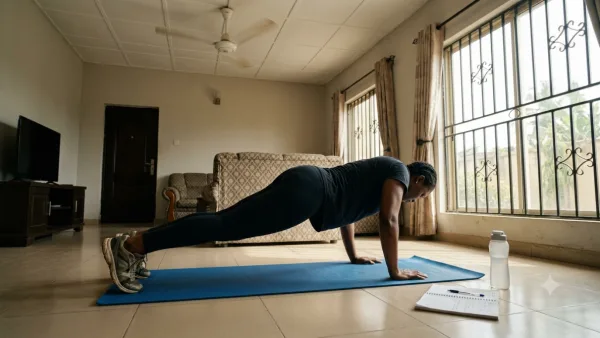
Push-ups: Hands slightly wider than shoulder-width, body in a straight line from head to heels (do not allow hips to sag or pike up), lower chest toward floor until elbows reach 90 degrees, press back up. Beginner modification: hands on a wall or raised surface (kitchen counter, table) — reduces the load while maintaining correct movement pattern. Do not do knee push-ups as a modification — they teach incorrect movement mechanics. Wall push-ups are superior.
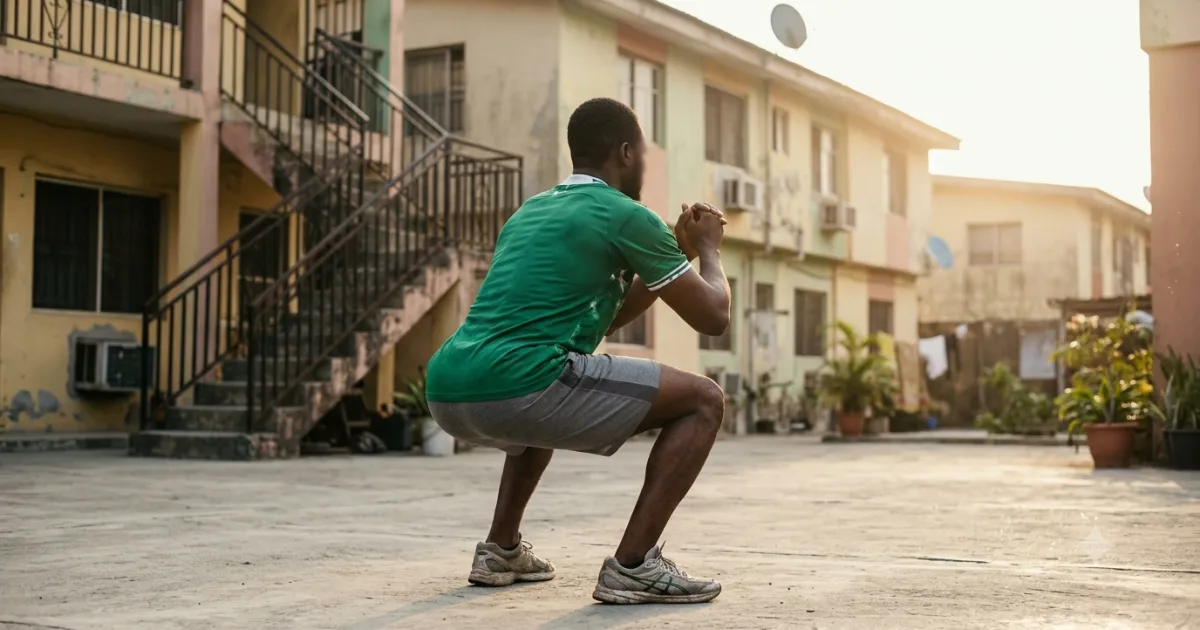
Squats: Feet shoulder-width apart, toes pointed slightly outward, weight in heels, chest up, hips back and down until thighs are parallel to the floor (or as low as mobility allows without heels rising), press through heels to stand. The most common Nigerian squat mistake: allowing knees to cave inward on the way up. Press knees outward actively throughout the movement.
Lunges: Stand tall, step one foot forward approximately 60 to 90cm, lower the back knee toward the floor while keeping the front shin vertical, push through the front heel to return to standing. Alternate legs. Keep torso upright — do not lean forward over the front knee.
Plank: Forearms on floor, elbows under shoulders, body in straight line from head to heels. Engage core (brace as if about to be punched in the stomach), squeeze glutes, keep hips level — do not let them sag or rise. Breathe normally. Hold for the prescribed time.
Mountain climbers: Start in push-up position (arms straight). Bring one knee toward chest, return it, bring the other knee toward chest. Alternate rapidly — the faster the pace, the more cardiovascular demand. Keep hips level and down.
Glute bridges: Lie on back, knees bent, feet flat on floor hip-width apart. Press through heels to lift hips until body forms a straight line from knees to shoulders. Squeeze glutes at the top for 1 second, lower. This is one of the most important exercises for Nigerians who sit at a desk or in traffic for extended periods — counteracts the hip flexor tightening and glute inhibition that sitting causes.
Burpees: Stand → squat, place hands on floor → jump feet back to push-up position → perform one push-up → jump feet back toward hands → jump up with arms overhead. One fluid movement. Scale the difficulty: skip the push-up, or skip the jump at the top if impact is an issue.
Jumping jacks: Jump feet wide while raising arms overhead simultaneously, jump feet back together while lowering arms. Classic, effective, requires zero space beyond arm’s width in each direction.
The 4-Week Plan
Week 1: Foundation (4 Sessions)
Rest 60 to 90 seconds between sets. Take a full rest day between each session — do not train on consecutive days in Week 1.
| Exercise | Sets | Reps/Duration |
| Push-ups (or wall push-ups) | 3 | 10 reps |
| Squats | 3 | 12 reps |
| Lunges | 3 | 10 each leg |
| Plank | 3 | 20 seconds |
| Glute bridges | 3 | 15 reps |
| Jumping jacks | 3 | 30 seconds |
Week 2: Volume (4 Sessions)
Rest 60 seconds between sets. You should be feeling stronger than Week 1 — if the exercises feel easy, add 1 to 2 extra reps per set.
| Exercise | Sets | Reps/Duration |
| Push-ups | 3 | 15 reps |
| Squats | 3 | 20 reps |
| Lunges | 3 | 15 each leg |
| Plank | 3 | 30 seconds |
| Mountain climbers | 3 | 30 seconds |
| Glute bridges | 3 | 20 reps |
| Jumping jacks | 3 | 45 seconds |
Week 3: Supersets (4 Sessions)
Perform paired exercises back-to-back with no rest between them. Rest 45 to 60 seconds after each pair. This increases cardiovascular demand and reduces total workout time.
| Superset | Exercise 1 | Exercise 2 | Sets × Reps |
| A | Push-ups × 15 | Squats × 20 | 3 rounds |
| B | Lunges × 15 each leg | Glute bridges × 20 | 3 rounds |
| C | Mountain climbers × 40 seconds | Plank × 40 seconds | 3 rounds |
| D | Burpees × 8 | Jumping jacks × 45 seconds | 3 rounds |
Week 4: Circuit Challenge (4 Sessions)
Perform all exercises in sequence with 20 seconds rest between each exercise and 90 seconds rest between complete circuits. Complete 4 circuits. This is the hardest week — the goal is to complete it, not to perform perfectly.
| Exercise | Reps/Duration |
| Push-ups | 15 reps |
| Squats | 20 reps |
| Burpees | 10 reps |
| Lunges | 12 each leg |
| Mountain climbers | 45 seconds |
| Glute bridges | 20 reps |
| Plank | 45 seconds |
| Jumping jacks | 60 seconds |
Cool-Down (5 Minutes — Do After Every Session)
Child’s pose (30 seconds), standing quadriceps stretch (30 seconds each leg), standing hamstring stretch (30 seconds each leg), chest opener stretch (30 seconds), seated spinal twist (30 seconds each side). Deep, controlled breathing throughout. The cool-down is not optional — it reduces delayed onset muscle soreness (DOMS), improves flexibility, and signals to your nervous system that the workout is complete.
Nigerian Nutrition to Support This Plan
No workout plan produces visible results without supporting nutrition. The simplified Nigerian food approach to support this 4-week plan. Protein at every meal — the most common gap in Nigerian home diets is insufficient protein. Eggs (2 to 3 daily), grilled fish, chicken (not fried daily), beans, moi moi, and lean beef provide the protein your muscles need to recover and strengthen after each session. Reduce refined carbohydrates — white rice in large quantities, white bread, and fried dough products (puff puff, buns, doughnuts daily) provide high calories with minimal nutrients and slow progress. Replace some white rice with ofada rice, sweet potato, unripe plantain, or yam — all produce more sustained energy and better satiety. Eat more vegetables — efo riro, vegetable soup, garden egg stew, and ugwu-based dishes provide fibre, vitamins, and minerals that support recovery and general health. Drink water — 2 to 3 litres daily. Nigerian heat accelerates fluid loss during and outside of exercise, and dehydration significantly impairs performance and recovery. Reduce soft drinks — a bottle of Coke or Fanta daily adds approximately 600 to 800 calories of pure sugar that directly undermines body composition goals.
Frequently Asked Questions
Can I lose weight with home workouts in Nigeria without a gym?
Yes — weight loss is primarily determined by nutrition (creating a modest caloric deficit through food choices) with exercise accelerating the process, improving body composition, and providing health benefits beyond weight. This 4-week plan, combined with reduced refined carbohydrates and increased protein and vegetables, produces visible changes in body composition within 4 to 6 weeks for most beginners.
How many days per week should I train?
4 days per week as prescribed in this plan, with rest days between sessions in Weeks 1 and 2. From Week 3 onward, consecutive training days become viable as your body adapts. Never train 7 days per week — rest is when muscle repair and strength gain actually occur.
What if I cannot do a full push-up?
Use wall push-ups (hands on wall) rather than knee push-ups. Wall push-ups maintain the correct movement pattern at reduced load and build the strength to progress to floor push-ups faster than knee push-ups do. Every week, attempt 1 to 2 full push-ups before beginning your wall push-up sets — you will find the transition point arriving earlier than you expect.
Staying Consistent: The Biggest Challenge of Home Workouts in Nigeria
The single most common reason Nigerians who start home workout plans do not complete them is not lack of fitness — it is the environmental and social conditions that make consistency harder at home than at a gym. At a gym, you travel there with the specific intention of exercising, and the social environment of others working out around you provides motivation. At home, the television is in the same room as your exercise space, your phone is on the floor beside you, and your bed is ten steps away. Solving the consistency problem before it becomes a dropout problem requires deliberate environmental design. Set a specific, fixed workout time and protect it — 5:30am before the Lagos traffic starts, or 7pm after dinner before the evening television routine. Lay out your workout clothes the night before so you do not have to make a decision in the morning. Tell a family member or WhatsApp friend your workout schedule so accountability exists outside your own willpower. Track your workouts — a simple notebook recording the date, exercises, sets, and reps of every session creates a visible record of your effort that makes missing a session feel like a concrete loss rather than an abstract one. Join a Nigerian fitness accountability group on WhatsApp or Instagram — the Nigerian home fitness community on social media is active, encouraging, and provides the social motivation that the home workout environment otherwise lacks. The 4-week plan in this guide is short enough to complete before the novelty wears off — 4 weeks, 16 sessions, and you will have built a foundation of fitness habit that makes the next 4-week plan significantly easier to begin and complete. The 4 weeks will pass regardless of whether you train or not — the question is only whether you are fitter at the end of them.
Sources
- Original fitness guide — NaijaSabi Health Desk, September 2026
- TechNext24 — “Nigeria’s fitness revolution: How Google search trends are shaping a healthier future” — September 2026
Last updated: 22 September 2026 · NaijaSabi Health Desk. Consult a physician before beginning any new exercise programme, particularly if you have a pre-existing medical condition.



0 Comments
No comments yet. Be the first to share your thoughts!