




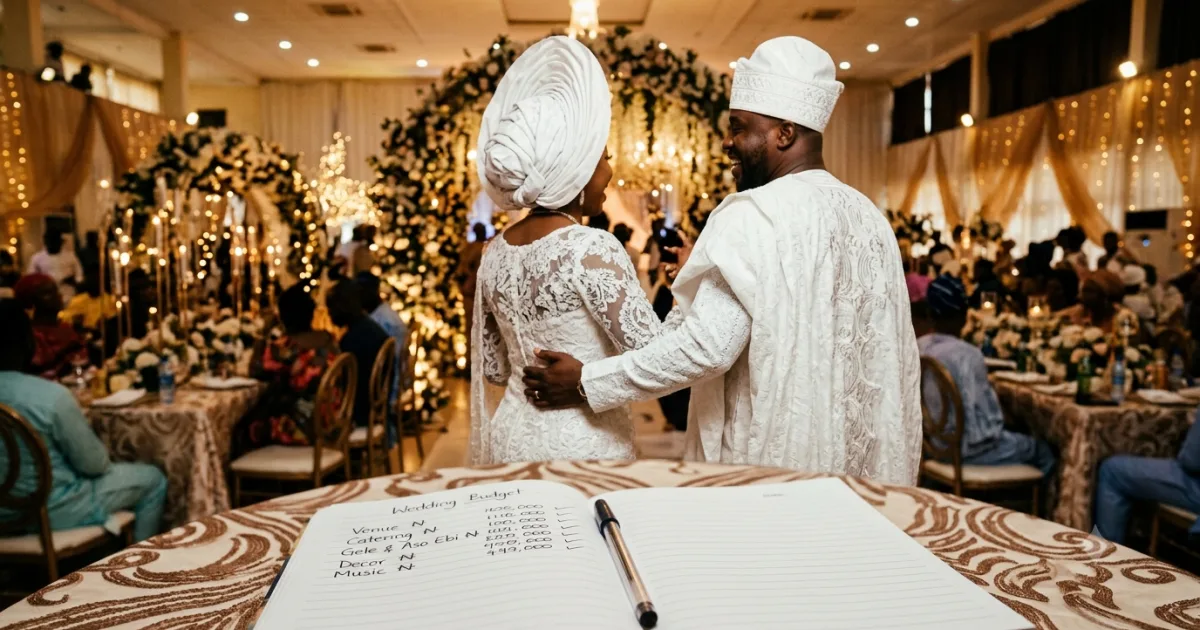
📌 Quick Summary: A Nigerian wedding in 2026 costs between ₦1,500,000 and ₦25,000,000+ depending on scale, location, and family expectations. A modest but respectable Lagos wedding for 200 guests costs approximately ₦3,500,000 to ₦6,000,000. The five biggest cost items are catering, venue, aso-ebi, décor, and photography/videography — together accounting for 70 to 80 percent of total wedding spend. A traditional wedding (introduction and traditional ceremony) typically costs 40 to 60 percent less than a white wedding. This complete guide covers the full cost breakdown for both traditional and white weddings, how to reduce costs without reducing quality, and a realistic budget template for Nigerian couples at every income level.
Nigerian weddings are one of the most joyful and expensive events in Nigerian life. They are also one of the most financially opaque — couples rarely discuss what their wedding actually cost, families negotiate quietly over budgets that often bear no relation to actual income, and guests arrive at elaborate events with no idea whether the hosts spent ₦3 million or ₦30 million. This guide breaks through that opacity and gives Nigerian couples — and their families — an honest, category-by-category cost breakdown for 2026, based on real vendor pricing across Lagos, Abuja, and major Nigerian cities. The goal is to help couples make informed decisions rather than spend beyond their means under social pressure, or under-budget and end up in debt after the celebration.
Nigerian Wedding Structure: Understanding the Events
A full Nigerian wedding typically involves three separate events, each with its own costs. Understanding the structure before budgeting prevents the common mistake of planning only the white wedding while neglecting the traditional ceremony costs.
| Event | Also Known As | Purpose | Typical Guest Count |
| Introduction/Knocking ceremony | Knocking, introduction, ikuiku | Formal family meeting — groom’s family presents to bride’s family | 30 to 80 (immediate families only) |
| Traditional wedding | Trad, ẹrẹdẹ (Yoruba), igba nkwu (Igbo), fatihah (Hausa) | Cultural/customary marriage rites — legally binding | 100 to 400+ |
| White/church wedding | Wedding reception, church wedding | Religious and/or civil marriage ceremony and reception | 150 to 1,000+ |
Not all couples do all three. Many do introduction + traditional only (legally sufficient). Some skip the traditional and do only a church wedding. Others do all three on separate weekends. The budget implications are significant: each event has its own venue, catering, outfit, and décor costs.
Full Cost Breakdown: Lagos White Wedding (200 Guests) 2026
| Category | Budget | Mid-Range | Premium |
| Venue (hall rental, 200 pax) | ₦250,000 – ₦500,000 | ₦600,000 – ₦1,500,000 | ₦2,000,000 – ₦5,000,000+ |
| Catering (food + drinks, 200 pax) | ₦600,000 – ₦900,000 | ₦1,200,000 – ₦2,500,000 | ₦3,000,000 – ₦8,000,000+ |
| Aso-ebi fabric (50 sets × ₦10,000 – ₦50,000) | ₦200,000 – ₦300,000 | ₦500,000 – ₦1,500,000 | ₦2,000,000 – ₦5,000,000+ |
| Bride outfit (dress + accessories + gele) | ₦150,000 – ₦300,000 | ₦400,000 – ₦900,000 | ₦1,500,000 – ₦5,000,000+ |
| Groom outfit (suit or agbada) | ₦80,000 – ₦150,000 | ₦200,000 – ₦500,000 | ₦800,000 – ₦2,000,000 |
| Photography (8 hours) | ₦200,000 – ₦350,000 | ₦500,000 – ₦900,000 | ₦1,500,000 – ₦4,000,000 |
| Videography | ₦150,000 – ₦250,000 | ₦350,000 – ₦700,000 | ₦1,000,000 – ₦3,000,000 |
| Décor (hall decoration + flowers) | ₦200,000 – ₦400,000 | ₦600,000 – ₦1,500,000 | ₦2,000,000 – ₦10,000,000+ |
| Music (DJ or live band) | ₦100,000 – ₦200,000 | ₦300,000 – ₦700,000 | ₦1,000,000 – ₦5,000,000+ |
| MC (master of ceremonies) | ₦50,000 – ₦100,000 | ₦150,000 – ₦350,000 | ₦500,000 – ₦2,000,000 |
| Wedding cake | ₦60,000 – ₦120,000 | ₦200,000 – ₦400,000 | ₦600,000 – ₦2,000,000 |
| Souvenirs and giveaways | ₦80,000 – ₦150,000 | ₦200,000 – ₦500,000 | ₦800,000 – ₦2,000,000 |
| Church/court fees | ₦30,000 – ₦80,000 | ₦100,000 – ₦300,000 | ₦400,000 – ₦1,000,000 |
| Honeymoon (domestic) | ₦150,000 – ₦300,000 | ₦500,000 – ₦1,000,000 | ₦2,000,000 – ₦10,000,000+ |
| Miscellaneous (invitations, transport, hairstyling, makeup) | ₦100,000 – ₦200,000 | ₦300,000 – ₦600,000 | ₦800,000 – ₦2,000,000 |
| TOTAL (White Wedding Only) | ₦2,150,000 – ₦4,000,000 | ₦5,900,000 – ₦12,950,000 | ₦18,900,000 – ₦52,000,000+ |
Traditional Wedding Cost Breakdown (200 Guests, Lagos) 2026
| Category | Budget | Mid-Range |
| Venue or family compound setup | ₦100,000 – ₦300,000 | ₦400,000 – ₦900,000 |
| Catering (food + drinks) | ₦400,000 – ₦700,000 | ₦900,000 – ₦2,000,000 |
| Bride traditional outfits (2 to 3 changes) | ₦150,000 – ₦300,000 | ₦500,000 – ₦1,500,000 |
| Groom traditional outfit (agbada, kaftan, or suit) | ₦80,000 – ₦150,000 | ₦200,000 – ₦600,000 |
| Aso-ebi for family | ₦200,000 – ₦500,000 | ₦600,000 – ₦2,000,000 |
| Bride price/list items | Varies by culture — ₦50,000 – ₦500,000+ | ₦500,000 – ₦2,000,000+ |
| Photography/videography | ₦150,000 – ₦250,000 | ₦350,000 – ₦700,000 |
| Music (DJ or cultural musicians) | ₦80,000 – ₦150,000 | ₦200,000 – ₦500,000 |
| Décor | ₦100,000 – ₦200,000 | ₦300,000 – ₦800,000 |
| TOTAL (Traditional Wedding Only) | ₦1,310,000 – ₦3,050,000 | ₦4,050,000 – ₦11,000,000 |
How to Have a Beautiful Nigerian Wedding at a Lower Budget
The five highest-leverage cost reductions that do not significantly affect the quality or experience of a Nigerian wedding. First: reduce the guest list. Catering is the largest or second-largest cost item at every budget level — reducing from 400 to 200 guests cuts catering cost by approximately 50 percent while reducing venue and aso-ebi costs proportionally. The most effective single budget decision a Nigerian couple can make. Second: have the traditional wedding at a family compound instead of a commercial venue — this eliminates the venue hire cost entirely for the trad and typically produces a more authentic, intimate atmosphere. Third: reduce the number of aso-ebi sets. Aso-ebi is optional — it is a cultural tradition, not a legal requirement. Limiting aso-ebi to immediate family (20 to 30 sets instead of 100+) saves ₦500,000 to ₦2,000,000 at mid-range fabric prices. Fourth: prioritise photography over videography if forced to choose. A great photographer produces images that last 50 years. A mediocre videographer produces footage that is rarely rewatched. If the budget requires cutting one, cut videography before photography. Fifth: consider a Saturday afternoon reception over an evening one — afternoon receptions in rented halls typically cost 30 to 40 percent less than evening bookings of the same venue.
Frequently Asked Questions
How much does a Nigerian wedding cost in 2026?
A modest but respectable Nigerian wedding for 200 guests costs ₦2,000,000 to ₦5,000,000. A mid-range Nigerian wedding with full vendor team costs ₦6,000,000 to ₦15,000,000. Premium Nigerian weddings in Lagos and Abuja cost ₦20,000,000 to ₦100,000,000 or more. The guest count and aso-ebi scope are the biggest cost drivers.
How can I have a cheaper Nigerian wedding?
The five most impactful cost reductions: reduce guest list, hold the traditional ceremony at a family compound, limit aso-ebi to immediate family, choose a budget-focused photographer over a premium one, and hold the reception in the afternoon rather than evening.
Is a traditional Nigerian wedding legally valid without a white wedding?
Yes — a properly conducted traditional marriage ceremony (igba nkwu, nikah, or Yoruba traditional marriage) is legally recognised in Nigeria under customary law. You do not need a church or court wedding for your marriage to be legally valid. Register your marriage at the local government marriage registry for documentation regardless of ceremony type.
What is bride price in Nigeria and how much is it?
Bride price (also called bride wealth) is a payment or gifts from the groom’s family to the bride’s family as part of the traditional marriage process. The amount varies enormously by ethnic group, family expectation, and negotiation — ranging from a symbolic ₦20,000 to millions of naira for some families. The bride price list is presented by the bride’s family and negotiated between families. In many urban Nigerian families, bride price is treated as symbolic rather than the significant economic transfer it once represented.
Nigerian Wedding Vendors: How to Choose and What to Ask
The quality of your Nigerian wedding depends almost entirely on the vendors you select — venue, caterer, photographer, decorator, and MC. The most important vendor selection advice that experienced Nigerian couples consistently give: always see the work before you pay. Ask every vendor for a portfolio of at least 5 recent weddings they have worked on — not 5 curated best shots, but actual wedding galleries or complete event footage. A photographer whose portfolio shows only 20 perfect images but cannot show you complete galleries from 3 recent weddings may not have the consistent performance under real event conditions that a wedding day demands. Always take vendor recommendations from people who have recently used the vendor — online reviews on Nigerian wedding sites (Wedding Digest Naija, Atinuke Weddings, Kamdora) are useful starting points, but a personal recommendation from a couple who used that specific photographer or caterer 6 months ago is more reliable than any online review. Negotiate payment structure carefully: reputable Nigerian wedding vendors typically request 50 percent deposit at booking and 50 percent balance 1 to 2 weeks before the event. Never pay 100 percent upfront to a vendor you are using for the first time. Never pay the remaining balance on the wedding day itself — this creates leverage pressure at the worst possible moment. Always get every agreement in writing — a WhatsApp message confirming the agreed price, service scope, and payment schedule is better than a verbal agreement and has been upheld in Nigerian consumer disputes.
Sources
- Original pricing research — NaijaSabi Lifestyle Desk, September 2026. Prices reflect vendor quotes across Lagos, Abuja and major Nigerian cities as at September 2026.
- Nigerian Marriage Act — marriage.gov.ng — legal validity of traditional and court marriages in Nigeria
Last updated: 16 September 2026 · NaijaSabi Lifestyle Desk. Wedding costs vary significantly by location, vendor choice, and negotiation. All figures are estimates based on market research and are subject to change.
The Hidden Costs of a Nigerian Wedding
Every Nigerian couple who has planned a wedding reports the same experience: the actual cost significantly exceeded the planned budget. The reason is not a failure of planning — it is a systematic underestimation of the costs that do not appear on vendor quotation lists. The five most commonly underestimated Nigerian wedding costs. First: pre-wedding events. Engagement parties, bridal showers, bachelor parties, pre-wedding photo shoots, and dinner nights all have their own costs that are separate from the wedding proper — and that many couples forget to budget for. A pre-wedding shoot in Lagos can cost ₦150,000 to ₦500,000. A bridal shower at a Lagos venue can cost ₦80,000 to ₦300,000. Second: family requirements. The bride’s family and groom’s family both have expectations — traditional items for the bride price list, gifts for elders, uniforms for family members, transportation and accommodation for out-of-town relatives. These costs are real, non-negotiable in most families, and frequently unpredictable in total. Third: overtime and extension costs. Nigerian events rarely end on time. The DJ plays until midnight when the booking was until 10pm. The venue charges extra for each additional hour. These overtime charges are not in the original quotation but appear in the final bill. Fourth: last-minute vendor changes. Vendors who cancel or underperform close to the wedding date require emergency replacements — typically at premium last-minute pricing. Budget a 10 to 15 percent contingency for vendor issues. Fifth: post-wedding expenses. The immediate post-wedding period often involves thank-you gifts for key vendors and family members, a honeymoon that was budgeted conservatively but expanded, and the costs of setting up a new shared household if the couple was not already cohabiting. The practical advice: whatever budget you have calculated for your Nigerian wedding, add 20 to 30 percent as a genuine contingency — not as a pool to be spent, but as a real reserve for the costs you did not see coming.
Saving for a Nigerian Wedding: A Realistic Timeline
The most financially responsible Nigerian wedding planning begins 18 to 24 months before the event with a dedicated wedding savings plan. Using the mid-range budget of ₦8,000,000 as a target (white wedding + traditional, 200 guests each), and assuming the couple will also need approximately ₦2,000,000 for post-wedding setup costs (₦10,000,000 total): a couple saving ₦400,000 per month combined needs 25 months to reach this target. At ₦600,000 per month combined, the same target is reached in 17 months. For couples who cannot achieve these savings rates, two realistic alternatives: reduce the wedding scope to match achievable savings (a beautiful ₦3,500,000 wedding saved for over 12 months is preferable to a ₦10,000,000 wedding financed partly by debt), or involve family contributions transparently — many Nigerian families contribute to wedding costs as a genuine gift, not a loan, and accepting this support is culturally appropriate when offered freely. Taking personal loans or running up credit card debt for a one-day celebration is the one financial choice most Nigerian financial advisers consistently recommend against regardless of income level.

0 Comments
No comments yet. Be the first to share your thoughts!