


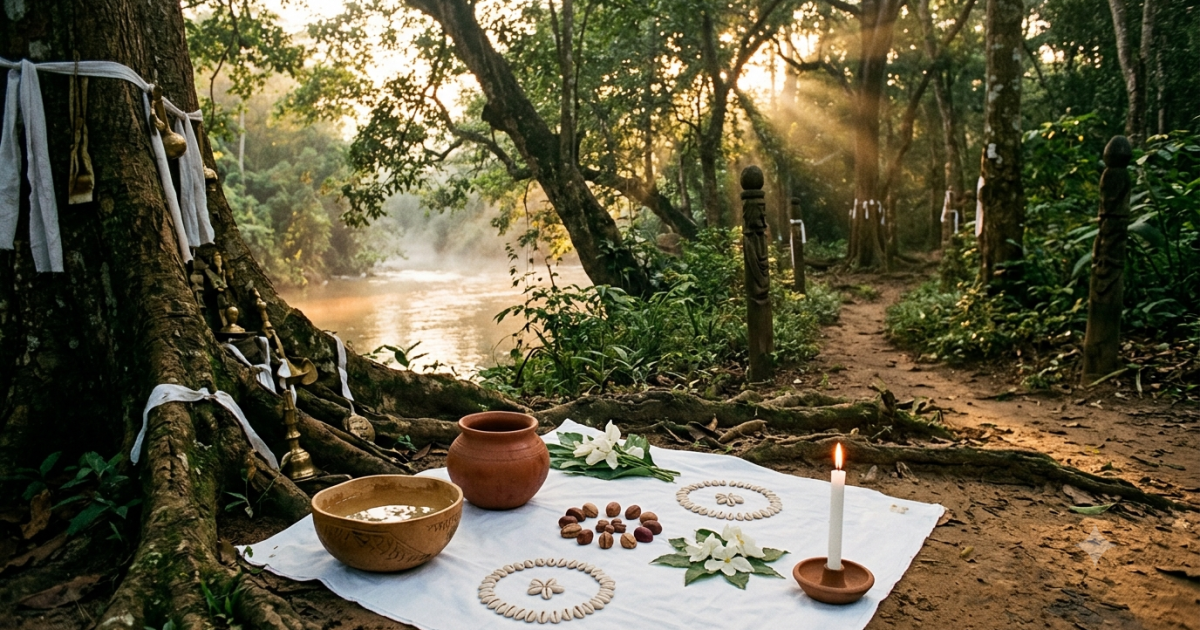
📌 Quick Summary: Ìṣẹ̀ṣẹ́ Day — the annual celebration of Yoruba traditional religion and indigenous culture — falls on Thursday, 20 August 2026. Four Southwest states (Oyo, Lagos, Ogun, and Osun) have declared it a public holiday. This is the complete guide: what Isese means, the Orishas it honours, how it became a public holiday, how it is celebrated, and why it matters for Yoruba identity in the 21st century.
Tomorrow is a public holiday in four Nigerian states — and most Nigerians could not tell you exactly why. Ìṣẹ̀ṣẹ́ Day, observed every 20 August, is one of the most culturally significant days in the Yoruba calendar: an annual affirmation that a people with a civilisation stretching back thousands of years has not forgotten who they are, where they came from, or the spiritual framework through which their ancestors understood the world. The day honours Yoruba traditional religion and indigenous culture through prayers, dances, rituals, and celebrations dedicated to the Orishas — the divine forces at the heart of the Yoruba spiritual universe.
Whether you are a practitioner of the Yoruba traditional religion, a Christian or Muslim Yoruba person curious about your ancestral roots, or simply a Nigerian who wants to understand what the public holiday means before Wednesday ends — this is the complete, honest, respectful guide to Ìṣẹ̀ṣẹ́ Day 2026.
What Does “Isese” Mean? The Yoruba Word at the Centre of Everything
The term Ìṣẹ̀ṣẹ́ translates to “tradition” in Yoruba. But that single-word translation, while accurate, undersells the concept. Isese, which more loosely translates to “Our Native Ways,” refers to the Yoruba traditional religion — but holistically, it captures the way of life of a people far beyond religion alone. Ìṣẹ̀ṣẹ́ is not merely a religious category. It is a comprehensive term for the accumulated wisdom, practices, ethics, aesthetics, and worldview that Yoruba civilisation developed across millennia — before the arrival of Christianity in the 19th century and Islam in the 11th century.
When a Yoruba person says “Isese lagba” — a common phrase associated with the celebration — they are saying “tradition is supreme” or “our traditional ways are the foundation.” It is a statement of cultural pride, not necessarily a rejection of other faiths. Many Yoruba Christians and Muslims participate in Isese Day festivities as an expression of ethnic identity and ancestral respect, even without practising the traditional religion itself.
The Yoruba Traditional Religion: What Isese Day Actually Celebrates
At the spiritual core of Ìṣẹ̀ṣẹ́ is the Yoruba religious system — one of the world’s oldest and most complex indigenous religious traditions, and arguably the most globally influential African religion in existence today. Its influence extends from West Africa across the Atlantic, forming the foundation of Candomblé in Brazil, Santería in Cuba, Trinidad’s Shango Baptist faith, and elements of New Orleans Voodoo in the United States — all carried across the ocean by enslaved Yoruba people who preserved their spiritual knowledge even in the most brutal circumstances imaginable.
Olodumare — The Supreme Being
The Yoruba religious system is not polytheistic in the simple sense. At its summit is Olodumare (also called Olorun or Olorun-Olodumare) — the Supreme Being, the ultimate source of all existence, uncreated, infinite, and beyond direct human approach. Olodumare does not receive direct worship or prayer in the way that, say, Allah or God the Father does in Abrahamic traditions. Instead, the Yoruba approach the divine through intermediaries — the Orishas.
The Orishas — Divinities Honoured on Isese Day
The Orishas are the divine forces, deities, or spiritual essences that mediate between Olodumare and humanity. Each Orisha governs a specific domain of natural and human life, and practitioners cultivate relationships with specific Orishas based on their personal destiny, family lineage, and life circumstances. The Orishas honoured during Isese Day celebrations include:
| Orisha | Domain | Symbol / Offering | Manifestation |
| Ọbatala | Creation, purity, wisdom, peace | White cloth, white foods, snails | White |
| Ṣàngó | Thunder, lightning, justice, kingship | Ram, red cloth, àkàrà | Red and white |
| Ọṣun (Oshun) | Rivers, fertility, love, beauty, wealth | Honey, yellow cloth, fish | Yellow / gold |
| Ògún | Iron, war, labour, hunting, technology | Dog, palm wine, iron implements | Dark green / black |
| Èṣù (Elegba) | Crossroads, communication, fate, beginnings | Palm oil, roasted corn, small offerings | Black and red |
| Ọya | Wind, storms, transitions, death | Eggplant, nine different items | Purple / multicoloured |
| Ifá (Ọrúnmìlà) | Divination, wisdom, destiny, healing | Kola nut, obi, palm nuts | Green and yellow |
| Yemọja | Ocean, rivers, motherhood, children | Fish, watermelon, blue cloth | Blue and white |
Ancestral Veneration: Egungun
Alongside the Orishas, Ìṣẹ̀ṣẹ́ celebrates the Yoruba tradition of ancestral veneration — the belief that the spirits of honourable ancestors continue to exist, influence the living, and deserve respect and communication. The Egungun masquerade — one of Yoruba culture’s most spectacular art forms — is the primary expression of this ancestral connection. Egungun masquerades are considered to be direct manifestations of ancestral spirits visiting the living world, and their appearance during Isese festivals in Oyo, Ibadan, and other Yoruba towns is one of the most visually extraordinary cultural expressions in all of West African tradition.
How Isese Day Became a Public Holiday: The Full History
The journey from a cultural practice to a recognised public holiday is a distinctly political story — one that reflects the gradual assertion of indigenous Nigerian identity in a post-colonial state whose official framework has long privileged Christianity and Islam.
2013–2014: Osun State Leads the Way
Former Governor Rauf Aregbesola of Osun State, in 2013, approved August 20th as a public holiday for traditional worshippers under Section 2(2) of the Public Holidays Act CAP P40 Laws of the Federal Republic of Nigeria 2010. Isese Day was first declared a public holiday by the Osun State Government in 2014. Aregbesola’s decision was significant precisely because Osun State — home to Osogbo and its sacred Osun-Osogbo Grove, a UNESCO World Heritage Site — has the strongest institutional relationship with Yoruba traditional religion of any Nigerian state. The annual Osogbo festival at the sacred Osun River has drawn global attention for decades. Recognising August 20 as a public holiday was the logical political expression of that relationship.
2023: Lagos, Oyo, and Ogun Join
Osun State has the longest history of recognising the day. But the movement expanded significantly in 2023, when Lagos, Oyo, and Ogun State governments all declared August 20 a public holiday for the first time — a coordinated recognition that reflected both growing political organisation among traditional religion practitioners and the broader cultural politics of the Southwest under governors who saw Yoruba cultural identity as a political asset. In August 2023, the Oyo State House of Assembly passed a resolution recognising August 20 as Isese Day, and Governor Seyi Makinde subsequently approved it as a public holiday. August 20 was formally designated as a public holiday for Isese Day in Ogun State in 2023, following a resolution by the Ogun State House of Assembly and the approval of Governor Dapo Abiodun.
2026: Four States, One Thursday Holiday
The states expected to declare the one-day holiday are Oyo, Lagos, Ogun and Osun, while Ondo and Ekiti are yet to officially recognise August 20 as Isese Day in their respective states. The pattern of state-by-state recognition reflects a deliberate political strategy by Isese Day advocates — building a base in Osun, expanding to the three major Southwest states, and waiting for Ondo and Ekiti to follow as the movement’s political momentum grows. The ultimate goal, articulated by several traditional religion advocacy groups, is federal recognition — a nationwide public holiday for Isese Day equivalent to the national holidays already accorded to Christian and Islamic celebrations.
How Isese Day Is Celebrated in 2026
Isese Day is marked annually on August 20 by traditional worshippers through prayers, dances, rituals and cultural activities dedicated to their deities. The specific forms of celebration vary by location, family lineage, and Orisha affiliation, but the common threads across all Isese celebrations are:
Prayers and Libations
The day begins with prayers — spoken in Yoruba, addressed to Olodumare, the Orishas, and the ancestors. Libations (pouring of water, palm wine, or other liquids onto the ground) are a fundamental part of the ritual communication with the spiritual world. In traditional Yoruba cosmology, the ground is the boundary between the world of the living and the realm of the ancestors — pouring libations is a physical act of communication across that boundary.
Orisha Worship at Shrines and Sacred Sites
Practitioners visit Orisha shrines — some household, some communal, some at sacred natural sites like rivers, forests, and hilltops — to make offerings, sing sacred songs (orin Orisa), and perform specific rituals appropriate to their Orisha. In Osogbo, the Osun-Osogbo Sacred Grove — designated a UNESCO World Heritage Site in 2005 — becomes the focal point of Oshun worship, with thousands of worshippers and tourists gathering at the Osun River to honour the goddess of water and fertility.
Egungun Masquerades
In Oyo, Ibadan, and across Yorubaland, Egungun masquerades emerge during Isese festivities. These elaborately costumed representations of ancestral spirits — with flowing layers of cloth, beads, and symbolic items that completely conceal the human carrier — move through communities accompanied by drumming, chanting, and the respectful clearing of paths by community members. The Egungun is considered an actual ancestral presence, not merely a performance. Interaction with Egungun carries specific protocols that vary by lineage and community.
Cultural Displays, Lectures, and Parades
Isese Day celebrates Yoruba traditions and religion in a display of culture and spirituality with parties, festivals, parades, lectures and display of traditional apparels to attract tourists from other parts of the world. In 2026, Isese Day events are expected across Ibadan, Lagos, Abeokuta, Osogbo, and multiple other Yoruba towns — ranging from formal symposia on Yoruba religion and philosophy to community celebrations where traditional attire, music, and food create the atmosphere of a full cultural festival.
Isese Day and the Nigerian Constitution: The Religious Freedom Argument
The political argument for Isese Day as a public holiday rests explicitly on the Nigerian Constitution’s guarantee of freedom of religion. Nigeria recognises Christmas Day and Good Friday as national public holidays for Christianity, and recognises Eid el-Fitr and Eid el-Adha for Islam. The argument made by traditional religion advocates — successfully, in four Southwest states — is that refusing to recognise Isese Day while recognising Christian and Islamic holidays constitutes unconstitutional religious discrimination against practitioners of indigenous African religion. The Ogun State Government stated that the declaration underscores its commitment to preserving and promoting Yoruba culture, heritage and traditional values, framing the holiday in cultural rather than purely religious terms — a strategic framing that makes it easier for Christian and Muslim Yoruba politicians to support without appearing to endorse religious practice.
Isese Day Beyond Nigeria: A Global Yoruba Celebration
Isese Day is celebrated by Yoruba diaspora communities around the world. The global reach of Isese Day reflects the extraordinary spread of Yoruba religion through the African diaspora. In Brazil, Cuban Santería communities, Trinidad, the United States, and the United Kingdom, August 20 has become a focal point for diaspora Yoruba communities to reconnect with their ancestral spiritual heritage. The Osun-Osogbo festival in particular draws significant international pilgrimage — practitioners of Candomblé and Santería from Brazil and the Caribbean make the journey to Osogbo to worship at the source of their tradition, creating one of West Africa’s most remarkable annual gatherings of spiritual tourism.
Isese Day 2026: States, Holiday Status, and What Is Open or Closed
| State | Holiday Status | Year First Declared | What Is Closed |
| Osun | ✅ Public Holiday | 2014 (Aregbesola) | Government offices, banks, schools |
| Lagos | ✅ Public Holiday | 2023 (Sanwo-Olu) | Government offices, banks, schools |
| Oyo | ✅ Public Holiday | 2023 (Makinde) | Government offices, banks, schools |
| Ogun | ✅ Public Holiday | 2023 (Abiodun) | Government offices, banks, schools |
| Ondo | ❌ Not yet declared | — | Normal working day |
| Ekiti | ❌ Not yet declared | — | Normal working day |
| All other states | ❌ Not a public holiday | — | Normal working day |
Private businesses, markets, and transport services in Lagos, Oyo, Ogun, and Osun may operate at reduced capacity on Thursday 20 August. Banks in all four states will be closed. NYSC orientation and NAQS CBT activities — both of which fall on Thursday 20 August — are expected to proceed, as federal government activities operate under the federal public holiday calendar, not state-level declarations.
Frequently Asked Questions
What is Isese Day and what does it mean?
Ìṣẹ̀ṣẹ́ Day is an annual celebration of Yoruba traditional religion and indigenous culture, observed every 20 August. The word “Isese” translates to “tradition” or “our native ways” in Yoruba. The day honours the Orishas (Yoruba divinities), ancestral spirits, and the accumulated cultural and spiritual heritage of the Yoruba people.
Is Isese Day a public holiday in 2026?
Yes — in four Southwest states. Oyo, Lagos, Ogun, and Osun have all declared Thursday, 20 August 2026, a public holiday for Isese Day. Ondo and Ekiti have not officially recognised it. It is not a federal public holiday.
Which states observe Isese Day as a public holiday?
Osun State (since 2014), Lagos State (since 2023), Oyo State (since 2023), and Ogun State (since 2023). Ondo and Ekiti are yet to officially recognise August 20 as a public holiday.
Who declared Isese Day a public holiday first?
Former Osun State Governor Rauf Aregbesola approved August 20 as a public holiday for traditional worshippers in 2013, under Section 2(2) of the Public Holidays Act CAP P40. Osun State first observed it as a public holiday in 2014 — making it the pioneer of the Isese Day public holiday movement.
What religion is Isese in Yoruba culture?
Isese refers to the Yoruba traditional religion — a spiritual system centred on Olodumare (the Supreme Being) and the Orishas (divine intermediaries governing different aspects of nature and human life). It is one of the world’s oldest indigenous religions and the source of Candomblé, Santería, and other African diaspora spiritual traditions.
Can Christians and Muslims participate in Isese Day?
Many Yoruba Christians and Muslims participate in Isese Day as a celebration of ethnic and cultural identity rather than religious practice — wearing traditional attire, attending cultural events, and honouring their Yoruba heritage without engaging in the specifically religious rituals. The cultural and religious dimensions of the day are distinct, and participation in the cultural expression does not require religious conversion.
Last updated: 20 August 2026 · NaijaSabi Entertainment Desk.




0 Comments
No comments yet. Be the first to share your thoughts!