



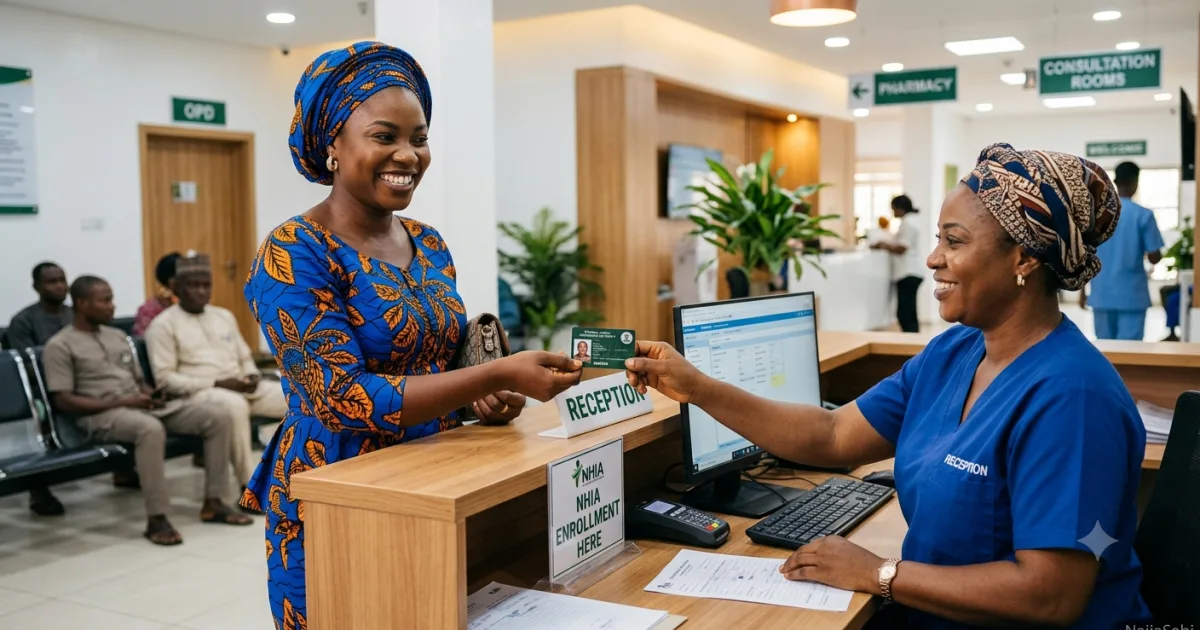
📌 Quick Summary: Nigeria’s National Health Insurance Authority (NHIA) — formerly NHIS — provides health coverage for employed Nigerians, self-employed workers, traders, artisans and families. Under the National Health Insurance Act 2022, health insurance is now mandatory for all Nigerians, and employers with five or more staff must enrol their employees. Self-employed Nigerians and those outside formal employment register under GIFSHIP — the Group, Individual and Family Social Health Insurance Programme. The NHIA ID card costs ₦1,500 and you need your NIN to register. This guide tells you exactly how to register in 2026, what NHIA covers, how much it costs, and how to actually use it at a hospital.
⚠️ Medical Disclaimer: This article is for informational purposes only and does not constitute medical or legal advice. NaijaSabi is not a medical institution or legal adviser. Information about NHIA/NHIS coverage, premiums and benefits is based on publicly available official data and may change. Always confirm current details directly with the National Health Insurance Authority at nhia.gov.ng or call +2348059282008. For medical emergencies, dial Nigeria’s emergency line: 112.
Every Nigerian knows the feeling — you or a family member is sick, and before the doctor even sees you, someone is asking for money. Upfront. In cash. Before any treatment. For millions of Nigerian families, a serious illness or hospital visit can wipe out months of savings, force the sale of assets, or lead to borrowed money that takes years to repay. This is not how it should be. And in 2026, there is a legal framework that says so: the National Health Insurance Act 2022, which makes health insurance a right for every Nigerian — not a luxury for civil servants and multinational company employees alone. This NaijaSabi guide tells you everything you need to know about registering for NHIA health insurance in 2026 — whether you work for a company, run your own business, trade at a market, drive a bus or farm for a living.
| Fact | Detail |
| Official body | National Health Insurance Authority (NHIA) — formerly NHIS |
| Law establishing it | National Health Insurance Act — signed 19 May 2022 |
| Is it mandatory? | Yes — for all Nigerians and legal residents under the 2022 Act |
| Employers legally required? | Yes — employers with 5 or more staff must enrol employees |
| Programme for self-employed | GIFSHIP — Group, Individual and Family Social Health Insurance Programme |
| GIFSHIP cost (2026) | From ₦38,718 per person per year (Ultimate Health HMO, March 2026) |
| Group minimum | ₦220,000 for 10 persons annually (₦22,000 per additional person) |
| NHIA ID card fee | ₦1,500 (one-time) |
| NIN required? | Yes — NIN mandatory for all enrolees |
| Drug co-payment | 10% — you pay a small fraction only; NHIA covers the rest |
| NHIA official website | nhia.gov.ng |
| NHIA contact | +2348059282008 / +2348065744100 |
NHIS or NHIA — What Is the Difference and Which Name Is Correct?
Many Nigerians are confused because they see both “NHIS” and “NHIA” used interchangeably. Here is the simple explanation: they refer to the same programme, but the name changed.
NHIS — the National Health Insurance Scheme — was established under the NHIS Act of 1999 and operated for over two decades as Nigeria’s primary health insurance programme, mostly covering federal civil servants. In May 2022, President Buhari signed a new law — the National Health Insurance Act 2022 — which replaced the old NHIS framework entirely. Under this new law, the body responsible for health insurance was renamed and restructured as the National Health Insurance Authority (NHIA).
The key difference between the old NHIS and the new NHIA is scope. The old NHIS largely covered federal civil servants. The new NHIA is designed for all Nigerians — civil servants, private sector employees, self-employed workers, traders, farmers, artisans, students and vulnerable populations. Health insurance is no longer a benefit for the formally employed alone. When Nigerians say “NHIS” in 2026, they generally mean the NHIA system. Both names are used in everyday conversation — this guide uses both, as you will encounter both in practice.
Who Can Register for NHIA in Nigeria?
Under the National Health Insurance Act 2022, every Nigerian and legal resident is entitled to health insurance coverage. The NHIA organises registration into different programmes depending on your employment status:
- Federal civil servants and public employees — covered under the Formal Sector Social Health Insurance Programme (FSSHIP). Your employer — a federal ministry, agency or parastatal — handles your enrolment
- Private sector employees — covered under the Organised Private Sector Social Health Insurance Programme (OPSSHIP). Your employer must register the company with NHIA and enrol all employees with five or more staff
- Self-employed, traders, artisans, farmers, informal sector workers, freelancers, transport workers — register under GIFSHIP (Group, Individual and Family Social Health Insurance Programme)
- Students at tertiary institutions — covered under TISHIP (Tertiary Institutions Social Health Insurance Programme) through their school
- Vulnerable and extremely poor Nigerians — covered under the Basic Health Care Provision Fund (BHCPF), a government-funded programme that provides free basic health care to those who cannot afford any premium
How to Register for NHIA if You Are Self-Employed or Informally Employed (GIFSHIP)
This section is for the majority of Nigerians who are not civil servants or large company employees — traders, artisans, Keke riders, market women, freelancers, farmers, small business owners. GIFSHIP is your programme. Here is exactly how to register:
Option 1 — Register as a Group (minimum 10 people):
- Gather a group of at least 10 people — this could be your trade association, cooperative, church group, mosque community, market union, family members or neighbours
- Submit an application to the NHIA expressing interest in joining GIFSHIP — visit your nearest NHIA office or apply online at nhia.gov.ng. Include a document with the group name and full list of all persons to be enrolled
- Each enrolee provides their NIN (National Identification Number) — this is mandatory and your application will not proceed without it
- Choose your preferred HMO (Health Maintenance Organisation) from the NHIA-approved list
- Choose your preferred primary healthcare facility — the hospital or clinic you want to receive care from
- Pay the group premium — minimum ₦220,000 for 10 persons annually (₦22,000 per additional person). Payment is made through the Remita platform. You have 24 hours after registration to complete payment using the Remita Retrieval Reference (RRR) number generated at registration — or pay directly at a bank
- Pay ₦1,500 per person for the NHIA ID card
- Receive your NHIA ID card — available within 24 hours of completed registration in most cases
Option 2 — Register as an Individual Voluntary Contributor:
- Visit nhia.gov.ng — the official NHIA website
- Select “Voluntary Contributors” on the homepage
- Fill in your personal details — full name, date of birth, gender, contact information, NIN
- Enter your state and Local Government Area (LGA) to see a list of NHIA-accredited primary healthcare facilities near you
- Choose your preferred health facility and HMO
- Choose your payment method and pay the required premium
- You can also find your nearest HMO office, purchase a voucher in person and complete registration without internet access
How to Register for NHIA if You Work for a Private Company (OPSSHIP)
If you work for a registered Nigerian company with five or more employees, your employer is legally required under the National Health Insurance Act 2022 to enrol you in an NHIA-approved health insurance plan. Here is how the process works for employees:
- Your employer — not you individually — initiates registration by applying to NHIA
- The company submits documentation and a staff list to NHIA
- NHIA coordinates an enrolment visit or online process for all staff
- Employees fill in the NHIA enrolment form, providing their NIN
- Each employee selects their preferred HMO and primary hospital
- NHIA issues each employee an NHIS/NHIA ID number
- Coverage becomes active after the ID is issued and premium is paid
If your employer has five or more staff and has not enrolled you in NHIA, they are breaking the law. You have the right to raise this with your employer or report non-compliance to the NHIA directly at nhia.gov.ng.
What Does NHIA Health Insurance Cover?
One of the most common questions from Nigerians considering NHIA is: what exactly will it pay for? The NHIA benefit package covers a broad range of services. Here is what you can expect to be covered as an NHIA enrollee:
- Outpatient consultations — visits to your primary health care facility for general medical consultations
- Inpatient care — hospital admission for treatment when necessary
- Surgical operations — major and minor surgeries up to defined limits
- Maternity care — antenatal care, delivery and postnatal care throughout all stages of pregnancy, including care for stillbirths and premature births
- Prescribed drugs — you pay only a 10% co-payment on prescribed medications. NHIA covers the remaining 90%
- Laboratory tests — blood tests, urine tests and other diagnostic investigations at your accredited facility
- Eye care — eye examinations and basic eyewear
- Dental care — basic dental consultations and treatments
- Mental health care — basic psychiatric consultations
- Specialist referrals — when your primary facility refers you to a specialist, NHIA covers that visit
What NHIA does NOT cover (common exclusions):
- Cosmetic procedures and surgery
- Experimental or unproven treatments
- Treatment outside Nigeria (international medical tourism)
- Injuries from intentional self-harm
- Some specialist treatments beyond defined coverage limits
How to Use Your NHIA Health Insurance at a Hospital
Once you are registered and have your NHIA ID card, using your health insurance is straightforward — but there are rules you must follow or you risk having to pay out of pocket:
- Always go to your accredited primary healthcare facility first. You cannot walk into any hospital and use your NHIA card. You must go to the specific HMO-accredited hospital or clinic you selected during registration. If you go to a hospital not on your HMO’s list, NHIA will not cover the cost
- Bring your NHIA ID card every time. Without it, the hospital cannot verify your coverage. If you lose your card, report it to your HMO immediately and request a replacement
- For specialist care, get a referral. If you need to see a specialist beyond your primary facility’s capacity, your primary facility must issue you a referral letter. Walk-in visits to specialist hospitals without a referral are generally not covered
- Pay only the 10% drug co-payment. When prescribed medications, you pay 10% of the drug cost — NHIA covers the remaining 90%. Do not let any hospital charge you the full drug price if you are an NHIA enrollee — query the bill
- Know your HMO’s number. Your Health Maintenance Organisation is your first point of contact for any billing disputes, questions about coverage or complaints about your healthcare facility. Save their number in your phone
Major HMOs in Nigeria for 2026
When registering, you must choose a Health Maintenance Organisation (HMO) — the body that manages your NHIA coverage and hospital network. Here are the most widely used NHIA-accredited HMOs in Nigeria in 2026:
| HMO | Notable Coverage | Strong In |
| Ultimate Health HMO | GIFSHIP ₦38,718/person/year (March 2026) | Lagos, Abuja, nationwide |
| Hygeia HMO | Wide hospital network, strong corporate plans | Lagos, Abuja, major cities |
| Clearline International HMO | Individual and family plans, good southern Nigeria coverage | South-South, South-East |
| Total Health Trust (THT) | Established corporate HMO, large hospital panel | Lagos, Abuja, Port Harcourt |
| Reliance HMO | Strong digital platform — app-based management | Tech-savvy Nigerians, nationwide |
| Avon HMO | Individual and family plans, affordable premiums | South-West Nigeria |
Before choosing an HMO, check their list of accredited hospitals in your area — this is the most important factor. An HMO with excellent coverage in Lagos may have very limited hospital options in Enugu or Sokoto. Always confirm your preferred local hospital is on their panel before registering.
The Basic Health Care Provision Fund — Free Care for Vulnerable Nigerians
If you genuinely cannot afford any premium at all, the Basic Health Care Provision Fund (BHCPF) exists specifically for you. The BHCPF is a government-funded programme managed by the NHIA that provides free or heavily subsidised basic healthcare to Nigeria’s most vulnerable populations — the extremely poor, the unemployed, people with disabilities and others who would otherwise have no access to healthcare.
BHCPF coverage is accessed through Primary Health Care Centres (PHCs) across Nigeria’s 36 states and the FCT. If you qualify, you receive basic consultations, maternal care, essential drugs and preventive health services at no cost. Contact your nearest Local Government Area (LGA) health office or the NHIA directly at nhia.gov.ng to find out how to access BHCPF services in your state.
When to See a Doctor in Nigeria — Regardless of Insurance Status
Whether or not you have NHIA coverage, certain symptoms always require immediate medical attention at your nearest hospital or emergency facility:
- Chest pain or difficulty breathing
- Stroke symptoms — sudden weakness on one side of the body, inability to speak, face drooping
- Severe abdominal pain that does not stop
- High fever (above 39°C/102°F) that does not respond to medication
- Vomiting blood or passing blood in stool or urine
- Unconsciousness or unresponsiveness
- Severe injuries or trauma
In any of these situations, call 112 or go to the nearest hospital emergency department immediately — do not wait for NHIA paperwork or referrals.
Frequently Asked Questions — NHIS/NHIA Registration Nigeria 2026
What is the difference between NHIS and NHIA?
NHIS (National Health Insurance Scheme) was Nigeria’s original health insurance body established in 1999. In May 2022, President Buhari signed the National Health Insurance Act 2022, which replaced NHIS with the restructured NHIA (National Health Insurance Authority). The key difference is that the old NHIS mostly covered federal civil servants, while the new NHIA is designed to cover all Nigerians — including self-employed workers, traders, artisans and vulnerable populations. Most Nigerians still say “NHIS” informally — but the official body is now NHIA. Both refer to the same health insurance system. Confirm current details at nhia.gov.ng.
How much does NHIA health insurance cost in Nigeria in 2026?
For self-employed Nigerians registering under GIFSHIP, Ultimate Health HMO announced a premium of ₦38,718 per person per year as of March 2026. Group registration (minimum 10 people) costs ₦220,000 annually for 10 persons, with each additional person at ₦22,000. A one-time NHIA ID card fee of ₦1,500 applies to each enrolee. For private sector employees, your employer pays the premium — the split between employer and employee contribution varies by company policy. Premiums vary by HMO, so compare options at nhia.gov.ng before registering. Prices are based on publicly available 2026 data — confirm current rates with your chosen HMO.
How do I register for NHIA if I am self-employed?
Self-employed Nigerians register under GIFSHIP. You can register as part of a group of at least 10 people — through a trade association, cooperative, family group or any organised collective — or as an individual voluntary contributor. Visit nhia.gov.ng, select “Voluntary Contributors,” fill in your details including your NIN, choose an HMO and a primary healthcare facility, then pay via the Remita platform. Your NHIA ID card is typically available within 24 hours of completed payment. You can also visit any NHIA office nationwide to register in person. Contact NHIA directly at +2348059282008 for the most current registration process.
What hospitals accept NHIA health insurance?
NHIA covers treatment at hospitals and clinics that are accredited by your chosen HMO — not all Nigerian hospitals. When registering, you must select a primary healthcare facility from your HMO’s accredited list. If you attend a hospital not on your HMO’s panel, NHIA will not cover the cost and you will pay out of pocket. Before registering, check that your preferred local hospital or clinic is on your chosen HMO’s accredited facility list. Most HMOs have searchable facility directories on their websites. Confirm the current list of accredited facilities with your HMO before your first visit.
Can my employer be forced to give me NHIA?
Yes — under Section 3 of the National Health Insurance Act 2022, employers with five or more staff are legally required to enrol all their employees in an NHIA-approved health insurance plan. If your employer has five or more staff and has not provided NHIA health insurance, they are in breach of Nigerian law. You can raise this with your employer directly, or report non-compliance to the NHIA via nhia.gov.ng or on +2348059282008. This is general legal information — consult a qualified Nigerian legal practitioner for advice specific to your situation.
What do I do if a hospital refuses my NHIA card?
If a hospital refuses to accept your valid NHIA card, you have several options. First, confirm the hospital is on your HMO’s accredited facility list — if it is not, you are at the wrong facility. If the hospital is on your HMO’s list and still refuses your card, call your HMO’s customer service line immediately and report the issue. Your HMO has a contractual obligation to ensure their accredited facilities honour your coverage. You can also report persistent refusals to the NHIA at nhia.gov.ng or call +2348059282008. Keep records of every refusal — date, hospital name, reason given. Confirm current NHIA complaint procedures directly at nhia.gov.ng.
Sources
- National Health Insurance Authority (NHIA) — official website, GIFSHIP registration requirements — nhia.gov.ng
- National Health Insurance Act 2022 — signed 19 May 2022, Federal Republic of Nigeria — Official Gazette
- NHIA GIFSHIP enrolment page — nhia.gov.ng/2776-2/
- Federal Government of Nigeria Digital Services Portal — NHIA online enrolment — services.gov.ng
Last updated: 5 September 2026 · NaijaSabi Health Desk. This article is for informational purposes only. Always confirm current NHIA registration processes, premiums and coverage details directly at nhia.gov.ng or by calling +2348059282008 before making any decisions. For medical emergencies, call 112.



0 Comments
No comments yet. Be the first to share your thoughts!