





📌 Quick Summary: Cervical cancer is one of the most preventable cancers, yet it still kills many Nigerian women. It is caused mainly by persistent infection with the human papillomavirus (HPV). Nigeria introduced the HPV vaccine into routine immunisation in October 2023: girls aged 9–14 get a single dose, free at government health facilities, and a September 2026 report quoting the National Primary Health Care Development Agency (NPHCDA) says more than 18 million girls have been vaccinated. Screening — Pap smear, HPV test or visual inspection (VIA) — can find changes before they become cancer, but Nigeria has no organised national screening programme, and costs vary widely, from a few thousand naira to well over ₦100,000 at private labs. Early cervical cancer often has no symptoms, so do not wait for symptoms before getting screened.
⚠️ Medical Disclaimer: This article is for general information only. It is not medical advice, a diagnosis or a substitute for care from a qualified doctor. Screening ages and schedules differ between sources, and the right plan depends on your age and history, so please discuss it with a doctor. If you have abnormal bleeding, discharge or pelvic pain, see a doctor or visit a hospital in Nigeria as soon as you can.
After breast cancer, cervical cancer is the cancer Nigerian women most need to know about — and the one we can do the most to prevent. There is a vaccine that protects against the virus that causes most cases, and there are tests that find the early changes years before cancer develops. This NaijaSabi guide explains what cervical cancer is, how common it is in Nigeria, the symptoms to watch for, how the free HPV vaccine works, which screening tests exist and what they cost.
| Fact | Detail |
| Main cause | Persistent infection with high-risk types of the human papillomavirus (HPV) |
| New cases per year | About 14,089 in Nigeria, according to WHO figures cited by BusinessDay |
| Daily toll | About 33 new cases and 22 deaths a day, according to figures cited at an event reported by NAN |
| HPV vaccine | Single dose for girls aged 9–14, free at government facilities; routine since October 2023 |
| Vaccine coverage | More than 18 million girls vaccinated, about 76% of the target (September 2026 report quoting NPHCDA) |
| Screening programme | No organised national programme; screening is mostly opportunistic |
| Screening tests | Pap smear, HPV DNA test, visual inspection with acetic acid (VIA) |
| Reported costs | VIA from about ₦2,000; Pap smear averaging about ₦5,000; HPV test averaging about ₦30,000; private lab prices much higher |
How Common Is Cervical Cancer in Nigeria?
According to World Health Organization figures cited by BusinessDay, about 14,089 new cases of cervical cancer are diagnosed in Nigeria every year. The News Agency of Nigeria reported a speaker at a book launch citing about 33 new cases and 22 deaths a day in Nigeria, at an event where a research director at the Nigerian Institute of Medical Research also said an estimated 36 million Nigerian women aged 15 and above are at risk. Rankings differ by source: WHO Nigeria describes it as the third most common cancer in the country and the second most frequent cause of cancer deaths among women aged 15 to 44, while other Nigerian reports rank it second among women. Whichever ranking you use, it is a leading cancer in women.
Medical experts quoted by BusinessDay link rising cases to poor uptake of screening, and a review of Nigerian studies found knowledge of cervical cancer screening and uptake of preventive services to be generally poor, partly because there is no organised screening programme. As with breast cancer, many women are diagnosed late, when the disease is harder to treat.
What Causes Cervical Cancer?
Persistent infection with high-risk HPV types is the main cause. HPV is a very common virus, and most infections clear on their own, but some persist and slowly change the cells of the cervix over years. WHO says HPV types 16 and 18 cause at least 70% of cervical cancers. Nigerian experts quoted by BusinessDay list the main risk factors as having HPV, not getting screened, smoking, having multiple sexual partners and age. Because the cervix is inside the body, cervical changes cannot be seen or felt, which is why screening matters.
Symptoms of Cervical Cancer
Early cervical cancer and the changes that come before it usually cause no symptoms at all. When symptoms appear, they can include:
- Bleeding between periods, after sex or after menopause
- Unusual vaginal discharge, sometimes with a bad smell
- Pain in the pelvis or lower back
- Pain during sex
These symptoms can have many causes, and most are not cancer — but each one deserves a medical check. Do not wait for symptoms: by the time they appear, the disease may be advanced.
The HPV Vaccine in Nigeria — Free for Girls Aged 9 to 14
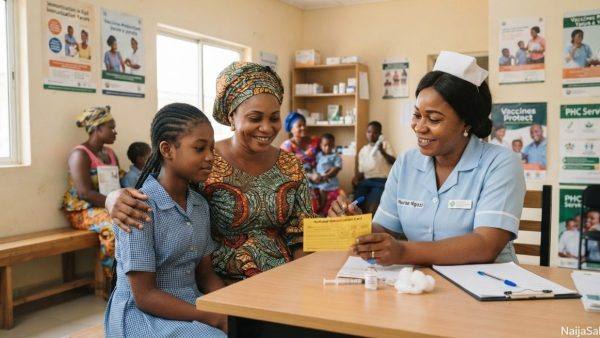
Nigeria introduced the HPV vaccine into its routine immunisation system in October 2023, aiming to reach 7.7 million girls in what WHO called the largest single round of HPV vaccination in the African region. It began with a five-day campaign in schools and communities across 16 states and the Federal Capital Territory, before moving into routine immunisation at health facilities.
- Who: girls aged 9 to 14. UNICEF Nigeria’s FAQ says the vaccine is given in a single dose and is recommended for girls in this age group because it works best before sexual activity begins.
- Cost: free for girls aged 9–14, available at government health facilities, according to UNICEF Nigeria.
- Progress: a September 2026 report quoting the NPHCDA’s director of disease control and immunisation says Nigeria has vaccinated more than 18 million girls, about 76% of the target population, and that the vaccine is now part of routine immunisation.
- How to get it for your daughter: ask at your nearest primary health centre or government hospital, and ask the school about outreach. Do not pay for a vaccine that is free for her age group.
What about older girls and women? The free national programme targets 9–14. Private health facilities may offer HPV vaccines for others. A Nigerian pharmacy’s product guidance describes two doses six to twelve months apart for those who start between ages 9 and 14, and three doses for those who start at 15 or older. A 2021 Nigerian health guide quoted prices of roughly ₦25,000 to ₦35,000 for the vaccines, which may be out of date, so confirm current prices with the provider. Whether the vaccine is worthwhile for an older woman is a decision to make with your doctor.
Important: the vaccine does not cover every cancer-causing HPV type, so vaccinated women still need regular screening.
Cervical Cancer Screening Options in Nigeria
| Test | What it does | Notes |
| VIA (visual inspection with acetic acid) | A trained health worker applies a dilute acid to the cervix and looks for abnormal areas | Low-cost, quick, often offered at outreach events and some centres; Nigerian cancer advocates have called for VIA to be offered at primary health centres |
| Pap smear (cytology) | Cells are collected from the cervix and examined under a microscope for abnormal changes | The most commonly used screening method in Nigeria; looks for precancerous changes rather than the virus itself |
| HPV DNA test | Looks for the high-risk HPV types that cause cervical cancer | Often more expensive; may be combined with a Pap smear |
Nigeria has no organised national cervical screening programme. The Guardian reported in 2025 that the country relies on sentinel and opportunistic screening — meaning women are mostly screened when they happen to visit a facility or an outreach event — and that screening is mainly available at public tertiary hospitals and private diagnostic centres. The government’s goal is to screen 70% of eligible women by 2030, but experts cited by the Guardian said the lack of a structured programme makes that target unlikely to be met without a change.
When should you start? Sources disagree, and Nigerian guides quote different ages and intervals. A Nigerian NGO’s 2023 screening campaign said women should start Pap smears every three years from age 21 and, from age 30, can have a Pap smear and HPV test together every five years. Other guides give different starting ages and intervals, and your history matters — for example, an abnormal result or a weakened immune system usually means more frequent checks. Ask a doctor which test and schedule suit you, and do not wait if you have symptoms.
How Much Does Cervical Cancer Screening Cost in Nigeria?
Prices vary widely by test, city and provider. Treat these as indicative and call ahead:
| Source | Reported cost |
| The Guardian (2025 report) | HPV test about ₦30,000 on average; Pap smear about ₦5,000 on average |
| A Nigerian health website (2021) | VIA about ₦2,000–₦5,000; Pap smear ₦3,500–₦15,000; HPV screening ₦10,000–₦15,000. It noted government hospitals and NGOs are generally cheaper — for example, the Lagos University Teaching Hospital’s community medicine unit charged about ₦3,500 for a Pap smear plus ₦500 for consumables at that time |
| SYNLAB Nigeria’s website (private lab network) | Liquid-based cytology ₦40,000; HPV genotyping ₦123,400; both tests together ₦163,300 (listed prices; the page may not be up to date) |
The 2021 prices are old, and the private-lab prices are far higher than the public ones, so ask what is included and whether the facility is a government hospital, an NGO or a private lab. Free or discounted screening is often offered at outreach events: Medicaid Cancer Foundation, for example, offered a 50% discount on Pap smears and HPV tests during October 2023 alongside free mammograms. Check for current events from groups such as Cancer Aware Nigeria, Project PINK BLUE and teaching hospitals.
What Happens If Screening Finds a Problem?
An abnormal result does not mean you have cancer. It usually means more tests are needed — often a colposcopy (a closer look at the cervix) and sometimes a small biopsy. Precancerous changes can often be treated before they become cancer, which is the whole point of screening. If cancer is found, treatment depends on the stage and may involve surgery, radiotherapy or chemotherapy under a specialist team. Finding it early gives the best chance of successful treatment, and later diagnosis makes treatment harder and costlier.
Insurance can help with the cost of care, but coverage varies, so ask before you need it. NaijaSabi’s guides to NHIS/NHIA registration and affordable HMO plans explain how to get covered.
How to Protect Yourself and Your Daughters
- Get your daughters vaccinated between ages 9 and 14 — it is a single dose and free at government facilities.
- Get screened regularly, even if you feel perfectly well and even if you have been vaccinated. Ask your doctor about the right test and schedule for you.
- Do not smoke, which Nigerian experts list among the risk factors.
- Use condoms and limit your number of sexual partners to lower the risk of HPV infection — condoms reduce but do not eliminate the risk.
- Follow up on abnormal results. A recommendation for further tests is not a diagnosis, but ignoring it could be dangerous.
- Talk about it. Share this with the women and girls in your family — awareness is what the experts say is missing.
When to See a Doctor in Nigeria
See a doctor — a gynaecologist or a general practitioner at a government or private hospital — as soon as you can if you:
- Have bleeding between periods, after sex or after menopause
- Have unusual or foul-smelling vaginal discharge that does not clear
- Have pelvic pain, lower back pain or pain during sex that does not go away
- Have never been screened for cervical cancer, or have not been screened for several years
- Had an abnormal Pap smear, HPV or VIA result and have not had follow-up
- Have a daughter aged 9–14 who has not received the HPV vaccine
Do not rely on herbal mixtures or prayer instead of a medical check. If a diagnosis is hard to cope with, NaijaSabi’s guide to mental health help in Nigeria lists support options.
Frequently Asked Questions — Cervical Cancer in Nigeria 2026
Is the HPV vaccine free in Nigeria?
Yes, for girls aged 9 to 14. UNICEF Nigeria says the vaccine is free for girls in this age group and is available at government health facilities, given as a single dose. Nigeria introduced it into routine immunisation in October 2023, and a September 2026 report quoting the NPHCDA says more than 18 million girls have been vaccinated. For older girls and women, vaccines may be available at private facilities for a fee — ask your doctor whether it is right for you.
What are the symptoms of cervical cancer?
Early cervical cancer and the changes that lead to it usually cause no symptoms. When symptoms appear they can include bleeding between periods, after sex or after menopause, unusual vaginal discharge, and pelvic or lower back pain, or pain during sex. These have many possible causes, and most are not cancer, but each one needs a medical check. Do not wait for symptoms before getting screened.
How much does a Pap smear cost in Nigeria?
Prices vary. A 2025 Guardian report put the average cost of a Pap smear at about ₦5,000 and an HPV test at about ₦30,000, while a 2021 Nigerian health website gave a range of ₦3,500 to ₦15,000 for a Pap smear. A private lab network lists liquid-based cytology at ₦40,000 and HPV genotyping at ₦123,400. Government hospitals and NGOs tend to be cheaper, and outreach events sometimes offer free or discounted screening. Call ahead to confirm prices.
At what age should a woman start cervical cancer screening in Nigeria?
Nigerian sources give different answers. A Nigerian NGO’s 2023 screening campaign said women should start Pap smears every three years from age 21 and, from age 30, can have a Pap smear and HPV test together every five years. Other guides give different ages and intervals, and your own history changes the advice. Ask a doctor which test and schedule suit you, and see a doctor promptly if you have symptoms regardless of age.
Do I still need screening if I have had the HPV vaccine?
Yes. The vaccine protects against the HPV types that cause most cervical cancers, but it does not cover every cancer-causing type, and it does not treat an existing infection. A Nigerian pharmacy’s guidance states that regular cervical screening remains essential for women regardless of vaccination status. Vaccination and screening work together.
Is there a national cervical cancer screening programme in Nigeria?
Not an organised one. The Guardian reported in 2025 that Nigeria relies on sentinel and opportunistic screening, and a review of Nigerian studies noted the lack of an organised screening programme as a reason for low uptake. The government’s goal is to screen 70% of eligible women by 2030, but experts have warned that this is unlikely without a structured programme. Screening is mainly available at public tertiary hospitals, private diagnostic centres and outreach events, so it is up to you to ask for it.
Sources
- WHO Nigeria — Nigeria to vaccinate 7.7 million girls against leading cause of cervical cancer (24 October 2023) — afro.who.int
- UNICEF Nigeria — Frequently Asked Questions about the HPV Vaccine — unicef.org/nigeria
Last updated: 13 October 2026 · NaijaSabi Health Desk. Vaccination policy, screening guidance, prices and event dates change — confirm with a qualified doctor and the facility concerned. This article is for general information only and is not medical advice. NaijaSabi is not affiliated with any government agency, NGO, laboratory or pharmacy mentioned.




0 Comments
No comments yet. Be the first to share your thoughts!