




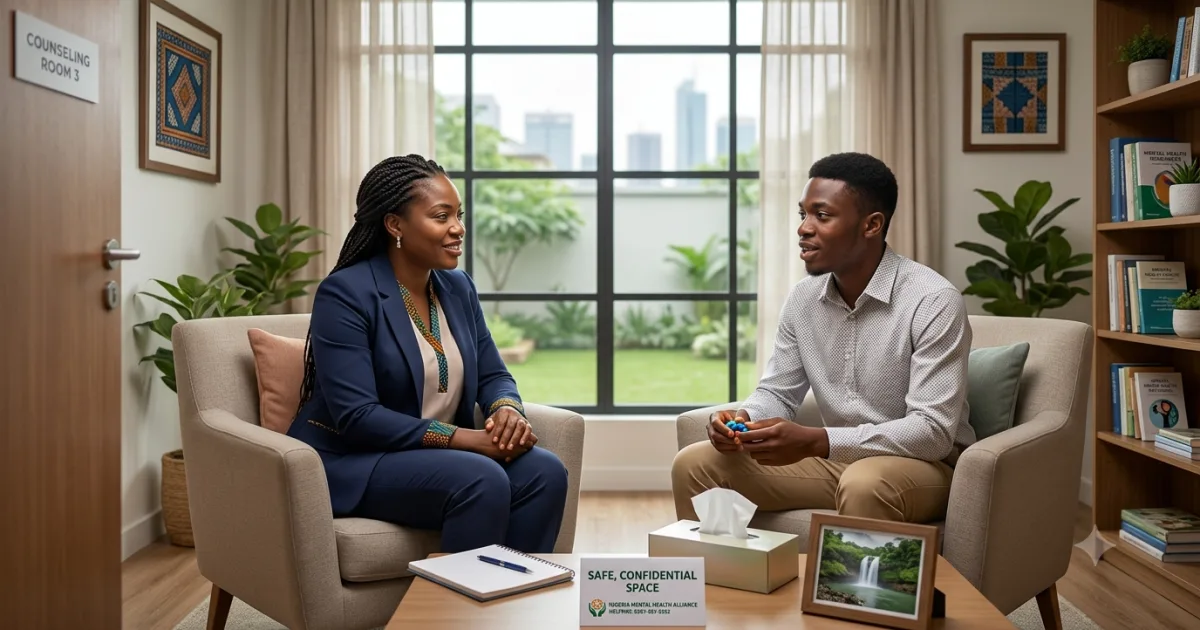
📌 Quick Summary: Mental health care in Nigeria is more accessible in 2026 than it has ever been — with online therapy sessions starting from as low as ₦3,000, free telephone counselling lines, NGO-funded free therapy, and government psychiatric hospitals in every state. Whether you are dealing with anxiety, depression, grief, relationship stress or burnout, there are real, affordable options for Nigerians in Lagos, Abuja, Port Harcourt and across the country. This NaijaSabi guide tells you exactly where to go, what it costs, and what to do if you cannot afford anything at all.
⚠️ Medical Disclaimer: This article is for informational purposes only and does not constitute medical advice. NaijaSabi is not a medical institution. The resources listed in this article are provided for informational purposes — NaijaSabi does not endorse any specific provider. Always consult a qualified Nigerian doctor or licensed mental health professional for diagnosis and treatment. If you or someone you know is in immediate danger, call Nigeria’s emergency line: 112. If you are experiencing suicidal thoughts, please call the Suicide Prevention Helpline Nigeria immediately: 0800-800-2000 (free, available 24/7).
There is something happening in Nigeria that is long overdue. More Nigerians are talking about mental health — on Twitter, in WhatsApp groups, on TikTok, in offices and homes across the country. People are saying the words: anxiety, depression, therapy, burnout. Words that were hidden or dismissed a decade ago are now part of everyday Nigerian conversations. But knowing you might need help and knowing how to get it in Nigeria — affordably, practically, without stigma — are two very different things. This guide closes that gap. Here is everything you need to know about getting mental health support in Nigeria in 2026, at every price point, in every major city.
| Option | Cost | Where |
| Free telephone counselling (Lagos Lifeline) | Free | Lagos residents |
| Arogi Trauma Care Foundation | Free (online and in-person) | Nationwide |
| Arogi free hotline | Free | 0800-0001-00020 |
| Mytherapist.ng (online) | From ₦3,000 per session | Nationwide (online) |
| Government psychiatric hospitals (outpatient) | ₦2,000–₦17,250 per consultation | All 36 states |
| Private therapy — other cities | ₦10,000–₦46,000 per session | Lagos, Abuja, PH, Ibadan, Kano |
| Private therapy — Lagos premium | ₦30,000–₦80,500 per session | Victoria Island, Ikoyi |
| Health Planet Psychotherapy | Varies — 8 locations | Lagos, Abuja, Enugu, PH, Owerri, Ibadan |
First — Why Mental Health Still Feels Like a Big Deal in Nigeria (And Why It Shouldn’t)
Before we get into the practical information, let us address something honestly. Many Nigerians — especially older ones — still believe that mental health struggles mean “you are mad” or “you have spiritual problems.” Many believe that prayer alone is enough, or that you just need to “be strong” and “face your problems.” These beliefs are understandable — they come from culture, religion and the way generations of Nigerians were raised. But they are also costing lives and causing unnecessary suffering.
Anxiety, depression, grief, trauma, burnout, OCD, PTSD — these are medical conditions. They have causes. They have treatments. They are not a sign of weakness. They are not a spiritual failure. They are not something you can simply “snap out of.” A person with untreated anxiety does not choose to feel constant fear any more than a person with malaria chooses to have a fever. The brain is an organ. Like every other organ in the body, it can struggle — and like every other organ, it can be helped with proper care.
The Federal Ministry of Health Nigeria has a National Mental Health Policy. The Nigeria Mental Health Act 2021 legally recognises the rights of people with mental health conditions to dignity and treatment. And in 2026, there are more trained Nigerian therapists, counsellors and psychiatrists than at any previous point in the country’s history. The help exists. You just need to know where to find it.
The Free Options — Mental Health Support at No Cost in Nigeria
If you are struggling and cannot afford to pay anything right now, there are genuine free options available to you in Nigeria. You do not need money to start getting help.
Arogi Trauma Care Foundation — Free Nationwide (Online and In-Person)
Arogi Trauma Care Foundation is a Lagos-based non-profit organisation that provides completely free psychotherapy and counselling to Nigerians across the country — both online and face-to-face. Their services cover grief, relationship problems, loss of livelihood, campus stress, trauma, and mental health challenges of all kinds. They also run suicide prevention support and crisis intervention.
- Free hotline: 0800-0001-00020 (toll-free)
- Online sessions: Available nationally via their website
- In-person: Lagos-based physical centre
- Cost: Absolutely free — no payment required
Lagos State Lifeline — Free Telephone Counselling
The Lagos State Lifeline is a tele-mental health service run by the Lagos State Government that provides free psychosocial support, counselling and psychotherapy to Lagos residents through a dedicated telephone line. It specifically targets people who cannot easily access physical mental health services, including people in hard-to-reach areas, victims of domestic and sexual violence, and people experiencing suicidal thoughts.
- Available to: Lagos State residents
- Cost: Free
- Service: Counselling by phone — no need to visit a clinic
Yaba Psychiatric Hospital — Free and Low-Cost Outpatient Services
Yaba Psychiatric Hospital in Lagos — officially the Federal Neuropsychiatric Hospital, Yaba — is one of Nigeria’s oldest and most established mental health facilities and offers outpatient psychiatric and counselling services at government-subsidised rates. Its “Yaba Voice” community outreach service also provides online mental health information through social media.
- Address: 8 Harvey Road, Yaba, Lagos
- Services: Outpatient psychiatric consultations, counselling, crisis support
- Cost: Government-subsidised — among the most affordable options in Lagos
Suicide Prevention Helpline Nigeria
If you or someone you know is experiencing suicidal thoughts right now, please call this number immediately:
Suicide Prevention Helpline Nigeria: 0800-800-2000 (free, 24 hours a day, 7 days a week)
You do not need to be in immediate danger to call. If you are having thoughts of harming yourself, if life feels unbearable, if you do not know what to do — call this number. The people on the other end are trained to help and the call is confidential.
Affordable Therapy in Nigeria — Sessions from ₦3,000
If you can afford to pay something but private therapy feels out of reach, there are genuinely affordable options in Nigeria — particularly online platforms that remove the overhead costs of a physical clinic and pass those savings directly to you.
Mytherapist.ng — From ₦3,000 Per Session
Mytherapist.ng is Nigeria’s most prominent dedicated online therapy platform, matching Nigerians with licensed Nigerian therapists for video, voice or chat sessions. Sessions start from ₦3,000 — making it one of the most affordable formal therapy options in the country. You can filter therapists by language, faith, gender and specialisation, and most people are matched within the same day. Initial consultations start with a free two-minute mental health check-in. The platform is fully confidential.
- Website: mytherapist.ng
- Starting cost: ₦3,000 per session
- Format: Online — video, voice or chat
- Available: Nationwide
Mental Health Foundation Nigeria
The Mental Health Foundation Nigeria offers community-led counselling and group support programmes at affordable rates. They focus on mental health education, crisis intervention and support groups — making them particularly useful for people who want community-based support rather than one-on-one therapy.
Government Hospital Outpatient Psychiatric Units — ₦2,000–₦17,250
Every state in Nigeria has at least one Federal Medical Centre or Teaching Hospital with a psychiatry or mental health outpatient unit. These facilities offer consultations with trained psychiatrists and psychologists at government-subsidised rates — typically between ₦2,000 and ₦17,250 per consultation depending on the facility and your state. This is by far the most affordable route to seeing a qualified mental health professional in person across Nigeria.
Government hospitals with mental health outpatient units across Nigeria:
- Federal Neuropsychiatric Hospital Yaba — Lagos
- Federal Neuropsychiatric Hospital Benin — Benin City
- Federal Neuropsychiatric Hospital Uselu — Edo State
- University of Port Harcourt Teaching Hospital — UPTH, Rivers State
- Aminu Kano Teaching Hospital — Kano
- National Hospital Abuja — Central Business District
- University of Nigeria Teaching Hospital — Enugu
- Lagos University Teaching Hospital (LUTH) — Idi-Araba, Lagos
Mid-Range Private Therapy — For Those Who Can Afford More
If you are able to spend more and want specialised private care, Nigeria’s major cities have a growing number of qualified private therapists and psychology practices. Based on 2026 pricing data, here is what to expect across different cities:
| City | Average Therapy Cost Per Session |
| Lagos (Victoria Island/Ikoyi) | ₦30,000 – ₦80,500 |
| Lagos (other areas) | ₦15,000 – ₦57,500 |
| Abuja | ₦15,000 – ₦57,500 |
| Port Harcourt | ₦15,000 – ₦46,000 |
| Ibadan | ₦10,000 – ₦34,500 |
| Kano | ₦10,000 – ₦34,500 |
| Enugu | ₦10,000 – ₦34,500 |
| Benin City | ₦10,000 – ₦28,750 |
Health Planet Psychotherapy — 8 Locations Across Nigeria
Health Planet Psychotherapy is one of Nigeria’s largest private therapy networks, with eight clinic locations across Lagos, Abuja, Enugu, Port Harcourt, Owerri and Ibadan. They offer individual therapy, couples therapy, family therapy and psychiatric consultations using evidence-based approaches including Cognitive Behavioural Therapy (CBT) and Dialectical Behaviour Therapy (DBT). They also offer online sessions for Nigerians who cannot attend in person.
- Website: healthplanetpsychotherapy.com
- Locations: Lagos, Abuja, Enugu, Port Harcourt, Owerri, Ibadan
- Services: Individual, couples and family therapy; psychiatric care
Olive Prime Psychological Services — Lagos
Olive Prime is one of Lagos’s most established private mental health centres, offering evidence-based treatments including CBT, inpatient care for severe cases, family therapy and relationship counselling. They are known for measurable outcomes and professional accountability.
- Location: Plot 3 Rock Drive, off C&I Leasing Drive, Central Business District, Lekki Phase 1, Lagos
- Services: CBT, DBT, inpatient care, family and couples therapy
How to Know if You Might Need Mental Health Support
Many Nigerians delay getting help because they are unsure whether what they are experiencing is “serious enough.” Here is a simple guide — if several of these apply to you consistently over two or more weeks, speaking to a mental health professional is worth considering:
- Feeling sad, empty or hopeless most of the time without a clear reason
- Constant worry or fear that you cannot control — about money, health, the future, relationships
- Difficulty sleeping — either sleeping too much or not being able to sleep at all
- Losing interest in things you used to enjoy — football, music, seeing friends
- Feeling exhausted even when you have not done much
- Difficulty concentrating, forgetting things, making decisions
- Feeling irritable or angry more easily than usual
- Withdrawing from family and friends
- Eating much more or much less than usual
- Physical symptoms without a medical cause — unexplained headaches, stomach pain, heart racing
- Thoughts of harming yourself or feeling like life is not worth living
You do not need to experience all of these to seek help. Even one or two, if persistent and affecting your daily life, are reason enough to talk to someone.
Tips for Nigerians Starting Therapy for the First Time
If you have never been to therapy before, the first session can feel daunting — especially in a country where mental health stigma is still real. Here are practical tips from Nigerian therapists for first-timers:
- You do not have to be “crazy” to go to therapy. Most people in therapy are managing everyday stress, relationship challenges, grief or work pressure — not severe psychiatric illness
- The first session is usually an introduction. Your therapist will ask about your background and what brought you in. You do not have to share everything immediately — you share what you are comfortable with
- It is okay to try different therapists. Like finding a good doctor, finding the right therapist sometimes takes two or three tries. Do not give up if the first one does not feel like a good fit
- Online therapy is real therapy. A session on Mytherapist.ng with a licensed Nigerian therapist is as valid as sitting in a clinic. For many Nigerians, online therapy is more accessible, more affordable and more private
- Everything is confidential. What you tell your therapist stays between you and them — with very narrow legal exceptions that your therapist will explain in your first session
- Filter for faith if it matters to you. Many Nigerian therapists on platforms like Mytherapist.ng identify as Christian or Muslim and can integrate faith into therapy for clients who want that
When to See a Doctor in Nigeria — Mental Health Emergencies
Some mental health situations require immediate medical attention — not a therapy session, but a hospital. Go to your nearest emergency room or call 112 if you or someone you know is experiencing any of the following:
- Active suicidal thoughts with a plan or intention to act
- Psychosis — seeing or hearing things that are not there, speaking or behaving in ways that seem disconnected from reality
- Severe depression where the person cannot eat, cannot get out of bed, or cannot care for themselves
- Manic episodes — extreme, unusual energy, not sleeping for days, making very impulsive decisions
- Threatening to harm themselves or others
If in doubt — go to the hospital. A mental health emergency is as real and as urgent as a physical one.
Frequently Asked Questions — Mental Health Help in Nigeria
How much does therapy cost in Nigeria in 2026?
Therapy costs in Nigeria in 2026 range widely depending on the type of provider and your city. Online therapy on platforms like Mytherapist.ng starts from as low as ₦3,000 per session — the most affordable formal option available. Government hospital outpatient psychiatric units charge ₦2,000–₦17,250 per consultation. Private therapists in Lagos charge ₦15,000–₦80,500 per session depending on location and specialisation. Abuja and Port Harcourt therapists charge ₦15,000–₦57,500 and ₦15,000–₦46,000 respectively. Completely free options also exist through Arogi Trauma Care Foundation (0800-0001-00020) and the Lagos State Lifeline. Prices are based on 2026 data and may vary — confirm with your chosen provider before booking.
Is there free mental health support in Nigeria?
Yes — free mental health support exists in Nigeria. Arogi Trauma Care Foundation offers completely free online and in-person counselling nationwide, reachable on their toll-free line 0800-0001-00020. The Lagos State Lifeline provides free telephone counselling to Lagos residents. Government psychiatric hospitals across all 36 states offer heavily subsidised outpatient consultations at ₦2,000–₦17,250. The National Suicide Prevention Helpline Nigeria — 0800-800-2000 — is also free and available 24 hours a day. This information is provided for informational purposes — contact each organisation directly to confirm availability and eligibility.
What is the suicide prevention hotline number in Nigeria?
The Suicide Prevention Helpline Nigeria number is 0800-800-2000. It is free to call, available 24 hours a day, seven days a week, and completely confidential. If you or someone you know is experiencing suicidal thoughts, please call this number immediately. You do not need to be in immediate danger — if you are struggling, calling is the right thing to do. If someone is in immediate physical danger, call Nigeria’s emergency line 112.
What is the difference between a therapist, psychologist and psychiatrist in Nigeria?
In Nigeria, a therapist or counsellor is a trained mental health professional who helps you talk through emotional challenges, develop coping skills and process difficult experiences — they cannot prescribe medication. A psychologist holds an advanced degree in psychology and can perform assessments and provide specialised therapeutic interventions — most also cannot prescribe medication in Nigeria. A psychiatrist is a medical doctor who specialised in mental health — they can diagnose mental health conditions and prescribe medication alongside therapy. For most everyday mental health support (anxiety, stress, grief, relationship challenges), a therapist or counsellor is a good starting point. For more complex conditions or medication, a psychiatrist at a government teaching hospital is the most accessible option for most Nigerians. This is a general guide — consult a qualified professional to determine what type of care is right for your specific situation.
Can I do therapy online in Nigeria?
Yes — online therapy is widely available in Nigeria in 2026 and has become one of the most popular and accessible routes to mental health support, particularly for Nigerians outside Lagos and Abuja. Platforms like Mytherapist.ng connect you with licensed Nigerian therapists for sessions by video, voice or chat, starting from ₦3,000. Online therapy is fully confidential, can be done from your phone, and removes the cost and time of travelling to a clinic. Many Nigerians find online therapy more comfortable because it provides a degree of privacy that in-person sessions may not. Ensure your chosen online platform uses licensed and verified Nigerian therapists before booking.
Will people find out I went to therapy in Nigeria?
No — therapy in Nigeria is confidential. What you share with your therapist is legally and professionally protected information that stays between you and them. Your therapist will not share your information with your family, employer, church or anyone else without your explicit written consent — with very narrow legal exceptions (such as if there is immediate danger to yourself or others), which your therapist will explain in your first session. Many Nigerians worry about stigma and what people will say — but your therapy sessions are your private business. Online therapy adds an additional layer of privacy since there is no waiting room or clinic visit for anyone to see. Confirm confidentiality policies with your specific provider before beginning sessions.
Sources
- Federal Ministry of Health Nigeria — National Mental Health Policy — health.gov.ng
- Nigeria Mental Health Act 2021 — Official Gazette, Federal Republic of Nigeria
- Arogi Trauma Care Foundation — official organisation information — arogifoundation.org
Last updated: 4 September 2026 · NaijaSabi Health Desk. This article is for informational purposes only. If you are in crisis, call 0800-800-2000 (Suicide Prevention Helpline Nigeria) or 112 (Emergency). Always consult a qualified healthcare professional before making any medical decisions.



0 Comments
No comments yet. Be the first to share your thoughts!