




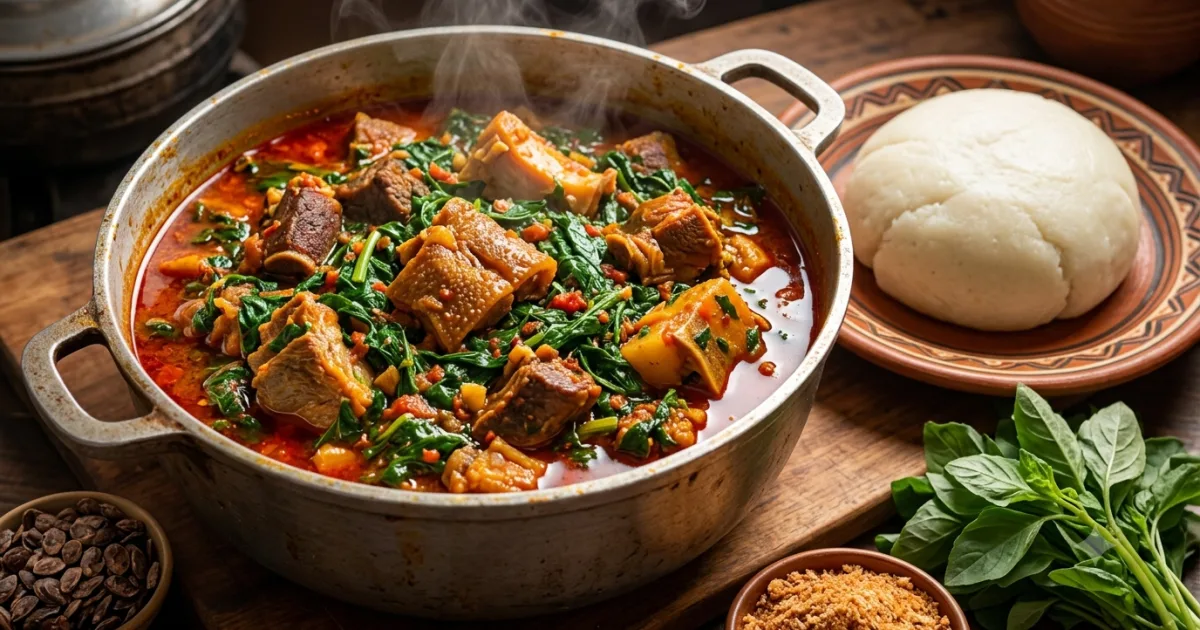
📌 Quick Summary: Efo riro is a Yoruba spinach stew made with tete (African spinach) or shoko (Lagos spinach), cooked in a tomato-pepper-onion base with palm oil, assorted meat, stockfish, crayfish, and locust beans (iru). It is one of Nigeria’s most beloved soups — lighter than egusi but equally rich, deeply flavoured, and versatile. A pot serving 8 to 10 uses 2 large bunches of tete or shoko, ½ cup of palm oil, assorted meat, and the key ingredient most people skip: iru (locust beans). This is the complete step-by-step recipe, ingredient guide, the difference between efo riro and efo elegusi, what to serve it with, and the most common mistakes.
Ask any Yoruba person about their favourite soup and efo riro will be in the first three answers. Translated literally as “stirred leafy vegetable,” efo riro is built on a principle that defines the best Nigerian cooking: simplicity of ingredient, complexity of technique. The same vegetables and palm oil that produce a mediocre soup in careless hands produce something extraordinary when the tomato base is fried properly, the iru is added at the right moment, and the greens are cooked just long enough to wilt without losing their vivid colour and fresh flavour. This guide will tell you exactly how to do it right.
What Is Efo Riro? Understanding the Dish
Efo riro is a Yoruba soup — efo meaning “leafy vegetable” and riro meaning “to stir.” It originates from the Yoruba-speaking Southwest Nigeria (Lagos, Ogun, Oyo, Ondo, Ekiti, and Osun states) but is now eaten and loved across all Nigerian regions. Unlike egusi soup, which is thickened by ground melon seeds, efo riro is a vegetable-dominant soup — the greens are the star, not a garnish. The base is a deeply fried tomato and pepper sauce enriched with palm oil, proteins, and the distinctive funky depth of iru (fermented locust beans). Efo riro is typically served with pounded yam, eba, amala, or semovita — though it is also excellent over white rice for a lighter meal.
Efo Riro vs Efo Elegusi: What Is the Difference?
| Feature | Efo Riro | Efo Elegusi |
| Primary identity | Vegetable soup — greens are the star | Egusi soup with added greens — egusi is the star |
| Thickener | None — purely vegetable and protein based | Ground egusi (melon seeds) |
| Texture | Lighter, leafy, with a rich oil base | Thicker, heavier, more filling per serving |
| Main vegetable | Tete (African spinach) or shoko (Lagos spinach) | Ugwu, bitter leaf, or spinach added to the egusi base |
| Cooking time | Faster — 45 to 60 minutes total | Longer — 60 to 90 minutes total |
| Calorie density | Lower — more vegetable, less seed | Higher — egusi seeds are calorie-dense |
| Shared elements | Both use palm oil, assorted meat, crayfish, stockfish, and iru | |
Ingredients — Serves 8 to 10
| Ingredient | Quantity | Notes |
| Tete (African spinach) or shoko (Lagos spinach) | 2 large bunches (approximately 800g–1kg washed and chopped) | Tete has a slightly bitter edge and holds its colour well. Shoko is milder and more tender. Both are correct — use whichever is freshest at your market. Frozen spinach can substitute in an emergency but produces a less vibrant soup. |
| Palm oil | ½ cup (120ml) | Fresh, unprocessed red palm oil. Not bleached oil. |
| Fresh tomatoes | 4 medium (approximately 400g) | Roma/plum tomatoes preferred |
| Red bell pepper (tatashe) | 2 large | Adds sweetness and body — do not skip |
| Scotch bonnet pepper (atarodo) | 2–3 (to taste) | Adjust to your heat preference |
| Onion | 2 medium | One blended into the tomato base, one sliced for frying |
| Assorted meat | 800g–1kg | Beef, pomo (cow skin), shaki (tripe), goat meat — any combination. Boil and season before use. |
| Stockfish (okporoko) | 150g | Soak in hot water for 2+ hours before cooking |
| Smoked or dried fish | 2 medium pieces | Smoked mackerel or panla (stockfish flakes). Wash thoroughly. |
| Ground crayfish | 3 tablespoons | Essential — the umami backbone of the soup |
| Iru (fermented locust beans) | 1–2 tablespoons | The ingredient that separates authentic efo riro from a pale imitation. Do not skip. Adds deep, complex, funky flavour. Available in all Nigerian markets. |
| Seasoning cubes | 2 | Maggi or Knorr |
| Salt | To taste | Add at end — stock, crayfish, and iru all contain salt |
Preparing the Vegetables: The Step Most People Get Wrong
How you prepare the tete or shoko determines whether your efo riro is vibrant and fresh-tasting or dull, soggy, and bitter. Sort through the leaves carefully and discard any yellowed, wilted, or damaged leaves — these turn the soup bitter and muddy its colour. Wash the leaves thoroughly in three changes of cold water to remove sand and grit — market greens in Nigeria carry significant soil residue. After washing, shake off excess water and chop into medium pieces — not too fine (they will disappear in cooking) and not too large (they will be difficult to eat). Spread on a clean surface or basket and allow to drain for 10 to 15 minutes before adding to the soup. Excess water in the greens will thin your soup and dilute its flavour.
Step-by-Step Recipe
Step 1: Cook and Season Your Meat
Season assorted meat with sliced onion, seasoning cubes, salt, and a pinch of thyme. Add the soaked stockfish. Cover with water and boil until tender — 30 to 45 minutes depending on the meat. Remove the meat and fish from the stock and set aside. Reserve all the stock — you will use it in the soup. The quality of your meat stock is one of the biggest determinants of efo riro flavour. If you are cooking without meat stock (vegetarian version), use water and increase the crayfish and iru quantities to compensate.
Step 2: Blend and Reduce the Tomato-Pepper Base
Blend the fresh tomatoes, red bell peppers, scotch bonnet peppers, and one onion until smooth. Pour into a pot and boil over medium-high heat for 10 to 15 minutes, stirring occasionally, to reduce the water content. This pre-boiling step prevents excessive splattering when the blended mixture hits the hot palm oil in the next step.
Step 3: Fry the Tomato Base in Palm Oil
Heat ½ cup of palm oil in a large, wide pot over medium heat until liquid and hot — do not bleach or overheat. Slice the second onion and fry in the palm oil until translucent and beginning to brown — about 4 minutes. Add the iru (locust beans) and fry for 1 minute — the heat activates its aroma and distributes it through the oil. Add the pre-reduced tomato-pepper blended mixture. Fry on medium heat, stirring frequently, until the raw tomato smell is gone and the oil has separated and is floating on top — 20 to 25 minutes. This is the most important step in efo riro. An under-fried base produces a sour, raw-tasting soup regardless of how good your other ingredients are.
Step 4: Add Proteins and Stock
Add the cooked meat, stockfish, and smoked or dried fish to the fried tomato base. Add 1 to 2 cups of the reserved meat stock. Add the ground crayfish and crumbled seasoning cubes. Stir everything together and bring to a gentle boil. Taste the soup base at this stage — it should be well-seasoned, savoury, and slightly salty. Adjust seasoning now before the greens go in. Simmer for 5 to 10 minutes to allow the flavours to integrate.
Step 5: Add the Greens — Timing Is Everything
This is the step that most defines the quality of efo riro. Add the prepared tete or shoko to the soup. Do not stir immediately — allow the leaves to rest on top of the soup for 30 seconds so the steam begins to wilt them. Then stir gently, folding the greens into the soup from the bottom up. Cook for exactly 3 to 5 minutes on medium heat. Tete wilts quickly and should not be overcooked — it goes from vibrant green to dull olive when overcooked, losing both its colour and its fresh flavour. Taste the soup after 3 minutes. If the greens are just wilted and still bright green, your efo riro is ready. Remove from heat immediately.
Step 6: Rest and Serve
Allow the soup to rest off heat for 3 to 5 minutes before serving. This short resting time allows the residual heat to finish wilting the greens without overcooking them on the stove. Serve with pounded yam, eba, amala, semovita, or white rice. Efo riro is one of the soups that genuinely improves on reheating — the flavours develop further overnight in the refrigerator.
Vegetarian Efo Riro
Efo riro can be made without any meat or fish and still be deeply flavoured. Increase the iru to 3 tablespoons, double the ground crayfish, add 2 tablespoons of good-quality vegetable bouillon, and use mushrooms (fresh or dried) for umami depth. The palm oil, iru, and crayfish carry the flavour burden that meat and fish normally provide. This version is popular among health-conscious Nigerians and diaspora cooks who cannot access fresh stockfish easily.
Storing Efo Riro
Efo riro stores excellently. Refrigerated: 3 to 4 days in a sealed container — the flavour improves on the second day. Frozen: 2 to 3 months. Freeze in portion sizes so you can thaw only what you need. When reheating, add a small splash of water or stock — efo riro thickens in the refrigerator as the palm oil solidifies. Reheat gently over low heat, stirring occasionally. The greens may lose some brightness on reheating but the flavour deepens.
Common Mistakes That Ruin Efo Riro
1. Skipping the Iru
Iru (fermented locust beans) is the ingredient that gives authentic efo riro its characteristic depth — a complex, slightly funky, deeply savoury note that no substitute fully replicates. Many cooks skip it because of its strong smell during cooking. Add it at the stage of frying the onion in palm oil — the cooking process mellows its aroma significantly while retaining its flavour contribution to the finished soup.
2. Overcooking the Greens
Greens cooked for 10 to 15 minutes turn an unappealing olive-brown and lose their fresh flavour. Three to five minutes is the maximum. Remove from heat the moment the leaves are just wilted and still bright green.
3. Under-frying the Tomato Base
The same mistake that ruins jollof rice ruins efo riro. The blended tomato-pepper mixture must be fried until the oil separates and all sourness is cooked out — at least 20 minutes on medium heat. Rushing this step produces a sour, raw-tasting soup.
4. Using Frozen or Old Greens
The quality of your tete or shoko determines the quality of your efo riro. Use the freshest greens available — bought on the day you cook if possible. Yellowed or wilted leaves turn the soup bitter. Frozen spinach produces a duller, less vibrant soup than fresh tete or shoko.
5. Adding Too Much Water
Efo riro should be thick and saucy — not watery. Add meat stock sparingly. The greens themselves release water as they cook, contributing liquid to the soup. If your efo riro is too thin, cook uncovered on medium heat for a few minutes after the greens are added to reduce excess liquid.
Frequently Asked Questions
What vegetable is used for efo riro?
Tete (African spinach, Amaranthus hybridus) or shoko (Lagos spinach, Celosia argentea) — both are correct and widely available in Nigerian markets. Tete has a slightly more robust flavour; shoko is milder and more tender. Either can be used depending on what is freshest at your market on cooking day.
What is iru and can I skip it?
Iru is fermented locust beans — a traditional West African condiment made from the seeds of the African locust bean tree. It has a strong, pungent smell that mellows significantly during cooking, adding deep umami complexity to soups and stews. It is available at every Nigerian market. Technically you can skip it, but the soup will lack the characteristic depth that defines authentic efo riro. Do not skip it.
Can I use regular spinach for efo riro?
Regular spinach (the type sold in supermarkets, Spinacia oleracea) can be used as a substitute when tete or shoko is unavailable — particularly useful for diaspora Nigerians. It produces a slightly different flavour and texture but an acceptable result. Use the same quantity and the same brief cooking time — regular spinach wilts even faster than tete.
How long does efo riro last in the fridge?
3 to 4 days refrigerated in a sealed container. The flavour improves on the second day. Frozen efo riro lasts 2 to 3 months with no significant quality loss — freeze in portion sizes.
What is the difference between efo riro and egusi soup?
Efo riro is a vegetable-dominant soup — the leafy greens are the primary ingredient and there is no thickener. Egusi soup is thickened by ground melon seeds (egusi) with vegetables as an addition. Efo riro is lighter, faster to cook, and has a fresher flavour profile; egusi is heavier and more filling.
Is efo riro Yoruba food?
Yes — efo riro originates from Yoruba culinary tradition in Southwest Nigeria. It is now eaten across all regions of Nigeria and by Nigerians worldwide. Its Yoruba name means “stirred leafy vegetable.”
Sources
- Original recipe — NaijaSabi Lifestyle Desk, September 2026
- Yoruba culinary tradition — efo riro preparation documented across Lagos, Ogun, Oyo and Ondo state cooking practices
Last updated: 6 September 2026 · NaijaSabi Lifestyle Desk.




0 Comments
No comments yet. Be the first to share your thoughts!