




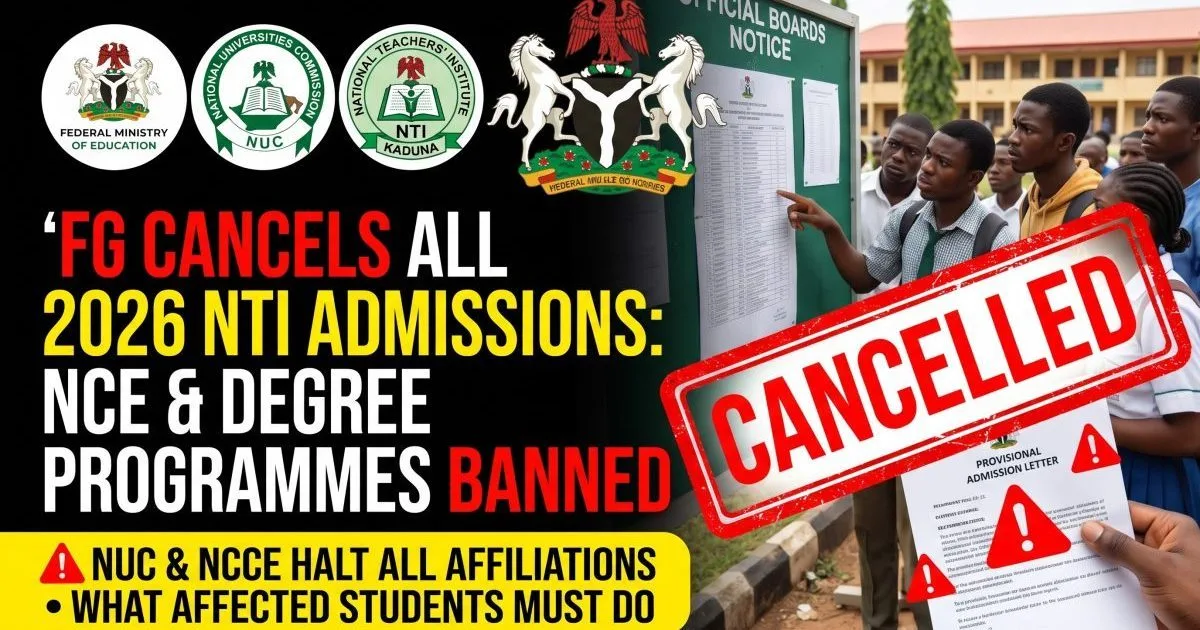
Key Takeaways: FG Cancellation of 2026 NTI NCE & Degree Admissions
- The Core Directive: The Federal Government, through the Federal Ministry of Education (FME), has officially cancelled all 2026 Nigeria Certificate in Education (NCE) and Bachelor’s Degree admissions conducted by the National Teachers’ Institute (NTI), Kaduna.
- Scope of the Ban: The cancellation applies across the board to full-time, part-time, and Distance Learning System (DLS) NCE and undergraduate degree programmes operated by the Institute.
- Why the Action Was Taken: Announced via an official statement signed by the Ministry’s Director of Press and Public Relations, Boriowo Folasade, the decision stems from grave regulatory breaches, overstepping of statutory mandates, and non-compliance with quality assurance standards.
- Orders to NUC & NCCE: The Ministry directed the National Universities Commission (NUC) and the National Commission for Colleges of Education (NCCE) to immediately halt and terminate all unauthorized university degree and NCE affiliations with NTI.
- What NTI Can Now Do: NTI has been ordered to return strictly to its original statutory mandate—providing in-service teacher training, continuing professional development (CPD), and short-term capacity-building rather than functioning as a degree-awarding university or regular college of education.
In a sweeping regulatory shake-up of Nigeria’s teacher education sector, the Federal Government of Nigeria, acting through the Federal Ministry of Education (FME), has ordered the immediate cancellation of all 2026 admissions into the Nigeria Certificate in Education (NCE) and Bachelor’s Degree programmes run by the National Teachers’ Institute (NTI), Kaduna. The directive—communicated in an official press statement issued in Abuja by the Ministry’s Director of Press and Public Relations, Boriowo Folasade—bars the institute from admitting fresh candidates into full-time, part-time, or Distance Learning System (DLS) degree and NCE tracks.
For decades, the National Teachers’ Institute has served as a popular distance-learning bridge for tens of thousands of working-class Nigerians, primary school teachers, and adult learners seeking NCE and affiliated Bachelor of Education (B.Ed / B.A. Ed / B.Sc. Ed) qualifications through study centres scattered across all 36 states and the FCT. However, following an exhaustive audit of tertiary education compliance and quality assurance across the federation, the Ministry of Education concluded that NTI’s operation of full-time and distance degree/NCE admissions violated established regulatory frameworks and exceeded the Institute’s founding statutory mandate.
The announcement has understandably triggered widespread anxiety among newly admitted 2026 applicants who recently paid acceptance or tuition fees on the NTI portal, returning 200-level to 400-level distance learners, and graduates awaiting NYSC exemption or Teachers Registration Council of Nigeria (TRCN) licensing. This comprehensive guide breaks down every aspect of the Federal Government’s directive, why the NUC and NCCE were ordered to sever NTI affiliations, what affected 2026 applicants must do regarding their tuition payments, and safe, accredited alternatives for teacher education in Nigeria.
Table of Contents
- Executive Summary Table: FG Directive on NTI 2026 Admissions
- Inside the Ministry of Education Directive: What Was Cancelled and Why?
- Why Did the FG Step In? NTI’s Original Act vs. Unauthorized Degree Affiliations
- The Role of NUC, NCCE & JAMB: Halting Unapproved Study Centre Affiliations
- Impact on Fresh 2026 Applicants: What Happens to Your Admission & School Fees?
- What About Returning (200L–400L) NTI Students and Past Graduates?
- Implications for NYSC Mobilization/Exemption & TRCN Teacher Licensing
- How to Protect Yourself From Study Centre Coordinators Still Collecting Fees
- Top 5 Accredited Alternatives to NTI for Distance Learning & Part-Time Education Degrees
- How to Verify If a University Affiliation or NCE Programme Is Approved by NUC/NCCE
- Directory of Official Regulatory Portals (FME, NUC, NCCE, TRCN & NTI)
- Frequently Asked Questions (FAQs)
1. Executive Summary Table: FG Directive on NTI 2026 Admissions
Review the verified administrative facts surrounding the Federal Government’s November 2026 directive on the National Teachers’ Institute (NTI):
| Policy Parameter | Official Verified Details (November 2026) |
|---|---|
| Issuing Authority | Federal Ministry of Education (FME), Abuja |
| Official Spokesperson | Boriowo Folasade (Director, Press and Public Relations, FME) |
| Affected Institution | National Teachers’ Institute (NTI), Headquarters in Kaduna & Nationwide Study Centres |
| Cancelled Programmes | All 2026 NCE and Bachelor’s Degree admissions (Full-Time, Part-Time, and Distance Learning) |
| Enforcement Regulators | National Universities Commission (NUC) and National Commission for Colleges of Education (NCCE) |
| Core Reason for Ban | Regulatory breaches, operating outside statutory mandate, and quality assurance violations |
| Permitted NTI Mandate Going Forward | Strictly in-service teacher training, continuing professional development (CPD) & capacity building |
2. Inside the Ministry of Education Directive: What Was Cancelled and Why?
According to the official directive issued by the Federal Ministry of Education in November 2026, the Federal Government ordered the immediate nullification and discontinuation of all 2026 academic admissions into NCE and Bachelor’s Degree programmes conducted by the National Teachers’ Institute (NTI).
The statement, signed by the Ministry’s Director of Press and Public Relations, Boriowo Folasade, left zero ambiguity regarding the scope of the ban: it covers all modes of study—whether advertised as full-time, part-time, weekend, or Distance Learning System (DLS) programmes. Furthermore, the Ministry instructed the National Universities Commission (NUC) and the National Commission for Colleges of Education (NCCE) to take immediate regulatory steps to halt all university degree and NCE affiliations operating under the NTI umbrella.
Why did the Ministry of Education take such decisive action? The directive cited three critical systemic failures:
- Severe Regulatory Breaches: Running full-time and unapproved degree/NCE admission exercises outside the statutory accreditation and carrying-capacity frameworks of the NUC, NCCE, and the Joint Admissions and Matriculation Board (JAMB).
- Deviation From Founding Statutory Mandate: Transforming an in-service teacher training institute into a de facto multi-campus degree-awarding university network without legislative authorization.
- Protection of Academic Standards & Students: Preventing unsuspecting Nigerian youths and working teachers from spending hundreds of thousands of Naira on unaccredited degree and NCE certificates that subsequently face rejection during NYSC mobilization, civil service promotion exercises, or international credential evaluations.
3. Why Did the FG Step In? NTI’s Original Act vs. Unauthorized Degree Affiliations
To understand why the Federal Ministry of Education clamped down on NTI’s 2026 admissions, one must examine the historical law that created the Institute.
The National Teachers’ Institute was established by the Federal Government in 1976 (under Decree No. 7 of 1978, now Cap N79 Laws of the Federation of Nigeria) in response to the acute shortage of qualified primary school teachers following the introduction of the Universal Primary Education (UPE) scheme. Its original statutory mandate was clear: to upgrade under-qualified and unqualified **serving teachers** (such as Grade II teachers) through distance learning and continuing professional education without pulling them out of their classrooms.
Over the years, however, NTI expanded far beyond in-service teacher upgrading. Across hundreds of study centres hosted in primary and secondary school premises nationwide, the Institute began admitting young secondary school leavers straight into NCE and affiliated 4-year Bachelor’s Degree programmes (B.A. Ed, B.Sc. Ed, B.Ed), often bypassing standard JAMB Central Admissions Processing System (CAPS) protocols and NUC resource-verification benchmarks. By ordering NTI back to its core mandate of in-service teacher retraining and continuing professional development (CPD), the Federal Government is drawing a hard legal line between professional training institutes and accredited degree-awarding universities.
4. The Role of NUC, NCCE & JAMB: Halting Unapproved Study Centre Affiliations
Under Nigerian education law, an institute like NTI cannot award a Bachelor’s Degree in its own name; it previously relied on affiliation agreements with conventional federal or state universities (such as Usmanu Danfodiyo University, Sokoto; University of Maiduguri; University of Ilorin; Nnamdi Azikiwe University; and National Open University of Nigeria in various historical cycles).
Under the November 2026 Federal Government directive:
- Directive to the NUC: The National Universities Commission has been mandated to enforce the immediate cessation of university degree affiliations operated through NTI’s sprawling study centre network and sanction any university Senate that continues to matriculate fresh 2026 NTI degree candidates.
- Directive to the NCCE: The National Commission for Colleges of Education has been tasked with halting fresh NCE admissions across NTI centres that fail to meet strict NCCE minimum academic standards, laboratory requirements, and staffing ratios.
- Alignment With the Federal Ban on Satellite Study Centres: Both the NUC and NCCE have repeatedly warned that unmonitored “study centres” operating in rented secondary school classrooms on weekends dilute the quality of Nigerian tertiary certificates.
5. Impact on Fresh 2026 Applicants: What Happens to Your Admission & School Fees?
If you recently purchased an application form, received a provisional 2026 admission letter, or paid tuition/registration fees for an NTI NCE or Bachelor’s Degree programme, here is how the Federal Government’s cancellation affects you directly:
Immediate Action for 2026 Applicants: Do NOT make any further tuition, acceptance, portal charge, or handout payments for any 2026 NTI NCE or Degree admission. Keep your original Remita Retrieval Reference (RRR) receipts, bank teller printouts, and online portal acknowledgment slips safely for official refund or credit reconciliation directives from the Ministry of Education and NTI Headquarters.
- 1. 2026 Admission Offers Are Nullified: Because the supervising Federal Ministry of Education has officially cancelled the 2026 NCE and Degree admission exercise, any 2026 admission letter issued for those programmes lacks regulatory backing from the NUC and NCCE.
- 2. Keep All Remita (RRR) Payment Proofs: Legitimate NTI fee payments are processed via the Treasury Single Account (TSA) using Remita (`my.nti.edu.ng`). Do not lose your RRR payment receipt; affected 2026 candidates should await the formal administrative circular from NTI Kaduna and the Ministry detailing the refund or transfer procedure.
- 3. Beware of Cash Payments to Local Centre Coordinators: If you paid cash directly into the personal bank account of a local study centre coordinator rather than generating an official Remita invoice on the NTI portal, demand an immediate refund from that individual, as unauthorized personal collections violate federal financial regulations.
6. What About Returning (200L–400L) NTI Students and Past Graduates?
Whenever a regulatory body halts new admissions into an academic programme in Nigeria, returning students in their second, third, or final year naturally panic that their previous years of study have gone down the drain. Understanding standard NUC and NCCE regulatory practice helps clarify the distinction between fresh 2026 admissions and previously matriculated cohorts:
- Focus on the 2026 Admission Intake: The Ministry’s November 2026 directive specifically cancels the 2026 NCE and Degree admissions and halts new intakes to stop further proliferation of unapproved cohorts.
- Standard “Teach-Out” vs. Transition Protocols for Existing Cohorts: In standard Nigerian tertiary regulation, when an affiliation is terminated by the NUC or NCCE, the supervising bodies and parent universities typically establish a structured transition or “teach-out” verification audit for genuinely matriculated students from earlier sessions whose records were duly captured by the parent university Senate prior to the ban.
- Past Graduates With Awarded Certificates: Graduates from earlier academic sessions who have already received their official NCE certificates or Senate-approved Bachelor’s Degree certificates from the affiliated parent universities—and who have completed their TRCN registration or NYSC documentation—retain the validity of their previously awarded certificates.
- Verify Your Matriculation Status With the Parent University: If you are currently a returning 200-level, 300-level, or 400-level B.Ed student under an NTI study centre, do not rely solely on verbal assurances from a local centre coordinator. Confirm directly with the Directorate of Affiliated Programmes of the parent university (and NTI Headquarters in Kaduna) that your JAMB regularization/matriculation number is validly logged on the parent university’s central registry.
7. Implications for NYSC Mobilization/Exemption & TRCN Teacher Licensing
Why is it so dangerous to ignore the Federal Ministry of Education’s ban and continue attending an unapproved study centre in 2026? Because every tertiary certificate in Nigeria must pass through three mandatory national gatekeepers after graduation:
- JAMB Central Admissions Processing System (CAPS) & Regularization: No graduate of a Nigerian university or degree-affiliation programme can be uploaded to the NYSC portal for national service or a Certificate of Exemption unless their admission was legally processed and regularized through JAMB. With the Ministry cancelling 2026 NTI degree admissions and ordering the NUC to halt affiliations, any unauthorized 2026 intake will be completely blocked on JAMB CAPS.
- NYSC Mobilization & Exclusion/Exemption Certificates: While distance-learning and part-time degree graduates do not attend the 3-week NYSC orientation camp, they still require an official NYSC Exclusion Letter or Certificate of Exemption to apply for federal civil service jobs, state teaching service commission (TESCOM/SUBEB) recruitment, or postgraduate (Master’s/PGDE) admissions. NYSC only generates certificates for programmes uploaded by NUC-approved institutions.
- Teachers Registration Council of Nigeria (TRCN) PQE Licensing: To legally teach in Nigeria or qualify for international teaching migration (such as UK Qualified Teacher Status / QTS or US credential evaluation via WES), your NCE or B.Ed must be recognized by the TRCN for the Professional Qualifying Examination (PQE). Following the Ministry’s directive, any unapproved 2026 NTI admission will not be recognized for professional teacher licensing.
8. How to Protect Yourself From Study Centre Coordinators Still Collecting Fees
Red-Alert Warning Against Rogue Study Centres & Admission Agents
Historically, whenever the Federal Government, NUC, or NCCE shuts down a satellite study centre or cancels an unaccredited programme, unscrupulous local coordinators in remote towns attempt to keep collecting tuition fees from uninformed students by claiming the news is “fake” or “already settled in Abuja.” Protect your money and academic future by enforcing these 4 rules:
- Trust Official Federal Ministry of Education Directives Over WhatsApp Audio Notes: The cancellation of the 2026 NTI NCE and Degree admissions was officially announced by the Federal Ministry of Education’s Director of Press and Public Relations, Boriowo Folasade. No local study centre coordinator has the power to overrule the Minister of Education, the NUC, or the NCCE.
- Refuse All “Late 2026 Registration” Solicitations: If any cybercafé operator, study centre desk officer, or agent tells you to hurry and pay cash so they can “backdate your 2026 NTI admission,” walk away immediately.
- Never Pay Tuition Into Personal or Microfinance Bank Accounts: Legitimate federal tertiary institutions never collect school fees through personal bank accounts or POS transfers to a coordinator’s name.
- Demand Official Written Clarification Before Paying a Kobo: Until the Federal Ministry of Education, the NUC, and the NCCE publish a formal public reversal or newly accredited framework, treat all 2026 NTI NCE and Degree admissions as cancelled.
9. Top 5 Accredited Alternatives to NTI for Distance Learning & Part-Time Education Degrees
If your dream was to obtain an NCE or a Bachelor’s Degree in Education (B.Ed / B.A. Ed / B.Sc. Ed) in 2026/2027 while working full-time, you do not need to put your education on hold. Nigeria has several 100% NUC- and NCCE-accredited institutions that offer flexible Open and Distance Learning (ODL), part-time, and sandwich programmes:
| Accredited Institution / Programme | Regulatory Approval | Why It Is a Safe Alternative to NTI |
|---|---|---|
| 1. National Open University of Nigeria (NOUN) (Faculty of Education — B.A. Ed, B.Sc. Ed, B.Ed, PGDE, M.Ed) |
100% NUC Accredited (Federal ODL University) | Nigeria’s premier statutory Open & Distance Learning university with 100+ official study centres nationwide, zero strikes, instant JAMB/NYSC Exclusion processing, and full TRCN & WES recognition. |
| 2. NUC-Approved University Distance Learning Centres (DLCs) (UI DLC, UNILAG DLI, OAU CDL, ABU DLC, UNIMAID DLC) |
NUC Approved ODL Centres | Operated directly by first-generation federal universities under strict NUC Open and Distance Learning licenses, awarding the exact same Senate degree as full-time students. |
| 3. Federal & State Universities of Education (TASUED, IAUE, Alvan Ikoku FUE, Adeyemi FUE Ondo, FUE Zaria/Kano) |
100% NUC Accredited | Specialized degree-awarding universities of education offering full-time UTME/Direct Entry, part-time, and holiday sandwich B.Ed programmes. |
| 4. Conventional University Sandwich Programmes (UNN, UNIBEN, UNILORIN, LASU, DELSU, UNIPORT) |
NUC & JAMB CAPS Approved | Designed specifically for working NCE teachers; lectures hold during school long-vacation periods on the main university campus. |
| 5. Accredited Federal & State Colleges of Education (FCE Yaba, FCE Zaria, FCE Kano, FCE Omoku, etc.) |
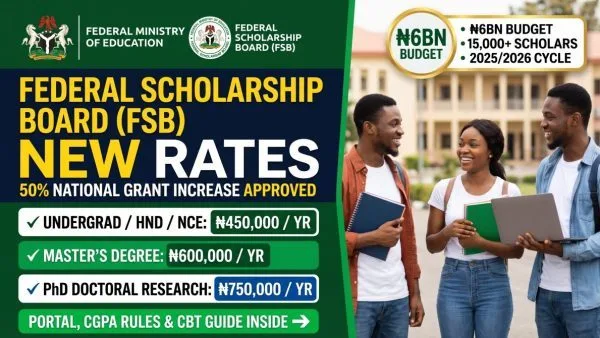
100% NCCE Accredited (Plus NELFUND Loan Eligible!) | Fully accredited by the NCCE for NCE programmes, and full-time students qualify for the Federal Government’s NELFUND student loan and the ₦450,000 FSB Education Bursary. |
10. How to Verify If a University Affiliation or NCE Programme Is Approved by NUC/NCCE
Before paying tuition to any college, institute, or affiliated study centre in Nigeria, spend five minutes running this three-point verification check:
- Check the Official JAMB Brochure (IBASS): Log onto the Joint Admissions and Matriculation Board Integrated Brochure and Syllabus System (`ibass.jamb.gov.ng`). Every legally recognized degree-awarding university, affiliated college, and NCE-awarding institution in Nigeria is listed there. If a programme cannot be selected on JAMB CAPS (even for Part-Time or Sandwich regularization), do not enrol.
- Verify Open & Distance Learning (ODL) Licenses on the NUC Portal: The NUC maintains a strict list of less than 20 Nigerian universities licensed to operate Open and Distance Learning Centres (`nuc.edu.ng`). Any off-campus satellite centre not listed by the NUC is illegal.
- Confirm NCCE Accreditation for NCE Programmes: Visit the National Commission for Colleges of Education portal (`ncce.gov.ng`) to view the directory of approved Federal, State, and Private Colleges of Education.
11. Directory of Official Regulatory Portals (FME, NUC, NCCE, TRCN & NTI)
For official circulars, accreditation verification, and updates on how the 2026 NTI directive is being implemented, consult only these verified government portals:
| Federal Agency / Regulator | Official Website / Portal | Core Regulatory Function |
|---|---|---|
| 1. Federal Ministry of Education (FME) | https://education.gov.ng/ | Supervising Ministry that issued the 2026 NTI admission cancellation directive |
| 2. National Universities Commission (NUC) | https://www.nuc.edu.ng/ | Regulates all Nigerian universities, ODL centres & degree affiliations |
| 3. National Commission for Colleges of Education (NCCE) | https://ncce.gov.ng/ | Regulates and accredits all NCE-awarding programmes in Nigeria |
| 4. Teachers Registration Council of Nigeria (TRCN) | https://trcn.gov.ng/ | Conducts professional qualifying exams (PQE) and licenses teachers |
| 5. National Teachers’ Institute (NTI), Kaduna | https://nti.edu.ng/ | Official NTI portal for administrative notices & in-service training updates |
12. Frequently Asked Questions (FAQs) About the FG Cancellation of 2026 NTI Admissions
1. Did the Federal Government really cancel all 2026 NTI NCE and Degree admissions?
Yes. In November 2026, the Federal Ministry of Education—through an official statement signed by its Director of Press and Public Relations, Boriowo Folasade—announced the immediate cancellation of all 2026 NCE and Bachelor’s Degree admissions (full-time, part-time, and distance learning) conducted by the National Teachers’ Institute (NTI), Kaduna.
2. Why did the Ministry of Education ban NTI from admitting NCE and Degree students in 2026?
The Ministry cited regulatory breaches, non-compliance with tertiary quality assurance standards, and the fact that NTI overstepped its original statutory mandate. The NUC and NCCE were consequently ordered to halt all unauthorized university degree and NCE affiliations with NTI.
3. Has the National Teachers’ Institute (NTI) been shut down completely?
No. NTI has not been scrapped as a federal agency. Rather, the Federal Government ordered the Institute to return strictly to its original statutory mandate—which is providing in-service teacher training, continuing professional development (CPD), and short-term capacity-building workshops for teachers, rather than admitting degree and NCE students.
4. What should I do if I already paid school fees for 2026 admission at an NTI study centre?
Stop any further payments immediately and preserve your original Remita Retrieval Reference (RRR) receipts, bank tellers, and portal printouts. Affected 2026 applicants should monitor official communications from the Federal Ministry of Education and NTI Headquarters (`nti.edu.ng`) for refund or fee-reconciliation procedures.
5. Are past NTI NCE and affiliated B.Ed certificates obtained before 2026 still valid?
Yes. The November 2026 directive cancels the 2026 admission intake and halts ongoing unauthorized affiliations going forward. Past graduates who were validly matriculated and awarded certificates by their respective affiliated parent universities or NCCE-recognized frameworks in prior years retain the validity of their qualifications.
6. Which accredited institutions can I apply to instead of NTI for a distance-learning Education degree?
Prospective students seeking flexible teaching degrees should apply to the National Open University of Nigeria (NOUN), NUC-approved University Distance Learning Centres (such as UI DLC, UNILAG DLI, OAU CDL, or ABU DLC), accredited Universities of Education (such as TASUED, IAUE, or Adeyemi Federal University of Education), or NCCE-accredited Federal and State Colleges of Education.




0 Comments
No comments yet. Be the first to share your thoughts!