




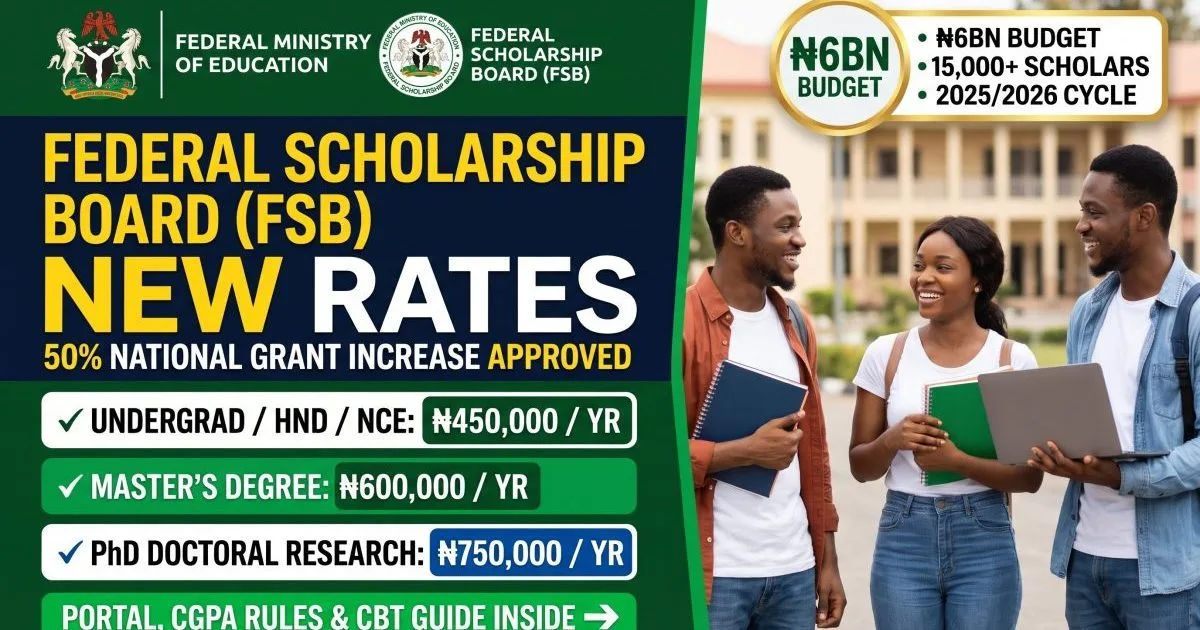
Key Takeaways: The Massive 50% FSB Scholarship Grant Increase
- Historic Funding Overhaul: The Federal Government, through the Federal Ministry of Education (FME), has officially approved a 50% increase in national scholarship grants across all tertiary education levels under the Renewed Hope Agenda.
- Undergraduate & NCE/HND Boost: Eligible full-time undergraduate, HND, NCE, and specialized vocational/medical students will now receive ₦450,000 annually, up from the previous ₦300,000.
- Postgraduate Escalation: Master’s degree grants have been bumped to ₦600,000 (formerly ₦400,000), while PhD students will get ₦750,000 (formerly ₦500,000) yearly to support high-level research.
- Massive Target Audience: Backed by a ₦6 Billion budget, the 2025–2026 cycle is designed to benefit over 15,000 Nigerian students under the Nigerian Scholarship Award (NSA) and the Education Bursary Award (EBA).
- Strict Eligibility Requirements: To qualify, applicants must be full-time students in their 2nd year (200L) or above at an accredited public Nigerian tertiary institution, maintaining a minimum 4.0 CGPA (out of 5.0) or its polytechnic/college equivalent.
- Mandatory CBT: Shortlisted applicants (outside of special-needs bursaries) must pass a Computer-Based Test (CBT) supervised by the Federal Scholarship Board (FSB) to secure the funding.
For thousands of Nigerian students battling escalating tuition costs, rising campus hostel fees, and inflation, a massive lifeline has arrived from Abuja. The Federal Government, through the Federal Ministry of Education (FME), has officially implemented the most significant national scholarship funding overhaul in over a decade. Under this new reform, the Federal Scholarship Board (FSB) has increased its annual local scholarship and bursary grants by exactly 50 percent across all levels of public tertiary education.
The strategic upgrade, championed by the Minister of Education and supported by a combined ₦6 Billion implementation budget, specifically targets the **Nigerian Scholarship Award (NSA)** and the **Education Bursary Award (EBA)** for the 2025–2026 academic cycle. Under the newly approved rates, the financial assistance for undergraduates, NCE, and HND candidates has been increased to ₦450,000 annually, while postgraduate allowances have been raised to ₦600,000 for Master’s and ₦750,000 for PhD researchers. This upgrade is a major policy shift under the current administration’s “Renewed Hope” Agenda, explicitly aimed at reducing the financial burden on students and preserving access to quality education.
However, many students still rely on outdated information found in online chat groups, leading them to apply incorrectly or miss crucial deadlines. To ensure you actually benefit from these higher allowances, this comprehensive guide will detail the new grant amounts, explore specific eligibility rules, map out the step-by-step application process via the official scholarship.education.gov.ng portal, and share the exact preparation tactics needed to pass the mandatory FSB Computer-Based Test (CBT).
Table of Contents
- 1. Before & After Table: The 50% FSB Scholarship Grant Increase
- 2. What is the Federal Scholarship Board (FSB) & Why Did Grants Increase?
- 3. Detailed Allowances by Category: ₦450k, ₦600k, & ₦750k
- 4. The 3 Main FSB Scholarship Programmes You Can Apply For
- 5. Who Qualifies? Strict Eligibility & CGPA Requirements
- 6. Document Checklist: What You Need to Upload to the Portal
- 7. Step-by-Step Application Guide: Registering on scholarship.education.gov.ng
- 8. Scoring High: FSB Computer-Based Test (CBT) Structure & Prep
- 9. Strategic Priorities: STEMM, Social Sciences, and Disability Quotas
- 10. Policy Alerts: Managing FSB, NELFUND, and Private Scholarships
- 11. Directory of Verified FSB Contact Channels & Helplines
- 12. Frequently Asked Questions (FAQs)
1. Before & After Table: The 50% FSB Scholarship Grant Increase
To help you visual the scale of this intervention, look at the exact difference between the old historical rates and the currently approved 2025–2026 allowances:
| Category of Student | Previous Annual Grant | New 50% Increased Grant | Target Focus / Disciplines Covered |
|---|---|---|---|
| Undergraduate Students | ₦300,000 / yr | ₦450,000 / yr | Universities, special focus on STEMM, Social Sciences & Medicine |
| Postgraduate (Master’s) | ₦400,000 / yr | ₦600,000 / yr | All coursework and research degrees in approved public institutions |
| Postgraduate (PhD) | ₦500,000 / yr | ₦750,000 / yr | Doctoral research with a 5% allocation reserved for candidates with disabilities |
| HND & OND (Polytechnic) | ₦300,000 / yr | ₦450,000 / yr | Technology, engineering, agriculture, and vocational programmes |
| NCE Students (Colleges of Ed) | ₦300,000 / yr | ₦450,000 / yr | All students enrolled in education-specific certificate tracks (NSA & EBA) |
| Education Bursary (EBA) | ₦300,000 / yr | ₦450,000 / yr | Special needs education, STEM-Ed, and vocational teaching students |
2. What is the Federal Scholarship Board (FSB) & Why Did Grants Increase?
To evaluate these opportunities correctly, you must understand the mandate of the issuing agency. The Federal Scholarship Board (FSB) is the specialized branch of the Federal Ministry of Education responsible for administering scholarship and educational assistance schemes on behalf of the Nigerian government.
The 50% grant increase, introduced in 2025 and currently implemented for the 2026/2027 cycle, is a response to the rising cost of living and tuition adjustments across public institutions. The Ministry of Education has noted that previous award rates had been eroded by inflation, making this policy update essential to help students stay in school.
Additionally, this funding aligns with the national goal of boosting the human capital required for a $1 Trillion economy, targeting STEMM, medical, and vocational programs to ensure the workforce meets modern demands.
3. Detailed Allowances by Category: ₦450k, ₦600k, & ₦750k
How do these new allowance tiers work across the different academic disciplines?
Undergraduates & NCE/HND Allowance — ₦450,000 Annually
This is the largest tier, covering university, polytechnic, and college of education students. The grant is paid once a year for the duration of the program, provided the student maintains the required academic standards. It covers tuition, study materials, and living expenses.
Postgraduate Master’s Allowance — ₦600,000 Annually
This category supports Master’s degree students in public institutions, helping to offset the high cost of postgraduate tuition and research materials. Payment is typically for one or two academic cycles depending on the programme.
Postgraduate PhD Allowance — ₦750,000 Annually
Designed for doctoral candidates, this top-tier award is intended to support extensive research, publishing fees, and conference participation. The funding is available for up to three years of study, provided progress is verified by the institution.
4. The 3 Main FSB Scholarship Programmes You Can Apply For
When you log onto the application portal, you must select the specific programme that matches your studies:
- 1. Nigerian Scholarship Award (NSA): The flagship domestic programme, open to all full-time undergraduate and postgraduate students in accredited public universities, polytechnics, and colleges.
- 2. Education Bursary Award (EBA): Specifically for students enrolled in education-related degree and diploma programmes. If you are training to be a teacher, this programme offers ₦450,000 annually to support your training.
- 3. Bilateral Education Agreement (BEA) Scholarship: Although this is for international study, the local allowances have also been adjusted to ensure that students selected for foreign programs are adequately supported during their transition.
5. Who Qualifies? Strict Eligibility & CGPA Requirements
Because these grants are paid from federal funds, the Board has strict academic and citizenship requirements. Do not apply unless you meet these exact criteria:
- Nigerian Citizenship: You must be a Nigerian citizen by birth, with valid state of origin and LGA documentation.
- Full-Time Enrollment: Part-time, distance-learning, and sandwich students are not eligible. You must be registered full-time in a federal or state public institution.
- 2nd Year (200L) or Above: Freshmen (100L) and OND1 students are not eligible. You must have completed your first year and have a CGPA.
- Minimum 4.0 CGPA: For university students, you must maintain a 4.0 out of 5.0 CGPA. For polytechnic and college of education students, you must have a 3.0 out of 4.0 CGPA (Upper Credit). For postgraduates, a Second Class Upper is required.
- Ineligible Institutions: Private university, polytechnic, and college of education students are completely ineligible to apply.
6. Document Checklist: What You Need to Upload to the Portal
The application is entirely online. Having your scanned documents ready will save you time and prevent system errors during the submission window:
- Letter of Admission: Your original JAMB and institutional admission letters.
- Academic Transcripts: Official statement of results from your 100-level (or preceding sessions), signed by your HOD or Examination Officer, proving your CGPA.
- Certificate of Origin: Your State and Local Government identification documents.
- Matriculation Card: Showing your active registration.
- Identification Documents: National Identity Card (NIN slip), Driver’s License, or International Passport.
- Special-Needs Certificate: If applying under the 5% disability quota, you must upload a verified medical report from a public hospital.
7. Step-by-Step Application Guide: Registering on scholarship.education.gov.ng
Getting your paperwork together is just the first part; you must register and submit correctly on the portal to be considered:
- Access the Portal: Go to the official site (
scholarship.education.gov.ng). Avoid third-party links or agents. - Create Your Account: Click ‘Create Account’, input your active email and NIN, and generate your login details.
- Select Your Scholarship: Choose the NSA (Nigerian Scholarship Award) or EBA (Education Bursary Award) based on your program.
- Complete the Form: Enter your personal, academic, state of origin, and CGPA details exactly as they appear on your school record.
- Upload Scanned Documents: Attach clear scans of your admission letter, transcript, state ID, and NIN. Verify that file sizes do not exceed the portal’s upload limits.
- Download and Print the Slip: Submit the application, then download and print the acknowledgment slip. You must bring this slip to the CBT exam venue.
8. Scoring High: FSB Computer-Based Test (CBT) Structure & Prep
The FSB local scholarship uses a Computer-Based Test (CBT) to screen candidates. Knowing what to expect will give you a significant advantage:
CBT Exam Centers: The test is conducted at designated JAMB centers in all 36 state capitals and the FCT. You will be scheduled based on the state you select during application.
Subject Areas: Questions are multiple-choice, covering general knowledge (Nigeria’s history, politics, current affairs), basic mathematics, English, and critical thinking. Education (EBA) candidates will face additional pedagogy questions.
CBT Prep Best Practices: Use past JAMB and general paper materials to practice speed, review current affairs from the past two years, and ensure you arrive early at your center with your slip and valid ID.
9. Strategic Priorities: STEMM, Social Sciences, and Disability Quotas
With more than 15,000 students targeted, how does the FSB allocate the budget? The new framework has a clear focus:
- 50% to Undergraduates: Reflecting the greatest financial need at this level.
- 70% for STEMM: Heavily prioritizing Science, Technology, Engineering, Mathematics, and Medicine to align with national needs.
- 5% for Students with Disabilities: A dedicated quota to ensure inclusive access for qualifying special-needs applicants.
10. Policy Alerts: Managing FSB, NELFUND, and Private Scholarships
Can you hold other scholarships while receiving FSB funding? The answer is a strict NO:
- NELFUND and FSB: The Federal Student Loan (NELFUND) is a credit facility that must be repaid. Because it is a loan and not a grant, you can hold both NELFUND and the FSB scholarship.
- Commercial/Private Scholarships: Holding private or oil-company awards (like MTN or shell) alongside the FSB award is technically prohibited. Double-dipping can lead to disqualification if discovered.
11. Directory of Verified FSB Contact Channels & Helplines
Use these verified channels if you encounter portal issues or have specific questions about your application:
| Channel | Contact / URL | Purpose |
|---|---|---|
| Official Portal | scholarship.education.gov.ng | Submit and track your application online. |
| Agency Email | fsb@education.gov.ng | Reach the Board for verification or general queries. |
| Official Helplines | 09015705399 / 07047719254 | Technical support for login or uploading issues. |
12. Frequently Asked Questions (FAQs)
1. Are the new FSB grant amounts (₦450k, ₦600k, ₦750k) available for 2026?
Yes. The 50% grant increase—unveiled by the Ministry of Education—is active and applies across the Board’s Nigerian Scholarship and Education Bursary schemes for the current cycle.
2. What are the CGPA requirements for undergraduates and polytechnic students?
University undergraduates need a 4.0 out of 5.0 CGPA, while polytechnic (OND/HND) and college of education (NCE) students require a **3.0 CGPA** (Upper Credit) to qualify.
3. Can 100-level students apply for the FSB scholarship?
No. You must have finished your first year (be in 2nd year/200L or above) and possess official results to apply.
4. Does the grant cover private university or polytechnic students?
No. These scholarships are strictly for full-time students in accredited federal or state public institutions.
5. Do applicants have to sit a screening test?
Yes, shortlisted applicants will sit a Computer-Based Test (CBT) at designated JAMB centres across the 36 state capitals and the FCT.



0 Comments
No comments yet. Be the first to share your thoughts!