




Key Takeaways: CBN’s New ₦15 Billion Stablecoin & P2P Crypto Regulations (November 2026)
- New CBN Rulebook Effective November 5, 2026: The Central Bank of Nigeria (CBN) has enacted the Regulations for the Operations of Non-Security Virtual Assets in Nigeria, asserting direct supervisory control over stablecoins, payment tokens, crypto wallets, and Peer-to-Peer (P2P) platforms.
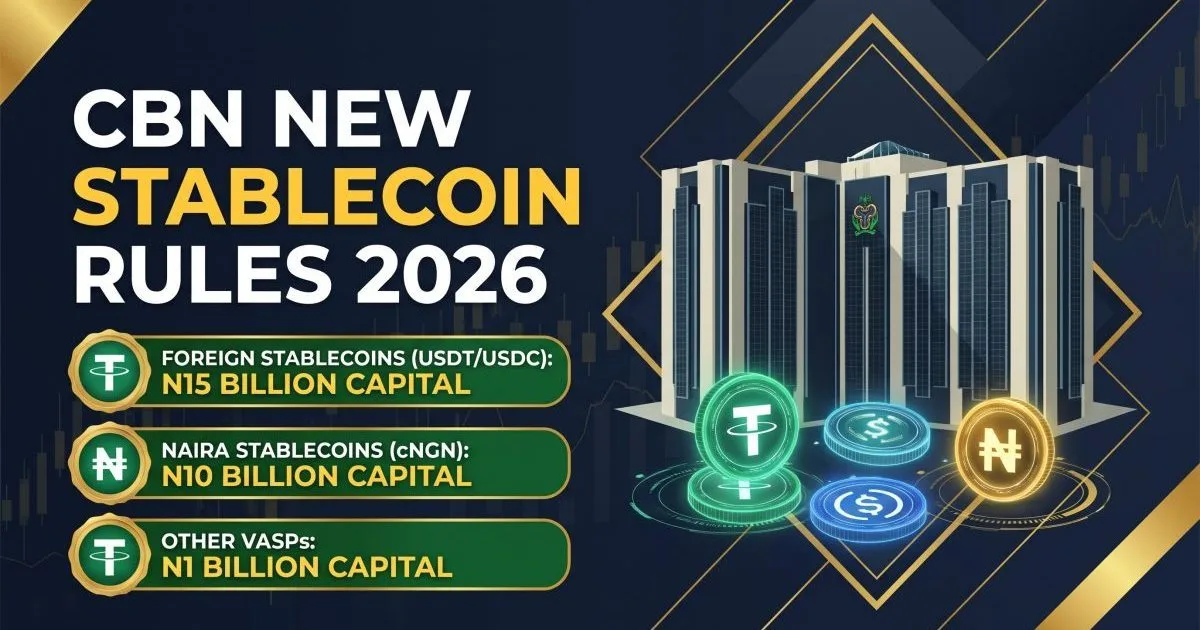
- ₦15 Billion Capital for Foreign Stablecoins (Class 2): Under Section 15.2, issuers of foreign-currency stablecoins (such as USD-pegged tokens like USDT and USDC) must incorporate a company in Nigeria, obtain a CBN licence, and maintain at least ₦15 billion in paid-up capital—with no offshore issuer exemption.
- ₦10 Billion for Naira Stablecoins (Class 1) & ₦1 Billion for VASPs: Issuers of Naira-referenced stablecoins (such as cNGN) must maintain ₦10 billion in paid-up capital, while other Virtual Asset Service Providers (exchanges, custody, payment gateways) must maintain ₦1 billion (separate from SEC capital rules).
- Mandatory BVN & Bank-Linked P2P Trading: P2P platforms must obtain CBN approval, match every Naira bank account to the user’s verified Bank Verification Number (BVN) and legal name, and classify frequent rate-advertising P2P merchants as regulated business users.
- 30-Day Registration & 180-Day Licensing Clock: All existing domestic and foreign crypto/stablecoin operators serving Nigerians have 30 days to register with the CBN and 180 days to apply for a full licence.
Nigeria’s digital asset and foreign-exchange landscape entered a historic new era in November 2026 as the Central Bank of Nigeria (CBN) unveiled its comprehensive regulatory rulebook titled the Regulations for the Operations of Non-Security Virtual Assets in Nigeria. Taking effect on November 5, 2026, the circular establishes the strictest capital, local incorporation, reserve liquidity, and Peer-to-Peer (P2P) traceability standards ever introduced in African cryptocurrency regulation.
At the heart of the new directive is **Section 15.2**, which divides stablecoins into two distinct licensing tiers and sets a massive financial barrier to entry: companies issuing foreign currency-referenced stablecoins—led globally by US dollar-pegged tokens such as Tether (USDT) and Circle’s USD Coin (USDC)—are classified as Class 2 Licensed Issuers and must maintain a minimum paid-up capital of ₦15 billion, incorporate locally as a Nigerian corporate entity, and hold at least $10 million (or 15% of Nigeria-linked liabilities) in operational liquidity. Meanwhile, issuers of Naira-backed stablecoins (Class 1, such as the cNGN consortium) must maintain ₦10 billion in paid-up capital, and general Virtual Asset Service Providers (VASPs) must hold at least ₦1 billion over and above existing Securities and Exchange Commission (SEC) capital floors.
Because Nigeria ranks among the top two digital asset markets in the world by retail adoption—with millions of freelancers, importers, tech workers, and everyday savers holding USDT and USDC or trading via P2P desks—this regulatory shake-up affects every wallet holder in the country. What happens if global issuers like Tether or Circle refuse to incorporate locally with ₦15 billion? Will P2P trading be shut down or strictly tied to your BVN? How does the 30-day registration window affect your funds on local and international exchanges? Here is the complete, authoritative breakdown.
Table of Contents
- Executive Summary Table: CBN Non-Security Virtual Assets Capital & Licensing Tiers
- Inside the November 5, 2026 Circular: Why the CBN Stepped Directly Into Stablecoins
- Section 15.2 Breakdown: Class 2 Foreign Stablecoins (₦15B) vs. Class 1 Naira Stablecoins (₦10B)
- The $10 Million Liquidity Floor, 100% Par Backing & Ban on Stablecoin Interest/Yield
- “No Offshore Issuer Exemption”: What This Means for Tether (USDT), Circle (USDC) & Global Apps
- New Peer-to-Peer (P2P) Crypto Rules: Mandatory BVN Matching, Bank Traceability & Merchant Limits
- CBN vs. SEC Dual Jurisdiction Explained: Why VASPs Need Separate ₦1 Billion Capital
- The 30-Day Registration & 180-Day Licensing Countdown for Crypto Exchanges
- What Everyday Nigerian Crypto Users, Freelancers & P2P Traders Should Do Right Now
- AML/CFT Compliance, the Crypto “Travel Rule” & Ban on Sanctioned Tokens
- Frequently Asked Questions (FAQs)
1. Executive Summary Table: CBN Non-Security Virtual Assets Capital & Licensing Tiers
Examine the official capital floors, reserve liquidity mandates, and compliance deadlines established under the Central Bank of Nigeria’s November 2026 regulatory framework:
| Licence Category / Provision | Minimum Paid-Up Capital | Key Operational & Regulatory Obligations |
|---|---|---|
| 1. Class 2 Licensed Issuer (Foreign Currency-Referenced Stablecoins: e.g., USD-pegged USDT, USDC) |
₦15 Billion (~$11.16 Million) |
Must incorporate locally in Nigeria; zero offshore exemption; hold operational liquidity equal to the highest of $10M, 15% of Nigeria-linked liabilities, or 30 days stressed outflows; each token requires separate CBN approval. |
| 2. Class 1 Licensed Issuer (Naira-Referenced Stablecoins: e.g., cNGN) |
₦10 Billion | Must be 100% backed by eligible Naira reserves, redeemable at par (1:1), incorporated in Nigeria, and prohibited from paying interest or yield to token holders. |
| 3. Other Non-Security VASPs (Exchanges, Digital Wallets, Payment Gateways, Remittances & Custody) |
₦1 Billion | Maintained separately from any capital requirements imposed by the Securities and Exchange Commission (SEC) under the Accelerated Regulatory Incubation Program (ARIP). |
| 4. Peer-to-Peer (P2P) Platforms (Platform-Facilitated P2P Desks) |
CBN Licence + FX Controls | Must tie every P2P crypto transfer to a verified Nigerian bank payment matching the user’s BVN and legal name; high-volume rate advertisers treated as business users with stricter limits. |
| 5. Transition Deadlines for Existing Operators | 30 Days / 180 Days | Effective November 5, 2026: Existing operators must register with the CBN within 30 days and submit full licence applications within 180 days. |
2. Inside the November 5, 2026 Circular: Why the CBN Stepped Directly Into Stablecoins
To understand why the Central Bank of Nigeria issued the Regulations for the Operations of Non-Security Virtual Assets in Nigeria in November 2026, it helps to trace the evolution of Nigeria’s crypto policy over the past five years.
In February 2021, the CBN famously barred commercial banks from servicing cryptocurrency exchanges, pushing millions of Nigerian traders onto informal Peer-to-Peer (P2P) networks. In December 2023, the apex bank reversed that blanket ban by issuing guidelines permitting banks to open settlement accounts for licensed Virtual Asset Service Providers (VASPs), while leaving primary licensing to the Securities and Exchange Commission (SEC).
However, between 2024 and 2026, statistical data showed that over **65% to 75% of all cryptocurrency transactions in Nigeria were not speculative investments in Bitcoin or altcoins—they were everyday payment, remittance, and dollar-hedging transactions using stablecoins (primarily USDT and USDC)**.
Because stablecoins function as digital payment instruments, cross-border settlement rails, and de facto foreign exchange substitutes rather than traditional investment securities, the CBN stepped in directly under its statutory mandate over **monetary policy, payments, foreign exchange management, and financial stability**. As the apex bank noted in its circular, while virtual assets and tokenised payment instruments present significant opportunities for innovation in remittances and digital commerce, their rapid adoption introduces systemic risks to foreign-exchange stability, consumer protection, and illicit finance controls that require direct central bank supervision.
3. Section 15.2 Breakdown: Class 2 Foreign Stablecoins (₦15B) vs. Class 1 Naira Stablecoins (₦10B)
Under **Section 15.2** and **Section 17** of the new regulations, the CBN establishes five specific token categories under its purview: Naira-Referenced Stablecoins, Foreign Currency-Referenced Stablecoins, Deposit Money Tokens (DMTs) issued by banks, and Other Designated Payment Tokens.
For stablecoin issuers, the rulebook creates a strict two-class licensing hierarchy:
Class 1 Licensed Issuers: Naira-Referenced Stablecoins (₦10 Billion Capital)
Class 1 covers companies issuing digital tokens pegged 1:1 to the Nigerian Naira (such as the cNGN token piloted by the Africa Stablecoin Consortium inside the regulatory sandbox). According to the CBN circular: “A Class 1 Licensed Issuer shall maintain paid-up capital of ₦10 billion Naira or such higher amount as the Bank may prescribe, on entry and at all times thereafter.”
Class 2 Licensed Issuers: Foreign Currency-Referenced Stablecoins (₦15 Billion Capital)
Class 2 covers companies issuing digital tokens designed to maintain a stable value against any foreign currency—most notably the US Dollar, Euro, or British Pound (such as USDT, USDC, PYUSD, or EURC). Under Section 15.2: “Class 2 Licensed Issuer shall maintain minimum paid-up capital of ₦15 billion or such higher amount as the Bank may prescribe, on entry and at all times thereafter.” Furthermore, every individual stablecoin token requires its own specific CBN product approval before it can be listed, marketed, or traded on Nigerian platforms.
4. The $10 Million Liquidity Floor, 100% Par Backing & Ban on Stablecoin Interest/Yield
Beyond the ₦15 billion and ₦10 billion paid-up share capital requirements, the CBN introduced tough prudential rules designed to prevent a TerraUSD-style stablecoin collapse from wiping out Nigerian savers:
- Mandatory Operational Liquidity Buffer for Class 2 Issuers: In addition to ₦15 billion in paid-up capital, every Class 2 foreign stablecoin issuer must hold dedicated operational liquidity equal to the highest of three metrics:
- $10 Million USD flat minimum;
- 15% of all Nigeria-linked token liabilities; OR
- 30 days of projected stressed redemption outflows.
- 100% Reserve Backing & Par Redemption Guarantee: Every stablecoin in circulation in Nigeria must be 100% backed at all times by high-quality liquid reserve assets and must be redeemable at par value (1:1) on demand by verified holders.
- Strict Ban on Paying Interest or Yield on Stablecoins: To prevent stablecoins from competing unlawfully with insured bank savings accounts or operating as unregistered money-market collective investment schemes, the CBN explicitly prohibited stablecoin issuers from paying **interest, staking rewards, or passive yield** simply for holding a payment stablecoin.
5. “No Offshore Issuer Exemption”: What This Means for Tether (USDT), Circle (USDC) & Global Apps
Perhaps the most consequential sentence in the entire November 2026 CBN rulebook is found in the licensing clause: “There is no offshore issuer exemption from incorporation, licensing or capital.”
The circular states that the framework applies to all regulated virtual asset activities “conducted in or from Nigeria, directed at Nigerian residents, or materially affecting Nigerian payment and financial systems.” In plain English, physical absence from Lagos or Abuja is no longer a legal shield:
- Global Issuers Must Register a Nigerian Subsidiary: For US dollar-pegged stablecoins like **USDT (issued by Tether)** or **USDC (issued by Circle)** to be legally offered by CBN-regulated exchanges and payment apps in Nigeria, the issuer must incorporate a local Nigerian company, deposit the ₦15 billion paid-up capital, and obtain a Class 2 CBN licence.
- Early Moves in the Market: Notably, Tether had already announced plans to collaborate with local African digital asset infrastructure partners (such as Shiga, whose Nigerian licensing process is underway) on wallet and payment services across Africa, while global payment giants like Mastercard have partnered with licensed regional players like Yellow Card for stablecoin settlement rails.
- Impact on Local Exchanges Listing Unlicensed Stablecoins: Once the transition window closes, Nigerian-licensed crypto exchanges and wallet apps will only be permitted to list and facilitate trading in Class 1 and Class 2 stablecoins whose issuers hold valid CBN authorization.
6. New Peer-to-Peer (P2P) Crypto Rules: Mandatory BVN Matching, Bank Traceability & Merchant Limits
For millions of everyday Nigerian crypto traders, Peer-to-Peer (P2P) marketplaces have long served as the primary bridge for converting Naira into USDT or Bitcoin. In early 2024, Nigerian authorities clashed fiercely with offshore P2P platforms over unmonitored foreign-exchange rate quotes. Rather than imposing an outright ban that drives P2P trading onto unpoliced WhatsApp and Telegram escrow groups, the CBN’s November 5, 2026 regulation brings **platform-facilitated P2P trading under strict formal supervision**:
- Every P2P Trade Must Link to a Verified Nigerian Bank Payment: P2P platforms operating in Nigeria must obtain CBN approval and technologically link every single digital asset transfer to a traceable domestic bank transfer.
- Strict Name & BVN Matching (Zero Third-Party Bank Accounts): Platforms must verify and enforce that the **legal name and Bank Verification Number (BVN)** on the Naira bank account sending or receiving payment match the exact KYC-verified identity of the P2P crypto account holder. Paying from a spouse’s, friend’s, or company account on a personal P2P profile is strictly prohibited.
- P2P Rate Advertisers Reclassified as Commercial Business Users: Under the new rules, frequent P2P traders and merchants who publicly post buy/sell advertisements and exchange rates are no longer treated as casual retail users. They will be classified as **commercial business users**, subjecting them to enhanced corporate KYC, source-of-funds audits, foreign-exchange controls, and daily/monthly transaction caps.
7. CBN vs. SEC Dual Jurisdiction Explained: Why VASPs Need Separate ₦1 Billion Capital
A common question among Nigerian fintech founders and crypto investors is: “Didn’t the Securities and Exchange Commission (SEC) already license crypto exchanges like Busha and Quidax under the Accelerated Regulatory Incubation Program (ARIP)? Why is the CBN asking for another ₦1 billion?”
The November 2026 circular explicitly clarifies how the **CBN and the SEC divide regulatory authority** across Nigeria’s digital asset industry:
| Regulatory Dimension | Central Bank of Nigeria (CBN) Mandate | Securities & Exchange Commission (SEC) Mandate |
|---|---|---|
| Covered Digital Assets | Non-Security Virtual Assets: Stablecoins (USDT, USDC, cNGN), Deposit Money Tokens, payment gateways, remittances, P2P payments & FX settlement. | Security & Investment Virtual Assets: Tokenised equities/bonds, investment crypto tokens, broker-dealers, and capital market digital exchanges. |
| Minimum Paid-Up Capital | ₦15B (Class 2 Foreign Stablecoins) ₦10B (Class 1 Naira Stablecoins) ₦1B (Other Non-Security VASPs) |
Separate SEC capital requirements (e.g., ₦500M–₦1B+ under SEC ISA 2025 / ARIP rules depending on VASP license tier). |
| Can Capital Be Combined? | NO. Under Section 15.2, the CBN’s ₦1 billion VASP capital requirement must be maintained completely separate from any capital requirements imposed by the SEC or other regulators. | |
8. The 30-Day Registration & 180-Day Licensing Countdown for Crypto Exchanges
Because the *Regulations for the Operations of Non-Security Virtual Assets in Nigeria* took effect on **November 5, 2026**, the compliance clock is already ticking for every domestic and international crypto company serving Nigerian residents:
Two Crucial Transition Dates to Watch:
• 30-Day Registration Deadline (By December 5, 2026): All existing virtual asset platforms, stablecoin issuers, wallet providers, and P2P operators currently serving Nigerians must formally register their operations with the Central Bank of Nigeria within 30 days of November 5, 2026.
• 180-Day Full Licensing Deadline (By Early May 2027): Registered operators must complete local incorporation, meet the ₦1B / ₦10B / ₦15B paid-up capital thresholds, and submit a comprehensive licence application within 180 days.
As industry leaders from the **Virtual Asset Service Providers Association (VASPA)** have noted, the high capital floors and local incorporation mandates will likely trigger a wave of mergers, partnerships, and market consolidation—mirroring the CBN’s banking recapitalization exercise—where smaller undercapitalized crypto apps either merge or plug into licensed infrastructure providers via white-label APIs.
9. What Everyday Nigerian Crypto Users, Freelancers & P2P Traders Should Do Right Now
5 Practical Steps to Protect Your Crypto Wallet & Bank Account in Late 2026
First, do not panic-sell your USDT or USDC at a loss. Your existing tokens on the blockchain cannot be deleted, and existing platforms have a 30-day registration and 180-day licensing transition window. However, to prevent your Nigerian bank account or exchange wallet from being flagged under the new CBN enforcement rules, follow these five steps immediately:
- Ensure 100% BVN & Name Alignment on All P2P Trades: Never accept or send a P2P bank transfer from a bank account that does not bear your exact BVN-verified legal name. Third-party P2P payments will now trigger automatic bank and exchange compliance freezes.
- Stop Posting Public P2P Rate Ads on Personal Bank Accounts: If you are a high-frequency P2P merchant posting buy/sell rate ads daily, prepare to register a formal corporate entity and transition to a business account, as the CBN now classifies rate advertisers as commercial foreign-exchange/virtual-asset business users.
- Favour Locally Licensed Nigerian Exchanges & Compliant Off-Ramps: Prioritize platforms that hold SEC ARIP approval and are actively completing their 30-day CBN registration, or keep long-term stablecoin savings in self-custody hardware/Web3 wallets where you control your private keys.
- Keep Clear Records of Remote Work & Freelance Inflows: Under the new Travel Rule and AML/CFT monitoring, transfers exceeding regulatory thresholds may require proof of source of funds (such as Upwork/Deel contracts or client invoices).
- Never Interact With Sanctioned Wallets or Mixing Services: The CBN circular strictly bans tokens or transfers linked to sanctioned entities, darknet mixers, or unlicensed offshore gambling portals.
10. AML/CFT Compliance, the Crypto “Travel Rule” & Ban on Sanctioned Tokens
Following Nigeria’s concerted push to exit international financial grey lists and align with **Financial Action Task Force (FATF)** standards, the CBN embedded strict Anti-Money Laundering and Combating the Financing of Terrorism (AML/CFT) rules inside the November 2026 regulations:
- Mandatory FATF “Travel Rule” Implementation: Whenever a qualifying virtual asset transfer is sent between two VASPs (for example, moving USDT from one exchange wallet to another), both platforms must securely transmit and record verified originator and beneficiary identity data alongside the blockchain transaction.
- Real-Time Sanctions Screening & NFIU Reporting: All licensed issuers and VASPs must integrate automated blockchain analytics software to screen wallet addresses against domestic and international sanctions lists and file Suspicious Transaction Reports (STRs) with the Nigerian Financial Intelligence Unit (NFIU).
- Cybersecurity & Consumer Asset Segregation: Customer digital assets must be segregated from the exchange’s proprietary corporate funds at all times, backed by independent cybersecurity audits and disaster-recovery protocols.
11. Frequently Asked Questions (FAQs) About the CBN ₦15 Billion Stablecoin & Crypto Rules
1. Has the Central Bank of Nigeria (CBN) banned USDT, USDC, or P2P crypto trading in November 2026?
No. Rather than banning stablecoins or P2P trading, the CBN issued the Regulations for the Operations of Non-Security Virtual Assets in Nigeria (effective November 5, 2026) to formally license, capitalize, and regulate them. Existing platforms have 30 days to register with the CBN and 180 days to apply for a full licence.
2. What is the difference between Class 1 and Class 2 stablecoin issuers under the new CBN rules?
Under Section 15.2 of the regulations, Class 1 Licensed Issuers are companies issuing Naira-referenced stablecoins (such as cNGN) and must maintain at least ₦10 billion in paid-up capital. Class 2 Licensed Issuers are companies issuing foreign currency-referenced stablecoins (such as USD-pegged tokens like USDT and USDC) and must maintain at least ₦15 billion in paid-up capital plus at least $10 million in operational liquidity.
3. Do foreign stablecoin companies like Tether (USDT) and Circle (USDC) have to register in Nigeria?
Yes. The CBN circular explicitly states that “there is no offshore issuer exemption from incorporation, licensing or capital.” Any foreign stablecoin issuer whose tokens are offered to Nigerian residents must incorporate a local Nigerian entity, meet the ₦15 billion capital requirement, and obtain CBN approval for each token.
4. How do the new CBN rules affect Peer-to-Peer (P2P) crypto trading in Nigeria?
P2P platforms must be licensed by the CBN and must tie every digital asset trade to a verified Nigerian bank payment where the bank account name and Bank Verification Number (BVN) match the verified crypto trader. In addition, frequent P2P traders who advertise exchange rates will be regulated as commercial business users with stricter limits and compliance checks.
5. If a crypto exchange already has an SEC licence in Nigeria, does it still need the CBN’s ₦1 billion capital?
Yes. The CBN clarified that while the SEC regulates security-related virtual assets, the CBN regulates non-security virtual assets (payments, stablecoins, remittances, P2P, and FX). Virtual Asset Service Providers operating in those areas must maintain at least ₦1 billion in paid-up capital completely separate from any capital required by the SEC.
6. Can stablecoin issuers pay daily interest or staking yield on stablecoins in Nigeria?
No. The new CBN regulations strictly prohibit Class 1 and Class 2 stablecoin issuers from paying interest or yield to token holders, ensuring stablecoins are used strictly as 1:1 par-redeemable payment and settlement instruments.




0 Comments
No comments yet. Be the first to share your thoughts!