


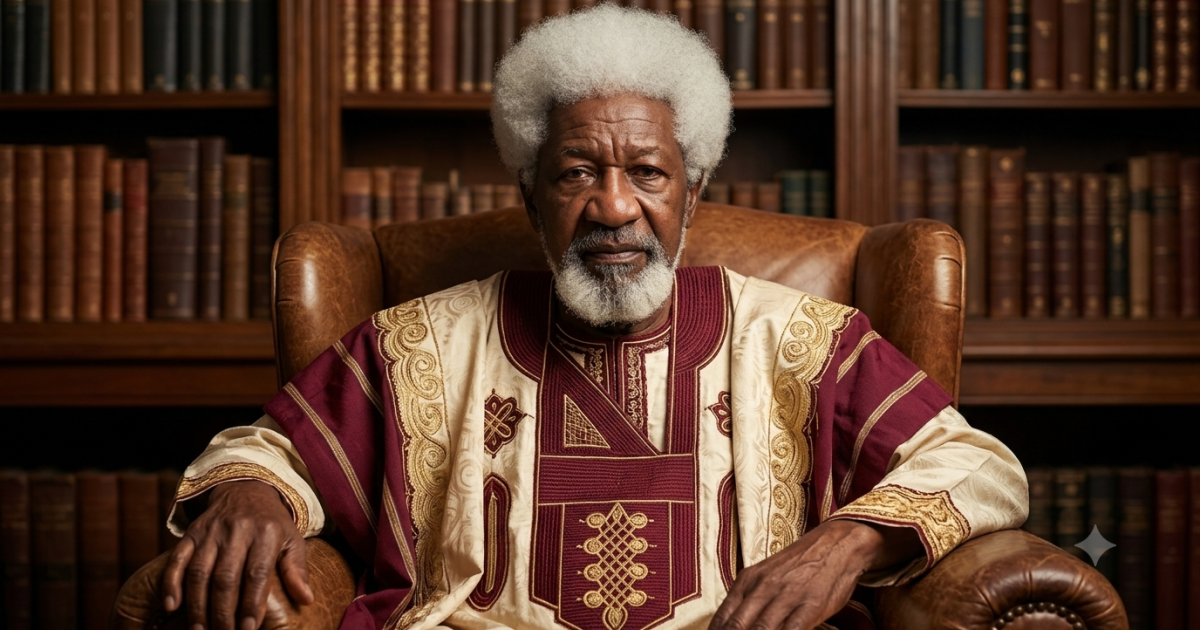
He is 92 years old. He has been writing plays, poetry, novels, and political essays for more than seven decades. He was jailed for two years in solitary confinement — for the crime of opposing a government that was trying to rig an election — and emerged from that cell not broken but sharpened, writing one of the most harrowing prison memoirs in the English language. He was the first Black African to win the Nobel Prize in Literature, in 1986, and when the Swedish Academy cited his work as marked by “vivid, often harrowing drama in a wide cultural perspective,” they were describing not just a body of literature but a life — a life spent in the conviction that art and conscience are not separate activities but a single one, that a writer who stays silent in the face of tyranny has ceased, in any meaningful sense, to be a writer.
In October 2025, the United States government revoked his visa — cutting him off from his wife and children in California, in what was widely condemned as an act of political vindictiveness dressed as bureaucratic procedure. He is ninety-one years old and separated from his family by an administrative decision. He was not cowed. He was not silent. He was not broken.
He was never broken.
His name is Akinwande Oluwole Babatunde Soyinka. The world knows him as Wole Soyinka. And this is his full biography.
Wole Soyinka Biography Facts at a Glance
| Full Name | Akinwande Oluwole Babatunde Soyinka |
| Date of Birth | July 13, 1934 |
| Age | 92 years old (as of 2026) |
| Place of Birth | Aké quarter, Abeokuta, Ogun State (then British Nigeria) |
| State of Origin | Ogun State, Nigeria |
| Ethnicity / Tribe | Yoruba |
| Father | Samuel Ayodele Soyinka (“Essay”) — Anglican minister and headmaster |
| Mother | Grace Eniola Soyinka (“Wild Christian”) — trader and community activist |
| Education | St. Peter’s Primary School; Abeokuta Grammar School; Government College Ibadan; University of Leeds (BA 1958, PhD 1973) |
| Occupations | Playwright, Poet, Novelist, Essayist, Professor, Political Activist |
| First Marriage | Barbara Dixon (m. 1958; div. 1963) |
| Second Marriage | Olaide Idowu (m. 1963; div. 1989) |
| Third Marriage | Folake Doherty (m. 1989 — present) |
| Children | Eight — including Olaokun, Moremi, Iyetade (deceased 2013), Peyibomi, Ilemakin, Tunlewa, Bojode, Eniara |
| Nobel Prize | Nobel Prize in Literature, 1986 — first Black African laureate |
| Major Works | Death and the King’s Horseman; The Lion and the Jewel; The Man Died; Aké: The Years of Childhood; Season of Anomy |
| Current Position | Arts Professor of Theater, NYU Abu Dhabi (since 2022) |
| Net Worth (Estimated) | $1.5 million USD |
| Nationality | Nigerian |
Early Life: Abeokuta, the Compound and Two Worlds in One Childhood
Akinwande Oluwole Babatunde Soyinka was born on July 13, 1934, in the Aké quarter of Abeokuta — a city in present-day Ogun State that sits on the rocky banks of the River Ogun in southwestern Nigeria. He was the second of seven children in a Yoruba Anglican family whose household contained more intellectual and cultural energy than many children encounter in a lifetime.
His father, Samuel Ayodele Soyinka — known affectionately as “Essay” — was an Anglican minister and headmaster of St Peter’s School in Abeokuta, with ancestral ties to the royal family of Isara-Remo. His mother, Grace Eniola Soyinka — whom Soyinka immortalised in his memoir Aké: The Years of Childhood under the unforgettable description “Wild Christian” — was a trader, community activist, and woman of extraordinary personal force who was involved in the famous Abeokuta Women’s Tax Revolt of 1949, in which women’s organisations led by her sister-in-law Funmilayo Ransome-Kuti forced the Alake of Abeokuta to abdicate over unjust taxation policies imposed under British colonial support.
Growing up in an Anglican mission compound, young Wole inhabited two worlds simultaneously. From his father and the school that was his home, he absorbed Christianity, English literature, and the disciplined intellectual culture of a mission education. From his grandfather, he absorbed the Yoruba spiritual tradition — its 401 deities, its folklore, its cosmology, its deep relationship with the natural world and human mortality. That dual inheritance — Christian and Yoruba, colonial and indigenous, Western and African — became the foundational tension from which all of his greatest work would eventually be generated.
One family story from his childhood captures the quality of mind that would make him one of the most formidable intellects in the history of African literature. He was such a relentlessly questioning child that the adults around him developed a warning they would share with each other whenever he entered a room: “He will kill you with his questions.” It is not difficult to see the playwright, the political activist, and the prison resister in that precocious, insatiable, infuriating child.
His family had a direct connection to one of Nigeria’s most distinguished cultural dynasties. The Ransome-Kuti family — through his mother’s side — produced Funmilayo Ransome-Kuti (the women’s rights activist and mother of Fela Kuti), Fela Kuti (the Afrobeat legend and political rebel), Beko Ransome-Kuti (the human rights activist), and Femi Kuti (the musician). Wole Soyinka was thus not merely adjacent to Nigerian history — he was embedded in the DNA of one of the families that made it.
Education: From Abeokuta to Leeds, Through Ibadan
Soyinka’s formal education followed a path that was simultaneously rooted in Nigerian intellectual tradition and opened to the best of what British university education could offer. He began at St Peter’s Primary School in Abeokuta — where his father was headmaster — and continued at Abeokuta Grammar School. He then attended Government College in Ibadan for university preparation, one of Nigeria’s most prestigious secondary institutions, between 1952 and 1954.
In 1954, he moved to England and enrolled at the University of Leeds, where he studied English literature, Greek, and Western history. He graduated with a Bachelor of Arts in English in 1958. During his six years in England, he also worked as a dramaturgist at the Royal Court Theatre in London (1958–1959) — the most influential theatre in Britain for new writing, where playwrights including Samuel Beckett, John Osborne, and later Harold Pinter were developing the works that would define post-war European drama. The Royal Court experience gave Soyinka direct exposure to the most sophisticated dramaturgy of his era and shaped his understanding of what theatre could do when it took ideas seriously.
He returned to Nigeria in 1960, awarded a Rockefeller bursary to study African drama. He subsequently taught drama and literature at universities in Ibadan, Lagos, and Ife, becoming Professor of Comparative Literature at the University of Ife (now Obafemi Awolowo University) from 1975. He returned to Leeds in 1973 to complete his PhD — adding a doctoral qualification to the body of dramatic and literary work that was already making him one of the most discussed writers in the world.
Importantly, while at university in Nigeria, Soyinka and six other students founded an organisation that would have a complex and lasting impact on Nigerian campus culture: the Pyrates Confraternity — originally conceived as an anti-corruption, justice-seeking student organisation committed to intellectual excellence and civic responsibility. It was the first student confraternity in Nigeria. Its founding ideals were admirable; its subsequent history — as the model that inspired the violent campus cults that have plagued Nigerian universities for decades — is one of the painful ironies of his legacy.
The Literary Career: Building Africa’s Greatest Body of Dramatic Work
Wole Soyinka’s literary output across seven decades is staggering in both quantity and quality. He has written three novels, ten collections of short stories, seven poetry collections, twenty-five plays, and five memoirs — a body of work that in its thematic range, its linguistic brilliance, and its sustained engagement with the most urgent political and philosophical questions of his era has no peer in African literature and very few in world literature.
His plays are the heart of his legacy. They draw with unique sophistication on Yoruba mythology and theatrical tradition — particularly the mythology surrounding Ogun, the Yoruba god of iron, war, roads, and creativity, with whom Soyinka has identified since childhood — while engaging fluently with the formal traditions of Western drama, from Greek tragedy to Brechtian epic theatre. The result is a dramatic universe that is simultaneously rooted in a specific cultural tradition and universally resonant.
His most celebrated plays include:
- The Lion and the Jewel (1959) — a comedy of tradition versus modernity, set in a Yoruba village, that established his ability to blend sharp social satire with theatrical warmth
- The Trials of Brother Jero (1960) — a biting satire of religious hypocrisy and the fraudulent beach prophets of Lagos, which remains one of the most performed Soyinka plays globally
- A Dance of the Forests (1960) — written for and performed at Nigeria’s independence celebrations; a darkly cautionary work that refused to celebrate uncritically
- The Road (1965) — widely regarded as one of his most complex and philosophically demanding plays, exploring death and the nature of transition through the lens of Yoruba cosmology
- Kongi’s Harvest (1967) — a savage satire of African dictatorship and the corruption of post-independence political power
- Death and the King’s Horseman (1975) — his most internationally celebrated play; a tragedy of colonial interference in Yoruba tradition that the Nobel Committee cited as among his finest achievements. The play was famously produced on Broadway in 1987 and has since been staged at major theatres around the world
- Canticles: A Pyre Foretold (2024) — his latest play, which premiered at the University of Ibadan in November 2024, demonstrating that at ninety years old, he remains an active creative force
His novels include The Interpreters (1965) — a dense, technically ambitious portrait of the generation that inherited Nigerian independence — and Season of Anomy (1973), written in the shadow of the Nigerian Civil War and widely read as an allegorical response to that catastrophe.
His memoirs are among the most compelling works in the canon of African autobiography. Aké: The Years of Childhood (1981) — a memoir of his boyhood in Abeokuta — is widely regarded as one of the most beautiful books ever written about childhood in Africa: lyrical, precise, and suffused with the particular magic of a child’s perception encountering the adult world’s bewildering contradictions. The Man Died (1972) — his account of his imprisonment during the Nigerian Civil War — is one of the most powerful prison memoirs in the English language, a document of psychological survival under conditions designed to destroy the self.
The Political Activist: Prison, Exile and the Courage to Speak
Wole Soyinka’s artistic achievement is inseparable from his political courage — and his political courage has been tested by circumstances that most human beings, let alone most writers, would not have survived with their integrity intact.
His first significant confrontation with state power came in 1965, when he was arrested and briefly detained after allegedly forcing a broadcast station to substitute a recording of his own voice for that of the Premier of Western Nigeria — in protest against what he believed was a fraudulent election result. He was acquitted, but the episode established both his willingness to take direct action against injustice and the government’s willingness to use its power against him.
In August 1967, at the outbreak of the Nigerian Civil War (the Biafran War), Soyinka made a private, unofficial visit to Enugu to meet with military governor Chukwuemeka Odumegwu Ojukwu, in an attempt to negotiate a ceasefire and prevent the catastrophe he could see approaching. For this act of conscience — attempting to prevent a war — he was arrested by the Nigerian federal government and imprisoned without trial.
He spent 27 months in prison, from August 1967 to October 1969 — the majority of it in solitary confinement. He was denied books, denied writing materials, denied human contact. He was subjected to conditions designed to break his mind. He fought back the only way available to him: by writing, in secret, on whatever scraps of material he could find — toilet paper, cigarette paper, the margins of books that were occasionally smuggled to him. The notes he made during those 27 months became The Man Died, published in 1972, which stands as one of the most extraordinary acts of literary resistance in the history of imprisoned writers.
He emerged from prison in 1969, left Nigeria, and was appointed to a position at Cambridge University. He returned to Nigeria in 1975 but went into exile again in the 1990s, during the brutal military dictatorship of General Sani Abacha, after the Abacha government sentenced him to death in absentia. He was stripped of his Nigerian passport and lived in exile in the United States and Europe until Abacha’s death in 1998 allowed him to return.
Throughout his life, he has spoken with characteristic directness about Nigerian governance, African politics, religious extremism, and global injustice — attracting controversy, condemnation, and occasionally genuine physical danger in the process. He has never moderated his voice for comfort or safety. The most famous expression of his philosophy is perhaps his own formulation: “The man dies in all who keep silent in the face of tyranny.” He has not kept silent. Not once.
The Nobel Prize: Africa’s First, Literature’s Greatest Honour
On October 16, 1986, the Swedish Academy announced that Wole Soyinka had been awarded the Nobel Prize in Literature — making him the first Black African and the first sub-Saharan African ever to receive that honour. The Academy cited his works as “in a wide cultural perspective and with poetic overtones fashioning the drama of existence.”
The announcement was received in Nigeria with an eruption of national pride that crossed every ethnic, religious, and political boundary in a country that is often divided by precisely those lines. Wole Soyinka was not merely a Yoruba writer or a Nigerian writer — he was an African writer who had demonstrated to the world that African literature deserved a place at the highest table of human creative achievement.
He used his Nobel lecture — delivered in Stockholm on December 8, 1986, and titled “This Past Must Address Its Present” — as a political statement as much as a literary one, dedicating the prize in part to Nelson Mandela, then still imprisoned on Robben Island, and using the global platform the award provided to speak about apartheid South Africa, African political repression, and the moral responsibilities of literature. It was entirely in character.
The Nobel Prize did not change him. He did not become more cautious, more diplomatic, or more accommodating of power after receiving the world’s most prestigious literary recognition. If anything, it gave him a larger platform for the same courage he had been displaying since 1965.
Recent Years: Nigeria Renames Its National Theatre, the US Revokes His Visa
In his nineties, Wole Soyinka remains active, relevant, and — characteristically — at the centre of controversy.
In October 2025, Nigeria’s National Theatre in Lagos was formally renamed the Wole Soyinka Centre for Culture and Creative Arts — a landmark recognition of his contributions to Nigerian cultural life that placed his name on the country’s most significant cultural venue. The centre reopened after renovation and began hosting major shows again in 2025 and 2026, with Adekunle Gold being the first artist to sell out the venue after its reopening. The University of Ibadan had previously renamed its arts theatre the Wole Soyinka Theatre in 2018 — making him one of the very few living Nigerians to have significant public institutions named in his honour.
In the same month — October 2025 — came the news that threw a shadow over these honours. The United States government revoked Wole Soyinka’s visa, with the US Consulate General in Lagos communicating the decision on October 23, 2025. The revocation left the 91-year-old playwright cut off from his family and personal residence in California. His wife, Folake Doherty Soyinka, is based in Los Angeles, where she lives with their three sons, Tunlewa, Bojode, and Eniara.
The revocation occurred in the context of broader changes to US visa policy for Nigerian nationals and was widely condemned across the Nigerian and global literary communities as an act that, whatever its stated bureaucratic justification, had the effect of separating a 91-year-old Nobel laureate from his family. Soyinka responded publicly with the same composed defiance he has brought to every indignity power has attempted to inflict on him across nine decades of living.
He also serves as Arts Professor of Theater at NYU Abu Dhabi since 2022, continuing to teach and engage with the next generation of writers and thinkers at a stage of life when most people have long retired. His latest play, Canticles: A Pyre Foretold, premiered at the University of Ibadan in November 2024. And in 2025, his early play The Swamp Dwellers (1958) debuted Off-Broadway in New York — demonstrating that work he wrote nearly seventy years ago retains sufficient power and relevance to find audiences on one of the world’s most competitive theatrical stages.
Personal Life: Three Marriages, Eight Children and a Faith in Myth Over Doctrine
Wole Soyinka has been married three times. His first marriage was to Barbara Dixon, a British writer, in 1958 — the year he graduated from Leeds. That marriage produced a son, Olaokun. The marriage ended in divorce in 1963.
His second marriage was to Olaide Idowu, a Nigerian librarian, in 1963. Together they had four children: Moremi, Iyetade (who passed away in 2013), Peyibomi, and Ilemakin. The marriage ended in divorce in 1989.
Since 1989, he has been married to Folake Doherty — a former student of Obafemi Awolowo University, where he was lecturing. Together they have three sons: Tunlewa (also rendered as Oreunlewa), Bojode, and Eniara, who have grown up in the United States. Folake Doherty Soyinka is based in Los Angeles, California.
In 2014, Soyinka revealed publicly that he had been diagnosed with prostate cancer and had undergone treatment, from which he was cured within ten months. The disclosure was characteristic of a man who has always been direct about his own vulnerability as well as his strength.
On the question of religion, Soyinka has maintained a position that is intellectually consistent with his life’s work: he has said he is drawn more to myth and cultural symbolism than to organised religion, despite his Anglican upbringing. His spiritual home is the mythology of Ogun — the Yoruba deity who represents creative destruction, the forge, the road, and the risks of knowledge — rather than the institutional Christianity of his father’s household. This orientation places him squarely in the tradition of African writers who have refused to allow colonial religious frameworks to displace indigenous cosmologies as valid systems of meaning.
He holds traditional Yoruba chieftaincy titles — “Akogun” of Isara-Remo and “Akinlatun” of Egbaland — recognitions from his ancestral community that sit alongside his Nobel Prize as complementary rather than competing honours.
Wole Soyinka’s Net Worth
Wole Soyinka’s estimated net worth is $1.5 million USD — a figure that is modest by the standards of the contemporary entertainment figures who surround him in any list of Nigeria’s most prominent names, but which is entirely consistent with the financial reality of a career built on literature, academic teaching, and public intellectual life rather than commercial entertainment.
Most of his money comes from his life’s work, not from businesses. He earns from his books — plays, novels, poetry, and essays that sell worldwide. He also makes money teaching at universities around the world and giving lectures. Because he is a Nobel Prize winner and a famous writer, he is paid to speak at events and appear publicly. The Nobel Prize itself came with a monetary component that would have contributed substantially to his personal finances, and his royalty income from a catalogue of works published by major international houses and assigned to university reading lists globally is ongoing.
His wealth, in short, is the wealth of a man who chose ideas over income and has never, across nine decades, had cause to regret that choice.
Major Works
| Year | Title | Genre | Significance |
| 1959 | The Lion and the Jewel | Play | Tradition vs. modernity; widely performed internationally |
| 1960 | The Trials of Brother Jero | Play | Religious satire; one of his most performed works globally |
| 1960 | A Dance of the Forests | Play | Written for Nigerian independence; cautionary tone |
| 1965 | The Road | Play | Death, Yoruba cosmology, existential complexity |
| 1965 | The Interpreters | Novel | Portrait of post-independence Nigerian generation |
| 1967 | Kongi’s Harvest | Play | Satire of African dictatorship; politically resonant |
| 1972 | The Man Died | Memoir | Prison memoir; one of literature’s great acts of resistance |
| 1973 | Season of Anomy | Novel | Civil War allegory; political urgency |
| 1975 | Death and the King’s Horseman | Play | His masterpiece; Nobel-cited; Broadway produced 1987 |
| 1981 | Aké: The Years of Childhood | Memoir | Childhood memoir; among the most beautiful African autobiographies |
| 2024 | Canticles: A Pyre Foretold | Play | Latest work; premiered University of Ibadan, November 2024 |
Career Timeline
| Year | Milestone |
| 1934 | Born July 13 in Aké quarter, Abeokuta; second of seven children in Yoruba Anglican household |
| 1940–1946 | St Peter’s Primary School, Abeokuta (father is headmaster) |
| 1946–1952 | Abeokuta Grammar School; continues to Government College Ibadan |
| 1954 | Moves to England; enrolls at University of Leeds |
| 1957 | Co-founds Pyrates Confraternity — Nigeria’s first student confraternity — at University of Ibadan |
| 1958 | Graduates from University of Leeds with BA in English; marries Barbara Dixon; works at Royal Court Theatre, London |
| 1959 | The Lion and the Jewel published — first major play |
| 1960 | Returns to Nigeria; awarded Rockefeller bursary; A Dance of the Forests performed at independence celebrations |
| 1963 | Marries Olaide Idowu; begins teaching at University of Ibadan |
| 1965 | Arrested for alleged radio station takeover in protest of election fraud; acquitted |
| 1967 | Arrested attempting private peace negotiations during Civil War; imprisoned without trial |
| 1967–1969 | 27 months in prison, mostly solitary confinement; secretly writes notes that become The Man Died |
| 1972 | The Man Died published — his prison memoir |
| 1973 | Returns to Leeds; completes PhD |
| 1975 | Death and the King’s Horseman written; becomes Professor of Comparative Literature at University of Ife |
| 1981 | Aké: The Years of Childhood published — celebrated memoir of boyhood |
| 1986 | Awarded Nobel Prize in Literature — first Black African laureate |
| 1989 | Marries Folake Doherty — third and current wife |
| 1994 | Goes into exile as Abacha military regime sentences him to death in absentia |
| 1998 | Returns to Nigeria following Abacha’s death |
| 2014 | Publicly reveals and is cured of prostate cancer |
| 2018 | University of Ibadan renames arts theatre the Wole Soyinka Theatre in his honour |
| 2022 | Appointed Arts Professor of Theater at NYU Abu Dhabi |
| November 2024 | Latest play Canticles: A Pyre Foretold premieres at University of Ibadan |
| October 2025 | Nigeria’s National Theatre renamed Wole Soyinka Centre for Culture and Creative Arts |
| October 2025 | US government revokes his visa — separates him from wife and children in California |
| 2025 | The Swamp Dwellers (1958) debuts Off-Broadway in New York City |
| 2026 | Celebrates 92nd birthday; continues to teach, write and speak as Africa’s greatest living writer |
Why Wole Soyinka Matters: Literature as an Act of Conscience
The significance of Wole Soyinka’s life and work cannot be fully captured by listing his prizes, his plays, his imprisonments, or his political exiles — though all of these are extraordinary by any measure. What makes him genuinely irreplaceable is the integration of these elements into a single coherent life: the life of a man for whom art and conscience have always been the same activity, performed simultaneously and without compromise.
He demonstrated — at a moment in history when it was genuinely not obvious — that African literature could compete with the best literature produced anywhere in the world, not by imitating Western forms but by rooting itself in African cultural traditions and applying to those traditions the full force of a trained and disciplined intellect. Death and the King’s Horseman is a great play not because it resembles Greek tragedy but because it uses Yoruba cosmology with the same structural sophistication that Greek tragedy uses Greek mythology. It achieves universality by being specifically and unapologetically African.
He also demonstrated — by surviving imprisonment, exile, death sentences, family separation, and a century’s worth of political violence — that intellectual courage is not merely a literary virtue but a lived one. The man has walked the talk across nine decades without flinching. His most famous line — “The man dies in all who keep silent in the face of tyranny” — is not an aphorism he read somewhere. It is the principle by which he has organised his entire life.
At 92, he is still teaching. Still writing. Still speaking. Still refusing to be silent. Africa has not produced another writer like him. It may not produce another in our lifetimes. That is not a reason for despair — it is a reason to read him, carefully, while he is still here to be read.
Frequently Asked Questions About Wole Soyinka
What is Wole Soyinka’s real name?
Wole Soyinka’s full name is Akinwande Oluwole Babatunde Soyinka. He was born on July 13, 1934, in the Aké quarter of Abeokuta, in present-day Ogun State, Nigeria. Wole is a shortened form of his Yoruba name Oluwole, and it is the name by which he has been known throughout his professional life. He is also referred to by his chieftaincy titles “Akogun” of Isara-Remo and “Akinlatun” of Egbaland.
How old is Wole Soyinka?
Wole Soyinka is 92 years old as of 2026. He was born on July 13, 1934, in Abeokuta, Nigeria. He celebrated his 92nd birthday on July 13, 2026, making him not only Nigeria’s greatest living writer but one of the oldest active literary figures in the world.
What Nobel Prize did Wole Soyinka win?
Wole Soyinka won the Nobel Prize in Literature in 1986 — becoming the first Black African and the first sub-Saharan African to receive that honour. The Swedish Academy cited his works as marked by “vivid, often harrowing drama in a wide cultural perspective and with poetic overtones fashioning the drama of existence.” He delivered his Nobel lecture in Stockholm on December 8, 1986, titled “This Past Must Address Its Present,” in which he dedicated the prize in part to Nelson Mandela and used the platform to address African political repression.
Who is Wole Soyinka’s wife?
Wole Soyinka has been married three times. His current wife is Folake Doherty, whom he married in 1989. Together they have three sons: Tunlewa, Bojode, and Eniara. Folake Doherty Soyinka is based in Los Angeles, California — where their sons have grown up. His first wife was British writer Barbara Dixon (married 1958, divorced 1963), and his second was Nigerian librarian Olaide Idowu (married 1963, divorced 1989).
How many children does Wole Soyinka have?
Wole Soyinka has eight children from his three marriages. From Barbara Dixon: Olaokun. From Olaide Idowu: Moremi, Iyetade (deceased 2013), Peyibomi, and Ilemakin. From Folake Doherty: Tunlewa (Oreunlewa), Bojode, and Eniara. His children are active across medicine, the arts, and public life.
Why was Wole Soyinka put in prison?
Wole Soyinka was imprisoned by the Nigerian federal government in August 1967, at the outbreak of the Nigerian Civil War (Biafra War). He had made a private visit to the secessionist region to attempt to negotiate a ceasefire — an act of conscience that the federal government treated as treasonous. He was held for 27 months without trial, the majority in solitary confinement, in conditions designed to break him psychologically. He survived by secretly writing the notes that would become his prison memoir, The Man Died, published in 1972. He was released in October 1969.
What is Wole Soyinka’s most famous play?
Death and the King’s Horseman (1975) is widely regarded as Wole Soyinka’s greatest play and his most significant single work. Set in colonial Nigeria in 1946, it dramatises the conflict between a traditional Yoruba obligation — the ritual death of a chief’s horseman following his king’s death — and the interference of British colonial officials who do not understand what they are disrupting. It was produced on Broadway in 1987 and has since been staged at major theatres worldwide. The Nobel Committee cited it prominently in their recognition of his body of work.
Why was Wole Soyinka’s US visa revoked?
In October 2025, the United States government revoked Wole Soyinka’s visa — a B1/B2 non-immigrant permit issued in April 2024 — citing “additional information” that became available after its issuance. The revocation occurred in the context of broader changes to US visa policy for Nigerian nationals. The practical effect was to separate Soyinka, then 91 years old, from his wife Folake Doherty and their sons, who are based in Los Angeles, California. The decision was widely condemned by literary organisations, human rights groups, and public figures internationally as a disproportionate action against one of the world’s most respected intellectual figures.

0 Comments
No comments yet. Be the first to share your thoughts!