

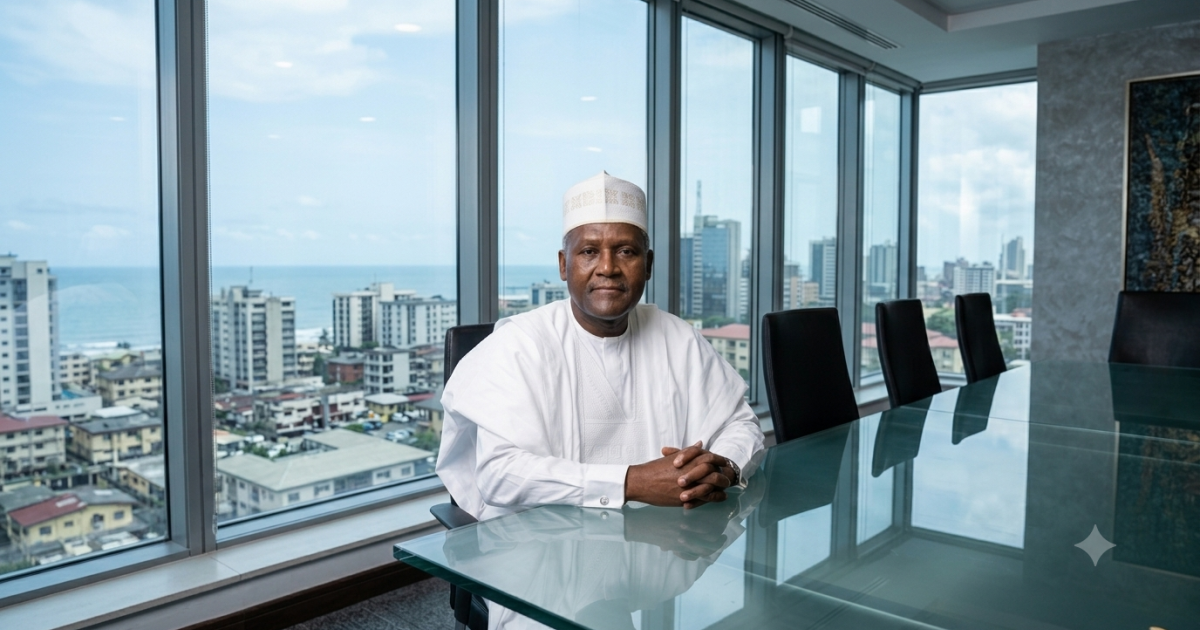
When he was a boy in Kano, Aliko Dangote used to buy cartons of sweets and resell them to his classmates for a profit. That detail — small, specific, entirely unsentimental — tells you almost everything you need to know about the man who would become the richest person in Africa. He was not playing. He was not pretending. He was doing, at seven or eight years old, precisely what he would spend the next sixty years doing at scales that the child in that Kano classroom could not have imagined, and might not have believed if someone had tried to tell him.
Today, Aliko Mohammad Dangote is the wealthiest Black person on the planet. His net worth has surged in 2026, powered largely by the operational take-off of the Dangote Oil Refinery, Africa’s largest, and according to the Bloomberg Billionaires Index sits at approximately $30–32 billion. He controls a conglomerate that operates across 17 African countries. His cement company is the largest cement producer on the continent. His refinery — a $20 billion project on the shores of Lagos — is the largest single-train oil refinery in the world. He is 68 years old, and he has just appointed his three daughters to senior executive roles, a move that signals the beginning of a succession story that will define the next chapter of Africa’s most consequential business dynasty.
This is his full biography — the boy from Kano, the businessman from nowhere, and the billionaire who built an industrial empire that has permanently changed what Africa is capable of producing for itself.
Aliko Dangote Biography Facts at a Glance
| Full Name | Aliko Mohammad Dangote GCON |
| Date of Birth | April 10, 1957 |
| Age | 68 years old (as of 2026) |
| Place of Birth | Kano, Northern Nigeria |
| State of Origin | Kano State, Nigeria |
| Ethnicity / Tribe | Hausa-Fulani |
| Religion | Islam (Muslim) |
| Father | Mohammed Dangote (businessman and transport company owner) |
| Mother | Mariya Sanusi Dantata (philanthropist; daughter of Sanusi Dantata) |
| Great-grandfather | Alhassan Dantata (wealthiest man in West Africa at time of death, 1955) |
| Education | Sheikh Ali Kumasi Madrasa; Capital High School, Kano; Al-Azhar University, Cairo (Business Studies) |
| Marital Status | Divorced |
| Children | Four — daughters Mariya, Halima, Fatima, and one son |
| Companies | Dangote Group; Dangote Cement; Dangote Sugar; Dangote Salt; Dangote Petroleum Refinery; Dangote Fertiliser; NASCON Allied Industries |
| Net Worth (2026) | $30 billion – $32 billion USD (Bloomberg); $26–28 billion (Forbes) |
| Honours | GCON (Grand Commander of the Order of the Niger); Forbes Africa Person of the Year (multiple) |
| Nationality | Nigerian |
Early Life: Born Into Commerce, Shaped by Dynasty
Aliko Mohammad Dangote was born on April 10, 1957, in Kano — the ancient commercial capital of northern Nigeria, a city whose trading traditions stretch back centuries and whose mercantile culture runs as deep as anything in the country’s history. His name — Aliko — was given to him by his maternal grandfather, Sanusi Dantata, and means in the Hausa language “the victorious one who defends humanity.” It was not a modest name to give a child. It turned out to be accurate.
The family he was born into was not merely wealthy — it was historically significant. His maternal great-grandfather, Alhassan Abdullahi Dantata, was a legendary West African trader whose commercial operations in kola nuts, groundnuts, and other commodities made him reputedly the wealthiest man in West Africa at the time of his death in 1955. That wealth and the trading networks that generated it passed to Sanusi Dantata — Aliko’s grandfather — who expanded the enterprise further and whose mentorship of his young grandson was a foundational influence on the businessman Aliko would become.
His father, Mohammed Dangote, was a business associate of the Dantata family who owned a transport company. His mother, Mariya Sanusi Dantata, was herself a successful businesswoman and philanthropist — the daughter of Sanusi Dantata, which made Aliko both a son of the Dangote family and a grandson of the Dantata dynasty simultaneously. He grew up at the intersection of two of northern Nigeria’s most distinguished commercial families, in a household where trade was not merely an occupation but a cultural identity and a multi-generational project.
He lost his father at a young age, after which he was raised by his maternal grandfather Sanusi Dantata, whose influence on his commercial education was profound and direct. It was Sanusi Dantata who taught him the principles of trade, the importance of reinvestment, and the long-term thinking that distinguishes generational wealth from transient success. The lesson about buying sweets and reselling them — his first documented profit — was not merely childish entrepreneurship; it was the practical application of principles his grandfather had been teaching him since he could understand them.
Education: Kano, Cairo and the Business Mind
Aliko Dangote’s formal education began at the Sheikh Ali Kumasi Madrasa in Kano — an Islamic school that provided his foundational education within the religious and cultural traditions of his Hausa-Muslim heritage. He subsequently attended Capital High School in Kano for his secondary education.
For his tertiary education, he moved to Egypt, enrolling at Al-Azhar University in Cairo — one of the oldest and most prestigious universities in the Islamic world, founded in 970 AD — where he studied Business Studies. The Al-Azhar education gave him both a formal grounding in business principles and a depth of exposure to the broader Islamic world’s commercial and intellectual traditions that complemented the practical mercantile education of his Kano childhood.
He graduated in 1977 and returned to Nigeria, where his grandfather Sanusi Dantata provided him with the seed capital that would launch his commercial career. By his own account, Sanusi Dantata gave him the equivalent of approximately $3,000 (₦500,000 at the time) to begin his first business. He was twenty years old. Within three years, he had turned that seed capital into the foundation of an enterprise that would eventually become the Dangote Group.
The Early Business Career: Cement, Sugar and the Building of an Empire
In 1977, Aliko Dangote founded Dangote Group as a trading company — initially dealing in commodities including cement, sugar, salt, and flour. The business model was straightforward: import commodities in large volumes, distribute them efficiently across Nigeria’s vast geography, and use the resulting cash flow to reinvest and expand.
What distinguished Dangote from other commodity traders of his era was not merely the scale of his operations but his instinct for vertical integration — the strategic logic that the most durable commercial advantage comes not from buying and selling products that someone else manufactures, but from controlling the production process itself. This instinct, which would eventually produce the cement plants, the sugar refineries, the fertiliser plant, and ultimately the oil refinery that define his empire today, was evident in his business strategy from a remarkably early stage.
In 1981, he incorporated the business as Dangote Group, diversifying beyond trading into manufacturing. The critical early insight was that Nigeria — with its vast population, its infrastructure deficit, and its growing middle class — had an enormous and largely unmet domestic demand for basic industrial products: cement for construction, sugar for food production, salt for preservation and cooking. If he could produce these commodities domestically rather than importing them, he could undercut importers on price while controlling quality — and build a business whose scale would create its own moat against competition.
In 1992, the company listed on the Nigerian Stock Exchange — a move that gave it access to public capital markets and significantly accelerated its growth trajectory.
Dangote Cement became the engine of his fortune. Today it is the largest cement producer in Africa — operating across multiple African countries with a combined production capacity that no competitor on the continent can match. The company went public on the Nigerian Stock Exchange in 2010 and is currently the most valuable company listed on that exchange.
The $20 Billion Refinery: The Biggest Industrial Bet in African History
For all of Dangote’s extraordinary achievements in cement, sugar, salt, and fertiliser, nothing he has done before or since approaches the scale and ambition of the Dangote Petroleum Refinery and Petrochemicals — a project so large, so complex, and so consequential that it deserves to be considered separately from everything else in his career.
The refinery sits on 2,635 hectares (approximately 6,500 acres) of land at the Lekki Free Zone on the edge of Lagos. It cost an estimated $19–20 billion to build — making it the largest single private-sector investment in the history of sub-Saharan Africa. It is the largest single-train oil refinery in the world by processing capacity. It was first scheduled to open in 2021, and its years of delays became a running source of public scepticism — many Nigerians concluded that it would never be completed.
They were wrong. The refinery was officially inaugurated on May 22, 2023, by then-President Muhammadu Buhari. The facility began operations and received its first crude deliveries in a critical step toward starting up the delayed megaproject. By early 2024, it was producing refined petroleum products at scale. The oil refinery, which began operations in 2024 producing 370,000 barrels of diesel and jet fuel per day, now produces roughly 650,000 barrels, significantly reducing Nigeria’s reliance on imported petroleum products.
The strategic significance of the refinery for Nigeria cannot be overstated. Nigeria — one of the world’s largest oil producers — had for decades been exporting crude oil and importing refined petroleum products, paying premium prices for petrol, diesel, and kerosene that it was perfectly capable of producing domestically if it had functioning refining infrastructure. This absurdity had been a defining characteristic of Nigeria’s resource curse for generations. The Dangote Refinery addresses it directly: Dangote stated that the refinery has “more than half a billion litres” of petroleum products in storage and is “producing enough refined products, like gasoline, diesel, and kerosene, to meet 100 per cent of Nigeria’s requirements.”
The refinery has not been without controversy. A highly publicised dispute between Dangote Industries and the Nigerian National Petroleum Corporation (NNPC) over crude oil supply pricing and forex arrangements generated significant public and industry debate through 2024 and into 2025 — a conflict that laid bare the complexities of Nigeria’s petroleum sector politics and the competing interests of the state oil company and the new private refining giant. The dispute has been partially resolved through government intervention, but the underlying structural tensions in Nigeria’s energy economy remain.
The Fertiliser Plant and the Vision of African Industrialisation
Adjacent to the refinery in Lagos’s Lekki Free Zone is another monument to Dangote’s industrial vision: the Dangote Fertiliser plant — a $2.5 billion facility that is the largest urea fertiliser plant in Africa and one of the largest in the world. The plant, which began commercial operations in 2022, produces three million metric tons of urea fertiliser annually — a commodity that African agriculture has historically imported at great expense from Russia, the Middle East, and elsewhere.
Like the refinery, the fertiliser plant represents Dangote’s consistent strategic logic: identify a commodity that Africa imports at enormous cost, build the infrastructure to produce it domestically, and capture the value that was previously flowing out of the continent. In the context of global fertiliser price shocks driven by the Russia-Ukraine war — which severely disrupted global agricultural input markets from 2022 onward — the Dangote Fertiliser plant’s timing proved extraordinarily fortuitous, allowing it to supply African agricultural markets at a critical moment of global supply disruption.
Net Worth and the 2026 Wealth Surge
Aliko Dangote’s net worth in 2026 is estimated between $26 billion (Forbes) and $32 billion (Bloomberg) — a range that reflects different methodological approaches to valuing his primarily private business assets. His fortune has surged in recent years, powered largely by the operational take-off of the Dangote Oil Refinery.
He first appeared on the Forbes Billionaires List in 2008 with a net worth of $3.3 billion. His wealth declined during the global financial crisis, dropping to $2.1 billion in 2010, before rebounding dramatically to $13.8 billion in 2011 with the public listing of Dangote Cement. The trajectory since then has been one of the most remarkable wealth appreciation stories in African business history.
He is consistently recognised as both the richest person in Africa and the wealthiest Black person in the world — two designations that he has held, with occasional fluctuations, since the early 2010s. His primary wealth drivers are:
- Dangote Cement: Publicly listed on the Nigerian Stock Exchange; largest cement producer in Africa with operations in multiple countries
- Dangote Petroleum Refinery: Now producing roughly 650,000 barrels of refined products per day — the primary driver of his recent wealth appreciation
- Dangote Fertiliser: Three million metric ton annual capacity; largest fertiliser plant in Africa
- Dangote Sugar Refinery: Major listed company on the Nigerian Stock Exchange; significant domestic market share
- NASCON Allied Industries: Salt production and consumer goods; listed on NSE
- Real estate and other investments: Including significant property holdings in Nigeria and internationally
Succession: Three Daughters and a $100 Billion Vision
In February 2026, Aliko Dangote made a series of executive appointments that confirmed what industry watchers had been anticipating: the formal beginning of a generational succession process for the Dangote empire. He appointed his daughters Halima, Fatima, and Mariya to key executive positions within the Dangote Group as part of a broader leadership restructuring and succession plan.
The appointments were specific and strategically significant:
Halima Aliko Dangote was named Group Executive Director, Dangote Family Office and International Offices (Dubai and London). She is overseeing the creation of a Dubai-based family office that will ramp up operations in early 2027 as an investment hub, with a stated goal of making the business survive eight to ten generations. Halima is also a trustee of the Aliko Dangote Foundation and has been managing the family’s global wealth positioning from Dubai.
Fatima Aliko Dangote was appointed Group Executive Director, Commercial Operations — Oil & Gas, providing commercial leadership across the group’s energy portfolio, including the Dangote Petroleum Refinery & Petrochemicals and fertiliser operations. Fatima holds a law degree from the University of Surrey and has completed executive leadership programs at Columbia University, the Wharton School, and Cambridge University.
Mariya Dangote, the eldest, heads operations at the food businesses and leads commercial strategy at the cement unit. Mariya received a Bachelor of Laws degree from Bayero University in Kano and earned an MBA from Coventry University in the United Kingdom.
The backdrop to these appointments is Dangote’s stated ambition of growing the group into a $100 billion enterprise by 2030 — a Vision 2030 goal that, given the group’s current trajectory and the scaling of the refinery and fertiliser operations, is audacious but not inconceivable. As Dangote himself stated publicly about his daughters: “My three daughters, Mariya, Halima, and Fatima, are all senior executives at the group, and I can tell you for a fact that they are critical to the success of our business.”
Philanthropy: The Aliko Dangote Foundation
The Aliko Dangote Foundation (ADF) is one of the largest private foundations in sub-Saharan Africa, with a focus on health, education, and economic empowerment across Nigeria and the broader African continent. Its flagship programme areas include:
- Nutrition: Fighting childhood malnutrition — one of Nigeria’s most persistent public health crises — through direct intervention programmes that have reached millions of children across Nigeria’s northern states
- Health: Including significant contributions to Nigeria’s COVID-19 response, polio eradication efforts, and disease prevention programmes
- Education: Scholarships and educational infrastructure investments targeting Nigerian students at secondary and tertiary level
- Economic empowerment: Programmes targeting women and youth entrepreneurs, providing seed capital and training to small business owners across Nigeria
The Foundation has committed over $1.2 billion to philanthropic initiatives across its existence — a figure that places it among the most significant philanthropic organisations in Africa regardless of sector or geography. Dangote was also one of the first African business leaders to sign the Giving Pledge — the commitment initiated by Bill Gates and Warren Buffett, in which billionaires pledge to give the majority of their wealth to charitable causes.
Personal Life: Divorced, Private and Focused
Aliko Dangote has been married and divorced. He has maintained extraordinary privacy around his personal relationships — the identity of his former wife is not widely reported in credible media, and he has consistently declined to discuss his romantic life in public. He has four children — his three daughters Mariya, Halima, and Fatima, who are now senior executives in the group, and one son.
He is known for a disciplined personal lifestyle that reflects his single-minded focus on his work. He is an early riser who has described his typical workday as beginning before dawn and extending well into the evening. He is a practising Muslim whose faith has been a consistent framework for both his personal conduct and his business ethics — he has spoken in interviews about the Islamic principle of honest trade and the obligation of the wealthy to support the poor as influences on both his business approach and his philanthropy.
He has received the GCON (Grand Commander of the Order of the Niger) — Nigeria’s second-highest national honour — in recognition of his contributions to Nigerian economic development. He has been named Forbes Africa Person of the Year on multiple occasions. He has sat on the boards of multiple international organisations and has been a consistent voice in global forums on African economic development, industrialisation, and investment.
Career Timeline
| Year | Milestone |
| 1957 | Born April 10 in Kano, Nigeria; grandson of Sanusi Dantata, great-grandson of Alhassan Dantata |
| ~1964 | Father passes away; raised by maternal grandfather Sanusi Dantata |
| ~1965–1975 | Education at Sheikh Ali Kumasi Madrasa and Capital High School, Kano |
| ~1975–1977 | Studies Business at Al-Azhar University, Cairo, Egypt |
| 1977 | Returns to Nigeria; grandfather Sanusi Dantata provides seed capital of ~$3,000; founds commodity trading business |
| 1981 | Formally incorporates Dangote Group; diversifies into manufacturing |
| 1992 | Dangote Group listed on Nigerian Stock Exchange |
| 2000s | Launches Dangote Cement, Dangote Sugar, and expands across multiple African countries |
| 2008 | First appearance on Forbes Billionaires List with $3.3 billion net worth |
| 2010 | Dangote Cement lists on Nigerian Stock Exchange — most valuable NSE listing |
| 2011 | Net worth reaches $13.8 billion — becomes Africa’s richest person and wealthiest Black person in the world |
| 2016 | Dangote Fertiliser plant construction begins at Lekki Free Zone, Lagos |
| 2016 | Signs the Giving Pledge — commits majority of wealth to philanthropy |
| 2021 | Brother Sani Dangote passes away from colon cancer in the United States (November 14) |
| 2022 | Dangote Fertiliser plant begins commercial operations — largest fertiliser plant in Africa |
| May 2023 | Dangote Petroleum Refinery inaugurated by President Buhari at Lekki Free Zone, Lagos |
| 2024 | Refinery reaches full production — 650,000 barrels per day; reduces Nigeria’s petroleum import dependency |
| 2025 | Steps down as chairman of Dangote Cement; retires from board of Dangote Sugar — succession planning begins |
| February 2026 | Formally appoints daughters Mariya, Halima, and Fatima to senior executive roles across the Dangote Group |
| 2026 | Net worth reaches $30–32 billion (Bloomberg); remains Africa’s richest person and wealthiest Black person globally |
Why Dangote Matters: The Man Who Proved Africa Could Industrialise Itself
The standard narrative of African economic development — the one taught in development economics courses and repeated in international financial institution reports — has always been organised around what Africa lacks: capital, technology, infrastructure, governance, institutions. The Dangote story is a direct, empirical refutation of the most limiting version of that narrative.
Aliko Dangote did not wait for foreign capital to industrialise Nigeria’s cement sector. He built the infrastructure himself and became the continent’s largest cement producer. He did not wait for the Nigerian government to fix its petroleum refining problem. He spent $20 billion of his own money building a refinery that is now producing enough petroleum products to meet Nigeria’s entire domestic demand. He did not look to international aid organisations to address Africa’s fertiliser import dependency. He built the continent’s largest fertiliser plant.
Each of these achievements is individually remarkable. Together, they constitute a proof of concept that has implications far beyond his personal biography: that African capital, African management, and African ambition — given the right institutional environment and the right individual — can build the industrial infrastructure that the continent needs without waiting for permission or assistance from outside.
He has also demonstrated that wealth built in Africa does not have to leave Africa. His investments are overwhelmingly on the continent, in African countries, employing African workers, building African infrastructure, and generating African tax revenue. In an era when capital flight is one of Africa’s most persistent economic pathologies, Dangote has consistently reinvested in the continent that made him.
He is 68 years old. His three daughters are now running the empire he built. His family office is being established to govern his wealth across eight to ten generations. The refinery that many said would never open is producing 650,000 barrels a day. His net worth is $30 billion. And he is already planning the next chapter.
Frequently Asked Questions About Aliko Dangote
What is Aliko Dangote’s full name?
Aliko Dangote’s full name is Aliko Mohammad Dangote GCON. He was born on April 10, 1957, in Kano, Nigeria. The name Aliko was given to him by his maternal grandfather Sanusi Dantata and means “the victorious one who defends humanity” in the Hausa language. He is from the Hausa-Fulani ethnic group and is a practising Muslim.
How old is Aliko Dangote?
Aliko Dangote is 68 years old as of 2026. He was born on April 10, 1957, in Kano, northern Nigeria. He celebrated his 68th birthday on April 10, 2025.
What is Aliko Dangote’s net worth in 2026?
Aliko Dangote’s net worth in 2026 is estimated at between $26 billion (Forbes) and $32 billion (Bloomberg Billionaires Index). His wealth has surged in recent years driven primarily by the full-scale operational launch of the Dangote Petroleum Refinery, which began producing 650,000 barrels of refined petroleum products per day in 2024 — making it the world’s largest single-train refinery and dramatically increasing the valuation of his energy business assets. He is consistently recognised as Africa’s richest person and the wealthiest Black person in the world.
How did Aliko Dangote make his money?
Aliko Dangote built his wealth through the Dangote Group — a diversified industrial conglomerate he founded in 1977 as a commodity trading business and systematically built into Africa’s largest private industrial enterprise. His primary wealth drivers are Dangote Cement (Africa’s largest cement producer), the Dangote Petroleum Refinery ($20 billion; produces 650,000 barrels/day), the Dangote Fertiliser plant (largest in Africa; 3 million metric tons annually), Dangote Sugar Refinery, and NASCON Allied Industries (salt and consumer goods). He received approximately $3,000 in seed capital from his grandfather Sanusi Dantata in 1977 to begin his trading business.
Who are Aliko Dangote’s children?
Aliko Dangote has four children — three daughters and one son. His daughters are Mariya Dangote (eldest; Group Executive Director, Food and Cement Commercial Operations), Halima Dangote (Group Executive Director, Dangote Family Office and International Offices in Dubai and London), and Fatima Dangote (Group Executive Director, Commercial Operations — Oil & Gas). All three daughters were formally appointed to senior executive roles in the Dangote Group in February 2026, as part of the succession planning process for the group’s Vision 2030 goal of becoming a $100 billion enterprise.
What is the Dangote Refinery?
The Dangote Petroleum Refinery and Petrochemicals is a $19–20 billion oil refinery located at the Lekki Free Zone on the outskirts of Lagos, Nigeria. It is the largest single-train oil refinery in the world by processing capacity, with a nameplate capacity of 650,000 barrels per day. It was inaugurated by President Muhammadu Buhari in May 2023 and reached full-scale production in 2024, producing petrol, diesel, jet fuel, and other petroleum products. It is currently producing enough refined petroleum to meet 100 per cent of Nigeria’s domestic petroleum needs, significantly reducing the country’s dependence on imported refined fuel.
Is Aliko Dangote married?
Aliko Dangote is currently divorced. He has maintained exceptional privacy around his personal relationships and the details of his marriage and divorce have not been extensively documented in credible public sources. He has four children — three daughters (Mariya, Halima, and Fatima) who now hold senior executive roles in the Dangote Group, and one son. He focuses his public persona almost entirely on his business and philanthropic activities rather than his personal life.
What is the Aliko Dangote Foundation?
The Aliko Dangote Foundation (ADF) is one of the largest private philanthropic foundations in sub-Saharan Africa, with a total commitment exceeding $1.2 billion to charitable causes. Its focus areas include childhood nutrition and malnutrition prevention, healthcare (including contributions to Nigeria’s COVID-19 response and polio eradication), education scholarships, and economic empowerment programmes for women and youth entrepreneurs. Dangote signed the Giving Pledge in 2016, committing to give the majority of his wealth to philanthropic causes. His daughters — particularly Halima, who serves as a trustee — are actively involved in the Foundation’s governance and operations.

0 Comments
No comments yet. Be the first to share your thoughts!