


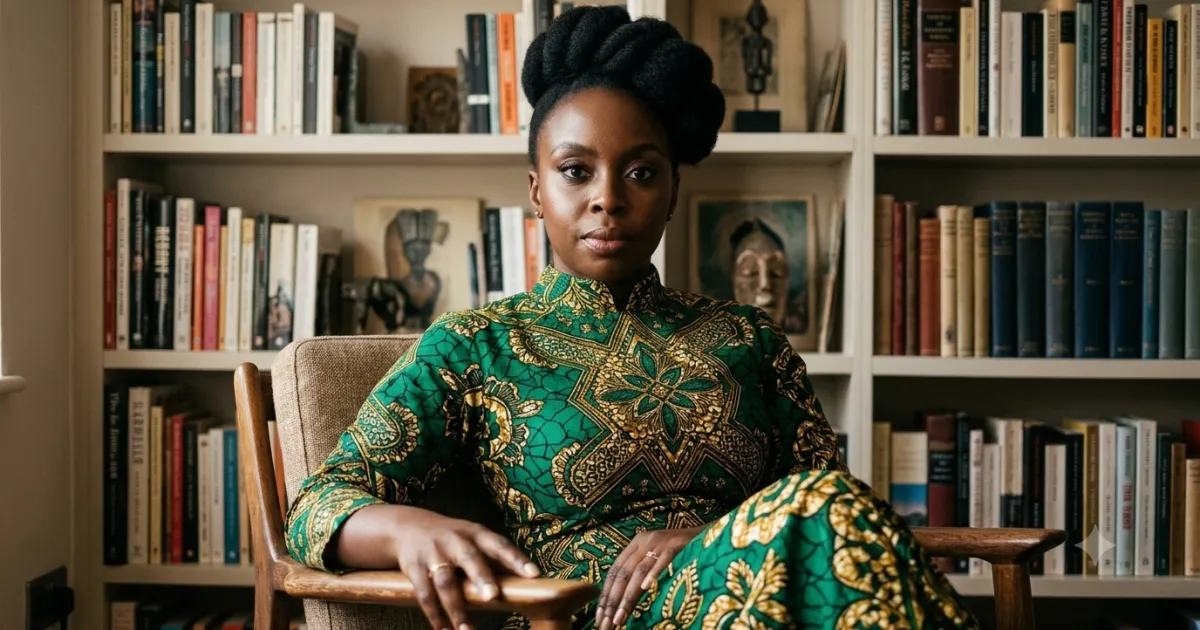
In the autumn of 2003, a young Nigerian woman named Chimamanda Ngozi Adichie published her first novel — a book about a teenager terrorised by her fanatically religious father, set in post-military Nigeria, written with the precision and the emotional intelligence of someone twice her age. She was twenty-six years old. The book won the Commonwealth Writers’ Prize. Two years later, she gave a TED talk called The Danger of a Single Story — a quiet, devastating argument about the violence that narratives do when they reduce complex people and places to a single reductive version of themselves — that has since been viewed more than fifty million times, making it one of the most watched TED talks in the programme’s history. Two years after that, she published Half of a Yellow Sun, a novel about the Nigerian Civil War that won the Orange Prize for Fiction and was adapted into a film starring Chiwetel Ejiofor and Thandie Newton. Then came Americanah, then We Should All Be Feminists, then Notes on Grief, then a twelve-year silence — broken finally in March 2025 with Dream Count, a novel about four Nigerian women that the literary world had been waiting for with the kind of anticipation usually reserved for returning legends.
And in January 2026, in the middle of all of this achievement, she buried her son.
The story of Chimamanda Ngozi Adichie is not merely a story of extraordinary literary achievement — though it is certainly that. It is a story about what it means to write from the truth of your own life, about the courage it takes to say things publicly that most people only think privately, about the losses that find you even in the midst of triumph, and about the singular responsibility that comes with being the writer that an entire continent looks to when it needs its experiences told with both dignity and honesty. This is her full biography.
Chimamanda Ngozi Adichie Biography Facts at a Glance
| Full Name | Chimamanda Ngozi Adichie |
| Date of Birth | September 15, 1977 |
| Age | 48 years old (as of 2026) |
| Place of Birth | Enugu, Nigeria |
| Grew Up | Nsukka, Enugu State, Nigeria |
| State of Origin | Anambra State (Abba); raised in Nsukka, Enugu State |
| Ethnicity / Tribe | Igbo |
| Religion | Christianity (raised Catholic) |
| Father | Professor James Nwoye Adichie (1932–2020) — professor of Statistics, University of Nigeria Nsukka |
| Mother | Grace Ifeoma Adichie (1942–2021) — first female registrar, University of Nigeria Nsukka |
| Education | University of Nigeria Nsukka (medicine, 1 year); Drexel University, Philadelphia; Eastern Connecticut State University (BA Communication and Political Science, summa cum laude, 2001); Johns Hopkins University (MA Creative Writing, 2003); Yale University (MA African History, 2008) |
| Husband | Dr. Ivara Esege — physician based in Maryland, USA |
| Children | One daughter (born 2016); twin sons (born 2024 via surrogacy; one, Nkanu Nnamdi, died January 7, 2026) |
| Occupation | Novelist, Essayist, Feminist Writer, Public Intellectual |
| Major Works | Purple Hibiscus (2003); Half of a Yellow Sun (2006); The Thing Around Your Neck (2009); Americanah (2013); We Should All Be Feminists (2014); Notes on Grief (2021); Dream Count (2025) |
| TED Talks | The Danger of a Single Story (2009 — 50M+ views); We Should All Be Feminists (2012) |
| Major Awards | Commonwealth Writers’ Prize (2005); Orange Prize for Fiction (2007); MacArthur Fellowship (2008); National Book Critics Circle Award (2013) |
| Net Worth (Estimated) | $3 million – $5 million USD |
| Nationality | Nigerian (lives between Nigeria and the United States) |
Early Life: Nsukka, a University Household and the Books That Raised Her
Chimamanda Ngozi Adichie was born on September 15, 1977, in Enugu, Nigeria — though she grew up primarily in Nsukka, a university town in Enugu State that sits on the eastern side of the country. She was the fifth of six children born to two exceptional parents whose academic achievements shaped the intellectual environment of her childhood in ways that are directly traceable in every book she has ever written.
Her father, Professor James Nwoye Adichie (1932–2020), was a professor of Statistics at the University of Nigeria, Nsukka — one of Nigeria’s most prestigious universities and the intellectual centre of southeastern Nigeria. Her mother, Grace Ifeoma Adichie (1942–2021), was the first female registrar of the University of Nigeria — a groundbreaking achievement in an era when institutional leadership positions were almost exclusively occupied by men.
The Adichie family lived on the university campus in Nsukka — in the same house that had previously been the home of Chinua Achebe, the author of Things Fall Apart and arguably the founding figure of modern African literature in English. That biographical detail is not merely interesting — it is symbolic in a way that Adichie herself has acknowledged. She grew up in the house of Africa’s greatest literary pioneer, surrounded by her father’s academic books, writing stories from the age of seven, and reading everything she could find.
Her early reading was largely British and American — Famous Five by Enid Blyton, American children’s literature, the canonical texts of the English-language tradition. She has spoken in interviews about the consequence of that reading diet: that her early attempts at fiction produced characters who ate apples and discussed the weather, even though she had never eaten an apple and the weather in Nsukka was nothing like what she was reading about. The discovery of African writers — particularly Achebe, whose Things Fall Apart demonstrated that characters who ate yam and spoke Igbo could exist in literature — was a revelation that changed everything for her as a writer.
Her family’s personal history was shaped by the Nigerian Civil War (the Biafran War, 1967–1970). Both of her grandfathers died in the war — one in a refugee camp, one from deprivation. Her parents survived the conflict but lost everything. Growing up with that inheritance — the stories of what the family had lost, the silence around subjects too painful to discuss, the particular texture of post-war Igbo memory — gave her the material for what would become her most internationally celebrated novel.
She attended primary and secondary school at the University of Nigeria Secondary School in Nsukka. After completing her secondary education, she enrolled at the University of Nigeria, Nsukka to study Medicine and Pharmacy — a choice that reflects both the academic environment she was raised in and the practical orientation of the Adichie household’s ambitions for their children. She studied medicine for approximately one year and a half before making the decision that would define her life.
The American Chapter: From Drexel to Johns Hopkins to Yale
At nineteen years old, Chimamanda Adichie left Nigeria for the United States — not because she had abandoned medicine but because she had decided, with the certainty that only very young people who know exactly what they are meant to do can summon, that writing was her life’s work and that she needed a different environment to pursue it.
She first enrolled at Drexel University in Philadelphia to study Communications and Political Science. She subsequently transferred to Eastern Connecticut State University, where she completed her degree — graduating summa cum laude (with the highest honours) in Communication and Political Science in 2001. It was during her time at Eastern Connecticut that she began working on what would become her first novel, Purple Hibiscus — writing it in the way that first novels are often written: at the edges of a busy student life, in whatever hours could be found, fuelled by the conviction that the story she was carrying needed to exist in the world.
She continued her academic training, earning a Master of Arts in Creative Writing from Johns Hopkins University in 2003 — the same year Purple Hibiscus was published, a coincidence that underscores the discipline and focus that have always characterised her working life. She subsequently earned a Master of Arts in African History from Yale University in 2008 — adding an academic grounding in historical scholarship to her literary credentials, which helps explain the extraordinary historical depth of her Civil War novel Half of a Yellow Sun.
She held prestigious academic fellowships at Princeton University (Hodder Fellow, 2005–2006) and at the Radcliffe Institute for Advanced Study at Harvard University (2011–2012) — confirming that the American academic establishment had recognised her as one of the most significant literary intellects of her generation.
Purple Hibiscus: The Debut That Announced a Major Voice
Purple Hibiscus was published on October 30, 2003, by Algonquin Books. Set in Nigeria, it tells the coming-of-age story of Kambili, a 15-year-old whose family is wealthy and well respected but who is terrorized by her fanatically religious father. The novel drew on the Nigeria Adichie had grown up in — the specific texture of Igbo Catholic middle-class life, the political instability of the military era, the silence that descends on families organised around the authority and violence of a patriarch.
Purple Hibiscus won the Hurston/Wright Legacy Award for Best Debut Fiction in 2004 and the Commonwealth Writers’ Prize for Best First Book in 2005. It was also shortlisted for the 2004 Orange Prize for Fiction — a remarkable achievement for a debut novel, and one that immediately placed Adichie in the company of the most celebrated novelists in the English language.
The novel established several of the qualities that would define her subsequent work: the psychological precision with which she depicts the interior lives of characters navigating impossible situations; the ability to locate universal emotional truth inside culturally specific Nigerian settings; the refusal to simplify complex moral situations into comfortable resolutions; and the prose style — clear, elegant, and deeply controlled — that has made her one of the most technically accomplished writers working in English today.
Half of a Yellow Sun: The Novel That Changed African Literature
Half of a Yellow Sun was published in 2006 — three years after her debut — and it is the book that established Chimamanda Ngozi Adichie as one of the most important novelists of her generation, regardless of geography, gender, or cultural origin. Set in Nigeria in the 1960s, the story follows Ugwu, a teenage houseboy who has moved from his village to work in a university town; his master Odenigbo, a mathematics professor with revolutionary views; and Olanna, the beautiful daughter of a wealthy Nigerian man, with whom Odenigbo is in love.
The novel is set before and during the Nigerian Civil War — the catastrophic conflict in which the predominantly Igbo southeast of Nigeria declared itself the independent Republic of Biafra, triggering a war with the Nigerian federal government that lasted from 1967 to 1970 and claimed between one and three million lives. It is the war in which Adichie’s own grandfathers died, the war whose aftermath shaped the Igbo collective memory she was raised within.
(cite index=”24-1″>She took the title from an emblem on the Biafran flag. In her own words, written in the novel’s afterword: “I grew up in the shadow of Biafra. It was as if the war had somehow divided the memories of my family… I was concerned about people who lived in Biafra, telling their story in a way that gave it dignity and that is true.”
The novel won the Orange Prize for Fiction in 2007 — one of the most prestigious literary awards in the world, given annually to the best novel written by a woman in English. It was subsequently adapted into a film, directed by Biyi Bandele and starring Chiwetel Ejiofor and Thandie Newton, released in 2013. According to literary scholar Ainehi Edoro, Adichie’s work shifted how African novels are received, moving away from the expectation of “explaining” Africa to Western audiences and toward more intimate, contemporary storytelling.
The TED Talks: When Literature Became Global Conversation
In 2009, Chimamanda Adichie delivered what has become one of the most influential TED talks ever recorded: The Danger of a Single Story. In it, she argued with crystalline clarity that the stories we tell about people and places — and the stories we do not tell, the stories we suppress or ignore — shape our understanding of reality in ways that are simultaneously subtle and devastating. A single story about Africa, she argued, makes Africa a place of poverty and conflict and nothing else. A single story about women makes women helpless and victimised and nothing else. The antidote is not to replace one story with another single story but to insist on the irreducible complexity of human experience.
The talk has been viewed more than fifty million times on TED’s platforms. It has been incorporated into school curricula across the world. It has been translated into dozens of languages. It is, in the strictest sense of the phrase, one of the most consequential pieces of public intellectual communication produced by any African writer in the twenty-first century.
Her second landmark TED talk — We Should All Be Feminists — was delivered at TEDx Euston in 2012 and subsequently published as a short book in 2014. Its title phrase was sampled by Beyoncé on the track ***Flawless from her 2013 self-titled album — introducing Adichie’s feminist thinking to an audience of tens of millions of music listeners who might not have found their way to her novels. The book has been distributed in schools, workplaces, and government institutions worldwide — in Sweden, it was given to every sixteen-year-old student in the country. It remains one of the most accessible and widely read feminist texts of the twenty-first century.
Americanah: Race, Identity and the Nigerian Immigrant Experience
Americanah, published in 2013, was Adichie’s third novel — and it turned the lens of her literary attention from Nigeria’s past to the present experience of Nigerians in America. The novel follows Ifemelu, a young Nigerian woman who emigrates to the United States and begins a popular blog about race in America as observed by a non-American Black woman. The novel is simultaneously a love story, an immigration story, a novel about race, and a novel about the peculiar complexity of returning home after a long time away.
Americanah won the US National Book Critics Circle Award in 2013 and was named one of The New York Times Top Ten Best Books of 2013. It was subsequently adapted for television — a production starring Uzo Aduba and Idris Elba that generated significant anticipation before its eventual release.
The novel is notable for its frank, often uncomfortable exploration of how race operates in America — filtered through the consciousness of a Nigerian immigrant who had not been racialised in the American sense before arriving in the United States. The blog posts that Ifemelu writes within the novel are themselves pieces of sharp cultural analysis, and the novel as a whole operates simultaneously as fiction and as public intellectual argument about identity, belonging, and the performance of race.
The Feminist Years: We Should All Be Feminists and Dear Ijeawele
Following Americanah, Adichie’s public intellectual work expanded beyond fiction. We Should All Be Feminists (2014) — the published version of her TEDx Euston talk — argued for a feminism rooted in the specific realities of African women’s lives rather than in the frameworks developed in Western feminist discourse. Dear Ijeawele, or A Feminist Manifesto in Fifteen Suggestions (2017) — originally a private letter she wrote to a childhood friend who had asked for advice on raising a feminist daughter — extended the argument into the specific domain of parenting and childhood development. Both books were received with the kind of reader engagement that literary fiction rarely generates — personal, immediate, and committed.
Her public feminist position — articulate, specific, and willing to engage with the complexities that most feminist discourse sidesteps — attracted both passionate admiration and, in some quarters, equally passionate opposition. Her criticism of certain trans-inclusive framings of feminism generated significant controversy in 2017 and led to an extended public debate about the boundaries of feminist solidarity that has not been fully resolved. She has addressed the controversy directly and at length in interviews and essays, maintaining her position while acknowledging its contested nature.
Notes on Grief: Writing Through Loss
Notes on Grief was published in 2021, following the death of her father, Professor James Nwoye Adichie, in June 2020. The book — a short, raw, and exceptionally honest account of grief — was received as one of the most intimate pieces of writing she had produced: a departure from the formal architecture of her novels into something more immediate and more vulnerable. Her mother, Grace Ifeoma Adichie, died the following year, in 2021, completing a period of profound personal loss that runs as an undercurrent beneath the twelve years of relative fictional silence between Americanah and Dream Count.
Dream Count: The Return, Twelve Years Later
On March 4, 2025, Chimamanda Ngozi Adichie published Dream Count — her first novel in twelve years and the literary event of the year for readers of African fiction worldwide. Her publisher, Penguin Random House, announced the novel on October 1, 2024 — Nigerian Independence Day — to maximum effect.
Dream Count follows the lives, longings and desires of four women dealing with the aftermath of sexual assault. The central character, Chiamaka, is a Nigerian travel writer living in America — alone during the pandemic, recalling past lovers and grappling with the choices and regrets that accumulate in a life lived between two worlds. The novel develops from a short story, Zikora, that Adichie published as an Amazon original in 2020 — expanding its central character into the full novelistic treatment she had always been capable of carrying.
The twelve-year gap between Americanah and Dream Count was not silence but a period of intense private work alongside the public essays, lectures, and nonfiction that kept her voice present in the world. Adichie spent ten years working on the novel — ten years of revision, of finding the shape of a story complex enough to justify the wait, of returning to fiction with the ambition of someone who knows what they are capable of and refuses to settle for less.
Personal Life: Marriage, Children and the Loss of Nkanu
Chimamanda Ngozi Adichie is married to Dr. Ivara Esege — a physician based in Maryland, United States. The couple have maintained exceptional privacy about their relationship, and Dr. Esege has largely stayed out of the public eye. Adichie divides her time between Nigeria — where she regularly teaches writing workshops and maintains her deep connection to Nsukka and the Igbo literary community — and the United States, where her husband is based.
Their daughter was born in 2016 — a fact that Adichie disclosed publicly with her characteristic combination of openness and restraint, sharing the news of her daughter’s existence while keeping the child’s name and identity firmly private. In 2024, she and Dr. Esege welcomed twin sons via surrogacy in the United States — an announcement she made during the promotional period for Dream Count.
On January 7, 2026, one of the twin boys — Nkanu Nnamdi Esege — died after a brief illness. He was 21 months old. The family released a statement through Adichie’s representative, Omawumi Ogbe, confirming the loss and requesting privacy as they grieved. The announcement triggered an outpouring of sympathy from writers, readers, academics, and admirers across Africa, Europe, and North America — a global community of people who had been shaped by her work and who understood, in reading the news, that the woman who had written so clearly about grief had now been asked to endure its most devastating form.
She has not yet spoken publicly about the loss beyond the initial statement. The world is waiting with the quiet patience that great writers earn from their readers — the understanding that some things take time to find their form.
Chimamanda Adichie’s Net Worth
Chimamanda Ngozi Adichie’s estimated net worth is between $3 million and $5 million USD. Like Wole Soyinka and Ngozi Okonjo-Iweala before her in this biography series, her wealth is the wealth of a writer and public intellectual — built through book royalties, speaking fees, academic fellowships, and the sustained commercial performance of a body of work that has been translated into more than thirty languages and sold millions of copies worldwide.
Her income streams include book royalties from her five major works of fiction plus her nonfiction books, all published by major international houses; speaking fees from lectures at universities, literary festivals, and corporate events worldwide; academic fellowship income from Princeton, Harvard, and other institutions; and the royalty income from the film adaptations of Half of a Yellow Sun and Americanah. The Beyoncé sampling of We Should All Be Feminists on ***Flawless also generated both additional royalty income and a vastly expanded readership for the essay.
Full Bibliography
| Year | Title | Genre | Key Achievement |
| 2003 | Purple Hibiscus | Novel | Commonwealth Writers’ Prize Best First Book 2005; Hurston/Wright Legacy Award 2004; Orange Prize shortlist 2004 |
| 2006 | Half of a Yellow Sun | Novel | Orange Prize for Fiction 2007; adapted into film (Chiwetel Ejiofor, Thandie Newton); translated into 30+ languages |
| 2009 | The Thing Around Your Neck | Short stories | Anisfield-Wolf Book Award 2010; PEN Beyond Margins Award 2010 |
| 2009 | The Danger of a Single Story | TED Talk | 50+ million views; one of most-watched TED talks in history |
| 2012 | We Should All Be Feminists (TEDx talk) | Talk/Essay | Sampled by Beyoncé on “***Flawless”; distributed in Swedish schools nationwide |
| 2013 | Americanah | Novel | National Book Critics Circle Award 2013; NYT Top Ten Best Books 2013; adapted for TV (Uzo Aduba, Idris Elba) |
| 2014 | We Should All Be Feminists | Essay (published) | Global bestseller; distributed to all 16-year-olds in Sweden; published in 30+ languages |
| 2017 | Dear Ijeawele, or A Feminist Manifesto in Fifteen Suggestions | Essay | International bestseller; widely used in schools and universities |
| 2020 | Zikora | Short story (Amazon) | Amazon original; seed narrative for Dream Count |
| 2021 | Notes on Grief | Memoir/Essay | Tribute to her late father; raw, intimate account of loss |
| 2023 | Mama’s Sleeping Scarf | Children’s book | Illustrated children’s picture book |
| 2025 | Dream Count | Novel | First novel in 12 years; published by Penguin Random House; four Nigerian women navigating love, trauma, and identity |
Career Timeline
| Year | Milestone |
| 1977 | Born September 15 in Enugu; grows up in Nsukka on University of Nigeria campus (same house previously occupied by Chinua Achebe) |
| ~1984–1995 | Primary and secondary education at University of Nigeria Secondary School, Nsukka; begins writing stories from age 7 |
| ~1995–1996 | Studies medicine at University of Nigeria Nsukka for approximately one year |
| 1996 | Leaves Nigeria for the United States aged 19; enrolls at Drexel University, Philadelphia |
| ~1997–2001 | Transfers to Eastern Connecticut State University; graduates summa cum laude in Communication and Political Science (2001) |
| 2001–2003 | MA in Creative Writing, Johns Hopkins University |
| October 2003 | Purple Hibiscus published — debut novel wins Commonwealth Writers’ Prize 2005 |
| 2005–2006 | Hodder Fellow at Princeton University |
| August 2006 | Half of a Yellow Sun published — wins Orange Prize for Fiction 2007 |
| 2008 | MacArthur Foundation Fellowship (“Genius Grant”) received; MA African History from Yale University |
| 2009 | The Thing Around Your Neck short story collection published; The Danger of a Single Story TED Talk delivered (50M+ views) |
| 2011–2012 | Radcliffe Institute Fellowship at Harvard University |
| 2012 | We Should All Be Feminists TEDx Euston talk delivered |
| 2013 | Americanah published — National Book Critics Circle Award; NYT Top Ten Books of 2013; Beyoncé samples essay on “***Flawless” |
| 2014 | We Should All Be Feminists published as book by Fourth Estate / Anchor |
| 2016 | Daughter born; Dear Ijeawele manuscript (private letter) written; disclosed to have married Dr. Ivara Esege |
| 2017 | Dear Ijeawele, or A Feminist Manifesto in Fifteen Suggestions published |
| June 2020 | Father, Professor James Nwoye Adichie, dies aged 88; Zikora published as Amazon original short story |
| 2021 | Mother, Grace Ifeoma Adichie, dies; Notes on Grief published — account of her father’s death |
| 2023 | Mama’s Sleeping Scarf (children’s picture book) published |
| 2024 | Twin sons born via surrogacy in the United States; Dream Count announced on Nigerian Independence Day (October 1) |
| March 4, 2025 | Dream Count published — first novel in 12 years; published by Penguin Random House |
| January 7, 2026 | Twin son Nkanu Nnamdi Esege dies after brief illness, aged 21 months |
| 2026 | Continues to be the most globally celebrated Nigerian female writer; remains a dominant voice in world literature and feminist discourse |
What Chimamanda Ngozi Adichie Means: The Storyteller Nigeria Needed
The question of what Chimamanda Ngozi Adichie means to Nigerian literature and to African literature more broadly is not a difficult one to answer — but it is important to answer it carefully, because her significance has several different dimensions that are sometimes collapsed into each other.
She is, first and most fundamentally, a great novelist. The technical achievement of Half of a Yellow Sun — the management of multiple narrative strands across a decade of historical upheaval, the emotional precision with which the Civil War’s devastation is rendered in individual human terms, the refusal to reduce complex moral situations to simple heroism and villainy — would place her among the most accomplished novelists of her generation regardless of where she came from or what else she had said or done. That is her foundation.
On top of that foundation, she has built a public intellectual identity that has made her arguably the most globally recognised African voice on feminism, identity, and the politics of narrative. The Danger of a Single Story is studied in universities on every continent. We Should All Be Feminists is distributed by governments. Her name is known to people who have never read a novel in their lives, because her ideas have found their way into the culture through channels that literature alone cannot access.
She is also, in the Nigerian context specifically, a model of a particular kind of achievement: the woman who left Nsukka at nineteen with nothing but ambition and intelligence, who competed at Harvard, Princeton, Yale, and Johns Hopkins without apology, who wrote Nigerian stories for a global audience without adjusting them for Western palatability, and who built a career of sufficient magnitude to change how the world reads Africa. In that, she is a direct successor to Chinua Achebe — the man whose house she grew up in — and a worthy one.
She is 48 years old. She has buried a son. She has buried both parents. She has published one of the most anticipated novels of the decade. And she is, in every meaningful sense, only in the middle of the story she is telling. The best, one suspects, may still be ahead.
Frequently Asked Questions About Chimamanda Ngozi Adichie
What is Chimamanda Ngozi Adichie known for?
Chimamanda Ngozi Adichie is known primarily as one of the most celebrated novelists of her generation — the author of Purple Hibiscus (2003), Half of a Yellow Sun (2006), Americanah (2013), and Dream Count (2025). She is also globally recognised for her two landmark TED talks: The Danger of a Single Story (2009, 50M+ views) and We Should All Be Feminists (2012), both of which have been incorporated into school curricula worldwide. Her feminist essay We Should All Be Feminists was sampled by Beyoncé on the track ***Flawless and distributed to every 16-year-old in Sweden. She is widely regarded as Nigeria’s greatest living female writer.
How old is Chimamanda Ngozi Adichie?
Chimamanda Ngozi Adichie is 48 years old as of 2026. She was born on September 15, 1977, in Enugu, Nigeria. She grew up in Nsukka, Enugu State, on the campus of the University of Nigeria. She celebrated her 48th birthday on September 15, 2025.
Who is Chimamanda Ngozi Adichie’s husband?
Chimamanda Ngozi Adichie is married to Dr. Ivara Esege — a physician based in Maryland, United States. The couple have maintained exceptional privacy about their relationship, and Dr. Esege has maintained a low public profile. Together they have one daughter (born 2016) and twin sons born via surrogacy in 2024; one of the twins, Nkanu Nnamdi Esege, died on January 7, 2026, after a brief illness aged 21 months.
What is Chimamanda Ngozi Adichie’s most famous book?
Half of a Yellow Sun (2006) is widely considered her most acclaimed literary work — it won the Orange Prize for Fiction in 2007, was translated into over 30 languages, and was adapted into a film starring Chiwetel Ejiofor and Thandie Newton. The Danger of a Single Story (2009 TED talk, 50M+ views) and We Should All Be Feminists (2012/2014) are probably her most globally recognised works across the broadest audiences, though they are essays and lectures rather than novels. Her most recent novel, Dream Count (2025), was her first in twelve years.
What state is Chimamanda Ngozi Adichie from?
Chimamanda Ngozi Adichie’s family is from Abba in Anambra State, southeastern Nigeria — making her Anambra State by origin, though she was born in Enugu and grew up in Nsukka, Enugu State. She is Igbo by ethnic heritage. Her parents were both senior staff at the University of Nigeria in Nsukka. She divides her adult life between Nigeria and the United States.
What is the Dream Count novel about?
Dream Count (2025) is Chimamanda Ngozi Adichie’s fifth novel, published by Penguin Random House on March 4, 2025 — twelve years after her previous novel, Americanah. The novel follows four Nigerian women with interconnected lives, navigating loves, longings, and desires. The central character, Chiamaka, is a Nigerian travel writer living in America who, isolated during the pandemic, recalls past lovers and confronts her choices and regrets. The novel expands on characters from Adichie’s 2020 Amazon original short story Zikora. Adichie spent approximately ten years writing the novel.
What is Chimamanda Ngozi Adichie’s net worth?
Chimamanda Ngozi Adichie’s estimated net worth is between $3 million and $5 million USD. Her wealth has been built through book royalties from novels and essays published by major international houses and translated into 30+ languages, speaking fees from lectures at universities and literary festivals worldwide, academic fellowship income from Princeton, Harvard, and other institutions, royalty income from film adaptations of her work, and the ongoing commercial performance of her backlist titles, particularly Half of a Yellow Sun, Americanah, and We Should All Be Feminists.
Did Chimamanda Ngozi Adichie study medicine?
Yes, briefly. Chimamanda Ngozi Adichie enrolled at the University of Nigeria, Nsukka to study Medicine and Pharmacy after completing her secondary education. She studied there for approximately one year before leaving Nigeria at age nineteen to pursue her passion for writing in the United States. She subsequently studied Communications and Political Science at Eastern Connecticut State University (graduating summa cum laude in 2001), then earned an MA in Creative Writing from Johns Hopkins University (2003) and an MA in African History from Yale University (2008).




0 Comments
No comments yet. Be the first to share your thoughts!