


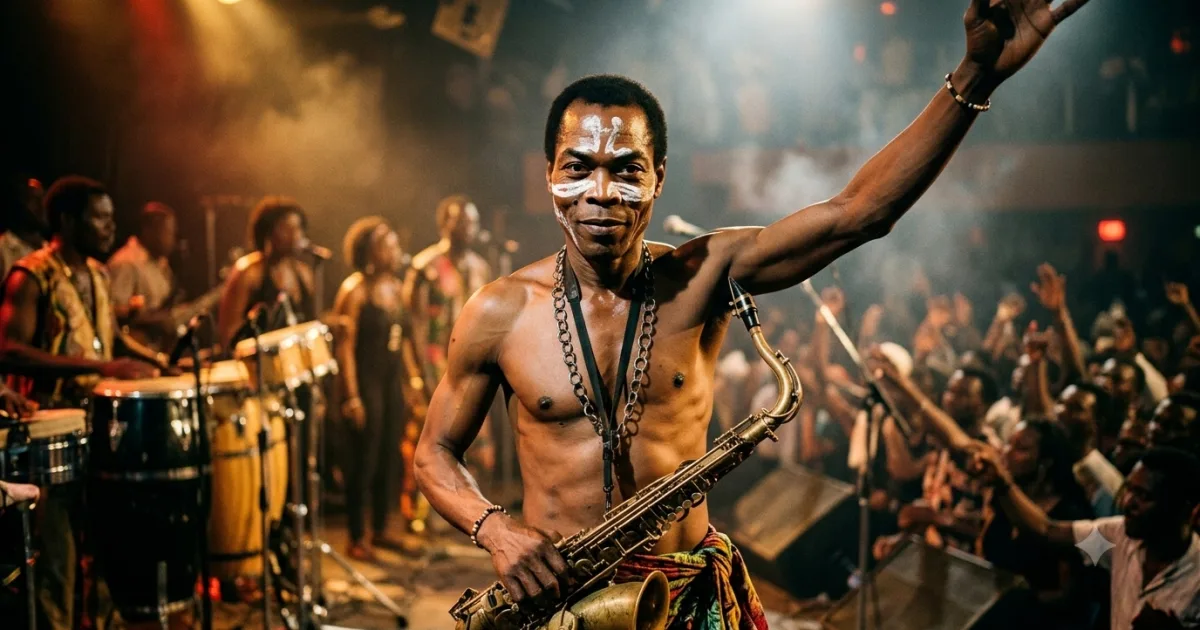
He told his parents he was going to London to study medicine. He went to London to study music instead — and never apologised for the deception, because the music that came out of it was too important to apologise for. He created an entirely new genre — Afrobeat — that fused Yoruba rhythmic tradition with American jazz, funk, and James Brown’s visceral energy, and deployed the resulting sound as a weapon against every military government, colonial legacy, and corrupt institution that dared cross his path. He was arrested more than two hundred times. The Nigerian army burned down his commune and threw his 77-year-old mother out of a window. He married twenty-seven women in a single ceremony. He declared his compound an independent republic. He ran for president. He refused, categorically and on multiple occasions, to be silent, to be accommodating, to be manageable, or to be afraid.
In 2026, nearly three decades after his death, the Rock and Roll Hall of Fame inducted Fela Kuti — making him the first African performer ever to receive that recognition. It was, in characteristic Fela fashion, a honour he would probably have greeted with a mixture of gratification and suspicion. The establishment recognising the man who spent his life fighting establishments is the kind of irony he appreciated.
His full name was Olufela Olusegun Oludotun Ransome-Kuti. He was born in Abeokuta. He died in Lagos. And in between, he changed African music, African political consciousness, and the world’s understanding of what a single artist can attempt with nothing but a saxophone, a compound full of musicians, and an absolute refusal to stop.
Fela Kuti Biography Facts at a Glance
| Full Birth Name | Olufela Olusegun Oludotun Ransome-Kuti |
| Known As | Fela Anikulapo Kuti; Fela; Abami Eda (Strange One); Black President |
| Date of Birth | October 15, 1938 |
| Date of Death | August 2, 1997 (aged 58) |
| Place of Birth | Abeokuta, Ogun State, British Nigeria |
| State of Origin | Ogun State, Nigeria |
| Ethnicity / Tribe | Yoruba |
| Father | Reverend Israel Oludotun Ransome-Kuti — Protestant minister, school principal, first president of Nigeria Union of Teachers |
| Mother | Funmilayo Ransome-Kuti — feminist, anti-colonial activist, political organiser |
| Family connections | First cousin of Nobel laureate Wole Soyinka; grandson of Josiah Ransome-Kuti (composer and clergyman) |
| Education | Abeokuta Grammar School; Trinity College of Music, London (1958–1963) |
| Genre Created | Afrobeat |
| Instruments | Saxophone, keyboards, vocals, trumpet, guitar, drums |
| Notable Bands | Koola Lobitos; Afrika 70; Egypt 80 |
| Wives | Remi Taylor (first wife); 27 women married simultaneously in 1978 (later divorced all) |
| Children | Yeni Kuti, Femi Kuti, Seun Kuti (among others) |
| Cause of Death | AIDS-related complications |
| Funeral Attendance | Approximately 1 million people |
| Rock Hall of Fame | Inducted 2026 — first African performer ever inducted |
| Nationality | Nigerian |
Early Life: Abeokuta, the Ransome-Kuti Dynasty and a Family of Rebels
Olufela Olusegun Oludotun Ransome-Kuti was born on October 15, 1938, in Abeokuta — the same city that would, sixteen years later, produce another member of his extended family who would become Africa’s greatest literary figure. His first cousin, Wole Soyinka, was born in Abeokuta in 1934. That two artists of such extraordinary magnitude — one musical, one literary, each a global first in their respective fields — came from the same family, in the same small Yoruba city, is one of the most astonishing biographical coincidences in African cultural history. It was not, however, a coincidence. It was a family.
The Ransome-Kuti family of Abeokuta was one of the most intellectually distinguished families in Nigeria’s modern history. Fela’s grandfather, Josiah Ransome-Kuti (1855–1930), was a clergyman, educationist, and composer who is credited with composing Nigeria’s first known African classical music. His father, Reverend Israel Oludotun Ransome-Kuti, was a Protestant minister, school principal, and the first president of the Nigeria Union of Teachers — one of the most significant positions in Nigerian education at the time. His uncles, Beko Ransome-Kuti and Olikoye Ransome-Kuti, were both distinguished medical doctors — Olikoye served as Nigeria’s Minister of Health and was globally recognised for his work on primary healthcare.
But the most consequential family influence on Fela’s life and music was his mother: Funmilayo Ransome-Kuti — one of the most remarkable women in Nigerian history. A feminist, a trade unionist, an anti-colonial activist, and a political organiser of fearless conviction, Funmilayo Ransome-Kuti led the Abeokuta Women’s Tax Revolt of 1949 — a mass protest by women against unjust taxation under British colonial governance — that resulted in the abdication of the Alake of Abeokuta and demonstrated, at a time when such demonstrations were dangerous, that organised women could force institutional change. She was the first Nigerian woman to drive a car. She was the first woman to be received at Buckingham Palace as a Nigerian representative. She was, in every meaningful sense, the ideological architect of the political consciousness that her son would later express through music.
Fela grew up in a household where music, education, political engagement, and moral courage were not separate activities but aspects of a single integrated life. His father encouraged him to study piano from childhood. He led his school choir at Abeokuta Grammar School. He was, by all accounts, a bright, curious, and occasionally difficult child — qualities that his family valued and that the world would eventually be grateful for.
London: The Deception, Trinity College and the Birth of a Sound
When Fela left Nigeria for London in 1958, he told his parents he was going to study medicine. He was not going to study medicine. He enrolled at the Trinity College of Music in London — one of Britain’s most distinguished music conservatories — where he studied classical music theory, composition, and performance.
London in the late 1950s was an extraordinary environment for a young Nigerian musician to inhabit. It was the centre of a global empire in its final years, a city teeming with immigrants from the Caribbean, West Africa, and South Asia who were reinventing British culture from the inside. It was also a city where American jazz and rhythm and blues had arrived with their full revolutionary force, where Fela could hear Miles Davis and Charlie Parker alongside West Indian calypso and highlife music from Ghana and Nigeria. He absorbed all of it.
At Trinity, he formed his first band: Fela Ransome-Kuti and His Highlife Rakers. The band recorded four sides for Melodisc — one of Britain’s first independent African and Caribbean music labels — giving him his first professional recording experience. The music was highlife: the Ghanaian-Nigerian popular music style that dominated West African dance halls in that era. It was good. It was not yet Fela.
Fela in London was a student learning his instruments — not just the saxophone that would become his signature, but the full language of Western music theory, jazz harmony, and the rhythmic complexity of American funk. He was also observing, with growing political consciousness, the structural injustices of a colonial system that was simultaneously ending and leaving its damage permanently embedded in the societies it was releasing.
He returned to Nigeria in 1963, formed a reconstituted version of his London band — renamed Koola Lobitos — and began the slow, methodical process of building a sound that did not yet exist.
The American Revelation: Sandra Izsadore, Malcolm X and Political Awakening
The event that transformed Fela from a talented musician into a revolutionary artist was a trip to the United States. In 1969, Koola Lobitos toured the United States — and the America Fela encountered was not the America of commercial jazz and pop radio. It was the America of the Black Power movement, of Malcolm X’s searing critique of white supremacy, of the Black Panther Party’s assertion of Black political rights through organised militancy, of James Brown’s incendiary performances that fused political consciousness with physical intensity.
The woman who catalysed much of this transformation was Sandra Izsadore (also known as Sandra Smith) — a member of the Black Panther Party and the girlfriend of Panther leader Eldridge Cleaver. She introduced Fela to the writings of Malcolm X, to the music of Sly Stone, James Brown, and the political dimensions of soul music, and to the Black consciousness philosophy that was simultaneously transforming American political culture and spreading across the African diaspora worldwide.
Fela received all of this with the intensity of a man who had been waiting, without knowing it, for exactly this framework. He went to America as a talented West African musician playing highlife. He came back with a new genre, a new name — dropping Ransome from his surname as a rejection of the colonial slave name — and a new purpose: to use music as the most powerful weapon available to him against the systems of oppression, corruption, and neo-colonial exploitation that he believed were destroying Africa.
The Creation of Afrobeat: Africa’s Most Significant Musical Innovation
In the early 1970s, back in Lagos, Fela created Afrobeat. The genre he invented was not merely a fusion of existing styles — though it drew on West African percussion traditions, Yoruba musical forms, American funk and jazz, and James Brown’s rhythmic architecture simultaneously. It was something genuinely new: a musical form built for political purpose, designed to communicate complex political ideas to ordinary people through the universal language of music that made them want to dance even as it made them think about who was stealing from them.
The structural innovations of Afrobeat were specific and technically sophisticated. The songs were long — not three-minute pop songs but extended compositions of fifteen, twenty, sometimes forty minutes — built on repeating rhythmic cycles that allowed the band to develop ideas over extended time. The horns — saxophone, trumpet, trombone — carried the melodic and harmonic content in layers of interlocking voices. The rhythm section was built on Tony Allen’s drumming — a rhythmic genius whose contributions to Afrobeat’s foundational sound were so significant that Fela himself later said: “Without Tony Allen, there would be no Afrobeat.” Fela’s vocals moved in and out — sometimes rapping, sometimes singing, sometimes speaking — in Yoruba, Pidgin English, and English simultaneously.
The lyrics addressed everything: military corruption, police brutality, the collaboration of African elites with foreign powers in the exploitation of African resources, the hypocrisy of organised religion, the psychological damage of colonialism, the beauty of African womanhood, the specific and documented crimes of specific Nigerian military governments. He named names. He described acts. He published evidence in song. In a country without a free press, Fela Kuti’s music was one of the most significant sources of political accountability available to ordinary Nigerians.
His band — first Afrika 70, then Egypt 80 — was a touring political enterprise that could carry forty or more musicians, dancers, and support staff. His Lagos club, the Afrika Shrine, was simultaneously a performance venue, a community centre, a political meeting space, and a place where ordinary Lagosians could experience music, politics, and community with an intensity that no other institution in Nigerian society was offering.
The Kalakuta Republic: Sovereignty as Performance and Principle
In 1970, Fela established a communal compound in Surulere, Lagos, that he named the Kalakuta Republic — declaring it an independent nation, sovereign from the Nigerian state, exempt from Nigerian law, and operating under its own rules. The name Kalakuta is derived from the Swahili word for rascal or rogue — an appropriately irreverent designation for what was, in effect, a permanent provocation directed at a military government that was simultaneously trying to manage, co-opt, and suppress him.
Kalakuta housed Fela, his musicians, his wives, his children, his supporters, and the entire infrastructure of his artistic and political enterprise. It was where the music was made, where the community lived, where the political meetings were held, and where the Nigerian military knew they could find him if they ever decided to come for him directly.
They did. On February 18, 1977, approximately one thousand Nigerian soldiers surrounded and attacked the Kalakuta Republic. They beat residents, raped women, destroyed equipment, burned buildings, and threw Fela’s 77-year-old mother, Funmilayo Ransome-Kuti, from a first-floor window. She sustained injuries from which she never fully recovered, dying the following year in October 1978. Fela buried his mother and sent her coffin to the military headquarters in Lagos as a statement of accusation that required no words.
The attack on Kalakuta did not silence him. He rebuilt. He continued. He documented the attack in music — the album Unknown Soldier (1979), named for the military government’s absurd official explanation that the destruction was caused by “an unknown soldier,” became one of his most politically powerful records.
The 27 Wives: Marriage as Political Statement
In 1978, Fela married 27 women simultaneously in a single ceremony — dancers and singers from his band, women who had been part of his community at Kalakuta. He declared them all his wives and announced that the institution of marriage, as defined by Christian monogamy and colonial law, was a foreign imposition on African culture that he was rejecting in favour of a practice more consistent with pre-colonial Yoruba tradition.
The mass marriage generated enormous controversy — among Nigerian Christians who found it offensive, among feminists who questioned whether it was genuinely liberatory for the women involved, and among his political critics who used it to undermine his moral authority. His first wife, Remi Taylor, with whom he had children including Femi, Yeni, and Sola, had preceded this ceremony.
In 1984, following his arrest and imprisonment by the Buhari military government on politically motivated currency smuggling charges, he was held for 20 months. Amnesty International designated him a prisoner of conscience. On his release in 1986 by General Ibrahim Babangida, he divorced all 12 of his remaining wives — stating with characteristic directness: “Marriage brings jealousy and selfishness.”
Rock and Roll Hall of Fame: The 2026 Induction
Fela was inducted into the Rock and Roll Hall of Fame in 2026 in the musical influence category — the first African performer to be inducted. The induction — nearly three decades after his death — was received in Nigeria and across the African music community as a long-overdue recognition of an artist whose influence on global music had been acknowledged by virtually every major artist who had engaged with African music in the intervening years.
From Beyoncé’s references to Fela in the context of African musical heritage, to Wizkid’s acknowledged debt to the Afrobeat tradition Fela created, to the Broadway musical Fela! (which ran in New York from 2009 to 2011 and won three Tony Awards), to the consistent citation of his influence by artists across hip-hop, jazz, world music, and electronic music — Fela’s influence on global music had been visible and audible for decades before the Hall of Fame formalised it.
The Musical Influence category of the Rock Hall recognises artists whose creative impact extends beyond their own commercial success to shape the broader direction of music. There is arguably no African artist — and very few artists of any nationality — whose musical influence has been more demonstrably global, more cross-genre, or more enduring than Fela Kuti’s.
His Children and the Living Legacy
Fela Kuti’s legacy is not merely preserved in his music — it is alive in his children, who have carried the Afrobeat tradition forward into the present with remarkable talent and commitment.
Femi Kuti (born June 16, 1962) — Fela’s eldest son — is himself a Grammy-nominated Afrobeat musician of international standing. He leads The Positive Force band and has continued performing at the New Afrika Shrine in Lagos — the venue his sister Yeni rebuilt after the original Afrika Shrine was demolished. Femi has been nominated for the Grammy Award for Best Contemporary World Music Album four times. His son, Made Kuti — Fela’s grandson — is also now a performing musician, making the Kuti family a three-generation Afrobeat dynasty.
Seun Kuti — Fela’s youngest son, born in 1983 to one of the 1978 wives — leads Egypt 80, the very band his father founded. He has maintained the most explicitly political stance of Fela’s children, continuing the tradition of using music as direct political commentary on Nigerian and African governance. He was arrested in Lagos in 2023 in connection with a protest — an echo of his father’s repeated encounters with Nigerian state power that generated significant national and international attention.
Yeni Kuti (born May 24, 1961) — Fela’s daughter — is the founder of Felabration, the annual music festival established in 1998 to celebrate her father’s legacy. She serves as Managing Director of the New Afrika Shrine. Felabration has grown into one of Africa’s most significant annual music and cultural events, attracting artists and visitors from across the world every October.
Fela’s Death: One Million Mourners
Fela Kuti died on August 2, 1997, in Lagos, from AIDS-related complications. He was 58 years old. His brother Beko Ransome-Kuti publicly disclosed the cause of death — a courageous act in an era when AIDS-related stigma was severe — and the disclosure sparked important public conversation about HIV/AIDS in Nigeria at a time when awareness was critically needed.
His funeral was one of the most remarkable public gatherings in Nigerian history. Roughly 1 million people attended his funeral procession, which began at Tafawa Balewa Square and ended at Kuti’s home, Kalakuta, in Ikeja, Lagos, where he was laid to rest in the front yard. One million people — in a country that was grieving a man who had been imprisoned, beaten, and persecuted by successive governments — came out to mourn him. The procession confirmed what his music had always suggested: that he was not merely an artist but a figure of mass popular identification, someone who gave voice to the experiences and the grievances of ordinary people in a way that made them feel seen and defended.
The Music: A Discography That Changed African Sound
Fela Kuti recorded more than seventy albums across his career — an extraordinary output that maintains consistent quality while evolving in sophistication across three decades. Some of his most celebrated works include:
- Zombie (1977) — a savage indictment of military soldiers as mindless automatons, which triggered the 1977 army raid on Kalakuta Republic. One of Afrobeat’s defining records
- Expensive Shit (1975) — inspired by an actual incident in which police planted marijuana in his food and he ate it to destroy the evidence, requiring them to collect and test his excrement as evidence. The surreal humour barely conceals the political horror
- Water No Get Enemy (1975) — a meditation on the elemental necessity of water; one of his most beloved compositions
- Unknown Soldier (1979) — his response to the Kalakuta raid; the title mocks the military government’s claim that an “unknown soldier” was responsible
- ITT (International Thief Thief) (1979) — an explicit, documented attack on ITT Corporation and General Olusegun Obasanjo, accusing both of complicity in the exploitation of Nigerian resources
- Army Arrangement (1985) — recorded while he was in prison; released through the efforts of his supporters
- Beasts of No Nation (1989) — a response to apartheid South Africa, featuring his vision of Reagan, Thatcher, and Botha as the true beasts of the title
Why Fela Kuti Matters: The Most Consequential African Artist of the 20th Century
The argument for Fela Kuti as the most consequential African artist of the twentieth century is not a difficult one to make. He created an entire musical genre that has since spread across the world and shaped the sound of contemporary global music in ways that are still being traced. He deployed that genre as a tool of political accountability in a country where such tools were scarce and dangerous to use. He absorbed more physical, legal, and governmental violence than almost any other artist in history and continued, without capitulation, until his body finally failed him.
He also demonstrated something about the relationship between art and politics that the comfortable institutional version of that relationship tends to avoid: that genuine political art is not commentary on power from a safe distance but confrontation with power at close range, at real personal cost, without guarantee of protection or recognition. The Rock and Roll Hall of Fame inducting him in 2026 is a wonderful posthumous honour. But Fela’s real legacy is not the awards. It is the music, still playing. The Shrine, still open. His sons, still performing. His daughter, still organising Felabration every October. One million people who came to say goodbye and have never really left.
Career Timeline
| Year | Milestone |
| 1938 | Born October 15 in Abeokuta, Ogun State; son of Reverend Israel Ransome-Kuti and Funmilayo Ransome-Kuti |
| ~1940s–1950s | Learns piano and drums; leads school choir at Abeokuta Grammar School |
| 1958 | Leaves Nigeria for London; enrolls at Trinity College of Music (not medicine, as parents expected) |
| 1958–1963 | Studies classical music at Trinity; forms Fela Ransome-Kuti and His Highlife Rakers; records with Melodisc |
| 1963 | Returns to Nigeria; reforms band as Koola Lobitos in Lagos |
| 1969 | US tour with Koola Lobitos; meets Sandra Izsadore; encounters Black Power movement and Malcolm X ideology; political awakening |
| Early 1970s | Creates Afrobeat; renames band Afrika 70; opens Afrika Shrine club in Lagos; drops “Ransome” from his name; renames himself Anikulapo (“He who carries death in his pouch”) |
| 1970 | Establishes Kalakuta Republic commune in Surulere, Lagos — declares it independent from Nigerian state |
| 1977 | Releases Zombie — triggers army raid on Kalakuta Republic; approximately 1,000 soldiers attack the compound; mother Funmilayo thrown from window |
| 1978 | Marries 27 women simultaneously — declares rejection of monogamous colonial marriage; mother Funmilayo dies from injuries sustained in 1977 raid; sends her coffin to military headquarters |
| 1979 | Releases Unknown Soldier; runs for Nigerian president as candidate of Movement of the People party |
| 1984 | Arrested and imprisoned by Buhari government on politically motivated currency smuggling charges; Amnesty International designates him a prisoner of conscience |
| 1986 | Released from prison by General Babangida; divorces remaining 12 wives; performs at Giants Stadium, New Jersey, at Amnesty International Conspiracy of Hope concert alongside Bono, Santana |
| 1990s | Continues recording and touring with Egypt 80; remains politically active |
| August 2, 1997 | Dies in Lagos of AIDS-related complications, aged 58; approximately 1 million people attend his funeral procession |
| 1998 | Daughter Yeni Kuti founds Felabration — annual festival to celebrate his legacy; held every October in Lagos |
| 2009–2011 | Broadway musical Fela! runs in New York, winning three Tony Awards — introduces his story to new global audiences |
| 2026 | Inducted into the Rock and Roll Hall of Fame — first African performer ever; Musical Influence category |
Frequently Asked Questions About Fela Kuti
What was Fela Kuti’s real name?
Fela Kuti’s full birth name was Olufela Olusegun Oludotun Ransome-Kuti. He was born on October 15, 1938, in Abeokuta, Ogun State, Nigeria. He later dropped the surname “Ransome” — which he described as a slave name of colonial origin — and adopted the name Anikulapo, meaning “he who carries death in his pouch” in Yoruba, making his full adopted name Fela Anikulapo Kuti. He is also known by the epithets Abami Eda (Strange One) and Black President.
How many wives did Fela Kuti have?
Fela Kuti’s first wife was Remi Taylor, a British woman he met in London, with whom he had children including Femi, Yeni, and Sola. In 1978, he married 27 additional women simultaneously in a single ceremony — dancers and musicians from his band — declaring the mass marriage a rejection of monogamous colonial marriage traditions in favour of pre-colonial Yoruba polygamous practice. Following his imprisonment in 1984 and release in 1986, he divorced all 12 of his remaining wives, stating that “marriage brings jealousy and selfishness.” He never remarried.
What is Afrobeat and did Fela Kuti create it?
Yes — Afrobeat is the musical genre created by Fela Kuti in the early 1970s. It fuses West African percussion traditions and Yoruba musical forms with American jazz, funk, and soul music — particularly drawing on the influence of James Brown. Characteristic features include extended song structures (often 15–40 minutes), interlocking horn arrangements, complex polyrhythmic drumming (developed with drummer Tony Allen), and politically charged lyrics delivered in Yoruba, Nigerian Pidgin, and English. Afrobeat should be distinguished from Afrobeats (plural) — the contemporary Nigerian pop genre that is Wizkid, Davido, and Burna Boy’s domain — which is a different, though related, musical tradition.
What happened to Fela Kuti’s mother?
Fela Kuti’s mother, Funmilayo Ransome-Kuti — one of Nigeria’s most celebrated feminist and anti-colonial activists — was thrown from a first-floor window of the Kalakuta Republic during the army raid of February 18, 1977, in which approximately 1,000 Nigerian soldiers attacked Fela’s compound. She sustained injuries from which she never fully recovered and died in October 1978. Fela responded by sending her coffin to the Supreme Military Council headquarters in Lagos — a gesture of accusation and defiance that required no words.
How did Fela Kuti die?
Fela Kuti died on August 2, 1997, in Lagos, Nigeria, from AIDS-related complications. He was 58 years old. His death was publicly confirmed as AIDS-related by his brother, Dr. Beko Ransome-Kuti — a disclosure that was courageous given the severe stigma surrounding AIDS in Nigeria at the time and that contributed to important public health conversations. He is buried in the front yard of the Kalakuta compound in Ikeja, Lagos, where his funeral procession ended with approximately one million mourners.
Who are Fela Kuti’s children?
Fela Kuti’s most publicly known children are his three children with first wife Remi Taylor: Femi Kuti (born 1962) — a Grammy-nominated Afrobeat musician who leads The Positive Force and performs regularly at the New Afrika Shrine; Yeni Kuti (born 1961) — founder of Felabration festival and Managing Director of the New Afrika Shrine; and Sola Kuti, who died of cancer shortly after her father’s death in 1997. His youngest son, Seun Kuti (born 1983), leads Egypt 80 — Fela’s own band — and has continued the explicitly political Afrobeat tradition. Seun’s son Made Kuti is also a performing musician, making the Kuti family a three-generation Afrobeat dynasty.
What is the Afrika Shrine?
The Afrika Shrine was Fela Kuti’s legendary performance venue in Lagos — a club, community space, and political meeting ground that he operated from the early 1970s. The original Afrika Shrine was closed following his arrest in 1984. After his death, his daughter Yeni Kuti oversaw the construction of the New Afrika Shrine in the Agidingbi area of Ikeja, Lagos — which opened in 2000 and continues to operate as a live music venue hosting regular performances by Femi Kuti, Seun Kuti, and visiting international artists. The New Afrika Shrine has become one of Africa’s most significant cultural venues and a pilgrimage site for music lovers and Fela devotees from around the world.
Was Fela Kuti inducted into the Rock and Roll Hall of Fame?
Yes. Fela Kuti was inducted into the Rock and Roll Hall of Fame in 2026 in the musical influence category, becoming the first African performer to be inducted. The induction came nearly three decades after his death in 1997, recognising a body of work and a musical influence — through the creation of Afrobeat and its impact on global music — that the Hall of Fame had long been expected to formally acknowledge. He joins a category that honours artists whose creative contribution to music’s broader direction exceeds their commercial impact, which in Fela’s case is itself enormous.




0 Comments
No comments yet. Be the first to share your thoughts!