


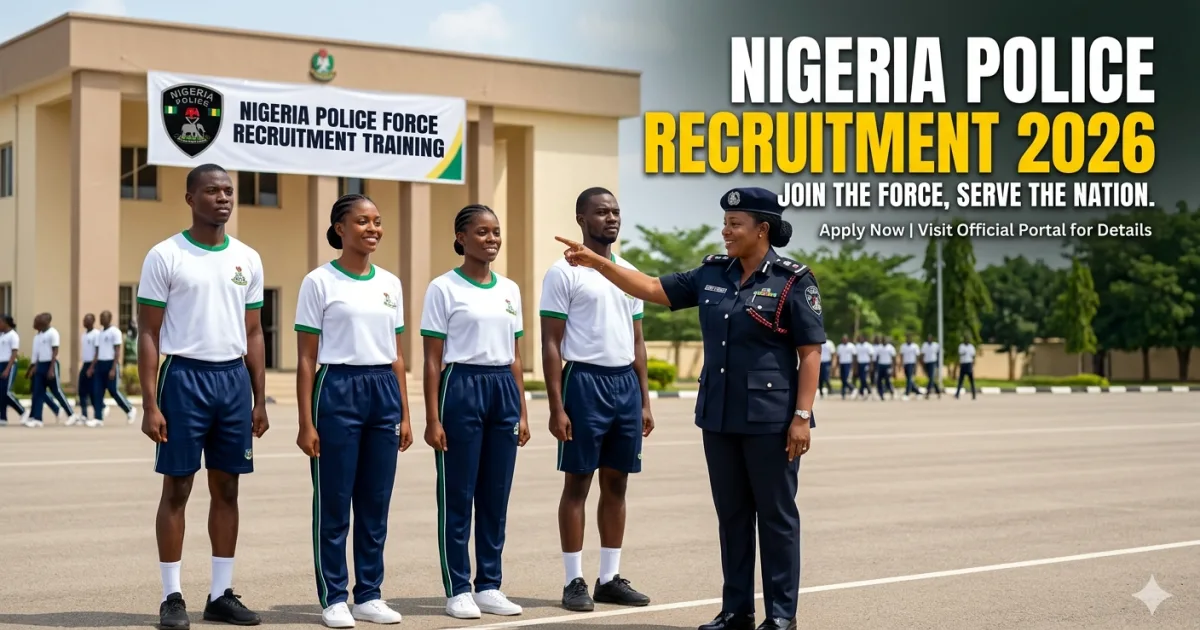
The Nigeria Police Force (NPF) periodically conducts nationwide recruitment exercises to bring new constables and inspectors into the force. If the Nigerian Police recruitment portal for 2026 opens — either for General Constable recruitment or for Constable/Inspector Special recruitment — this guide tells you exactly what you need to know: the full eligibility requirements, how to apply through the official NPF recruitment portal, what happens at screening, the documents you must bring, how to prepare physically, and how to avoid the many fraud schemes that target police recruitment applicants. All legitimate Nigerian Police recruitment is completely free — no payment is ever required.
Nigerian Police Recruitment 2026: Is It Currently Open?
As of the time of writing (May 2026), check the official Nigeria Police Force website at npf.gov.ng and the official NPF recruitment portal at recruitment.npf.gov.ng for the current status of any open recruitment exercise. The NPF recruitment window opens when announced — there is no fixed annual schedule. When recruitment is announced, applications are typically open for 2–4 weeks before closing. The NPF makes announcements through: its official website, its verified social media accounts (@PoliceNG on X/Twitter and Facebook), and official press releases in major newspapers. Any other source of “NPF recruitment” information should be verified against these official channels before acting on it.
Nigerian Police Recruitment Requirements 2026
The following requirements are standard for Nigerian Police General Constable recruitment, based on official NPF criteria from previous recruitment exercises and confirmed by multiple recruitment guidance sources including MasterCareer.com.ng, Bestmaza.com, and RecruitNGR:
Age
Minimum 17 years and maximum 25 years at the time of recruitment. Some special categories (particularly for holders of OND, HND, or university degrees) may have slightly different age limits — check the specific recruitment advertisement for the exact cutoff. Applicants must not have exceeded the maximum age by the date announced in the specific recruitment exercise.
Height
The Nigerian Police standard minimum height requirements are: Male: 1.67 metres (5 feet 6 inches); Female: 1.64 metres (5 feet 5 inches). These are physical minimums — candidates who do not meet the height standard are disqualified at the physical screening stage regardless of all other qualifications. Measure your actual height accurately before deciding to apply.
Educational Qualifications
| Category | Minimum Educational Requirement |
|---|---|
| General Constable | Minimum 5 O’Level credit passes (including English Language) in WAEC, NECO, GCE, NABTEB, or NBAIS in not more than 2 sittings |
| Constable (Trades) | O’Level credits + relevant trade/vocational certificate |
| Inspector (Graduate) | University degree (BSc/BA) or HND in relevant field — different recruitment track |
Other General Requirements
- Nigerian citizen by birth
- Single/unmarried — married candidates are not eligible for constable recruitment
- Medically and physically fit as determined by NPF medical examination
- No criminal conviction from any court in Nigeria
- No tattoos or body inscriptions (traditional tribal marks excepted)
- NIN (National Identification Number) — compulsory; must match all other documents
- Not a known member of any secret society, cult, or banned organisation
- Certificate of Local Government of Origin
How to Apply for Nigerian Police Recruitment 2026 — Step by Step
All Nigerian Police recruitment applications are submitted online through the official portal. Here is the application process:
- Visit the official NPF recruitment portal: recruitment.npf.gov.ng
- Click “Apply Now” or “Register” for the current recruitment exercise
- Create an account with your email address — use an active email you check regularly
- Log in and complete the application form: personal details (name matching NIN exactly), date of birth, state of origin, LGA, educational qualifications, NIN number, contact information
- Upload required documents: passport photograph (recent, white background), O’Level result, NIN slip
- Submit the application — no payment is required at any stage
- Print your acknowledgment slip and application form — required at screening
- Monitor recruitment.npf.gov.ng for shortlist publication and screening dates
Critical warning: NPF recruitment is free at every stage. MasterCareer.com.ng’s NPF guide states clearly: “The NPF has made it clear that recruitment is absolutely free. You shouldn’t pay anyone claiming to fast-track your application.” Any payment request — whether from a person at the gate of a police station, through WhatsApp, or on any website other than recruitment.npf.gov.ng — is a scam.
Documents Required for NPF Screening
- Application/acknowledgment slip (printed from portal)
- Photo card (signed, as specified in application)
- Original WAEC/NECO/GCE result (plus photocopies)
- Original birth certificate or age declaration affidavit
- Certificate of Local Government of Origin (signed by LGA Chairman or Secretary)
- NIN slip (original)
- Police clearance/DPO certification from your local area
- Parent/guardian consent form (for candidates under 18)
- Any trade or professional certificate (for Trades category applicants)
- Recent passport photographs (bring 10–12 copies — forms and procedures require multiple)
What Happens at NPF Physical Screening?
Police Force screening exercises are multi-stage, conducted at state police command headquarters in each state. The stages typically include:
Document Verification
Police officers cross-check every document you present against originals and databases — WAEC results against WAEC’s system, NIN against NIMC database, O’Level subjects confirmed, age calculated from birth certificate, and LGA certificate authenticated. Name mismatches between documents are flagged and result in immediate disqualification until resolved.
Physical Measurement
Height is measured standing upright without footwear on a calibrated measurement board. Weight is also recorded — the police may note candidates who appear significantly overweight or underweight relative to their height, though there is no formal BMI minimum/maximum in published NPF criteria. Candidates below the minimum height (1.67m male, 1.64m female) are immediately disqualified.
Medical Examination
NPF medical officers conduct examinations including: eyesight test, blood pressure, general physical health assessment, and checks for conditions that would prevent active police duty. Good overall health and fitness is required — candidates with significant medical conditions, very poor uncorrected vision, or other disqualifying health factors are screened out at this stage.
Physical Fitness Test
Physical exercises test basic fitness: timed run (typically 1.6km to 2.4km), push-ups, sit-ups, and potentially other exercises. Candidates who arrive at screening having not exercised in months routinely fail this stage. Begin your physical preparation at least 8 weeks before your screening date — daily running, push-ups, and sit-ups are the most relevant exercises.
Benefits of Joining the Nigerian Police Force in 2026
- Stable government employment: Police officers are federal government employees with job security, structured promotion, and defined service terms
- Monthly salary: Police constables receive salaries under the Consolidated Police Salary Structure (CONPOSS) — entry-level constable salary approximately ₦50,000–₦80,000 per month plus allowances; check current salary scales at npf.gov.ng
- Free housing: Police barracks accommodation is available to officers and their families at most police commands, significantly reducing accommodation costs
- Free medical care: Police officers and their families receive medical coverage at police hospitals and designated civilian facilities
- Career progression: Structured promotion from Constable through Corporal, Sergeant, Inspector, and commissioned officer ranks with regular review
- Pension: Federal government pension on retirement based on years of service
- Educational opportunities: In-service training, promotion courses, and opportunities for overseas training with international partners
NPF Recruitment Scams: How to Protect Yourself
Nigerian Police recruitment attracts an enormous volume of fraud. Common scam patterns include: individuals collecting “connection fees” or “placement fees” of ₦20,000–₦200,000 claiming to have inside connections at police commands; fake recruitment portals that look like the official NPF website but collect your personal information and payment; WhatsApp and Telegram groups selling “guaranteed slots” at police training schools; and individuals posing as serving police officers who can guarantee shortlisting for payment. None of these work — the official NPF recruitment system is computerised and anti-corruption measures are increasingly embedded in the process. Paying anyone for police recruitment assistance means losing your money to a criminal and potentially missing the legitimate opportunity entirely.
Protect yourself: apply only through recruitment.npf.gov.ng, verify all information against the official NPF social media accounts (@PoliceNG), never pay any person or platform for recruitment assistance, and report any person claiming to sell police recruitment slots to the NPF Inspector General’s complaint line or the EFCC.
Frequently Asked Questions — Nigerian Police Recruitment 2026
Is Nigerian Police recruitment 2026 ongoing?
Check recruitment.npf.gov.ng and npf.gov.ng for the current status. NPF recruitment exercises are announced when they open — there is no fixed annual schedule. Monitor the official NPF website and @PoliceNG on X/Twitter for announcements.
How much does NPF recruitment form cost?
Nigerian Police recruitment is completely free. There is no application fee. Any individual or platform requesting payment for NPF recruitment is running a scam.
What is the age limit for Nigerian Police recruitment?
The standard age range is 17–25 years for constable-level recruitment. Graduate/Inspector recruitment may have a higher upper age limit. Married candidates are not eligible for constable recruitment.
What is the height requirement for Nigerian Police?
Male minimum: 1.67 metres (5 feet 6 inches). Female minimum: 1.64 metres (5 feet 5 inches). Candidates below these heights are disqualified at physical screening regardless of other qualifications.
👮 Nigerian Police Recruitment 2026 — Quick Reference
- Official portal: recruitment.npf.gov.ng | npf.gov.ng
- Cost: FREE — never pay anyone
- Age: 17–25 years (constable level)
- Height (male): Minimum 1.67m | Female: 1.64m
- Education: Minimum 5 O’Level credits including English
- Single only: Married candidates disqualified
- NIN compulsory: Must match all other documents
- Screening: Document check + height measurement + medical + fitness test
- Scam warning: No legitimate NPF recruitment involves any payment
- Verify info: @PoliceNG on X/Twitter — official NPF announcements only
Also read: Nigerian Army Recruitment 2026 | NYSC Allowance 2026 | How to Make Money Online Nigeria 2026
Nigerian Police Force: Structure and Ranks
Understanding the NPF’s rank structure helps prospective recruits see the full career trajectory they are entering. The Nigeria Police Force has two broad categories of personnel: Gazetted Officers (commissioned officers) and Non-Gazetted Officers (lower-ranking officers and constables). General recruitment at the constable level enters candidates into the non-gazetted category. Here is the full rank structure from bottom to top:
| Rank | Category | Entry Route |
|---|---|---|
| Police Constable | Non-Gazetted | General recruitment (WAEC/NECO qualifications) |
| Lance Corporal | Non-Gazetted | Promotion from Constable |
| Corporal | Non-Gazetted | Promotion |
| Sergeant | Non-Gazetted | Promotion |
| Sergeant Major | Non-Gazetted | Promotion |
| Inspector | Non-Gazetted | Graduate/HND direct entry OR promotion from Sergeant |
| Chief Inspector | Non-Gazetted | Promotion |
| Assistant Superintendent of Police (ASP) | Gazetted Officer | NIPSS cadet officer direct entry (degree required) OR promotion from Inspector |
| Deputy Superintendent of Police (DSP) | Gazetted Officer | Promotion |
| Superintendent of Police (SP) | Gazetted Officer | Promotion |
| Chief Superintendent of Police (CSP) | Gazetted Officer | Promotion |
| Assistant Commissioner of Police (ACP) | Gazetted Officer | Promotion |
| Deputy Commissioner of Police (DCP) | Gazetted Officer | Promotion |
| Commissioner of Police (CP) | Gazetted Officer | Promotion (State Police Commanders) |
| Deputy Inspector General of Police (DIG) | Senior Officer | Promotion |
| Inspector General of Police (IGP) | Most Senior | Presidential appointment — top of the force |
A constable who joins through the general recruitment exercise and performs consistently can realistically reach the rank of Inspector within 8–15 years of service, and some exceptional officers progress to Superintendent or above through in-service education, outstanding performance records, and senior-level examination success. The career trajectory from constable to officer level requires dedication, continued education (many officers complete university degrees while serving through part-time or distance learning), and sustained exemplary conduct.
Nigerian Police Academy (POLAC): The Officer Cadet Route
For university graduates who want to enter the police as commissioned officers rather than starting from constable rank, the Nigerian Police Academy (POLAC) in Wudil, Kano State offers a degree-awarding cadet officer training programme. POLAC was established in 2012 and offers a 4-year Bachelor of Science degree in Police Science and Management, graduating students as ASP (Assistant Superintendent of Police) — skipping the entire constable-to-inspector career pathway and entering directly at officer level. POLAC admission requires JAMB UTME, O’Level credits, and the standard physical requirements. This is a separate and more competitive track from the general NPF constable recruitment — it is essentially a military-style police officer academy equivalent to the Nigerian Military Academy for the Army.
Physical Preparation for Police Screening: 8-Week Plan
The most avoidable reason candidates fail police screening is poor physical fitness. Unlike the document requirements — which are either met or not and can be prepared in advance — physical fitness requires weeks of consistent training to develop. Here is an 8-week preparation programme specifically for police physical screening standards:
Weeks 1–2: Foundation Building
Begin with 20-minute daily runs at a comfortable pace — the goal is building the habit and assessing your baseline. Add 2 sets of 10 push-ups and 2 sets of 15 sit-ups daily. If you are significantly deconditioned, start with a walk-run interval rather than continuous running. Measure your 1.6km time at the end of week 2 to establish your baseline.
Weeks 3–5: Building Capacity
Increase running to 30–40 minutes daily, incorporating some faster-paced intervals. Push-ups: build to 3 sets of 20. Sit-ups: 3 sets of 25. Add a weekly 2.4km timed run to track your improvement. Focus particularly on running pace — being able to complete 1.6km in under 9 minutes (male) or under 11 minutes (female) comfortably is the target.
Weeks 6–8: Peak Preparation
Maintain fitness levels without overtraining. Push-ups: 3 sets of 30+. Sit-ups: 3 sets of 35+. Run: 5km three times per week at your target pace. In the final week before screening, reduce intensity to 60% of peak — you want to arrive rested and recovered, not exhausted from final-week overtraining. Adequate sleep (7–8 hours) in the week before screening is as important as physical training.
What Nigerian Police Training Involves
Successful candidates from physical screening proceed to police training at one of the Nigeria Police Force Training Schools located across the country (Ikeja, Maiduguri, Kaduna, Jos, Enugu, Port Harcourt, among others). Training duration is typically 6 months for constables. The training programme covers: law and criminal procedure (understanding the Criminal Code, the Police Act, evidence rules, and citizens’ rights), first aid and life-saving procedures, drill and parade (military-style discipline and order), firearms handling and safety, police ethics and professional conduct, physical training (continued throughout), traffic management, crowd control, and detective/investigation techniques. Recruits who complete training are passed out in a formal passing-out parade ceremony and posted to their first duty station — typically in the state they were recruited from, though posting is ultimately at the discretion of NPF command.
NPF Cadet ASP Recruitment: The Graduate Track
Beyond the constable-level recruitment covered above, the Nigeria Police Force also periodically conducts Cadet Assistant Superintendent of Police (Cadet ASP) recruitment — the graduate entry track that commissions university graduates directly as officers at the Inspector/ASP level, bypassing the constable rank. This is the police equivalent of the Army’s DSSC/SSC — a route for degree holders who want to enter the police force as commissioned officers rather than enlisted constables. Requirements for Cadet ASP recruitment include: a university degree (minimum Second Class Lower) in any discipline, NYSC discharge certificate, age typically not exceeding 30 years, and the same physical and medical standards as constable recruitment. Cadet ASPs undergo training at the Police Staff College in Jos and are commissioned as ASPs (equivalent to a junior officer rank) upon successful completion. Salaries and career prospects are significantly higher than for constables — Cadet ASPs start at higher pay scales and progress through the commissioned officer ranks (DSP, SP, CSP, ACP, DCP, CP, AIG, DIG, and up to Inspector General). If you have a university degree and are considering the Nigerian Police as a career, the Cadet ASP track is worth investigating when it opens. Monitor npf.gov.ng and official NPF social media for Cadet ASP recruitment announcements.
NPF Training: What Happens After Successful Recruitment
Candidates who successfully pass all stages of the NPF recruitment screening (document verification, height, medical, fitness) are shortlisted for police training. Recruit constables undergo training at one of Nigeria’s Police Training Schools and Colleges — including the Police Academy in Wudil (Kano State), Police Staff College in Jos, and various state police training schools. The basic police training programme lasts approximately six months and covers: police law and criminal procedure, constitutional rights and civil liberties, traffic management and road safety, crime investigation fundamentals, firearms handling and safety, physical fitness and drill, first aid and emergency response, and community policing principles. Upon successful completion of training, recruits are passed out as Constables and posted to various police commands across the country. The posting is typically determined by the Police Service Commission and considers the recruit’s state of origin, available vacancies, and the force’s strategic deployment needs. Constables are on probation for their first two years of service — performance during this probation period significantly affects their career progression opportunities.
Physical Preparation Guide: 8-Week Plan for NPF Screening
Arriving at NPF screening physically unprepared is one of the most avoidable failure reasons. Police physical fitness standards require baseline cardiovascular fitness and upper body strength — achievable by anyone who trains consistently for 8 weeks before screening. Here is a practical preparation plan:
Weeks 1–2: Building the Base
Begin with achievable targets: run 2km daily at a comfortable pace (no timing pressure in week 1), 2 sets of 15 push-ups, 2 sets of 20 sit-ups. The goal is building the habit of daily exercise and establishing a baseline of fitness. Rest one day per week. During these weeks you will experience expected muscle soreness — this is normal and diminishes as your body adapts.
Weeks 3–5: Building Intensity
Increase run distance to 3–4km daily, with 2–3 days per week of timed runs (try to complete 2km in under 12 minutes by week 5). Increase push-ups to 3 sets of 20, sit-ups to 3 sets of 30. Add a weekly long run of 5–6km at a comfortable pace to build aerobic base. By the end of week 5, most candidates who have trained consistently are significantly more fit than when they began.
Weeks 6–8: Simulation and Sharpening
Run the full estimated screening distance (1.6km–2.4km) three times per week at full effort — timed. Your target pace should be completing 1.6km in under 8 minutes (male) or under 10 minutes (female). Do 3 sets of 30+ push-ups and 3 sets of 40+ sit-ups at least 4 times per week. Reduce exercise intensity in the final 3 days before screening to allow your body to recover and perform at its best on screening day. Arrive at screening rested, hydrated, and having eaten a light meal 2–3 hours before the physical fitness portion.
NPF vs Nigerian Army: Which Security Service Should You Join?
Both the Nigerian Police Force and the Nigerian Army are federal security institutions offering stable government employment, structured career progression, accommodation, medical care, and pension. The choice between them depends on your personal preferences, skills, and career goals. Key differences: the Nigerian Army is a military organisation with potential for deployment to active conflict zones (North-East against Boko Haram/ISWAP, North-West counter-banditry operations, and international peacekeeping missions under the UN, ECOWAS, and AU) — while police officers primarily operate in civilian law enforcement environments. Army recruitment (through the RRI system) offers separate tracks for Tradesmen up to age 26; Police recruitment applies the same age limits to all candidates (17–25). Army training takes place at the Army Depot in Zaria; Police training at various police training schools. Both services have experienced significant reform efforts in recent years — the EndSARS movement led to the dissolution of the SARS unit and broader NPF reform initiatives, while the Army continues professionalisation efforts through international training partnerships. Salary structures are broadly comparable at entry level for both services. Candidates who have specific skills (medical, engineering, IT, music for military band) may find the Army’s Tradesmen category provides a more direct path to relevant duty assignments than the NPF’s more general constable role.
Police Community Relations: NPF’s Civilian-First Mandate
A significant aspect of Nigerian Police recruitment in the post-EndSARS era is the force’s renewed emphasis on community policing and civilian-first orientation. New recruits are trained in community engagement, conflict de-escalation, and rights-respecting law enforcement — reflecting both internal reform commitments and recommendations from the panels that investigated the 2020 EndSARS protests. Candidates who demonstrate good interpersonal skills, emotional intelligence, and a genuine commitment to community service — rather than purely physical capabilities — are increasingly valued in the NPF’s reformed recruitment framework. In interviews and community assessment stages of screening, articulating a clear understanding of the police officer’s role as a protector and servant of the community (not merely an enforcer of authority) is advantageous for candidates seeking to distinguish themselves from the competition.
NPF Salary Scale 2026: What Police Officers Earn
Police salary in Nigeria is structured under the Consolidated Police Salary Structure (CONPOSS). Entry-level Constables start at a base pay that, combined with allowances (housing, clothing, risk, and others), typically yields a total monthly package of ₦50,000–₦100,000 depending on posting and allowances applicable. Corporals and Sergeants earn progressively more, while Inspector-level officers (who typically enter as Cadet ASPs with a degree) start at significantly higher pay scales. The full CONPOSS salary table is published periodically by the Office of the Head of Civil Service of the Federation and reproduced on government salary tracking platforms. For the most current salary figures, check npf.gov.ng or visit your nearest police command’s administrative office. Beyond base salary, officers on active operational deployments (particularly in the North-East and North-West theatres) receive operational allowances and hazard pay that substantially increase their total monthly income. Officers at inspector rank and above also receive vehicle maintenance allowances and domestic staff allowances at some postings. The financial package for a Nigerian Police officer — combining salary, housing (barracks), free medical, and pension — compares favourably with many private-sector entry-level positions, particularly when the job security and career progression of federal government employment are factored in.
Reform in the Nigerian Police Force: What Has Changed Since EndSARS
The #EndSARS protests of October 2020 were a watershed moment for the Nigerian Police Force — a mass expression of public frustration with police brutality, extortion, and impunity that forced both the dissolution of the Special Anti-Robbery Squad (SARS) and broader commitments to police reform. In 2026, the NPF continues implementing a reform agenda that includes: improved vetting and psychological screening of recruits to screen out candidates with aggressive or corrupt tendencies; mandatory human rights and rules of engagement training integrated into the basic training curriculum; body camera deployment at some commands; establishment of the Police Complaints Response Unit (PCRU) as an internal accountability mechanism; and improved oversight by the Police Service Commission (PSC) over recruitment, deployment, and promotion decisions. For new recruits joining in 2026, these reforms mean a police training environment that is more focused on professional ethics, community relations, and rights-respecting policing than was the case for officers recruited in earlier years. Whether these commitments translate into consistently different conduct in the field remains a work in progress — but the direction of reform is clear, and recruits who genuinely embrace the community-first policing philosophy have more institutional support in 2026 than their predecessors did.
Anyone aspiring to join the Nigerian Police Force in 2026 should approach the opportunity with clear eyes: policing in Nigeria is a demanding, sometimes dangerous, and often underappreciated profession — but it is also one of the most impactful roles a Nigerian can occupy, directly affecting the safety, justice, and dignity of millions of ordinary Nigerians in their daily lives. The officers who embody genuine community service values, maintain integrity under pressure, and apply the law fairly and professionally are the foundation on which a safer Nigeria will be built. Begin your preparation today: gather your documents, start your physical training, monitor recruitment.npf.gov.ng for announcements, and apply the moment the portal opens — applying early maximises your chance of being processed before quotas fill.
In conclusion, the Nigerian Police Force 91-equivalent 2026 recruitment presents a genuine career opportunity for qualified young Nigerians who meet the age, height, educational, and personal character requirements. Apply only through the official portal at recruitment.npf.gov.ng, prepare physically for at least 8 weeks before screening, ensure every document matches your NIN exactly, and never pay any person claiming to assist with the process. A career in the NPF offers job security, structured progression, accommodation, free healthcare, and a pension — making it one of the most stable career paths available to Nigerians with O’Level qualifications. The post-EndSARS reform environment also means new recruits in 2026 join a force that is more accountable and professional than at any previous point — a meaningful factor for recruits who genuinely want to serve their communities and build a career they can be proud of.
How to Prepare for NPF Physical Fitness Test
Physical fitness is one of the most eliminatory stages of Nigerian Police recruitment screening — and one of the most preventable failure points. Many candidates who meet every other requirement (documents, age, height, education) fail simply because they arrived at screening untrained. An 8-week preparation programme starting immediately after submitting your application gives you a significant advantage over unprepared candidates:
Week 1–2: Build Base Fitness
Start with 20-minute walks/jogs daily, 10 push-ups, and 15 sit-ups per session. Do not attempt to do too much in the first week — the goal is to establish the habit and let your body adapt without injury. By end of week 2, you should be jogging continuously for 20 minutes without stopping.
Week 3–5: Build Endurance and Strength
Increase to 30-minute runs (aiming for 3–5km), 3 sets of 20 push-ups, and 3 sets of 25 sit-ups. Add squats (3 sets of 20) to build lower body strength for the running test. By end of week 5 you should be able to complete a 2km run in under 12 minutes for females and under 10 minutes for males.
Week 6–8: Sharpen for Screening Standards
Focus on timed runs at the distance the police fitness test uses (typically 1.6km to 2.4km depending on the specific exercise). Push-up target: 25–35 in 2 minutes. Sit-up target: 30–40 in 2 minutes. Run the test distance once every 3 days at maximum effort — track your time and aim to improve by 10–15 seconds per attempt. On non-run days, focus on upper body strength (push-ups, pull-ups if possible) and core work (planks, sit-ups). Arrive at screening well-rested — do not exercise the day before your screening date.
NPF vs Nigerian Army vs DSS: Which Security Agency Should You Apply To?
Nigerian school leavers and young graduates interested in security careers often compare the three major federal security services. Here is how they compare on the key dimensions that matter for recruitment decisions:
| Factor | Nigeria Police Force (NPF) | Nigerian Army (91RRI) | Dept. of State Services (DSS) |
|---|---|---|---|
| Age range | 17–25 years | 18–22 (non-trades); 18–26 (trades) | Typically 18–30 depending on intake |
| Min. height (male) | 1.67m | 1.68m | Varies by intake |
| Education minimum | 5 O’Level credits | 4 O’Level credits | Degree for most positions |
| Marital status | Single only | Single only | Single (for most intakes) |
| Training period | 6 months (Police College) | 6 months (Army Depot, Zaria) | Longer — classified details |
| Entry salary | ~₦50,000–₦80,000/month | ~₦50,000–₦80,000/month | Typically higher — classified |
| Application portal | recruitment.npf.gov.ng | recruitment.army.mil.ng | dss.gov.ng (when announced) |
| Best for | Community policing; investigative work; wide operational variety | Military career; combat training; structured military hierarchy | Intelligence; surveillance; higher education requirement |
For candidates meeting requirements for both NPF and Army, applying to both simultaneously is a rational strategy — both applications are free and concurrent applications are permitted. The one that produces a successful outcome first is the one to pursue; if both succeed, choose based on your personal preference for police versus military service culture and career.
Life as a Nigerian Police Officer: What to Realistically Expect
Joining the Nigeria Police Force is a significant life decision that deserves honest assessment of what the career actually involves — beyond the idealistic vision of serving and protecting the public.
The Reality of Policing in Nigeria in 2026
Nigerian policing in 2026 remains challenging. The force is chronically underfunded relative to its mandate — officers often lack adequate equipment, vehicles, and resources for their duties. Officers are sometimes required to provide their own basic operational items (gloves, some personal protective equipment) from personal funds. Posting to security-challenging states (North-East counter-terrorism operations, North-West counter-banditry) carries significant personal safety risk that must be factored into career expectations. Pay, while stable, is lower than many private sector roles requiring equivalent education. The public’s perception of the police — shaped partly by legitimate grievances about some officers’ conduct — creates an environment where officers who maintain professional integrity must work against stereotype.
The Positive Reality
Alongside these challenges, many Nigerian police officers find genuine professional satisfaction in their roles. Detectives who solve significant crimes, officers who make meaningful community security contributions, and senior NPF officers who have risen through the ranks to positions of real authority and impact consistently report pride in their service. The career provides lifetime employment security, a pension, housing, and healthcare that many Nigerians in the informal sector will never access. Promotion opportunities for hardworking, disciplined, and educated officers are real — the NPF’s Force CID, SARS replacement units, counter-terrorism departments, and specialized units offer career specializations that make for interesting and meaningful work. Officers with university degrees can pursue accelerated promotion tracks and specialised roles that distinguish them from constable-track entrants.
The Importance of Integrity
A commitment to personal integrity is the single most important quality a new police officer can bring to the force. Nigeria’s police reform agenda — driven by civil society, ENDSARS aftermath recommendations, and international pressure — is creating an institutional environment where corrupt practices are more scrutinised and punished than in the past. Officers who build reputations for professionalism, fairness, and integrity advance more reliably and more safely than those who compromise their conduct for short-term gains. The NPF’s Professional Standards Unit investigates officer misconduct — dismissal, prosecution, and reputational damage are real consequences that increasingly follow corrupt conduct. Young officers entering in 2026 enter a force in reform — the choices they make about their own conduct in these formative years shape both their own career trajectory and contribute to either the problem or the solution in Nigeria’s police reform journey.




0 Comments
No comments yet. Be the first to share your thoughts!