




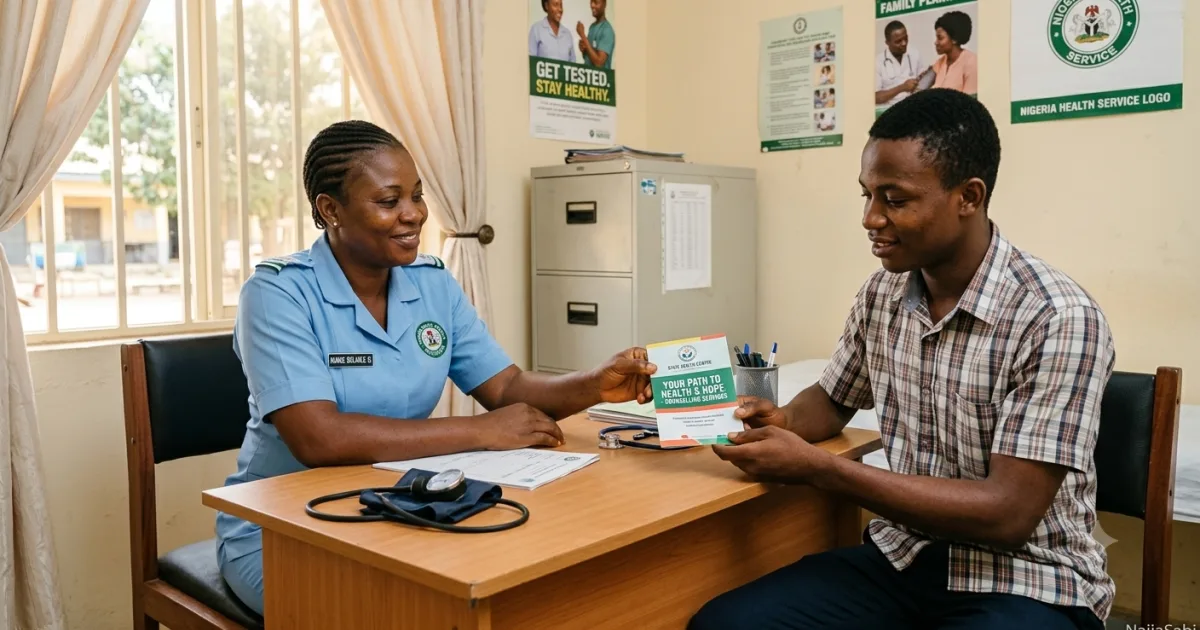
📌 Quick Summary: HIV testing in Nigeria is free and confidential at all government hospitals and health centres. To find the HIV testing centre closest to you, call the NACA toll-free HIV hotline: 6222 (available 8am–8pm, Monday to Friday). HIV self-test kits are also available and can be used at home. If you test positive, HIV treatment is free at all government-approved health facilities — confirmed by the National Agency for the Control of AIDS (NACA) in July 2026. An estimated 1.9 million Nigerians are living with HIV — and early diagnosis and treatment means people with HIV can live long, healthy, normal lives. Knowing your status is the first and most important step.
⚠️ Medical Disclaimer: This article is for informational purposes only and does not constitute medical advice. NaijaSabi is not a medical institution. HIV diagnosis, treatment and care must be managed by qualified Nigerian healthcare professionals. Always seek testing at a certified health facility or through officially approved self-test kits. For the nearest HIV testing centre, call the NACA toll-free line: 6222. For emergencies, call 112.
There is a sentence that changed everything about HIV in Nigeria, and it deserves to be stated clearly at the start of this article: HIV is no longer a death sentence. This is not a comfort phrase — it is a medical fact. With early diagnosis and consistent access to antiretroviral therapy (ART), people living with HIV in Nigeria today can have a viral load so low it is undetectable — meaning they cannot transmit the virus to sexual partners and can expect to live a normal lifespan. The National Agency for the Control of AIDS (NACA) Director-General Temitope Ilori said it herself in her December 2025 statement: HIV is “manageable and no longer a death sentence.” The barrier between a Nigerian and this outcome is a single step: getting tested. This NaijaSabi guide tells you exactly how to take that step — for free, confidentially, and without fear.
| Fact | Detail |
| Nigerians living with HIV | ~1.9 million (NACA 2026) — largest epidemic in West and Central Africa |
| HIV prevalence in Nigeria | 1.3–1.4% among adults aged 15–49 |
| States with highest burden | Rivers, Benue, Akwa Ibom, Lagos, FCT Abuja |
| Is HIV testing free in Nigeria? | Yes — free and confidential at all government hospitals and health centres |
| Is HIV treatment free in Nigeria? | Yes — free at all government-approved health facilities (NACA confirmed July 2026) |
| NACA HIV toll-free hotline | 6222 — to locate nearest testing centre. Available 8am–8pm, Monday–Friday |
| HIV self-test kits | Available — can be used at home. Positive self-test must be confirmed at a health facility |
| NACA website | naca.gov.ng |
| NACA Abuja address | No 3, Ziguinchor Street, off IBB Way, Wuse Zone 4, Abuja |
| NACA contacts | 08091836222 / 08091846222 |
The Most Important Thing to Know — HIV Testing and Treatment Are Both Free in Nigeria
Many Nigerians do not get tested because they assume they cannot afford testing or treatment if they test positive. This assumption is wrong — and it is costing lives. Here is what NACA has confirmed officially in 2026:
- HIV testing is free at all government hospitals, government health centres and PEPFAR/Global Fund-supported facilities across Nigeria. You do not pay for the test
- HIV testing is confidential. Your result is not shared without your consent. Healthcare workers are bound by confidentiality. You can request that only you receive your result
- HIV treatment (antiretroviral therapy — ART) is free at all government-approved health facilities. NACA’s Director-General Temitope Ilori confirmed this categorically in July 2026: “HIV treatment in Nigeria remains free of charge at government-approved health facilities.” This is sustained by PEPFAR (the US President’s Emergency Plan for AIDS Relief) and the Global Fund
- Free annual liver and kidney function tests are now provided to Nigerians living with HIV through expanded health insurance — announced by the Federal Government in December 2025
The cost of not knowing your status — in terms of progression to AIDS, transmission to partners, pregnancy complications and delayed treatment — is vastly greater than any perceived barrier to testing. The barrier is not cost. The barrier is stigma, fear and lack of information. This article addresses all three.
How to Find an HIV Testing Centre Near You in Nigeria
Method 1 — Call the NACA HIV Toll-Free Hotline: 6222
The fastest and most reliable way to find the HIV testing centre closest to you anywhere in Nigeria is to call 6222 — the NACA HIV toll-free hotline. This service is:
- Available 8am–8pm, Monday to Friday
- Free to call from any Nigerian mobile network
- Staffed by trained counsellors who can direct you to your nearest testing facility and answer any questions you have about HIV testing and treatment
- Confidential — you are not required to give your name or personal details to receive assistance
Method 2 — Visit Any Government Hospital or Health Centre
HIV testing is available at every government hospital — federal, state and local government — and at most government primary health centres (PHCs) across Nigeria’s 36 states and FCT. You do not need a referral, you do not need an appointment, and you do not need any special documentation to request an HIV test. Walk in and ask for the HIV counselling and testing unit or the ART clinic — every government hospital receiving PEPFAR or Global Fund support has one.
Major government hospitals confirmed to offer free HIV testing and treatment in Nigeria’s largest cities:
| City / State | Hospital |
| Lagos | Lagos University Teaching Hospital (LUTH) — Idi-Araba; Lagos Island General Hospital; General Hospital Lagos; Gbagada General Hospital; Isolo General Hospital |
| Abuja (FCT) | National Hospital Abuja; University of Abuja Teaching Hospital (UATH) — Gwagwalada; Maitama District Hospital; Garki Hospital |
| Port Harcourt (Rivers) | University of Port Harcourt Teaching Hospital (UPTH); Braithwaite Memorial Specialist Hospital; Rivers State University Teaching Hospital |
| Kano | Aminu Kano Teaching Hospital; Murtala Muhammad Specialist Hospital |
| Ibadan (Oyo) | University College Hospital (UCH); Adeoyo Maternity Hospital; Ring Road State Hospital |
| Enugu | University of Nigeria Teaching Hospital (UNTH) — Ituku-Ozalla; Enugu State University Teaching Hospital |
| Benin City (Edo) | University of Benin Teaching Hospital (UBTH); Central Hospital Benin |
| Kaduna | Barau Dikko Teaching Hospital; Yusuf Dantsoho Memorial Hospital |
| Benue | Benue State University Teaching Hospital — one of the highest-burden states in Nigeria |
| Akwa Ibom | University of Uyo Teaching Hospital (UUTH); Ibom Specialist Hospital — one of the highest-burden states |
This is not an exhaustive list — government hospitals in every state capital and LGA offer free HIV testing. Call 6222 to locate the facility nearest to your specific location.
Method 3 — HIV Self-Test Kits
HIV self-test kits are available in Nigeria and allow you to test at home, privately, without visiting a health facility. A self-test kit uses a small blood sample (finger prick) or oral fluid and gives a result in 15–20 minutes. Self-test kits are available at some pharmacies and through PEPFAR-supported community distribution programmes. NACA has confirmed self-testing as a valid and available option for Nigerians who prefer it.
Critical points about HIV self-testing in Nigeria:
- A positive self-test result must be confirmed at a government health facility with a laboratory-based confirmatory test before any treatment decisions are made. Self-test kits can produce false positives
- A negative self-test result may not reflect a recent infection — HIV has a “window period” of up to 45 days after exposure during which the test may return negative even when infection has occurred. If you had a potential exposure less than 45 days before testing, retest after the window period at a health facility
- If you test positive on a self-test kit, do not panic — go to the nearest government hospital immediately for confirmatory testing and to begin the process of accessing free treatment
Method 4 — Community Testing Events and Outreach
NACA, PEPFAR, the Global Fund and their implementing partners regularly organise free community HIV testing events across Nigeria — at churches, mosques, market places, universities and community centres. These events bring testing directly to communities and are often combined with awareness campaigns, free condom distribution and counselling.
Follow NACA on social media (naca.gov.ng, @NACAnigeria on X) to find upcoming community testing events near you. University health centres also frequently organise free on-campus HIV testing days — check with your student affairs office or health centre.
What Happens During an HIV Test at a Nigerian Hospital
Understanding what to expect removes the fear of the unknown. Here is what a standard HIV testing visit at a Nigerian government hospital involves:
- Registration: You register at the outpatient or HIV counselling and testing (HCT) unit. You do not need a referral letter. At most facilities, you can test anonymously or with just a first name if you prefer
- Pre-test counselling: A trained counsellor speaks with you privately — explaining what HIV is, how it is transmitted, what the test involves, and what support is available if you test positive. This typically takes 10–15 minutes. The counsellor answers your questions. This session is confidential
- The test: A small blood sample is taken — either from a finger prick (rapid test) or a vein draw (for laboratory-based testing). The rapid test gives results in 15–20 minutes. Laboratory-based confirmatory tests take longer. Many facilities use a two-test protocol — a rapid screening test followed by a confirmatory test
- Post-test counselling: You receive your result in a private setting. Whether the result is negative or positive, a counsellor speaks with you about the next steps:
- Negative result: counselling on maintaining your negative status — safe sex practices, condom use, PrEP (Pre-Exposure Prophylaxis) where available
- Positive result: immediate linkage to care — you are introduced to the ART clinic, assessed for treatment readiness, and your journey to free treatment begins. You are not left alone with a positive result
If You Test Positive — What Happens Next in Nigeria
A positive HIV test in Nigeria in 2026 is the beginning of a manageable health journey — not an ending. Here is what the process looks like from a positive test to sustained healthy living:
- Confirmatory testing: A positive rapid test is confirmed with a second laboratory test. You begin treatment only after a confirmed positive result
- CD4 count and viral load testing: These blood tests measure how your immune system is functioning and the level of HIV in your blood. They guide your treatment and are provided free at government ART clinics
- Starting antiretroviral therapy (ART): Nigeria’s current policy is “test and treat” — you are eligible to start treatment on the same day as your confirmed diagnosis. You do not need to wait until you are sick. ART is a daily pill regimen — most people in Nigeria take a single tablet daily (a fixed-dose combination). ART is free at government ART clinics
- Achieving undetectable viral load: With consistent daily ART, most people reach an undetectable viral load within 3–6 months. At undetectable levels, HIV cannot be sexually transmitted — this is the scientifically proven U=U principle (Undetectable = Untransmittable), which NACA and PEPFAR have officially promoted in Nigeria
- Ongoing monitoring: Regular clinic visits (initially monthly, then quarterly as your health stabilises) for viral load monitoring, medication pickup and general health assessment — all free at government ART clinics
- Free annual organ function tests: The Federal Government announced in December 2025 that Nigerians living with HIV now have access to free annual liver and kidney function tests through expanded health insurance
PrEP — HIV Prevention for Nigerians at High Risk
Pre-Exposure Prophylaxis (PrEP) is a daily medication taken by HIV-negative individuals who are at high risk of HIV infection — it significantly reduces the risk of contracting HIV. PrEP is now available in Nigeria through PEPFAR-supported facilities. If you are HIV-negative but at ongoing high risk — a partner living with HIV, multiple sexual partners, or other risk factors — ask your healthcare provider about PrEP. When taken consistently, PrEP reduces the risk of HIV infection through sex by approximately 99%.
Addressing HIV Stigma in Nigeria — What You Need to Know
HIV stigma is one of the biggest barriers to testing and treatment in Nigeria. Fear of being seen entering an HIV clinic, fear of the result, fear of how family and partners will react — these fears prevent Nigerians from testing and, when they do test positive, from seeking treatment. Here are the facts that counter the most common stigma-driven fears:
- Your result is confidential. Healthcare workers are bound by professional confidentiality. They cannot share your result with family members, employers or anyone else without your specific consent
- You cannot get HIV from casual contact. HIV is not spread through hugging, handshakes, sharing food, using the same toilet, mosquito bites, coughing or sneezing. It is transmitted through specific routes: unprotected sex with an infected person, sharing needles, blood transfusion with infected blood, and mother-to-child during pregnancy, birth or breastfeeding without treatment
- People on ART with undetectable viral load cannot transmit HIV sexually — U=U. A person living with HIV who is on treatment and has an undetectable viral load cannot transmit HIV to their sexual partner. This scientific fact, confirmed globally, fundamentally changes the picture of HIV in relationships
- You can have children safely. Nigerian women living with HIV who receive appropriate treatment and care during pregnancy can deliver HIV-negative babies. Prevention of Mother-to-Child Transmission (PMTCT) programmes are available free at government hospitals
When to See a Doctor — HIV Warning Signs That Need Immediate Attention
Go to a government hospital immediately — do not wait — if you experience any of the following, particularly if you may have been exposed to HIV:
- Acute HIV syndrome symptoms (2–4 weeks after potential exposure): sudden fever, severe headache, body rash, sore throat, swollen lymph nodes in the neck or groin, extreme fatigue, muscle and joint pain. These symptoms — similar to severe flu — appear in the early weeks after HIV infection when viral load is very high. Getting tested and starting treatment in this acute phase is medically significant
- Persistent unexplained fever lasting more than 2 weeks
- Dramatic unexplained weight loss — more than 10% of body weight without dieting
- Persistent diarrhoea lasting more than 4 weeks without a clear cause
- Oral thrush — white patches in the mouth and throat in an otherwise healthy adult
- Recurrent severe infections — tuberculosis, pneumonia, meningitis — that keep returning or are unusually severe
- Skin changes — unusual rashes or sores that do not heal, particularly on the face, body or genitals
None of these symptoms diagnose HIV — they diagnose the need to test. Only an HIV test can confirm or rule out HIV. If you have had a potential exposure and experience these symptoms, go to the nearest government hospital immediately. For the nearest HIV testing centre, call the NACA toll-free line: 6222. For emergencies, call 112.
Frequently Asked Questions — HIV Testing Nigeria 2026
Where can I get a free HIV test in Nigeria?
Free HIV testing is available at all government hospitals and primary health centres across Nigeria’s 36 states and FCT. To find the specific HIV testing centre nearest to your location, call the NACA HIV toll-free hotline 6222 (8am–8pm, Monday to Friday, free on all networks). Major hospitals confirmed to offer free HIV testing include LUTH (Lagos), National Hospital Abuja, UPTH (Port Harcourt), Aminu Kano Teaching Hospital, UCH (Ibadan), UNTH (Enugu) and UBTH (Benin City). HIV self-test kits are also available at some pharmacies and through community distribution programmes — a positive self-test must be confirmed at a health facility.
Is HIV testing confidential in Nigeria?
Yes — HIV testing at government health facilities in Nigeria is confidential. Your result is not shared with family members, employers, partners or any other person without your specific written consent. Healthcare workers and counsellors at PEPFAR-supported facilities are trained in and bound by confidentiality protocols. You can also request to test anonymously at most facilities — giving only a first name or a code rather than your full name. NACA has explicitly stated that testing services are designed to encourage Nigerians to test without fear of disclosure. If you have concerns about confidentiality at a specific facility, you can call the NACA hotline at 6222 to ask about your options.
Is HIV treatment free in Nigeria in 2026?
Yes — HIV treatment (antiretroviral therapy, ART) is free at all government-approved health facilities in Nigeria. NACA Director-General Temitope Ilori confirmed this categorically in July 2026: “HIV treatment in Nigeria remains free of charge at government-approved health facilities.” This is funded by PEPFAR (the US President’s Emergency Plan for AIDS Relief), the Global Fund and the Federal Government. Free annual liver and kidney function tests for Nigerians living with HIV were also announced by the Federal Government in December 2025. Nigeria’s current policy is “test and treat” — eligible patients can begin free treatment on the same day as their confirmed positive diagnosis.
What does a positive HIV test mean for my life in Nigeria?
A positive HIV test in Nigeria in 2026 means you have been diagnosed with HIV and can now access free, life-saving treatment. It does not mean you will die soon, that you cannot have relationships, that you cannot have children, or that your life is over. With consistent antiretroviral therapy (ART), most people living with HIV reach an undetectable viral load within 3–6 months — meaning HIV cannot be detected in their blood and cannot be sexually transmitted (the U=U principle). People on effective ART in Nigeria can expect to live a normal lifespan. Free treatment is available at all government ART clinics. The step after a positive test is immediate linkage to care — the counsellor who gives you your result will guide you through this process. A positive test is the beginning of management, not the end of anything.
Can I test for HIV at home in Nigeria?
Yes — HIV self-test kits are available in Nigeria and allow you to test privately at home. A self-test kit uses a finger-prick blood sample or oral fluid and gives a result in 15–20 minutes. Self-test kits are available at some pharmacies and through NACA and PEPFAR community distribution programmes. Two critical points: a positive self-test result must be confirmed at a government health facility with a laboratory confirmatory test before treatment begins — self-tests can produce false positives. A negative self-test may not capture a recent infection — HIV has a 45-day window period during which the test may return negative even after infection. If you had a potential exposure in the last 45 days, retest after the window period. Call the NACA hotline at 6222 for guidance on accessing self-test kits in your location.
Sources
- NACA Nigeria — NACA confirms HIV treatment remains free at government facilities, July 2026 — naca.gov.ng / gazettengr.com
- AllAfrica — NACA warns against risky sexual behaviour, urges HIV testing, February 2026 — allafrica.com
- NANNEWS — NACA DG Temitope Ilori urges Nigerians to prioritise HIV testing — nannews.ng
- VON Nigeria — NACA National HIV Testing Day, Dr Gambo Aliyu statement, toll-free line 6222 — von.gov.ng
- Gazette Nigeria — FG offers free annual liver and kidney tests for HIV patients, December 2025 — gazettengr.com
- National Agency for the Control of AIDS (NACA) — official portal — naca.gov.ng
Last updated: 19 September 2026 · NaijaSabi Health Desk. This article is for informational purposes only and does not constitute medical advice. HIV testing and treatment must be managed by qualified Nigerian healthcare professionals. For the nearest HIV testing centre, call NACA toll-free: 6222 (8am–8pm, Monday–Friday). For emergencies, call 112.


0 Comments
No comments yet. Be the first to share your thoughts!