


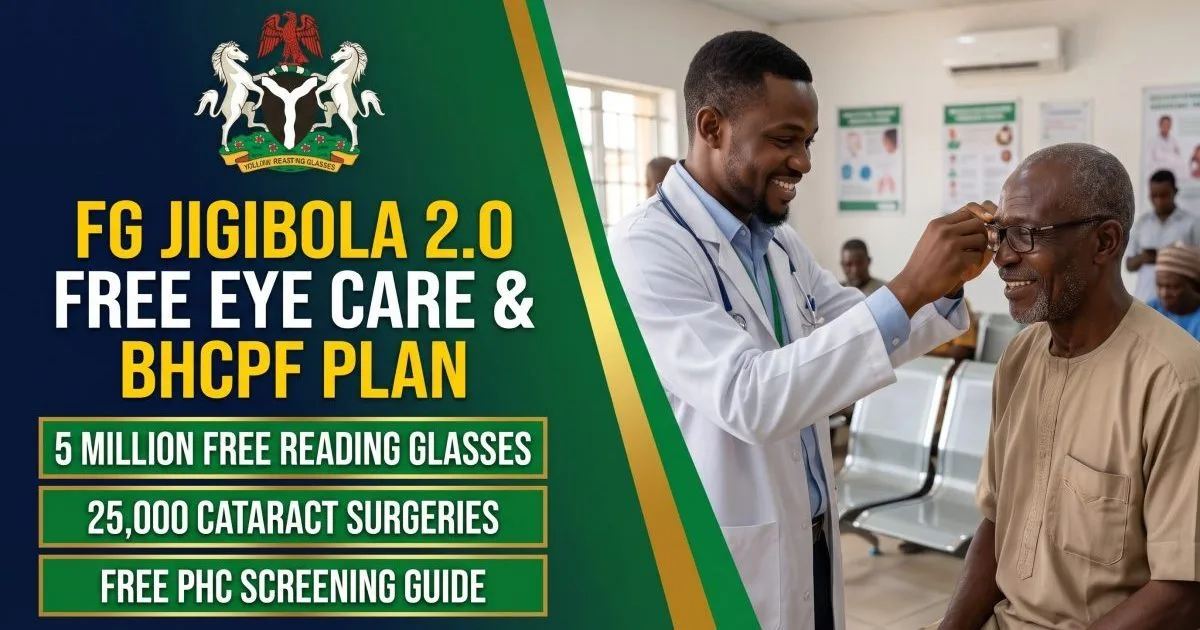


Key Takeaways: FG “JigiBola 2.0” Free Eye Care & ₦249.6B BHCPF Expansion (2026/2027)
- 5 Million Free Reading Glasses by 2027: The Federal Ministry of Health and Social Welfare—led by Coordinating Minister Prof. Muhammad Ali Pate and Minister of State Dr. Iziaq Adekunle Salako—is scaling up JigiBola 2.0 (officially the Effective Spectacle Coverage Initiative Nigeria — ESCIN) to distribute 5 million free pairs of reading glasses to Nigerians with near-vision impairment (presbyopia).
- 25,000 Subsidised Cataract Surgeries: Alongside free spectacles, the initiative targets 25,000 free and heavily subsidised sight-restoring cataract surgeries across tertiary and secondary public hospitals nationwide by 2027.
- 15,000 PHC Workers Trained Across 21+ States: Implemented through the National Eye Health Programme (NEHP) under National Coordinator Dr. Oteri Eme Okolo, the programme is training 15,000 Primary Healthcare (PHC) workers to conduct walk-in vision screening at local PHCs across more than 21 participating states.
- Integrated Into the ₦249.6 Billion BHCPF: Primary eye care is now embedded into the expanded ₦249.6 billion Basic Health Care Provision Fund (BHCPF) across Nigeria’s revitalised network of 17,600 Primary Healthcare Centres.
- Zero Online Registration Fee: Screening and reading glasses dispensation at accredited government Primary Healthcare Centres are 100% free at the point of care—no online payment or agent fee is required.
For millions of Nigerian artisans, tailors, mechanics, market traders, teachers, civil servants, and elderly citizens over the age of 40 who struggle to thread a needle, read small print on medicine labels, inspect phone screens, or see clearly due to cataracts, the Federal Government has rolled out its largest grassroots vision-restoration intervention in history. Operating under the popular banner “JigiBola 2.0”—and formally domiciled in the Federal Ministry of Health and Social Welfare as the Effective Spectacle Coverage Initiative Nigeria (ESCIN)—the programme is on track to deliver 5 million free pairs of reading glasses and 25,000 subsidised cataract surgeries across Nigeria by 2027.
Modelled after President Bola Ahmed Tinubu’s famous “Jigi Bola” free eyeglasses initiative launched during his tenure as Governor of Lagos State between 1999 and 2007, the national JigiBola 2.0 rollout is spearheaded by Coordinating Minister of Health and Social Welfare Prof. Muhammad Ali Pate, Minister of State for Health Dr. Iziaq Adekunle Salako, and National Coordinator of the National Eye Health Programme (NEHP) Dr. Oteri Eme Okolo, with technical and catalytic backing from the Clinton Health Access Initiative (CHAI), the Livelihoods Impact Fund (LIF), Sightsavers, and RestoringVision.
Even more importantly for rural and urban low-income families, primary eye care has now been mainstreamed into the Federal Government’s ₦249.6 billion Basic Health Care Provision Fund (BHCPF) across Nigeria’s revitalised Primary Healthcare Centres (PHCs). This comprehensive guide explains how JigiBola 2.0 works, who qualifies for free reading glasses or subsidised cataract surgery, the participating states across all six geopolitical zones, and how to walk into an accredited Primary Healthcare Centre to get your eyes tested free of charge.
Table of Contents
- Executive Summary Table: FG “JigiBola 2.0” (ESCIN) & ₦249.6B BHCPF Specifications
- What Is “JigiBola 2.0” (Effective Spectacle Coverage Initiative Nigeria — ESCIN)?
- Nigeria’s Vision Crisis: Why 24 Million Nigerians Have Sight Loss & How Presbyopia Hurts Incomes
- How the ₦249.6 Billion Basic Health Care Provision Fund (BHCPF) Brings Eye Care to Local PHCs
- Who Qualifies for the 5 Million Free Reading Glasses vs. 25,000 Cataract Surgeries?
- Participating States Across Nigeria’s 6 Geopolitical Zones (21+ States Rollout)
- Step-by-Step Guide: How to Get Free Eye Screening & Reading Glasses at a Primary Healthcare Centre
- How the Subsidised Cataract Surgery Referral Pathway Works (From PHC to Teaching/General Hospitals)
- Economic Impact on Tailors, Mechanics, Welders, Farmers & Market Women (30%+ Productivity Boost)
- Training 15,000 PHC Health Workers in Primary Eye Care (PEC)
- Official Federal Ministry of Health, NEHP & NPHCDA Verification Channels
- Frequently Asked Questions (FAQs)
1. Executive Summary Table: FG “JigiBola 2.0” (ESCIN) & ₦249.6B BHCPF Specifications
Review the verified operational targets, institutional partners, and patient eligibility parameters for the Federal Government’s national eye health intervention:
| Programme Parameter | Official Verified Details (2026 / 2027) |
|---|---|
| Official Programme Names | Effective Spectacle Coverage Initiative Nigeria (ESCIN) / Presidential Initiative on Eye Health (“JigiBola 2.0”) |
| Lead Federal Authorities | Federal Ministry of Health & Social Welfare (Prof. Muhammad Ali Pate & Dr. Iziaq Adekunle Salako), National Eye Health Programme (Dr. Oteri Eme Okolo) & NPHCDA |
| Reading Glasses Distribution Target | 5,000,000 (5 Million) Free Pairs of Reading Glasses by 2027 (75% first-time wearers recorded so far) |
| Cataract Surgery Target | 25,000 Free / Subsidised Sight-Restoring Cataract Surgeries |
| Health Workforce Training Target | 15,000 Primary Healthcare (PHC) Workers trained in Primary Eye Care (PEC) |
| Primary Care Funding Pool | ₦249.6 Billion Basic Health Care Provision Fund (BHCPF) across 17,600 PHCs |
| International Technical Partners | Clinton Health Access Initiative (CHAI), Livelihoods Impact Fund (LIF), RestoringVision, Sightsavers & CBM |
| Cost to Eligible Patients at PHCs | FREE (₦0 for near-vision screening & reading glasses dispensation at participating PHCs) |
2. What Is “JigiBola 2.0” (Effective Spectacle Coverage Initiative Nigeria — ESCIN)?
Why do Nigerians call the Federal Government’s national eye care programme “JigiBola 2.0”? In Yoruba, “Jigi” means eyeglasses, and during President Bola Ahmed Tinubu’s tenure as Governor of Lagos State from 1999 to 2007, his administration launched the historic Jigi Bola grassroots eye-care campaign, which screened and provided free prescription spectacles and cataract surgeries to hundreds of thousands of Lagosians.
Scaled up to the national level under the Renewed Hope Health Agenda and the Nigeria Health Sector Renewal Investment Initiative (NHSRII), JigiBola 2.0—formally executed as the Effective Spectacle Coverage Initiative Nigeria (ESCIN)—is a three-year federal roadmap (2024–2027) aligned with the World Health Organization’s (WHO) global SPECS 2030 initiative. Its core mission is simple: bring basic eye testing and free reading glasses out of expensive urban specialist hospitals and place them directly inside local Primary Healthcare Centres (PHCs) in every ward across Nigeria.
3. Nigeria’s Vision Crisis: Why 24 Million Nigerians Have Sight Loss & How Presbyopia Hurts Incomes
According to verified national ophthalmic data from the Federal Ministry of Health’s National Eye Health Programme (NEHP), approximately 24 million Nigerians live with varying degrees of vision loss, yet **over 80% of blindness and visual impairment in Nigeria is completely preventable or treatable** through two low-cost interventions:
- 1. Uncorrected Refractive Error & Presbyopia (Solved by Reading Glasses): Beginning around age 35 to 40, the human eye’s natural lens gradually loses flexibility—a normal aging condition called presbyopia that makes it difficult to focus on close objects (such as reading a book, checking phone messages, sorting grains, or sewing clothes). Over 80% of Nigerians who need simple reading glasses do not have them, with women bearing a disproportionate 57% of the burden.
- 2. Unoperated Cataracts (Solved by a 20-Minute Microsurgery): Cataracts—the clouding of the eye’s natural lens—remain the #1 cause of avoidable blindness among older Nigerians, accounting for nearly half of all blindness cases nationwide.
4. How the ₦249.6 Billion Basic Health Care Provision Fund (BHCPF) Brings Eye Care to Local PHCs
Previously, if a rural farmer in Benue, a tailor in Osun, or a fisherman in Rivers State experienced blurry vision, their local Primary Healthcare Centre had neither a Snellen vision chart nor trained staff to examine their eyes—forcing them to travel hours to a teaching hospital in the state capital.
How the ₦249.6 Billion BHCPF Integration Changes Everything:
Under the Federal Government’s expanded ₦249.6 billion Basic Health Care Provision Fund (BHCPF)—which funds the revitalisation and operational budgets of up to 17,600 Primary Healthcare Centres through the National Primary Health Care Development Agency (NPHCDA) and the National Health Insurance Authority (NHIA)—Primary Eye Care (PEC) has been integrated into routine primary healthcare delivery. When a citizen visits an accredited BHCPF facility for blood pressure, malaria, or maternal checks, trained community health workers can now screen their vision on the spot and dispense free reading glasses.
5. Who Qualifies for the 5 Million Free Reading Glasses vs. 25,000 Cataract Surgeries?
Check which of the two clinical tracks under JigiBola 2.0 applies to you or your elderly parents:
| Intervention Track | Target Beneficiaries & Symptoms | Where Service Is Delivered |
|---|---|---|
| Track 1: Free Reading Glasses (5 Million Pairs Target) |
• Nigerians typically aged 35–40 years and above diagnosed with uncomplicated presbyopia (difficulty seeing near objects, holding phones/books at arm’s length, eye strain in dim light). • Priority for artisans, market women, teachers, and rural dwellers. |
Dispensed immediately on the spot at participating Primary Healthcare Centres (PHCs) & outreach camps. |
| Track 2: Subsidised / Free Cataract Surgery (25,000 Surgeries Target) |
• Citizens diagnosed with visually significant cataracts (cloudy/milky pupil, painless progressive dimming of distance and near vision, glare sensitivity) whose sight cannot be corrected with simple reading glasses. | Screened at PHCs and referred to designated General Hospitals, Federal Medical Centres (FMCs) & Teaching Hospitals. |
6. Participating States Across Nigeria’s 6 Geopolitical Zones (21+ States Rollout)
As confirmed by Minister of State for Health Dr. Iziaq Adekunle Salako and NEHP National Coordinator Dr. Oteri Eme Okolo during the November 2026 review briefings, JigiBola 2.0 has already scaled across **more than 21 states** spanning all six geopolitical zones, with hundreds of thousands of free spectacles already dispensed (75% of recipients getting their very first pair of eyeglasses, and 53% being women).
Participating phase-one and expansion states across the federation include:
- South-West: Lagos, Ogun, Oyo, Osun, Ondo, and Ekiti States.
- North-West: Kano, Kaduna, Katsina, Jigawa, Sokoto, Kebbi, and Zamfara States.
- North-Central & FCT: Federal Capital Territory (Abuja), Kwara, Kogi, Plateau, Benue, Nasarawa, and Niger States.
- North-East: Bauchi, Gombe, Borno, Yobe, Adamawa, and Taraba States.
- South-South: Rivers, Delta, Edo, Akwa Ibom, Cross River, and Bayelsa States.
- South-East: Enugu, Abia, Ebonyi, Imo, and Anambra States.
7. Step-by-Step Guide: How to Get Free Eye Screening & Reading Glasses at a Primary Healthcare Centre
Unlike student loans or business grants that require complex online portal registrations, accessing JigiBola 2.0 is designed to be simple enough for an elderly grandparent or rural artisan with no internet access. Follow these 5 steps:
- Step 1 — Locate a Participating BHCPF Primary Healthcare Centre (PHC) in Your LGA: Visit the designated model Primary Healthcare Centre in your ward/Local Government Area (or look out for official State Ministry of Health / NPHCDA JigiBola 2.0 community outreach announcements at local markets, town halls, and trade union centres).
- Step 2 — Present Basic Identification at the PHC Registration Desk: Bring along your phone number and any basic ID (such as your National Identification Number [NIN] slip, Voter’s Card, or existing hospital card) so the health worker can log your visit in the national ESCIN register.
- Step 3 — Undergo the 5-Minute Torchlight & Distance/Near Vision Screening: A trained Primary Eye Care (PEC) health worker will first inspect your eyes for red-flag conditions (such as infections, trauma, or cataracts) and test your distance vision using an eye chart.
- Step 4 — Near-Vision Presbyopia Chart Matching (+1.00D to +3.00D): If your distance vision is healthy and your only issue is age-related difficulty seeing small print up close, the health worker will test you with calibrated reading lens powers (typically +1.00, +1.50, +2.00, +2.50, or +3.00 dioptres) until near print looks crisp and comfortable.
- Step 5 — Collect Your Free Pair of Reading Glasses on the Spot: You will be handed a brand-new pair of reading glasses matching your exact power free of charge!
8. How the Subsidised Cataract Surgery Referral Pathway Works (From PHC to Teaching/General Hospitals)
What happens if the PHC health worker examines an elderly patient’s eyes and discovers that reading glasses do not clear their vision because they have a mature **cataract**, glaucoma, or diabetic retinopathy?
- No Wrong Glasses Dispensed: Under the national Primary Eye Care protocol, PHC workers do not hand out simple reading glasses to patients with cataracts or distance refractive errors.
- Direct Referral Slip to Secondary / Tertiary Eye Clinics: Instead, the PHC issues an official NEHP Eye Referral Slip directing the patient to the nearest participating State General Hospital, Federal Medical Centre (FMC), National Eye Centre (Kaduna), or University Teaching Hospital Ophthalmology Department where the 25,000 subsidised/free cataract surgeries and comprehensive optometric prescriptions are performed by licensed ophthalmologists and optometrists.
9. Economic Impact on Tailors, Mechanics, Welders, Farmers & Market Women (30%+ Productivity Boost)
Why did global impact investors like the Clinton Health Access Initiative (CHAI) and the Livelihoods Impact Fund (LIF) partner with the Nigerian government on JigiBola 2.0? Because clinical and economic studies across West Africa show that giving a ₦0 pair of reading glasses to a 45-year-old artisan is one of the fastest poverty-reduction tools in the world:
Up to 30% Immediate Income & Productivity Gain for Informal Workers
- Tailors, Fashion Designers & Shoemakers: Can thread needles, cut patterns, and stitch fine seams late into the evening without eye headaches.
- Auto-Mechanics, Electricians & Phone Repair Technicians: Can read tiny circuit boards, fuse diagrams, and engine part numbers accurately.
- Farmers, Cocoa/Grain Sorters & Market Traders: Can grade agricultural produce, detect counterfeit Naira notes or fake bank transfer alerts on phone screens, and keep accurate daily ledger books.
- Teachers & Civil Servants: Can mark student scripts and read lesson notes without prematurely retiring due to poor near sight.
10. Training 15,000 PHC Health Workers in Primary Eye Care (PEC)
Because Nigeria has fewer than 1,000 ophthalmologists and several thousand optometrists concentrated mostly in major cities like Lagos, Abuja, Port Harcourt, Kano, Ibadan, and Enugu, relying solely on specialists would leave rural communities underserved for decades.
To bridge that workforce gap permanently, the Federal Ministry of Health and the National Primary Health Care Development Agency (NPHCDA) are training 15,000 existing Community Health Extension Workers (CHEWs), Community Health Officers (CHOs), and PHC nurses using the standardized WHO/National Primary Eye Care curriculum. This ensures that long after the initial 5 million pairs of glasses are distributed, every revitalised PHC in Nigeria retains permanent in-house eye screening capacity.
11. Official Federal Ministry of Health, NEHP & NPHCDA Verification Channels
Health workers, state primary health boards, civil society groups, and citizens can verify official updates on the JigiBola 2.0 (ESCIN) rollout and BHCPF Primary Healthcare Centres through these official federal portals:
| Official Health Institution | Verified Portal / Headquarters | Role in JigiBola 2.0 & BHCPF |
|---|---|---|
| Federal Ministry of Health & Social Welfare (FMOHSW) | https://health.gov.ng/ Federal Secretariat Complex Phase III, Abuja |
Houses the National Eye Health Programme (NEHP) & ESCIN / JigiBola 2.0 Secretariat. |
| National Primary Health Care Development Agency (NPHCDA) | https://nphcda.gov.ng/ Plot 681/682 Port Harcourt Crescent, Area 11, Garki, Abuja |
Supervises the 17,600 BHCPF Primary Healthcare Centres and 15,000 PHC worker trainings. |
| National Health Insurance Authority (NHIA) | https://www.nhia.gov.ng/ | Manages the BHCPF insurance gateway for vulnerable citizens and surgical referrals. |
12. Frequently Asked Questions (FAQs) About the FG “JigiBola 2.0” Free Reading Glasses & Eye Care Plan
1. What is the Federal Government’s “JigiBola 2.0” eye care programme?
JigiBola 2.0—officially the Effective Spectacle Coverage Initiative Nigeria (ESCIN) under the Presidential Initiative on Eye Health—is a Federal Ministry of Health programme aimed at distributing 5 million free pairs of reading glasses, performing 25,000 subsidised cataract surgeries, and training 15,000 Primary Healthcare (PHC) workers across Nigeria by 2027.
2. How much does it cost to get tested and collect reading glasses under JigiBola 2.0?
Near-vision eye screening and the dispensation of reading glasses at participating public Primary Healthcare Centres (PHCs) and official JigiBola 2.0 outreach centres are 100% FREE (₦0).
3. Do I need to fill out an online application form or pay a website to get JigiBola 2.0 glasses?
No. There is no paid online application portal for citizens. Because your eyes must be physically examined to determine your correct lens power (or to rule out cataracts and glaucoma), you simply walk into a participating Primary Healthcare Centre (PHC) or accredited state outreach centre in your Local Government Area.
4. Who is eligible to receive the free reading glasses?
The free reading glasses are targeted at Nigerians—typically aged 35 to 40 years and above—who have presbyopia (age-related difficulty seeing small print or close objects clearly), with special focus on artisans, traders, farmers, teachers, women, and low-income citizens who cannot afford private optometric care.
5. How is JigiBola 2.0 connected to the ₦249.6 billion Basic Health Care Provision Fund (BHCPF)?
The Federal Government integrated Primary Eye Care (PEC) into the expanded ₦249.6 billion Basic Health Care Provision Fund (BHCPF) so that routine eye screening, basic treatment, and surgical referrals are sustainably funded across Nigeria’s network of 17,600 Primary Healthcare Centres.
Get the NaijaSabi Morning Brief
Verified daily Naira FX rates, fuel & food prices, and open Nigerian job portals — zero spam, unsubscribe anytime.


0 Comments
No comments yet. Be the first to share your thoughts!