




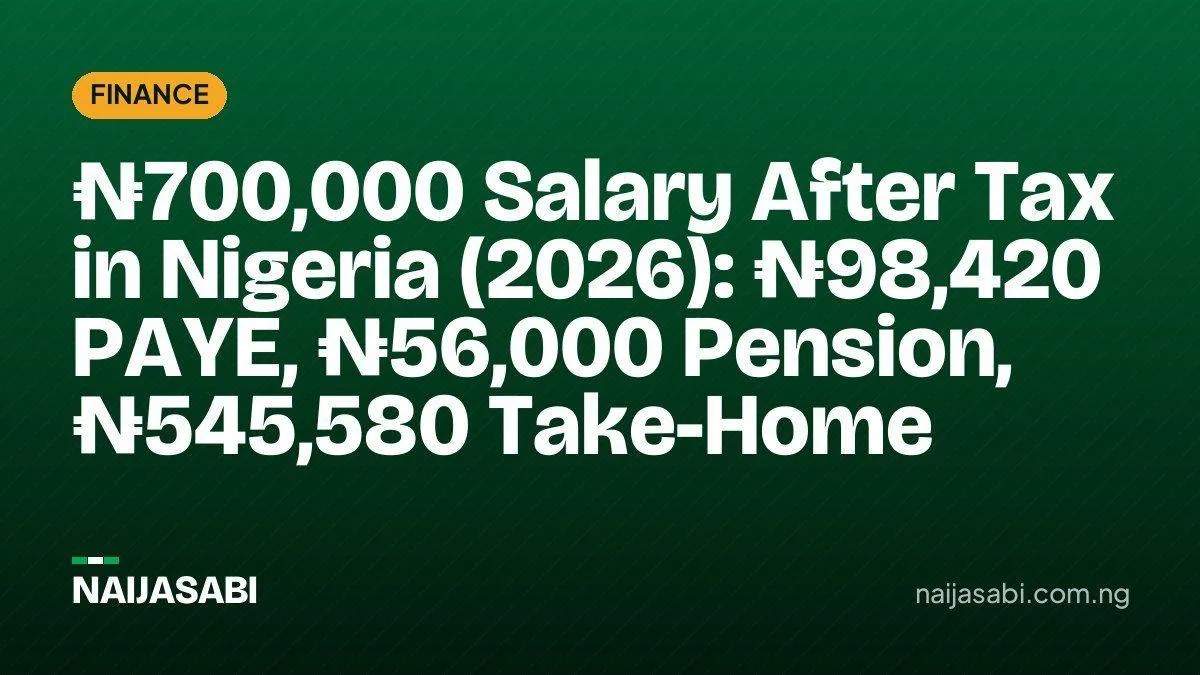
📌 Quick answer: On a gross salary of ₦700,000 a month in 2026, you pay ₦98,420 PAYE tax and ₦56,000 pension (8%), so your take-home pay is ₦545,580, an effective tax rate of 14.1%. Over a year that is ₦8.4 million gross and ₦6,546,960 take-home. You pay ₦1,206.67 a month less than under the old rules. The top part of your taxable income is in the 18% band, so rent relief can cut your tax by up to ₦7,500 a month.
A ₦700,000 monthly salary is solid mid-to-senior pay in Nigeria: experienced bankers, engineers, product managers, doctors in their first years of specialist training, and many staff of multinationals and tech companies earn around this figure. Since 1 January 2026, PAYE on it has been worked out under the Nigeria Tax Act 2025, which taxes the first ₦800,000 a year at 0% and replaced the old Consolidated Relief Allowance (CRA).
At this salary, you are comfortably inside the 18% band, still well below the 21% band, and you pay slightly less than you did in 2025. Here is the full picture.
₦700,000 Salary After Tax: The Full Breakdown
| Item | Monthly | Yearly |
|---|---|---|
| Gross salary | ₦700,000 | ₦8,400,000 |
| Pension (8% employee contribution) | −₦56,000 | −₦672,000 |
| Chargeable income | ₦644,000 | ₦7,728,000 |
| Taxed at 0% (first ₦800,000 a year) | ₦66,667 | ₦800,000 |
| Taxed at 15% (next ₦2.2 million a year) | ₦183,333 | ₦2,200,000 |
| Taxed at 18% (the rest) | ₦394,000 | ₦4,728,000 |
| PAYE tax | −₦98,420 | −₦1,181,040 |
| Take-home pay | ₦545,580 | ₦6,546,960 |
How the ₦98,420 Is Worked Out
- Yearly gross pay: ₦700,000 × 12 = ₦8,400,000.
- Take off pension: 8% of ₦8,400,000 is ₦672,000, leaving a chargeable income of ₦7,728,000.
- First band: the first ₦800,000 is taxed at 0%.
- Second band: the next ₦2,200,000 is taxed at 15% = ₦330,000.
- Third band: the remaining ₦4,728,000 is taxed at 18% = ₦851,040.
- Yearly tax: ₦330,000 + ₦851,040 = ₦1,181,040.
- Monthly PAYE: ₦1,181,040 ÷ 12 = ₦98,420.
Take-home pay is ₦700,000 − ₦56,000 − ₦98,420 = ₦545,580.
How far you are from the 21% band
The 18% band covers chargeable income from ₦3 million to ₦12 million a year. Your chargeable income is ₦7.73 million, so you have ₦4.27 million a year (₦356,000 a month) of room before any income is taxed at 21%. With 8% pension on the full salary, the 21% band starts at a gross salary of about ₦1,087,000 a month.
Old Rules vs New Rules at ₦700,000
| ₦700,000 a month | 2025 (old PITA rules) | 2026 (Nigeria Tax Act 2025) |
|---|---|---|
| Reliefs | Pension + CRA of ₦1,880,000 a year | Pension; first ₦800,000 taxed at 0% |
| Chargeable income (yearly) | ₦5,848,000 | ₦7,728,000 |
| Top rate reached | 24% | 18% |
| Tax for the year | ₦1,195,520 | ₦1,181,040 |
| Monthly PAYE, no rent relief | ₦99,626.67 | ₦98,420 |
| Difference | New law saves ₦1,206.67 a month (₦14,480 a year) | |
| Monthly PAYE with maximum rent relief | ₦99,626.67 (no rent relief existed) | ₦90,920, saving ₦8,706.67 a month |
The old CRA gave you more tax-free income at this salary (₦1.88 million a year against ₦800,000), but under the old rules part of your income was taxed at 24%. Under the new law your top rate is 18%, and that lower rate more than makes up for the smaller relief, so you pay slightly less even without claiming anything extra.
What Changes Your Number
| Your situation (₦700,000 gross) | Monthly tax | Monthly take-home |
|---|---|---|
| Standard: 8% pension on the full ₦700,000 | ₦98,420 | ₦545,580 |
| You pay ₦600,000 a year rent and claim rent relief | ₦96,620 | ₦547,380 |
| You pay ₦1.2m a year rent and claim rent relief | ₦94,820 | ₦549,180 |
| You pay ₦1.8m a year rent and claim rent relief | ₦93,020 | ₦550,980 |
| Your rent is ₦2.5m a year or more (maximum relief of ₦500,000) | ₦90,920 | ₦553,080 |
| Your employer deducts NHF on a ₦350,000 basic salary (₦8,750) | ₦96,845 | ₦538,405 |
| Pension is on basic + housing + transport of ₦490,000 only (₦39,200) | ₦101,444 | ₦559,356 |
| Your employer runs no pension scheme | ₦108,500 | ₦591,500 |
Rent relief at ₦700,000
You can deduct 20% of the rent you pay in a year, up to ₦500,000, before tax is worked out. At ₦700,000 a month, all of that relief comes off income taxed at 18%, so every ₦100,000 of relief saves you ₦18,000 a year:
- ₦600,000 rent: relief of ₦120,000 saves ₦21,600 a year (₦1,800 a month).
- ₦1.2 million rent: relief of ₦240,000 saves ₦43,200 a year (₦3,600 a month).
- ₦1.8 million rent: relief of ₦360,000 saves ₦64,800 a year (₦5,400 a month).
- ₦2.5 million rent or more: the maximum relief of ₦500,000 saves ₦90,000 a year (₦7,500 a month).
It only shows on your payslip if HR knows what you pay. Give them your tenancy agreement and rent receipts. If you own your home or live in company accommodation, there is no rent relief to claim.
Pensionable pay
Under the Pension Reform Act 2014, the 8% is worked out on basic salary, housing and transport, not your full gross. If your package includes other allowances, your pension deduction may be lower than ₦56,000. On a ₦490,000 pensionable base, you pay ₦3,024 more tax but take home ₦13,776 more each month. Your employer must add at least 10% of the same base to your Retirement Savings Account: ₦70,000 a month on a full ₦700,000 base.
NHF and other reliefs
If your employer deducts the National Housing Fund contribution of 2.5% of basic salary, that is deductible too: on a ₦350,000 basic it is ₦8,750 a month and cuts your PAYE by ₦1,575. The Nigeria Tax Act 2025 also allows deductions for life insurance or deferred annuity premiums, National Health Insurance contributions and interest on a loan to build or buy your own home. Each naira of these reliefs saves 18 kobo at this salary. Give HR the documents so payroll can apply them.
Salaries Close to ₦700,000
| Gross monthly salary | 2026 PAYE | 2026 take-home | 2025 PAYE (old rules) |
|---|---|---|---|
| ₦500,000 | ₦65,300 | ₦394,700 | ₦65,067 |
| ₦600,000 | ₦81,860 | ₦470,140 | ₦82,347 |
| ₦700,000 | ₦98,420 | ₦545,580 | ₦99,627 |
| ₦800,000 | ₦114,980 | ₦621,020 | ₦116,907 |
| ₦900,000 | ₦131,540 | ₦696,460 | ₦134,187 |
| ₦1,000,000 | ₦148,100 | ₦771,900 | ₦151,467 |
At this level, every extra ₦10,000 of gross pay adds ₦800 of pension and ₦1,656 of PAYE, so you keep ₦7,544 of it. A raise from ₦700,000 to ₦800,000 adds about ₦75,440 to your monthly take-home, not ₦100,000.
Bonuses and the 13th Month
A bonus is added to your income for the year. With ₦4.27 million of room left in the 18% band, a bonus at this salary is taxed at 18%:
- ₦700,000 bonus (a 13th month): ₦126,000 tax, you keep ₦574,000.
- ₦1,000,000 bonus: ₦180,000 tax, you keep ₦820,000.
These figures assume no pension is deducted from the bonus.
What ₦545,580 Take-Home Looks Like in a Year
| Item | Per year |
|---|---|
| Gross salary | ₦8,400,000 |
| Your pension (8%) | ₦672,000 |
| Employer pension (at least 10%) | ₦840,000 |
| PAYE tax | ₦1,181,040 |
| Take-home pay | ₦6,546,960 |
| Total going into your RSA | at least ₦1,512,000 |
Work Out Your Own Take-Home Pay
Enter your own salary, rent, NHF and allowances below. The calculator uses the 2026 rules and shows the old-rules figure for comparison.
Take-home pay calculator 2026
Nigeria Tax Act 2025 rates, in force since 1 January 2026.
| Monthly | Yearly |
|---|
How your tax was worked out
What it costs your employer
Take-home on common salaries
| Gross a month | Tax a month | Take-home a month |
|---|---|---|
| ₦70,000 | ₦0 | ₦64,400 |
| ₦100,000 | ₦3,800 | ₦88,200 |
| ₦150,000 | ₦10,700 | ₦127,300 |
| ₦250,000 | ₦24,500 | ₦205,500 |
| ₦500,000 | ₦65,300 | ₦394,700 |
| ₦1,000,000 | ₦148,100 | ₦771,900 |
With 8% pension on the full gross pay, no NHF and no rent relief.
An estimate. Your employer's payroll may treat allowances differently. For a formal answer ask your HR team or a tax adviser.
Source: Nigeria Tax Act 2025 (sections 30 and 58, Fourth Schedule); Pension Reform Act 2014; National Housing Fund Act; National Minimum Wage (Amendment) Act 2024. Employer costs: Pension Reform Act 2014 (at least 10%), Employee's Compensation Act 2010 (NSITF, 1%), Industrial Training Fund Act (ITF, 1%).
Check Your Payslip
- Tax above ₦98,420 on ₦700,000? If pension is on the full gross and you have no other income, ask HR how it was worked out.
- Paying rent but tax unchanged? Rent relief has not been applied. Give HR your rent details and documents.
- Still a “CRA” line in 2026? Your employer’s payroll may still be using the old rules. Ask HR to confirm the Nigeria Tax Act 2025 bands are in use.
- Pension deducted but missing from your RSA? Compare your payslip with your Pension Fund Administrator’s statement.
- Side income? Rent, consulting or freelance income is added to your salary for the year. See our guide to filing tax as a self-employed Nigerian.
For the rules behind these numbers, see our explainer on Nigeria’s new tax law and your salary, and compare with our breakdowns for ₦1,000,000, ₦400,000 and ₦300,000.
Frequently Asked Questions
How much tax is paid on ₦700,000 salary in Nigeria in 2026?
₦98,420 a month (₦1,181,040 a year), with 8% pension on the full salary and no other reliefs.
What is ₦700,000 a month after tax?
₦545,580 a month, or ₦6,546,960 a year, after ₦98,420 tax and ₦56,000 pension.
Do I pay less tax on ₦700,000 under the new law?
Yes: ₦1,206.67 a month less than under the old rules without reliefs, and ₦8,706.67 less if you claim the maximum rent relief.
What tax band is a ₦700,000 salary in?
After pension, ₦800,000 a year is taxed at 0%, ₦2.2 million at 15% and the remaining ₦4.73 million at 18%. None of it reaches the 21% band.
What is ₦8.4 million a year after tax in Nigeria?
With 8% pension and no other reliefs, ₦6,546,960 a year, or ₦545,580 a month.
Sources
- Nigeria Tax Act 2025 – income tax bands (Fourth Schedule) and allowable reliefs including rent relief (section 30), in force from 1 January 2026
- Personal Income Tax Act (as amended) – Consolidated Relief Allowance and tax bands applying until 31 December 2025
- Pension Reform Act 2014 – employee (8%) and employer (10%) contributions on basic salary, housing and transport allowances
- National Housing Fund Act – 2.5% employee contribution on basic salary
Last updated: 8 November 2026 · NaijaSabi Finance Desk. Figures are worked examples for a single source of employment income; your payslip can differ if you have other income, allowances or reliefs. This is general information, not tax advice.


0 Comments
No comments yet. Be the first to share your thoughts!