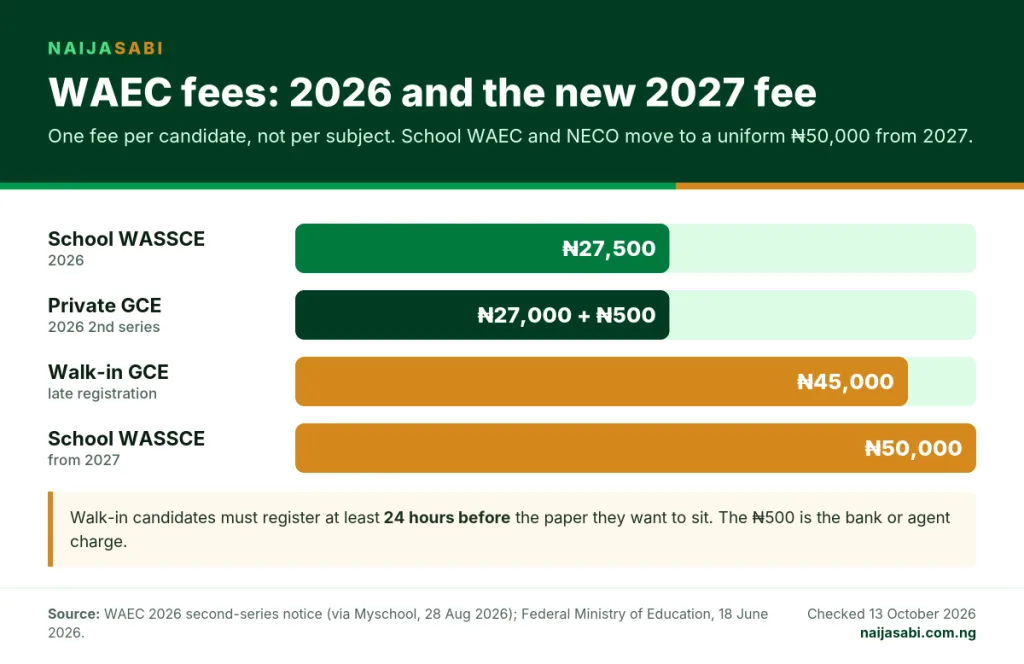




The West African Examinations Council (WAEC) conducts the WASSCE — Nigeria’s most important and internationally recognised secondary school leaving examination. Every year, millions of Nigerian secondary school students and private candidates register for the WASSCE, and the registration fees are a recurring expense that parents, schools, and private candidates need to plan for. In 2026, WAEC registration fees vary depending on whether you are a school candidate (registered through your school) or a private candidate (GCE — registering independently). This guide provides the confirmed fee schedule for 2026, explains what each fee covers, details the registration process, and answers every common question about WAEC forms and registration.
WAEC Registration Fee 2026 — Official Confirmed Fees
The following fees are confirmed from multiple educational sources reporting on the 2026 WAEC registration exercise:
| Candidate Type | Registration Fee | What It Covers | Source |
|---|---|---|---|
| WASSCE — Government/Public School Candidates | ₦23,050 | Up to 8 subjects; examination papers, marking, certificate processing | EdugistNG; MySchoolGist confirmed fee schedule |
| WASSCE — Private/Mission School Candidates | ₦26,050 | Up to 8 subjects; same as above with additional private school processing fee | EdugistNG; multiple sources confirmed |
| GCE (Private Candidates — Nov/Dec) | ₦27,000 per subject | Per-subject fee for private candidates registering independently | Confirmed: “27,000 per subject” for GCE private candidates 2026 |
| BECE (Junior WAEC — Basic Education) | Lower — confirm with school | Junior secondary school assessment | School-administered; fee varies by state |
Important note on GCE fees: The GCE fee of ₦27,000 is per subject — so a candidate registering for 5 subjects pays 5 × ₦27,000 = ₦135,000 total. This significantly higher per-subject cost compared to the school WASSCE rate (which covers up to 8 subjects for ₦23,050–₦26,050 total) makes the GCE significantly more expensive for candidates resitting multiple subjects. Strategic subject selection — resitting only the subjects you genuinely need to improve to gain the required credits — is essential for managing GCE costs.
What the WAEC Registration Fee Covers
The WAEC examination registration fee is not simply a processing charge — it funds a comprehensive examination service that includes: preparation, printing, and secure distribution of examination question papers to all centres nationwide; provision of answer scripts; recruitment, training, and payment of examination supervisors and invigilators at all examination centres; marking of scripts by trained markers; data capture and processing of results; generation and quality control of results; printing and distribution of result certificates; and maintenance of the examination infrastructure (CBT centres, question databases, marking centres). WAEC operates across five West African countries (Nigeria, Ghana, Sierra Leone, Liberia, and the Gambia) and the fee contributes to maintaining this regional examination organisation that issues internationally recognised qualifications.
WAEC Registration Process 2026 — School Candidates (WASSCE)
School candidates — those sitting the WASSCE as students enrolled in a registered secondary school — do not register directly with WAEC themselves. Registration is handled by the school’s examination officer or principal on behalf of all candidates. Here is how the school-based registration process works:
The School’s Role
Your school’s WAEC examination coordinator logs into WAEC’s Exams Management System and enters the details of all candidates: full names (as they should appear on the result), date of birth, state of origin, gender, subjects registered, and examination centre details. The school pays the registration fees to WAEC directly and recovers the amount from students/parents through the school fees or a separate WAEC levy. Your school receives examination cards (admit cards) for each registered candidate — these must be presented at the examination venue for every paper.
Your Responsibility as a School Candidate
Pay your WAEC registration levy to your school within the specified deadline — late payment may result in your name being submitted without confirmation or not submitted at all. More critically: verify your name and date of birth as they appear on your WAEC registration documents from your school. Any error in name spelling, date of birth, or subject combination that enters the WAEC system must be corrected before the examination begins — corrections after examination are much harder and more costly. Request a copy of your examination card and verify every detail is correct.
WAEC GCE Registration Process 2026 — Private Candidates
Private candidates (those not enrolled in a secondary school, or school leavers who need to improve their results) register for WAEC GCE independently through WAEC-approved registration channels. Here is the registration process:
- Find a WAEC-registered private candidates registration centre: Visit the WAEC Nigeria state office in your state capital or check waec.int for the list of authorised private candidate registration centres — these include accredited private schools that accept external candidates, WAEC state offices, and authorised registration agents
- Prepare your documents: Bring your original WAEC or NECO result slip (for candidates improving previous results), your NIN slip, two recent passport photographs, and proof of age (birth certificate or NIN showing date of birth)
- Select your subjects: Choose only the subjects you need — remember, GCE is ₦27,000 per subject. A candidate who needs to improve Mathematics and Biology registers only for those two subjects (₦54,000 total) rather than re-registering all eight subjects from their original sitting
- Complete the registration form: Fill in all personal details accurately — your name must match exactly what appears on your previous results, NIN, and all other identity documents
- Pay the registration fee: ₦27,000 per subject through the authorised payment channel (Remita or specified bank) — keep your payment receipt
- Collect your examination card: Your admit card is either given immediately or collected later — confirm the collection process at your registration centre
- Verify your details on the admit card before the examination: Any error must be reported to your registration centre immediately for correction — you cannot sit an examination under a wrong name
WAEC GCE Registration Timeline 2026
| Event | Period |
|---|---|
| GCE registration opens | Usually September 2026 |
| GCE registration closes (normal deadline) | Usually early October 2026 |
| GCE registration closes (late deadline with extra fee) | Usually mid-October 2026 |
| GCE examinations begin | Usually November 2026 |
| GCE examinations end | Usually December 2026 |
| GCE results released | Usually February–March 2027 |
Exact dates are announced by WAEC Nigeria on waec.int and waeconline.org.ng approximately 4–6 weeks before registration opens. Monitor these platforms from August 2026 for the 2026 GCE registration announcement.
Subjects You Can Register for WAEC GCE 2026
WAEC GCE offers the full range of WASSCE subjects, allowing private candidates to resit any subject from their original WASSCE sitting or sit new subjects not previously registered. The most commonly resit subjects by Nigerian GCE candidates are: Mathematics (the most failed core subject), English Language (compulsory for university admission), Biology, Chemistry, Physics, Government, Economics, and Geography. Less commonly resit subjects include Literature in English, Further Mathematics, Agricultural Science, and various trade subjects. You are not limited to subjects you previously sat — if you need a completely new subject for a specific course requirement (for example, you now want to study Medicine and need Biology which you didn’t sit previously), you can register Biology as a new GCE subject.
WAEC vs NECO Registration Fees: Which Is Cheaper?
| Examination | Private Candidate (GCE) Fee | Per Subject | 5 Subjects Total |
|---|---|---|---|
| WAEC GCE 2026 | ₦27,000 per subject | ₦27,000 | ₦135,000 |
| NECO GCE 2026 | ~₦20,000–₦25,000 flat or per subject | Verify at neco.gov.ng | Typically cheaper than WAEC GCE |
For candidates on a tight budget who only need to improve one or two subjects, NECO GCE is worth investigating as a cheaper alternative — the results are equally accepted by all Nigerian universities and JAMB. The key trade-off: WAEC is internationally recognised (UK, Canada, etc.) while NECO is primarily for Nigerian domestic use. If you have no international education plans, NECO GCE at lower cost may be the more economical route for supplementing your O’Level credits.
Frequently Asked Questions — WAEC Registration Fee 2026
How much is WAEC registration fee in Nigeria 2026?
WASSCE school candidates (registered through their school): ₦23,050 for government schools and ₦26,050 for private/mission schools. WAEC GCE private candidates: ₦27,000 per subject. A GCE candidate registering 5 subjects pays ₦135,000 total.
How much is WAEC GCE form 2026?
WAEC GCE (private candidates, November/December examination) costs ₦27,000 per subject in 2026. Register only for subjects you genuinely need — every additional subject adds ₦27,000 to your total cost.
When does WAEC GCE registration open in 2026?
WAEC GCE registration typically opens in September 2026 and closes in early October 2026 (with a late registration extension through mid-October at additional cost). Monitor waec.int and waeconline.org.ng from August 2026 for the official registration announcement.
📝 WAEC Registration Fee 2026 — Quick Reference
- WASSCE (govt school): ₦23,050 per candidate (up to 8 subjects)
- WASSCE (private school): ₦26,050 per candidate
- GCE (private candidates): ₦27,000 per subject
- 5 GCE subjects: ₦135,000 total
- WAEC portal: waeconline.org.ng | waec.int
- GCE registration opens: Usually September 2026
- GCE examinations: Usually November–December 2026
- NECO GCE alternative: Cheaper; equally accepted by Nigerian universities
- Key tip: Only register subjects you need — each GCE subject costs ₦27,000
Also read: How to Check WAEC Result 2026 | NECO Result Checker 2026 | How to Check JAMB Result 2026
WAEC Registration Fee History: How the Cost Has Changed
The WAEC examination registration fee has risen steadily over the years, driven by the same economic pressures affecting all Nigerian services: naira depreciation, higher operational costs, and WAEC’s need to maintain examination standards and infrastructure. Understanding this history helps parents and students plan for future fee increases:
| Year | School WASSCE Fee (Govt) | GCE Private (Per Subject) | Key Driver |
|---|---|---|---|
| 2015 | ~₦8,900 | ~₦5,600 | Older exchange rate; lower operational costs |
| 2019 | ~₦10,950 | ~₦9,500 | Gradual cost increases |
| 2022 | ~₦14,950 | ~₦15,500 | Rising costs; naira pressure |
| 2024 | ~₦20,000 | ~₦22,000–₦25,000 | Post-devaluation cost surge |
| 2026 | ₦23,050 (govt) / ₦26,050 (private) | ₦27,000 per subject | Current confirmed fees |
The pattern is clear — fees have nearly tripled in ten years in naira terms, largely reflecting the cumulative impact of naira depreciation on WAEC’s dollar-denominated operational costs (question paper printing, international marking moderation, examiner training, and regional administrative expenses are priced in foreign currency). Parents of secondary school students should budget for continued fee increases in future years — setting aside WAEC fees as part of annual school planning rather than treating them as a surprise expense.
What Happens If You Register WAEC With Wrong Details?
Registration errors — particularly name misspellings, wrong dates of birth, incorrect school names, or wrong subject combinations — are among the most damaging and distressing problems that afflict WAEC candidates each year. The consequences range from minor inconvenience to serious academic setbacks. Understanding what can be corrected and what cannot is essential:
Name Errors
A name that appears incorrectly on your WAEC result creates problems for university admission, JAMB O’Level upload (where JAMB’s system cross-references your WAEC name against your NIN name), NYSC registration, and employment credential verification. If your name is wrong on your WAEC registration, report it to your school’s examination officer immediately — before the examination begins. Corrections made before the examination are straightforward. Corrections after results are released require an application for a “result amendment” or re-certification through WAEC’s state office, with supporting documentation (birth certificate, NIN), and payment of an amendment fee. This process takes 4–8 weeks. The earlier you catch the error, the easier and cheaper the correction.
Subject Combination Errors
Being registered for the wrong subjects — for example, being registered for Economics instead of Chemistry when you need Chemistry for Medicine — is a catastrophic error that cannot be corrected after the examination has taken place. You cannot sit an examination for a subject you are not registered for. If you discover a subject combination error before the examination date, notify your school immediately — corrections through the WAEC system may still be possible depending on how far the examination is from the registration close date. After the examination, you would need to register for the missing subject through GCE (private candidates) at ₦27,000 per subject in the next examination cycle. This is avoidable: always request and review your examination card from your school, verify every subject in your combination is correct, and confirm that the subjects match the requirements for your intended course of study.
WAEC Malpractice: The True Cost of Examination Fraud
WAEC examination malpractice — cheating, leakage of questions, impersonation, and use of unauthorised materials — is a persistent problem in Nigeria that costs candidates dearly when detected. The consequences of being caught in WAEC malpractice in 2026 include: immediate cancellation of all results from that sitting (not just the paper where malpractice occurred — all papers), a two-year ban from sitting WAEC examinations (effectively setting the candidate back two academic years), and potential prosecution for serious cases such as impersonation. WAEC also maintains a malpractice database — candidates with malpractice records face scrutiny in future sittings and their certificates carry a permanent flag in WAEC’s system. The risks of malpractice vastly outweigh any potential benefit. Authentic preparation — past questions, consistent study, and legitimate examination support — is the only sustainable path to the WAEC credits needed for a productive future.
WAEC Scholarship Opportunities for High Performers
Strong WAEC performance opens doors beyond just university admission. WAEC and its partner organisations in West Africa offer recognition and scholarship opportunities for the highest-performing candidates each year. The WAEC Best Candidate Award recognises candidates with outstanding aggregate performance across all papers, typically earning candidates national recognition, certificates of distinction, and in some years, monetary prizes from sponsor organisations. Individual federal and state governments sometimes award scholarships or bursaries to WAEC candidates who perform exceptionally — particularly in science and mathematics subjects that align with national development priorities. Private companies and foundations also offer annual scholarship programmes that use WAEC performance as a qualifying criterion. Candidates who achieve five A1 grades or above should document their results carefully and actively research scholarship opportunities at their universities, through state scholarship boards, and through private foundation programmes.
How to Prepare Effectively for WAEC in 2026
Given the cost of registration — ₦23,050–₦26,050 for school candidates and ₦27,000 per subject for GCE — passing WAEC in one sitting is both academically and financially important. Repeating failed subjects costs ₦27,000 each through GCE plus the delay to your academic and career timeline. Effective preparation maximises your return on the registration investment:
- Past questions are non-negotiable: WAEC past questions from the last 5–10 years are the single most valuable preparation tool. Patterns in question style, recurring topics, and marking scheme formats are highly consistent. Available from WAEC bookshops, educational publishers (Bounty, Tonad, Exam Focus), and digital platforms including Myschool.ng and the Mywaec app
- Understand the marking scheme: WAEC’s marking scheme for essay and theory papers rewards specific keywords and structured answers. Past question marking schemes (available alongside past questions) teach you the exact format examiners are looking for — this knowledge alone can add 10–15% to your score in theory papers
- Start 6 months before the examination: Candidates who begin serious preparation in October or November for May/June WAEC have a substantial advantage over those who start in March. Six months of consistent study (even one hour daily) covers all topics thoroughly with time for revision
- Use the WAEC syllabus: Download the official WAEC syllabus for each of your subjects from waec.int — the syllabus defines the exact scope of examinable content. Study within the syllabus rather than broadly reading entire textbooks, which wastes time on content that WAEC does not examine
- Practise under timed conditions: WAEC papers are time-pressured — particularly the theory/essay sections. Practising with a timer ensures you develop the pace needed to attempt all questions within the allotted time
How WAEC Fees Compare to Other West African Countries
WAEC operates across five countries — Nigeria, Ghana, Sierra Leone, Liberia, and The Gambia — and registration fees differ by country. Nigeria’s WAEC fees are generally higher in naira terms because they reflect the higher operational costs of running the world’s largest national WAEC examination (Nigeria accounts for approximately 65% of all WAEC candidates globally, with over 1.5 million registered annually). The fee structure in each country is set by WAEC’s National Office for that country in consultation with the relevant ministry of education. For Nigerian candidates studying or relocating to other West African countries, WAEC results from any of the five member countries are mutually recognised — a Nigerian WAEC certificate is accepted for educational admission in Ghana, Sierra Leone, Liberia, and The Gambia, and vice versa. This mutual recognition is one of the key advantages of the West African regional examination system.
WAEC Digital Initiatives in 2026: CBT and Technology
WAEC has been progressively introducing Computer Based Testing (CBT) for selected subjects in the WASSCE, following the success of NECO’s full CBT transition. In 2026, WAEC’s CBT implementation covers multiple-choice (objective) components of several subjects — candidates answer the objective section on computers at designated CBT centres, with theory/essay sections remaining paper-based. This hybrid approach allows WAEC to benefit from the speed and accuracy of CBT for objective marking while maintaining paper-based assessment for the higher-order thinking skills tested in essay and theory questions. For candidates preparing in 2026, the practical implication is to practise with both paper-based and computer-based formats for objective questions — most WAEC past question apps now include timed CBT simulation modes that replicate the screen-based examination environment. Schools in urban areas increasingly have designated WAEC CBT preparation periods in their examination preparation curriculum — rural schools with limited computer access should seek access to community CBT centres or cybercafés for CBT familiarisation practice before examination day.
WAEC Subject Combinations for Different University Courses
One of the most important but frequently overlooked aspects of WAEC registration is selecting the right subject combination for your intended university course. Most candidates register based on what their school’s science or arts class offers — without checking whether those subjects actually meet the O’Level requirements of their target course. This mismatch causes candidates to score five credits in the wrong subjects and then discover they don’t meet course-specific O’Level requirements. Here are the WAEC subject requirements for Nigeria’s most competitive courses:
| Course | Compulsory WAEC Subjects | Additional Relevant Subjects |
|---|---|---|
| Medicine and Surgery | English Language, Mathematics, Biology, Chemistry, Physics | All five must be credits (C6+); no substitutions accepted at most medical schools |
| Law | English Language, Literature in English, Mathematics | Government, Economics, CRS/IRS, History — any 2 additional credits from arts/social science |
| Engineering | English Language, Mathematics, Physics, Chemistry | Biology or Further Mathematics (varies by engineering type) |
| Computer Science | English Language, Mathematics, Physics | Chemistry or Biology plus 2 additional credits |
| Accounting/Finance | English Language, Mathematics, Economics | Commerce, Government, or any social science subjects as additional credits |
| Mass Communication | English Language, Mathematics | Literature, Government, CRS, Economics — strong arts/social science combination |
| Education (any subject) | English Language, Mathematics | Credits in subjects relevant to your teaching specialisation |
Always verify subject requirements directly from your target university’s official admissions page before finalising your WAEC registration — individual institutions sometimes have additional requirements beyond the general course standards above. This verification takes 15 minutes and can save you years of academic delay from discovering post-result that you registered the wrong subjects.
WAEC Registration Fee History: How Fees Have Changed Over the Years
Understanding how WAEC fees have evolved gives context to the current cost and helps parents and students budget for future sitting years. WAEC examination fees in Nigeria have risen significantly over the past decade, tracking the general inflation trajectory of the Nigerian economy. In 2015, WAEC registration for school candidates was approximately ₦9,850 — a fraction of today’s ₦23,050–₦26,050. The progressive increases reflect higher operational costs for WAEC: increased question paper security measures, CBT infrastructure investment, examiner and supervisor remuneration increases in line with general wage growth, and the administrative cost of managing examinations for over 1.5 million candidates annually across Nigeria alone. While the fee increases are often painful for families — particularly for GCE private candidates paying ₦27,000 per subject — they fund the maintenance of a credible, internationally recognised examination system whose certificates open doors across West Africa, the UK, Canada, and other Commonwealth countries. Perspective: at ₦27,000 per GCE subject, a credit pass in Mathematics that enables university admission represents extraordinary value relative to the career earnings differential between a university graduate and a secondary school leaver.
WAEC vs NECO vs NABTEB: Which Examination Should You Choose?
Nigerian students and private candidates have multiple O’Level examination choices beyond WAEC. Understanding the differences helps you select the most appropriate and cost-effective examination for your specific needs:
| Examination | Conducted By | Private Candidate Cost | International Recognition | Best For |
|---|---|---|---|---|
| WAEC (WASSCE/GCE) | West African Examinations Council | ₦27,000 per subject | UK, Canada, Caribbean, West Africa | University admission; international study plans |
| NECO (SSCE/GCE) | National Examinations Council | ~₦20,000–₦25,000 | Nigeria only | Domestic university admission; budget-conscious candidates |
| NABTEB (NBT/NAB) | National Business and Technical Examinations Board | Lower — confirm at nabteb.gov.ng | Nigeria only; technical/vocational focus | Technical and vocational students; trade qualifications |
| NBAIS (Islamic schools) | National Board for Arabic and Islamic Studies | Lower — Islamic schools only | Nigeria only; specific institution types | Arabic and Islamic studies schools |
For Nigerian students whose sole goal is domestic university admission through JAMB, NECO GCE at a lower cost per subject is a perfectly valid and accepted alternative to WAEC GCE. Both are equally recognised by JAMB and Nigerian universities. For students with any possibility of international study (UK universities, Canadian colleges, Caribbean institutions, or pan-West African institutions in Ghana, Sierra Leone, Gambia), WAEC is the essential choice — NECO results are not recognised outside Nigeria. NABTEB is the appropriate choice for students in technical and vocational schools seeking qualifications that align with their trade and craft focus rather than traditional academic subjects.
How Schools Handle WAEC Registration: What Parents Should Know
For parents of SS3 students, WAEC registration is one of the most significant and sometimes stressful financial obligations of the final secondary school year. Here is what parents need to understand about how schools manage the process — and how to protect yourself from school-level irregularities:
What the School’s Registration Fee Should Cover
The WAEC levy your school charges should cover: the ₦23,050 (government school) or ₦26,050 (private school) fee paid to WAEC, plus a reasonable administrative fee for the school’s registration processing work. Total charges above ₦35,000–₦40,000 for WAEC registration at most schools warrant a request for itemised breakdown — parents have the right to understand exactly what they are paying for. Some schools add additional charges for “examination invigilation,” “hall charge,” or other items — verify whether these are legitimate school operational costs or padding above the actual WAEC fee.
Verify Your Child’s Registration
After paying your WAEC levy to your child’s school, request confirmation that your child has been registered with WAEC. You can verify registration by asking for the examination centre number and checking that your child’s name appears on the centre’s candidate list. Unregistered candidates — who paid the school levy but whose names were never submitted to WAEC — have lost both the opportunity to sit the examination and the money paid. This rare but devastating situation is most common in cases of school fraud or administrative negligence. Early verification (at least 4 weeks before the examination date) allows time to resolve any registration problems before it is too late.
Name Errors in WAEC Registration: Act Early
The most common and most consequential WAEC registration problem is name errors — a child’s name submitted to WAEC with a misspelling, incorrect surname, or wrong middle name. This causes a mismatch between the WAEC result and the student’s other documents (birth certificate, NIN), which then creates problems for JAMB upload, university admission processing, and subsequent identity verification. Parents should request to see their child’s WAEC examination card when it is distributed and verify every detail: full name exactly as it should appear, date of birth, subject combination, examination centre. Any error must be reported to the school’s examination officer immediately for correction through WAEC’s amendment process — corrections after the examination are significantly harder and may require formal affidavit and a fee paid to WAEC for result amendment.
WAEC Examination Format 2026: Paper-Based and CBT
Unlike NECO which moved to fully CBT in 2026, WAEC maintains a hybrid format — some subjects are conducted as traditional paper-based examinations while others have CBT components. The specific format for each subject in 2026 is specified in WAEC’s timetable and syllabus, available at waeconline.org.ng. English Language, Mathematics, and most essay-based subjects (Literature, Government, Economics) retain paper-based objective and essay components. Some multiple-choice subjects have been progressively moved to CBT at centres with adequate facilities. Check the specific examination format for each of your subjects in the official WAEC timetable when it is published — and if any of your subjects has a CBT component, practice on a computer keyboard and screen environment before the examination. Candidates who have never typed on a keyboard before encounter significant disadvantage in CBT examinations if they come unprepared.
Preparing for WAEC 2026: The Most Effective Study Strategy
The WAEC registration fee — whether ₦23,050 or ₦26,050 for school candidates — is a significant investment that deserves a serious preparation strategy to ensure maximum return. Here is the evidence-based approach to WAEC preparation that consistently produces the best results:
Past Questions Are Your Most Valuable Resource
WAEC past questions — going back 5–10 years for each subject — reveal the consistent pattern of questions, topic emphasis, and question style that defines what WAEC actually tests. A student who has thoroughly practised all past questions for a subject knows what to expect in both format and content, dramatically reducing examination anxiety. Past questions are available from WAEC-approved bookshops, Tonad Publishers, Bounty Books, and online platforms including Myschool.ng, ExamSuccess.ng, and dedicated WAEC past questions apps on Google Play Store. Practice with these under timed conditions — not just reading through answers but actually writing out responses to essay questions, selecting answers for objective questions, and timing yourself against the allocated examination time.
Focus on WAEC’s Marking Scheme Requirements
WAEC markers follow a specific marking scheme for each question — particular points earn particular marks. Understanding what the marking scheme rewards (specific key points, correct methodology for calculations, specific language in essay responses) is critical for maximising marks. Many students write long essay responses that miss the specific points the marking scheme requires, earning fewer marks than shorter, more targeted responses would. WAEC past question books that include official marking scheme answers are more valuable than those with only the questions — study both the questions and the model answers carefully to understand exactly what each mark requires.
Mathematics: The Subject That Makes or Breaks Admission
Mathematics is the most important and most failed core WAEC subject — required for virtually all university courses and the most common reason candidates need to resit WAEC GCE. The structured preparation approach: work through past questions chronologically from the most recent year backwards. Identify which topics consistently appear (algebraic expressions, simultaneous equations, geometry, trigonometry, statistics, mensuration are the core areas). For topics you consistently struggle with, use a textbook (New General Mathematics series, Essential Mathematics) to rebuild understanding from fundamentals rather than just memorising procedures. Daily Mathematics practice — even 30 minutes of problem solving — improves performance more reliably than intensive weekend-only sessions. A student who solves 5 past Mathematics questions daily for 3 months builds genuine competency rather than surface-level familiarity.

0 Comments
No comments yet. Be the first to share your thoughts!