


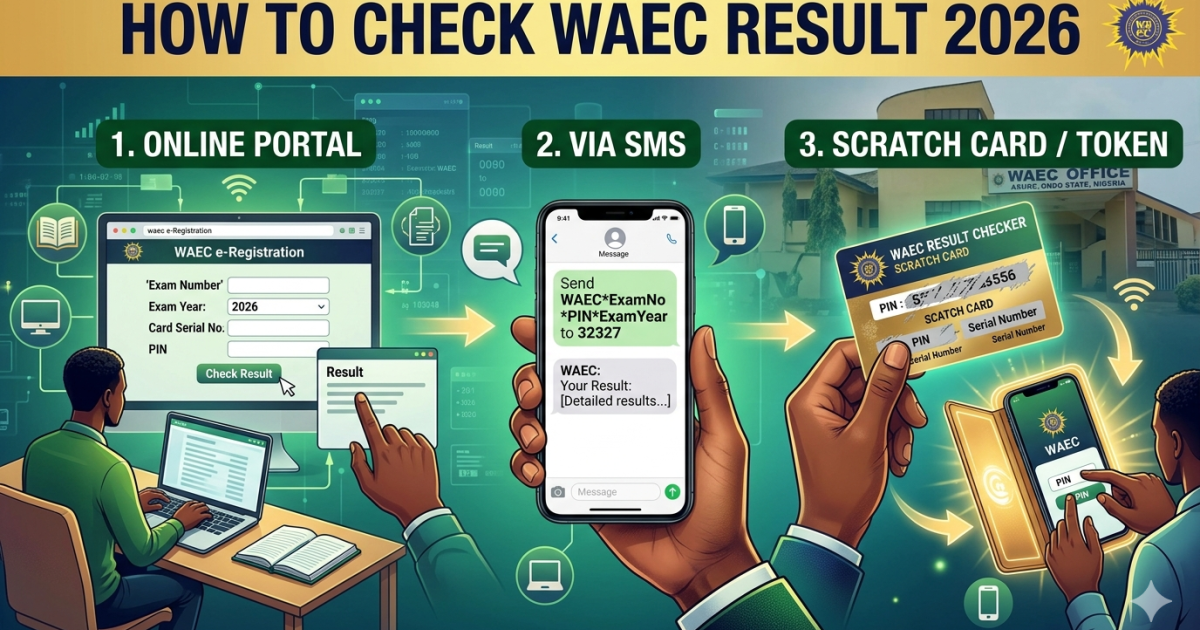
WAEC (West African Examinations Council) conducts Nigeria’s most widely taken secondary school leaving examination — the WASSCE — and its results are accepted for university admission across Nigeria, Ghana, Gambia, Sierra Leone, and internationally. In 2026, checking your WAEC result online is a straightforward process once you have your result-checking token (PIN). This comprehensive guide covers every method available: online via the official portal, the token scratch card system, and what to do if your result is being withheld or you encounter an error.
WAEC Result Portal and Token: What You Need to Know First
The West African Examinations Council’s official result checking portal in Nigeria is waeconline.org.ng. This is the only legitimate portal for checking WAEC results — any other website claiming to provide WAEC results is unofficial at best and fraudulent at worst. To check your result on the portal, you need two things: your 10-digit WAEC examination number (also called your index number — found on your WAEC examination card or your result slip from your school) and a valid WAEC result-checking token/PIN.
The WAEC token (also called scratch card PIN or e-PIN) is available in two forms: (1) a physical WAEC scratch card sold at authorised banks and WAEC-approved sales points, with the PIN revealed by scratching the silver coating; and (2) a digital e-PIN purchased directly from the waeconline.org.ng portal using a debit card. Both forms of PIN work identically on the portal. The token can be used 5 times for the same examination number — allowing you to share it with parents, your school, and institutions that need to verify your results.
WAEC Token Price 2026
The current price for a WAEC result-checking token in 2026 is approximately ₦2,000–₦3,000 depending on the examination type and purchase channel. Physical scratch cards purchased from authorised banks (First Bank, GTBank, Access Bank, UBA, Zenith Bank, and others designated by WAEC) cost approximately ₦2,000–₦2,500. Digital e-PINs purchased directly from the portal attract a similar fee plus any applicable card processing charge. Confirm the current exact price at waeconline.org.ng before purchasing — WAEC periodically adjusts fees. Never buy WAEC scratch cards from unofficial sources at inflated prices — buy from authorised banks or directly from the portal.
How to Check WAEC Result Online 2026 — Complete Step-by-Step
📋 What You Need Before Starting:
- Your 10-digit WAEC examination number (index number from your exam card)
- Your WAEC result checking PIN (from scratch card or e-PIN purchase)
- Your examination type (WASSCE for school candidates; GCE for private candidates; BECE for Basic Education)
- Your examination year (2026 for current results)
- An internet-enabled device
- Open your browser and go to waeconline.org.ng
- On the homepage, click “Result Checker” or navigate to the result checking section
- Select your Examination Type: WASSCE (May/June) for school candidates; WASSCE for Private Candidates (Nov/Dec) for GCE; BECE for Junior WAEC
- Enter your Examination Number (10-digit index number) exactly as it appears on your exam card
- Enter your Card Serial Number (the serial number printed on the scratch card or provided with your e-PIN)
- Enter your Card PIN (the PIN revealed by scratching the silver coating, or the digital PIN you received)
- Enter the CAPTCHA or security code displayed on screen
- Click “Check Result”
- Your result displays showing all your subject grades — verify it is correct
- Click “Print Result” to download or print your result. Save a digital copy (PDF/screenshot) for your records
Understanding Your WAEC Grades 2026
| Grade | Score Range | Classification | University Admission Status |
|---|---|---|---|
| A1 | 75–100% | Excellent | Credit — accepted |
| B2 | 70–74% | Very Good | Credit — accepted |
| B3 | 65–69% | Good | Credit — accepted |
| C4 | 60–64% | Credit | Credit — accepted |
| C5 | 55–59% | Credit | Credit — accepted |
| C6 | 50–54% | Credit | Credit — accepted (minimum for most requirements) |
| D7 | 45–49% | Pass | Pass — NOT accepted as credit for admission |
| E8 | 40–44% | Pass | Pass — NOT accepted as credit |
| F9 | 0–39% | Fail | Fail — not acceptable |
University admission in Nigeria requires a minimum of five credit passes (C6 and above) in relevant subjects including English Language and Mathematics (for most courses). Grades D7, E8, and F9 are NOT credits — they cannot be counted toward the five-credit requirement even though D7 and E8 are passing grades. This distinction catches many candidates by surprise. A candidate with 3 credits and 2 passes has effectively failed the O’Level requirement for university admission despite “passing” five subjects.
Common WAEC Portal Errors and Solutions
“Invalid Card” or “PIN Already Used”
If your PIN is rejected as invalid, first verify you have entered it correctly — check for common data entry errors (confusing 0 and O, or 1 and l). If the PIN shows as “already used 5 times,” it has been exhausted — purchase a new scratch card or e-PIN. If you believe the PIN is valid but was never used, contact WAEC Nigeria directly at results@waecnigeria.org or visit the nearest WAEC state office with your scratch card for verification.
“Result Not Available” or “Result Withheld”
“Result Not Available” means your result has not yet been released by WAEC — check back after 24–48 hours. WAEC releases results in batches and not all centres’ results are processed simultaneously. “Result Withheld” is more serious — it typically means WAEC has flagged your result for investigation due to suspected malpractice at your examination centre. Contact your school’s principal and the nearest WAEC state office immediately with your examination number. Withheld results require WAEC investigation — the process takes 4–12 weeks depending on the nature of the allegation and the evidence review.
Portal Not Loading or Very Slow
The waeconline.org.ng portal experiences extreme traffic immediately after results are released. Try checking at midnight or early morning (1am–5am) when fewer users are online. Clearing your browser cache and trying a different browser (Chrome → Firefox, or vice versa) often resolves loading issues. A stable internet connection with at least 3G/4G data is needed — checking on a very slow connection causes timeouts.
How to Upload WAEC Result to JAMB Profile
Uploading your WAEC result to your JAMB profile is a mandatory step for university admission processing through the JAMB CAPS system. Without this upload, your admission cannot be fully confirmed regardless of your UTME score and Post-UTME performance. Here is the process:
- Log into the JAMB eFacility portal at efacility.jamb.gov.ng
- Navigate to “Upload O’Level Results” in your dashboard
- Select “WAEC” as the examination body
- Enter your WAEC examination number (index number)
- Enter your examination year and type (WASSCE May/June or GCE Nov/Dec)
- JAMB verifies your results directly against WAEC’s database — you do not upload a scanned copy; JAMB retrieves the grades electronically from WAEC
- Once verified, your O’Level results appear on your JAMB profile and the “Awaiting Results” flag is removed
If you registered JAMB with “Awaiting Results” status, complete this upload immediately your results are released. Do not delay — your CAPS admission processing cannot proceed until your O’Level results are confirmed in JAMB’s system.
WAEC vs NECO: Key Differences and Which to Prioritise
| Factor | WAEC (WASSCE) | NECO (SSCE Internal) |
|---|---|---|
| Exam period | May/June (main); Nov/Dec (GCE private) | June–August (main); Nov/Dec (GCE private) |
| Nigerian university acceptance | ✅ Fully accepted — equal to NECO | ✅ Fully accepted — equal to WAEC |
| International recognition | Recognised in UK, Canada, Caribbean, West Africa | Primarily Nigeria only |
| Result checking portal | waeconline.org.ng — token ~₦2,000–₦3,000 | results.neco.gov.ng — token ₦2,100 |
| Format 2026 | Combination paper and CBT (subject-dependent) | Fully CBT |
| Can combine sittings? | Yes — with NECO or second WAEC sitting | Yes — with WAEC or second NECO sitting |
Key advice: For Nigerian university admission, WAEC and NECO are perfectly interchangeable — there is no advantage to one over the other for domestic purposes. If you plan to study or work in the UK, Canada, or other Commonwealth countries, WAEC has broader recognition. You can combine results from two different sittings (WAEC + NECO, or two WAEC sittings, or two NECO sittings) for JAMB’s purposes — so if you have English from one examination and Mathematics from another, both count toward your five-credit requirement.
What to Do After Getting Your WAEC Result 2026
If You Have Five or More Credits
Immediately upload your result to your JAMB profile via efacility.jamb.gov.ng. Register for Post-UTME at your institution as soon as it is announced. Monitor JAMB CAPS (admission.jamb.gov.ng) for admission offers — respond promptly when an offer appears. Print multiple copies of your WAEC result for future use (university screening, NYSC, employment).
If You Need to Improve Your Result
Register for WAEC GCE (private candidates examination) in November/December 2026 to resit subjects where you did not score credit. The WAEC GCE registration window typically opens in September. You can combine your May/June 2026 results with your GCE results — credits from either sitting count. Alternatively, register for NECO GCE (also November/December) if you prefer the NECO system.
Frequently Asked Questions — WAEC Result 2026
How do I check my WAEC result 2026?
Visit waeconline.org.ng, select Result Checker, choose your examination type and year, enter your 10-digit examination number, enter your scratch card serial number and PIN, enter the CAPTCHA, and click “Check Result.” Your grades appear instantly if results have been released.
How much is a WAEC scratch card in 2026?
WAEC result-checking scratch cards cost approximately ₦2,000–₦3,000 at authorised banks (GTBank, Access, First Bank, Zenith, UBA). Digital e-PINs purchased directly from waeconline.org.ng cost a similar amount. Always buy from authorised channels — not from scalpers or unofficial sellers.
How many times can I use one WAEC scratch card?
One WAEC scratch card PIN can be used up to 5 times to check the same candidate’s result. You can share your PIN with parents, your school, or any institution that needs to verify your result — each use counts toward the 5-use limit. After 5 uses, purchase a new scratch card.
My WAEC result says “withheld” — what do I do?
A withheld result means WAEC has flagged your result for investigation — typically related to suspected malpractice at your examination centre. Contact your school principal and the WAEC state office serving your examination centre immediately. Provide your examination number and school name. The investigation process takes several weeks — withheld candidates cannot be admitted through the normal process until the result is released or the case resolved.
📋 WAEC Result Checker 2026 — Complete Quick Reference
- Official portal: waeconline.org.ng
- What you need: 10-digit exam number + scratch card serial + PIN
- Token price: ~₦2,000–₦3,000 (authorised banks or portal direct)
- Token uses: Up to 5 times per exam number — shareable
- Buy token at: GTBank, Access, First Bank, Zenith, UBA (WAEC authorised) or waeconline.org.ng
- Credits required for uni: Minimum 5 credits (C6 and above) including English and Maths
- D7/E8 = NOT a credit — cannot count toward admission requirements
- Upload to JAMB: efacility.jamb.gov.ng → Upload O’Level Results → select WAEC
- Result withheld? Contact school principal and WAEC state office immediately
- WAEC vs NECO: Both equally accepted for Nigerian university admission
Also read: How to Check JAMB Result 2026 | NECO Result Checker 2026 | JAMB Cut-Off Marks 2026
How WAEC Generates Results: Understanding the Marking Process
Understanding how WAEC generates and releases results helps candidates set realistic expectations for timing and interpret their grades correctly. WAEC operates a sophisticated dual-marking system designed to ensure accuracy and fairness. After the May/June examinations conclude, answer scripts are collected from all centres across Nigeria (and the other four WAEC member countries), batched, and distributed to trained examiners who mark them according to the official mark scheme developed by the Chief Examiner for each subject. Each script is marked by a first marker, then sampled for quality control by a second marker or team leader. Significant discrepancies trigger additional review by a senior examiner.
After physical script marking, the raw scores are entered into WAEC’s database and subjected to statistical moderation — a process that adjusts marks to account for variation in difficulty between different paper variants (where multiple paper versions were used), between examination centres, and between years. This moderation process is why a candidate’s raw score on a paper does not always directly translate to the grade shown on the result — moderation can move grades up or down depending on the statistical analysis of performance across the candidate population. The final moderated grades are verified by the WAEC Technical Committee before publication. This multi-stage process typically takes 10–12 weeks from the final examination paper to the release of results — which is why May/June WASSCE results are typically released in August, sometimes into September.
WAEC Result Re-Sitting: How to Improve Grades You Are Not Satisfied With
If your May/June 2026 WAEC result does not meet your needs — whether because you scored passes (D7/E8) instead of credits in critical subjects, or simply did not perform as expected — you have two main re-sitting options through WAEC:
WAEC GCE (November/December) — For Private Candidates
The WAEC WASSCE for Private Candidates — commonly called GCE — is conducted in November/December each year and is open to any Nigerian who wants to sit or re-sit WAEC subjects. You can register for only the specific subjects you need to improve, rather than re-sitting all subjects. Registration opens in September, with the examination typically in October–November. Results are released approximately 90 days after the examination concludes. The GCE results carry exactly the same weight as the May/June WASSCE for all Nigerian university admission and employment purposes. Many candidates who sat May/June 2026 will sit GCE 2026 in November to improve specific subject grades before the next JAMB cycle or Post-UTME season.
Re-Checking: Official Grade Review
If you believe a specific subject grade is significantly lower than your performance warrants, WAEC offers an official re-checking service. Re-checking (not re-marking) involves a verified examiner reviewing the clerical accuracy of the marking for your specific script — confirming that all questions were marked and totals were correctly calculated. It does not involve a subjective re-evaluation of the examiner’s judgment of individual answers. The re-checking fee is paid through designated banks and the process takes 6–10 weeks. Re-checking occasionally results in grade improvements where clerical errors occurred, but candidates should not rely on re-checking as a primary strategy for improving unsatisfactory grades — the re-sit option is typically more productive.
WAEC Result Verification for Tertiary Institutions and Employers
Universities, polytechnics, employers, and professional bodies that need to verify a candidate’s WAEC result independently use WAEC’s official verification service rather than relying on the candidate’s printed result or scratch card check. WAEC’s institutional verification system — accessible at verification.waecdirect.org — allows authorised institutions to submit candidates’ examination numbers and receive verified grade data directly from WAEC’s database. This system is used during post-UTME screening to confirm that O’Level results presented by candidates match the grades in WAEC’s own records.
For individual candidates who need to provide verified results to an institution that has not integrated WAEC’s API: provide your examination number and the institution’s request for verification — the institution then submits through their own institutional account with WAEC. You do not need to take any additional action beyond providing your exam number and allowing the institution to verify directly with WAEC. This direct institutional verification is much more robust than checking via the public scratch card portal, and institutions that conduct it are protected against fraudulent result manipulation.
How to Prepare for WAEC Examinations: Practical Tips for 2026 Candidates
For candidates currently preparing for the 2026 WAEC May/June WASSCE (or for those preparing for the GCE November/December sitting), here are the most effective preparation strategies:
- Past questions are essential: WAEC past questions from the past 10 years — available from WAEC bookshops, educational publishers (Tonad, Exam Focus, Bounty Press), and online platforms — reveal question patterns, recurring topics, and the format of WAEC questions. For most subjects, practising past questions consistently for 12 weeks before the examination provides more examination preparation value than any other single activity
- Focus on your weak subjects first: Identify the subjects where you are most likely to score a pass (D7/E8) rather than a credit (C6 and above) and devote disproportionate preparation time to those subjects. Getting a C6 in a weak subject instead of a D7 makes the difference between meeting and not meeting the five-credit requirement
- Use WAEC marking schemes: WAEC’s published marking schemes (available at waecnigeria.org for past years) show exactly what an examiner looks for in each answer. Understanding marking scheme requirements — particularly for essay questions — dramatically improves the efficiency of your examination technique
- Practice time management: Sit past papers under timed conditions — set a timer for the actual examination duration and complete the full paper without stopping. WAEC examinations have strict time limits and candidates who have never practised timed completion frequently run out of time on the actual day
- Do not memorise — understand: WAEC examinations increasingly test conceptual understanding, analysis, and application rather than rote memorisation. Candidates who understand the underlying concepts in each subject — rather than memorising specific answers — are better equipped to handle unfamiliar question variants
WAEC Result Verification for Institutions (e-Verification)
Universities, polytechnics, employers, and professional bodies that need to officially verify a candidate’s WAEC result (rather than just viewing it through the scratch card) use WAEC’s electronic verification service. This is separate from the candidate-facing result checker portal. Institutions access WAEC’s e-verification system at waec.int or through direct API integration for bulk verification. For individual candidates asked by an institution to provide a “verification token,” WAEC offers a specific institutional verification service with a unique reference that institutions use to confirm your results against WAEC’s database in real time. If an institution you are applying to requests this, contact the nearest WAEC state office to obtain the appropriate institutional verification reference for your result.
How to Get Your Original WAEC Certificate
The WAEC result you check online (and print from the portal) is your result printout — not your official certificate. The original WAEC certificate is a separate, more formal document printed on security paper with WAEC’s embossed seal. For school candidates (WASSCE May/June), the original certificate is typically distributed through your school — collected from your school’s examination officer, usually 6–12 months after results are released. If your school has closed, you graduated years ago, or you need a replacement certificate (for a lost or damaged original), you must apply directly to WAEC Nigeria.
To apply for a replacement or collect a delayed original WAEC certificate directly: visit the WAEC Nigeria headquarters at WAEC House, 7A Makinde Street, off Shipeolu Street, Somolu, Lagos (the central office) or any WAEC state office, with your examination number, a completed application form, relevant ID, and the applicable processing fee (confirm the current fee at waecnigeria.org). Processing typically takes 4–8 weeks. The original certificate is the definitive document for employment, professional registration (NMA, COREN, ICAN, NSE), immigration, and other purposes where a portal printout is not accepted.
WAEC Subject Requirements by Course — University Admission Guide
Beyond the general five-credit requirement, Nigerian universities specify the exact O’Level subjects that must be among the five credits for each course. Holding five credits in the wrong subjects — even at very high grades — will not qualify you for your intended course. Here are the standard O’Level subject requirements for the most competitive courses:
| Course | Compulsory O’Level Credits Required |
|---|---|
| Medicine and Surgery | English, Mathematics, Physics, Chemistry, Biology — all five must be credits |
| Pharmacy | English, Mathematics, Physics, Chemistry, Biology |
| Nursing | English, Mathematics, Biology, Chemistry, Physics (or Agricultural Science at some schools) |
| Law | English, Mathematics/Literature + 3 other credits in any social science or arts subjects |
| Engineering (all types) | English, Mathematics, Physics, Chemistry + one relevant science or technical subject |
| Computer Science | English, Mathematics, Physics + 2 other credits |
| Accounting/Finance | English, Mathematics + 3 other credits (Economics, Commerce or similar preferred) |
| Mass Communication | English, Mathematics + 3 others (Literature, Government, Economics often required) |
| Architecture | English, Mathematics, Physics, Fine Art or Technical Drawing + 1 other |
| Agriculture | English, Mathematics, Biology/Agricultural Science, Chemistry + 1 other |
Always verify the specific O’Level requirements for your intended course directly on your target university’s admissions page — subject requirements can vary slightly between institutions, particularly at private universities which have some flexibility in their O’Level specifications. The University Matriculation Examination (UMTE) brochure, published by JAMB annually and available at JAMB offices or efacility.jamb.gov.ng, contains the official O’Level subject requirements for every course at every accredited Nigerian institution. This brochure is the definitive reference — check it before assuming your subject combination qualifies you for any specific course-institution combination.
WAEC 2026 Registration: How to Register for the June/July Examination
For students who have not yet sat WAEC and need to register for the 2026 WASSCE (May/June), registration is handled through your secondary school. Your school’s examination officer submits candidate entries to WAEC through the school’s registration account on the WAEC portal. Individual candidates cannot register directly — you must be registered through an accredited school. For students who are no longer in school and want to sit as private candidates (GCE), registration for the November/December 2026 sitting opens approximately in August–September 2026 and is done online at waeconline.org.ng under the “Private Candidate (GCE)” section. GCE registration requires creating an account, selecting subjects, uploading a passport photograph, and paying the applicable registration fee (confirm current fee at waecnigeria.org).
WAEC Result Fraud: Protecting Yourself
WAEC-related fraud affects thousands of Nigerians each exam season. The most common schemes targeting candidates checking their 2026 results are: fake WAEC portals that mimic waeconline.org.ng to steal login credentials and payment information; scratch card scalpers who sell used (exhausted) scratch cards at discounted prices; WhatsApp messages claiming to offer “WAEC grade upgrades” for a fee; and websites claiming to provide “free WAEC result checking” that in reality harvest your examination number and personal details for fraud. Always navigate directly to waeconline.org.ng by typing the address — never through links in messages. Buy scratch cards only from WAEC-authorised banks. Report any website or individual advertising “grade upgrades” to WAEC at results@waecnigeria.org or to the EFCC at efcc.gov.ng. Your WAEC result is generated by the examination system and stored on WAEC’s secure servers — no third party can change it.
WAEC Result Verification for Institutions
Universities, polytechnics, employers, and professional bodies that need to officially verify a candidate’s WAEC result — rather than simply viewing it through the student’s scratch card — use WAEC’s formal verification service. This is separate from the student result-checking process and is designed for institutional verification of credentials. Educational institutions can access WAEC’s e-verification platform through a dedicated institutional account at WAEC’s registrar portal. This system allows bulk verification of large numbers of candidates (important for universities processing thousands of admission applications simultaneously), generates certified verification letters for individual candidates on official WAEC letterhead, and flags any discrepancy between the candidate-presented result and WAEC’s master database. For individual candidates who need to provide WAEC-certified results to specific institutions: contact the nearest WAEC state office, present your examination details, pay the applicable verification fee, and WAEC issues a verification letter directly to the requesting institution. This formal verification route is typically required for employment in regulated professions (medicine, law, teaching), application to certain foreign universities, and for court proceedings where educational credentials are in dispute.
How to Prepare for WAEC if You Are Resitting in 2026
For candidates planning to resit WAEC GCE (private candidates examination, November/December 2026) to improve specific grades, a strategic preparation approach yields significantly better results than simply reading textbooks again in the same way. The most effective resit preparation strategies confirmed by successful resitters are:
- Obtain WAEC past questions for at least 5 years: WAEC past questions for every subject are available from WAEC bookshops at all state offices, from major bookshops (Patabah, Fola Bookshops), and from legitimate online platforms. Work through these systematically — WAEC questions follow consistent patterns and recurring topic areas that past papers reveal clearly
- Identify and target your weak topics: Review your previous result to identify which subjects and topics you scored poorly in. For most students, poor performance is concentrated in 20–30% of the syllabus content rather than uniformly distributed. Targeting that weak 20–30% with focused additional study typically produces the most result improvement per hour of preparation
- Practice under timed conditions: WAEC examinations are strictly timed. Many candidates who know the material well still underperform because they cannot complete the paper in the allocated time. Practice completing full past papers within the exact examination time limit regularly in the weeks before your examination
- Understand the marking scheme: WAEC’s detailed marking schemes (available from WAEC bookshops and education portals) reveal exactly what examiners give marks for — specific keywords, required calculation steps, acceptable answer formats. Understanding the marking scheme is often more valuable than additional content study for borderline candidates
- Join a WAEC tutorial class: Well-run WAEC tutorial centres (particularly in Lagos, Ibadan, Abuja, and Port Harcourt) have experienced teachers who know WAEC’s specific requirements and can efficiently fill knowledge gaps in a structured programme
WAEC Expo Sites and Why You Must Avoid Them
Every WAEC examination season, dozens of websites and WhatsApp groups advertise “WAEC runs” — leaked examination questions and answers that they claim allow candidates to answer questions before or during the examination. These sites are a trap in multiple ways. First, the vast majority of the answers they provide are wrong — they guess at questions and manufacture answers that sound plausible but are incorrect. Candidates who use these “runs” often perform worse than they would have by simply answering from their own preparation. Second, WAEC actively collaborates with NCC, security agencies, and mobile network operators to track the distribution of examination materials and has prosecuted operators of expo sites. Third, even if a candidate somehow uses these sites without detection during the examination, WAEC’s post-examination statistical analysis identifies answer pattern anomalies that trigger investigation — the same set of unusual answers appearing across multiple examination centres is a red flag that leads to result withholding and investigation. The risk-reward calculation is overwhelmingly negative: the marginal benefit of cheating (if it even works) is far outweighed by the risk of a withheld result, criminal prosecution, and permanent academic record damage. The only reliable path to a good WAEC result is adequate preparation.
WAEC Subject Combinations by Course: What Credits Do You Need?
One of the most practically important but often overlooked aspects of WAEC result interpretation is knowing which specific subjects need to be credits for your intended university course and institution. It is not enough to have five credits in random subjects — the credits must be in subjects relevant to your intended programme of study. Here is the standard O’Level subject requirement for the most popular courses in Nigerian universities:
| Course | Compulsory Credits | Additional Required Credits |
|---|---|---|
| Medicine and Surgery | English Language, Mathematics | Biology, Chemistry, Physics (all required) |
| Pharmacy | English, Mathematics | Chemistry, Biology, Physics |
| Nursing Sciences | English, Mathematics | Biology, Chemistry, and one of Physics/Health Science |
| Engineering (all types) | English, Mathematics | Physics, Chemistry, and one other science |
| Computer Science | English, Mathematics | Physics, and two others from sciences or technical subjects |
| Law | English, Mathematics | Literature in English plus three other subjects (Arts/Social Sciences) |
| Accounting / Finance | English, Mathematics | Economics, and two others from Commerce, Business Studies, Government, or sciences |
| Mass Communication | English, Mathematics | Literature in English plus two social science subjects |
| Architecture | English, Mathematics | Physics, Fine Art or Technical Drawing, and one other science |
| Agriculture | English, Mathematics | Biology or Agricultural Science, Chemistry, Physics or one other |
Note: Individual universities may add specific subject requirements beyond these general guidelines. Always verify your target institution’s specific O’Level requirement from their official website or JAMB’s institution-specific requirements database before finalising your choice of institution and course combination.
WAEC Result and International University Applications
WAEC results are recognised far beyond Nigeria’s borders — making them a genuinely internationally portable academic credential. Here is how WAEC results are treated by international university systems:
United Kingdom
UK universities (via UCAS) formally recognise WAEC/WASSCE grades as equivalent to GCSE qualifications for entry requirement purposes. A grade A1 or B2 in WAEC is typically treated as equivalent to an A* or A at GCSE, while C4 through C6 is treated as equivalent to a GCSE grade C. For A-Level equivalent entry requirements to UK universities, WAEC alone is typically insufficient — UK universities generally require A-Levels, International Baccalaureate, or other Level 3 qualifications in addition to WAEC for direct entry. Nigerian students who complete A-Levels (through international schools or UK foundation year programmes) in addition to WAEC are typically eligible for direct degree entry.
Canada
Canadian universities (particularly those in Ontario, British Columbia, and Quebec) recognise WAEC results for admission consideration, though typically alongside other credentials. Nigerian applicants to Canadian universities usually present WAEC results plus IELTS/TOEFL for English proficiency, and may be required to complete a university foundation or pathway programme before degree admission depending on the institution and programme level.
West Africa
As a West African Examinations Council product, WAEC results are directly recognised at universities in all five WAEC member countries: Nigeria, Ghana, Sierra Leone, Gambia, and Liberia. Nigerian students who wish to attend the University of Ghana, Fourah Bay College in Sierra Leone, or the University of the Gambia can present their WASSCE results directly for admission consideration — a significant advantage over NECO results, which have no equivalent regional recognition outside Nigeria.
WAEC Result Verification for Employment and Professional Bodies
Beyond university admission, your WAEC result is required throughout your career. Nigerian employers, professional regulatory bodies, and government agencies frequently request O’Level results for: NYSC mobilisation verification, employment background checks, professional registration (e.g., COREN for engineers, MDCN for medical practitioners, NBA for lawyers, ICAN for accountants), civil service appointment confirmations, and promotions in government service. Keeping multiple printed copies of your WAEC result in good condition — and knowing how to retrieve a fresh print from waeconline.org.ng whenever needed — is a lifelong necessity, not just a one-time student activity.
For official verification required by employers or institutions (rather than a self-print): WAEC operates a formal result verification service where institutions can verify results directly with WAEC. The institutional verification portal at waecnigeria.org allows accredited institutions to query the WAEC database using a candidate’s examination number and year. This institutional verification is more authoritative than a candidate’s self-printed result — employers conducting background checks use this channel rather than relying on documents provided by the candidate themselves.
WAEC Result Fraud: Fake Results and Certificate Forgery
WAEC result and certificate fraud is a persistent problem in Nigeria that has severe consequences for those involved. The most common forms of WAEC fraud include: forged result printouts (digitally altered to show better grades than actually earned), forged physical WAEC certificates with fake WAEC security features, and false examination number claims (presenting another person’s genuine result as your own). All of these are criminal offences under Nigerian law and the law of other WAEC member states.
The consequences of WAEC certificate fraud have become increasingly severe in 2026 as institutions and employers use WAEC’s institutional verification portal to cross-check every result. A forged result that passes a cursory employer review in 2022 may be exposed in 2026 when a promotion review or background check leads to institutional verification. Nigerian courts have imposed prison sentences on individuals convicted of academic certificate forgery. More immediately damaging: a university or professional body that discovers forged O’Level results typically revokes the degree, professional qualification, or appointment obtained on the basis of the forgery — regardless of how long after the forgery the discovery occurs. No short-term advantage from a forged result is worth this lifelong risk.
WAEC Certificate: When You Receive It and How to Use It
The online result you check via waeconline.org.ng is a portal printout — useful for most immediate purposes (JAMB upload, university admission, NYSC, employer verification) but distinct from your original WAEC certificate. The original WAEC WASSCE certificate — the printed, embossed, signed official document — is issued by WAEC Nigeria and delivered to your school (for school candidates) or to your nominated address (for private candidates) typically within 12–24 months of your examination. Many Nigerian graduates experience delays in collecting their WAEC certificate from their school — leaving certificates uncollected for years. This becomes a problem when employers or postgraduate institutions specifically request the original certificate rather than a portal printout.
To collect your WAEC certificate: contact your school’s examination officer (for school candidates) or the WAEC state office (for private candidates). If your school has misplaced your certificate, or if you graduated years ago and the school no longer has records, you can apply for a replacement directly from WAEC Nigeria at waecnigeria.org. The replacement certificate process requires your examination number, a sworn affidavit, and payment of the current replacement fee — contact WAEC Nigeria for the current amount. Do not delay collecting your WAEC certificate — as it is a permanent record of your academic achievement that will be requested throughout your education and career.
WAEC Result Verification for Institutions
Universities, polytechnics, employers, and professional licensing bodies that need to verify a candidate’s WAEC result can use WAEC’s official e-Verification system. Rather than relying on the candidate’s printed result (which could theoretically be falsified), institutions query WAEC’s database directly using the candidate’s examination number and verify the grades against WAEC’s records. This system is particularly important during university admission screening, NYSC documentation verification, and professional body registration processes.
For candidates being verified: your portal printout is sufficient for most purposes. However, if an institution specifically requests “WAEC verification” rather than just a copy of your result, they are asking to run the e-verification query — give them your examination number and examination year and they will conduct the verification through their institutional WAEC access. You do not need to provide your scratch card PIN for institutional verification — the institution’s verification access operates through a separate channel that doesn’t use candidate scratch cards.
How to Register for WAEC GCE 2026 (Private Candidates)
If you need to improve your WAEC result — either because you didn’t score enough credits in the May/June examination, or because you are a graduate sitting for the first time as a private candidate — the WAEC GCE November/December 2026 examination provides that opportunity. Here is the registration process:
- Registration window: Typically opens September–October 2026 — monitor waecnigeria.org and major educational news platforms for the announcement
- Registration fee: Approximately ₦27,000–₦32,000 for 8 subjects (the fee increases with each cycle — confirm current amount at waecnigeria.org when registration opens)
- Registration method: Online at the WAEC Nigeria website — create an account, fill in personal details, select subjects, upload passport photograph, and pay via the portal
- Subjects to choose: Select only subjects where you did not score credit in previous sittings, or where you are sitting for the first time. You do not need to resit subjects where you already have credit
- Result combination: Credits from your GCE November/December sitting can be combined with credits from your May/June sitting or previous sittings for JAMB upload — they all count equally toward your five-credit requirement
- Examination centres: Choose your nearest approved GCE centre during registration — unlike school-based WASSCE, GCE candidates sit at designated public examination centres
WAEC WASSCE Subject Combinations for Different Courses
The specific five credits you need for university admission depend on your intended course of study. Different faculties and courses have different mandatory O’Level requirements beyond English Language and Mathematics. Here is a reference for the most popular Nigerian university courses:
| Course | Required WAEC Credits (in addition to English and Maths) |
|---|---|
| Medicine and Surgery | Biology, Chemistry, Physics (all 3 compulsory) |
| Pharmacy | Biology, Chemistry, Physics or Mathematics |
| Nursing | Biology, Chemistry, Physics or Health Education |
| Engineering (all types) | Physics, Chemistry; Further Maths recommended but not always mandatory |
| Computer Science | Physics, Chemistry or Further Maths; some schools accept Data Processing |
| Law | Government or History; Literature or CRK/IRS; any Social Science subject |
| Accounting / Finance | Economics, Commerce or Business Studies; any Science subject or Geography |
| Mass Communication | Literature, Government, and any Social Science or Art subject |
| Education (Science) | Same requirements as the teaching subject (Biology Ed = Biology + Chemistry) |
| Agriculture | Agricultural Science or Biology, Chemistry; Geography useful |
Always verify the specific O’Level requirements for your exact institution and course — requirements vary between universities and are sometimes updated. Check the institution’s prospectus or admissions page, not just the general guidelines above.
WAEC 2026 Key Dates and Timeline
| Event | Approximate Date |
|---|---|
| WASSCE May/June 2026 examinations | May–June 2026 |
| WASSCE May/June 2026 results release | Approximately July–August 2026 |
| WAEC GCE Nov/Dec 2026 registration opens | September–October 2026 |
| WAEC GCE Nov/Dec 2026 examinations | November–December 2026 |
| WAEC GCE Nov/Dec 2026 results | January–February 2027 |
WAEC Result Verification for Institutions — The e-Results Verification System
Universities, polytechnics, employers, and government agencies that need to officially verify WAEC results — rather than merely viewing them through the candidate’s scratch card — use WAEC’s dedicated verification portal at waecdirect.org. This institutional verification service is separate from the candidate result-checking portal at waeconline.org.ng. An institution enters the candidate’s examination number and year into waecdirect.org and WAEC returns the official, authenticated result directly from WAEC’s database — a verification that cannot be forged or altered by any party. This is the system Nigerian universities use during screening exercises and why presenting a printout of your result from waeconline.org.ng at a university screening is supplemented by the institution running its own direct verification against WAEC’s database.
For candidates: understanding that institutions verify independently means there is absolutely no value in presenting a forged or altered result printout at any screening. The moment the institution runs the waecdirect.org check, the accurate result from WAEC’s database appears — completely overriding whatever is shown on any printout the candidate presents. Attempting to present a manipulated result is not only ineffective; it is a criminal offence that results in immediate disqualification, blacklisting from that institution, and referral to law enforcement. Every year, candidates are caught and prosecuted for result forgery — do not be among them.
WAEC GCE 2026: For Those Who Need to Resit or Improve
The WAEC GCE (General Certificate Examination) — officially the WASSCE for Private Candidates — is the second sitting of WAEC’s Senior Secondary examination, conducted in November and December each year. It is open to private (non-school) candidates, including graduates of secondary schools who sat the May/June examination and want to resit subjects, candidates who missed the May/June examination entirely, or adults who never sat WAEC and now need the qualification for career or educational purposes. WAEC GCE results carry exactly the same weight as May/June WASSCE results for all Nigerian university admission, NYSC, and employment purposes.
Registration for WAEC GCE 2026 (for the November/December sitting) typically opens in September 2026. The registration fee for WAEC GCE private candidates is approximately ₦27,000 — paid online through the WAEC portal. Candidates select the subjects they want to write (they can write as few as one subject or as many as eight), pay the prescribed fee, obtain a centre assignment (an approved private candidate examination centre near them), and sit the examination in November/December. Results are released approximately 3–4 months after the examination. Candidates who combine May/June WASSCE credits with GCE credits can present both results to JAMB’s portal — the system accepts the combined credits across both sittings toward the five-credit requirement.
How Many Credits Do You Need for Different University Courses?
Beyond the universal five-credit minimum (which all courses require), different courses have additional specific subject requirements. Here is a guide to what WAEC subjects are specifically required for the most popular university courses in Nigeria:
| Course | Required WAEC Credits (in addition to English) |
|---|---|
| Medicine and Surgery | Mathematics, Biology, Chemistry, Physics (all 4 at credit — C6 minimum) |
| Pharmacy / Nursing | Mathematics, Biology, Chemistry, Physics — credit in all |
| Engineering (all types) | Mathematics, Physics, Chemistry — credit in all; further Mathematics a plus |
| Law | Mathematics + any 3 arts/social science subjects at credit |
| Accounting / Finance | Mathematics (credit compulsory) + Economics or Commerce |
| Computer Science | Mathematics (credit compulsory) + Physics; Chemistry helpful |
| Economics | Mathematics (credit) + Economics or Commerce; Government |
| Mass Communication | English (credit) + any 4 other credits; Literature in English helpful |
| Agriculture | Biology, Chemistry, and Agriculture or Agricultural Science at credit |
| Education courses | Credit in English + the relevant teaching subject area |
Always verify the specific subject requirements with your target university — requirements can vary slightly between institutions. JAMB also publishes the official subject requirements for each course in its brochure, which is available for download at jamb.gov.ng.
WAEC Result for Employment: What Nigerian Employers Require
WAEC results are required not only for university admission but also for employment in most Nigerian organisations — public and private. The federal civil service requires a minimum of five O’Level credits (WAEC or equivalent) for Grade Level 06 entry positions. Nigerian Army, Navy, and Air Force recruitment requires a minimum of four credits including English. Nigerian Police recruitment, Customs recruitment, and Immigration recruitment all specify O’Level credit requirements. Many private sector employers — banks, insurance companies, FMCG companies — require WAEC credentials as part of their minimum qualification screening for entry-level roles, even when the candidate also has a university degree.
For employment verification, the waecdirect.org institutional verification system is used by HR departments at major Nigerian employers — the same electronic verification system used by universities. This means presenting a printed result alone is insufficient for many formal employers; they will independently verify through WAEC’s database using your examination number. Ensuring your WAEC result accurately reflects your performance and that the details (name, examination number, year) are correctly recorded is therefore important not just for university admission but for your entire career trajectory.
WAEC Result International Recognition: Studying Abroad with Nigerian WAEC
One of WAEC’s major advantages over NECO is its international recognition — particularly in the United Kingdom, Canada, parts of the Caribbean, and across West Africa. For Nigerian students applying to UK universities, WAEC WASSCE results are accepted as evidence of secondary school completion in most UK university admissions processes. Specific credit requirements vary by UK university and course — generally, 5 credits including English Language and Mathematics at C4/equivalent are required for most undergraduate programs. A1 and B2 grades in key subjects can strengthen a UK university application significantly. UCAS (the UK university application service) includes WAEC on its recognised qualifications list, and most UK universities have a conversion guide that maps WAEC grades to their UK equivalent for comparison with A-Level results.
For Canada, some provinces and universities accept WAEC WASSCE directly while others may require additional assessment through credential evaluation services like WES (World Education Services). Australian universities and some US universities also recognise WAEC WASSCE as a secondary school leaving qualification, though requirements vary significantly by institution. If international university applications are in your future, always check the specific requirements of your target university regarding WAEC results — do not assume acceptance based on general recognition patterns.
WAEC Result Verification for Employers and Institutions
Universities, polytechnics, employers, and professional bodies that need to verify a candidate’s WAEC result — rather than simply view a printed copy — use WAEC’s official e-Verification system. This is separate from the candidate result checking portal. The WAEC e-Verification platform is at waecnigeria.org/e-verification and requires the institution or employer to register as a verifying organisation and pay a verification fee per candidate. The verification is done against WAEC’s central database and provides a certified response that the result is genuine, reducing the risk of accepting forged certificates. For individual candidates who are asked to provide “verified” results to an employer: obtain your WAEC result printout from the waeconline.org.ng portal and share your scratch card PIN with the employer if they want to verify directly — the 5-use limit means you have sufficient uses for multiple institutions to verify.
WAEC Certificate vs Result Printout: Understanding the Difference
Many candidates and their parents confuse the WAEC result they can print from the portal with the official WAEC certificate. They are different documents with different levels of authority. The portal result printout is a digital document showing your grades — it is widely accepted for JAMB upload, university Post-UTME registration, and most employer pre-employment screening purposes, but it is not the formal certificate. The WAEC certificate is the physical document bearing the WAEC seal, signed by the WAEC Registrar, with embossed security features — it is the permanent, formal record of your O’Level achievement. WAEC certificates are issued through your school (for school candidates) or directly from the nearest WAEC state office (for private candidates) and may take several months after the examination to be ready for collection. When an employer, university admission office, or professional body specifically requests your “WAEC certificate” — as opposed to your result — they want the physical embossed certificate, not the portal printout. Keep both documents safely filed separately — the portal printout for everyday use and the original certificate in a secure location.
How WAEC Results Are Graded: The Internal Assessment Component
One aspect of WAEC grading that candidates often overlook is the school-based assessment component that contributes to the final grade. WAEC’s grading system incorporates both the written external examination (which accounts for the majority of the final grade — typically 80%) and a school-based assessment or practical component (typically 20%) for subjects that include practicals or continuous assessment. This means your final WAEC grade in subjects like Biology, Chemistry, Physics, Agricultural Science, and Technical Drawing includes marks from school-based practicals conducted throughout the year — not just from the external examination papers you wrote at the WAEC centre. Understanding this is important for candidates who feel their external paper performance was strong but their final grade is unexpectedly low — it may reflect a weak school-based component. Conversely, strong consistent performance in school practicals throughout the year provides a grade buffer that can boost a borderline external examination performance into a higher grade band.
WAEC Re-Checking and Re-Marking 2026
If you believe your WAEC result contains an error — a grade lower than expected in a subject you feel confident you answered well — you can apply for result re-checking or re-marking through WAEC. This process is called a Re-Checking of Results or Appeal Against Result (AAR). The process: visit your nearest WAEC state office, complete an application form specifying the examination year, your index number, and the subject(s) you want re-checked, and pay the applicable fee (confirm current fee at the state office — it varies by examination type and number of subjects). WAEC re-marks your original scripts and issues a revised result if errors are found. The process takes 4–8 weeks. Important caveat: your grade can go up or down following re-marking — if the re-marking confirms your original grade or results in a lower grade, the revised result stands. Only apply for re-checking/re-marking if you genuinely believe a marking error occurred — not simply because your grade was lower than expected.
Preparing for WAEC 2026 If You Are Still Awaiting Results
For SS3 students who wrote or are writing WAEC in 2026 and have not yet received results, here are the most effective strategies for the period between sitting your exams and receiving results: First, use the waiting period to intensify your JAMB preparation — if you have already written JAMB, use the time before Post-UTME to study past Post-UTME questions from your target institution. If you have not yet written JAMB, focus entirely on JAMB preparation. Second, gather all the documents you will need for university Post-UTME registration — birth certificate, NIN, BVN, WAEC exam card, local government certificate — so you are ready to move quickly the moment your results are released. Third, monitor your school notice board and WAEC’s official channels (waeconline.org.ng, the WAEC Nigeria social media pages) for the official result release date announcement. WAEC typically releases WASSCE May/June results within 2–3 months of the last examination date — candidates who wrote May/June 2026 exams should expect results around August–September 2026.
WAEC GCE 2026: The Second Chance Examination
The WAEC Senior School Certificate Examination for Private Candidates — commonly called WAEC GCE — is the November/December version of the WASSCE examination, designed for candidates who did not sit the May/June examination or who need to improve their May/June results. For 2026, the GCE registration window is expected to open in September–October 2026. Any Nigerian of any age can register for WAEC GCE as a private candidate — there is no age restriction and no requirement to be currently enrolled in secondary school. This makes it the ideal route for gap-year candidates, working adults who need O’Level qualifications for career advancement, and May/June 2026 candidates who did not achieve the credit passes they need for their target university course.
WAEC GCE registration is done online at waeconline.org.ng. The registration fee for 2026 is approximately ₦22,000–₦27,000 depending on the number of subjects registered — confirm the current fee on the WAEC portal as it is adjusted annually. You select an examination centre from WAEC’s list of approved GCE centres near you. Bring your May/June result when registering — you only need to re-register for the subjects where you did not achieve credit, not all your subjects. WAEC allows combining May/June credits with GCE credits across different sittings for university admission purposes, making targeted re-registration in only failing subjects the most cost-effective and time-efficient approach.
WAEC Certificate: How to Apply for the Original 2026
The WAEC result you print from waeconline.org.ng is a portal printout — useful for most immediate purposes but not the original WAEC certificate. The original WAEC Senior School Certificate (the officially bound, signed, and embossed certificate) is a separate document issued by WAEC Nigeria and typically distributed through your school for internal candidates. If you have not received your original certificate from your school, follow these steps: first, contact your school’s examination officer — certificates are delivered to schools in batches and some schools are slow to distribute them. If your school confirms they have not received your certificate, or if your school has closed, contact WAEC Nigeria directly at results@waecnigeria.org with your examination number, year, examination type, and personal details. For replacement of a lost or damaged original certificate, WAEC requires a formal application with affidavit, publication in two national newspapers declaring the loss, and payment of a replacement fee — all processed through the WAEC state office in your region.
WAEC International: Using Your Result Abroad
WAEC’s geographic reach gives Nigerian candidates one of the most internationally recognised secondary school qualifications in the African context. The West African Examinations Council operates in Nigeria, Ghana, Gambia, Sierra Leone, and Liberia — and the WASSCE is internationally recognised, particularly in Commonwealth countries. In the UK, the National Academic Recognition Information Centre (NARIC, now ENIC) formally recognises the WAEC WASSCE as equivalent to GCSE qualifications for admission to UK universities and colleges — specifically, WAEC grades A1–C6 are considered equivalent to GCSE grades A*–C. This recognition makes WAEC results directly usable for applications to UK undergraduate programmes without requiring any additional conversion or validation. In Canada, some universities and colleges accept WAEC results directly; others require the academic credentials be assessed by a designated organisation like WES (World Education Services). Always check the specific recognition policy of the institution you are applying to — WAEC’s official website at waec.int provides guidance on international recognition for different destination countries.
Tips for Preparing for WAEC Examinations
For candidates still preparing for upcoming WAEC examinations — or those preparing for the GCE resit — here are the most effective preparation strategies based on WAEC’s own examination patterns over the past five years:
- Use WAEC past questions exclusively for 60% of your study time: WAEC examination questions follow highly predictable patterns — topics, question styles, and difficulty levels repeat with remarkable consistency year-to-year. Past papers from 2018–2024 are the most efficient preparation material available. Completing every past paper under timed conditions is more valuable than reading textbooks passively
- Focus on understanding, not memorisation: WAEC’s essay questions and theory sections require you to demonstrate understanding — not rote recall. A student who understands why a chemical reaction occurs will perform better on WAEC Chemistry than one who has memorised the reaction without understanding it
- Prioritise English Language: English is compulsory for all candidates and many universities make it a specific credit requirement separately from the five-credit total. WAEC English tests comprehension, summary, essay writing, and lexis/structure — four distinct skills that each require targeted practice
- Allocate time based on weakness, not comfort: Most students spend most of their preparation time on subjects they already find comfortable. The highest marks-improvement comes from targeting your weakest subjects — the ones where you are currently at D7 or E8 and need to lift to C6 or above
WAEC Result Verification for Institutions and Employers
Universities, employers, and professional bodies that need to verify a WAEC result (rather than simply view it) use the WAEC Result Verification Service — available at verification.waec.org.ng. This service allows institutions to enter a candidate’s examination number and verify that the result they presented matches WAEC’s official database record. Institutional verification is the definitive confirmation of result authenticity and is used by: Nigerian universities during Post-UTME screening and final admission processing; the NYSC mobilisation system when processing corps member documentation; professional bodies (ICAN, COREN, NMA, NBA) verifying that candidates meet O’Level entry requirements; and employers who require certified O’Level qualifications as a condition of employment.
For candidates providing WAEC results to institutions in 2026, the standard process is: give the institution your examination number and share your scratch card PIN so they can verify directly on the WAEC verification portal. Some institutions have institutional accounts with WAEC that allow bulk verification — in this case, they only need your examination number and the institution accesses WAEC’s database through their own login. Never allow anyone to handle your original scratch card unsupervised — once the PIN is used 5 times, a new card must be purchased if further verification is needed.
WAEC Result Certificate: Getting Your Original Document
The WAEC result printout from the portal is an unofficial document — it is useful for immediate purposes (university screening, JAMB upload, Post-UTME) but is not the official WAEC certificate that bears WAEC’s embossed seal and official stamp. The original WAEC certificate (WASSCE certificate) is a separate, more formal document that is typically issued to candidates through their school after the examination. For school candidates (May/June WASSCE), the original certificates are delivered to schools approximately 6–12 months after the examination — candidates collect them from their school’s examination officer. For private candidates (GCE Nov/Dec), certificates are delivered through the candidates’ registered examination centres.
If you have not received your original certificate from your school, contact the school’s examination officer with your examination number. If the school no longer operates or if many years have passed since your examination, you can apply for a replacement certificate directly from WAEC Nigeria at the state office — bring your examination number, a valid ID, and pay the replacement certificate fee (confirm current fee at waecnigeria.org). Original certificates are increasingly requested for professional licensing, international study applications, and employment in formal sector organisations that require authenticated originals rather than portal printouts.
How to Register for WAEC GCE 2026 (Private Candidate)
The WAEC GCE (Senior School Certificate Examination for private candidates) is the November/December examination that allows candidates who did not sit or did not pass the May/June WASSCE to take or retake their WAEC examination. The GCE results carry exactly the same weight as the regular WASSCE for all Nigerian university admission and employment purposes. Registration for WAEC GCE 2026 (November/December sitting) typically opens in August–September 2026. Here is what candidates need to know:
Who should register for WAEC GCE 2026: Anyone who wrote the May/June 2026 WASSCE and did not achieve five credits in their required subjects; students who missed the May/June sitting due to illness, bereavement, or any other reason; students who have left school and are not registered for any current May/June WASSCE; and anyone seeking to add additional subject credits from a second sitting to combine with a previous result. Registration process: Visit waecnigeria.org during the GCE registration window (August–September 2026); select subjects you wish to sit (you can retake only specific subjects, not necessarily all subjects you previously sat); pay the GCE registration fee (approximately ₦17,000–₦27,000 depending on number of subjects — confirm current fee at waecnigeria.org); select your preferred examination centre; and download your GCE examination card. The GCE examination takes place from approximately November through December 2026, and results are typically released in January–February 2027.
How to Study Effectively for WAEC Retakes
Candidates planning to retake WAEC in the GCE sitting benefit from a focused, evidence-based approach to preparation. The months between May/June results (typically August) and November GCE examination give approximately 8–10 weeks of structured preparation time. Key preparation principles for WAEC retakes: first, analyse your May/June result to identify specifically which questions or topic areas you struggled with — WAEC marks individual components and knowing whether you failed essays vs objectives vs practicals tells you where to concentrate. Second, use WAEC past questions — at least the previous 5 years for each subject you are retaking. WAEC past questions are available from WAEC bookshops, educational publishers (Bounty, Tonad, Exam Focus), and online platforms like Examstuff.com, Myschool.ng, and various mobile apps. Third, do past questions under timed examination conditions — not leisurely reading but sitting with a timer, attempting each question in examination conditions, then reviewing your answers. Fourth, focus on the WAEC examiner’s report for your specific failing subject — WAEC publishes annual Chief Examiner’s Reports that detail the most common errors candidates make and the specific topics that caused the most failures. These reports are the most precise study guidance available from WAEC itself.
How WAEC Marks Your Examination: Understanding the System
Many Nigerian students approach WAEC examinations without fully understanding how the marking system works — a gap in knowledge that can cost valuable marks that could have been the difference between a D7 and a C6, or a C5 and a B3. The WASSCE uses a combination of objective (multiple choice) and essay/theory components for most subjects. Understanding the weighting helps you allocate your preparation time most effectively.
For most science subjects (Mathematics, Physics, Chemistry, Biology), the paper structure is: Paper 1 = multiple choice (objective questions, typically 50 items worth 50 marks); Paper 2 = structured questions and essays (theory, typically 100 marks). The final grade combines both papers with Paper 2 generally carrying more weight. The practical implication for students: if you are strong at theory but weak at objective questions, you can still achieve a good grade through strong essay performance — and vice versa. Practising both past objective questions and essay writing under timed conditions gives you the best overall preparation.
For English Language, the paper structure includes: Lexis and Structure (multiple choice vocabulary and grammar), Reading Comprehension, Essay Writing, and Oral English (tested via a separate listening or speech component depending on the year). English is the most critical subject since it is required as a credit for virtually all university courses and is listed as compulsory in both WAEC and NECO requirements. A failure in English Language — even with excellent grades in all other subjects — means the O’Level requirement for university admission is not met. Candidates who score D7 or E8 in English in their first sitting must resit immediately and cannot proceed with university admission until a credit in English Language is achieved.
WAEC Past Questions: How to Use Them Effectively
WAEC past questions are the single most effective preparation tool available to any WASSCE candidate — more valuable than any textbook, lesson note, or tutorial class. Here is why and how to use them:
Why past questions work: WAEC has been conducting examinations for over 70 years in Nigeria. The question patterns, common topics, essay question structures, and marking scheme conventions are highly consistent across years. Examiners frequently return to the same concepts and question styles with minor variations. A student who has practised the last 10 years of past questions in a subject knows not just the content but the format the questions take — dramatically reducing examination anxiety and improving time management on the day.
Where to get WAEC past questions in 2026: Official WAEC past questions are sold at WAEC state offices and can be downloaded from waecnigeria.org as part of their e-learning resources. Third-party compilations are available from educational publishers (Bounty, Tonad, Exam Focus, Oxford Advanced Learner’s Guide to WAEC), at bookshops across Nigeria, and through apps on Google Play Store (Myschool, WAEC Past Questions, ExamsSuccess). When using third-party compilations, verify the answers against official WAEC marking schemes — some unofficial compilations contain errors.
How to use past questions effectively: Do not read past questions passively — attempt every question under timed conditions before checking the answer. Set a timer for the actual examination duration, work through all questions, then review. Note every question you got wrong, identify whether the error was a knowledge gap or a time management issue, and address each systematically. For essay questions, write out full answers and compare them against model answers — the ability to structure and express arguments clearly under time pressure is a skill that requires repeated practice to develop.
WAEC Certificate: How to Get Your Original After Checking Online
The result you check on waeconline.org.ng is a digital verification of your performance — it is not the same as your original WAEC certificate. Your original WAEC certificate is the physical, officially printed and stamped document that bears the WAEC seal and is considered the primary proof of your examination performance for all serious institutional purposes including undergraduate admission, postgraduate applications, employment verification, and immigration applications.
For school candidates (May/June WASSCE), your original certificate is collected from your secondary school. WAEC sends certificates to schools for distribution to their candidates. Contact your school’s examination office for the collection timeline — certificates are typically distributed 3–6 months after results are released. If your school has closed or you have lost contact with it, you can apply for your certificate directly from the nearest WAEC state office with your examination number and valid ID.
For private candidates (WAEC GCE, Nov/Dec), certificates are collected directly from the WAEC state office where you registered for the examination. Bring your GCE registration slip and a valid government ID. The processing period after results release is typically 3–6 months before certificates are ready for collection. If you urgently need a certified copy of your result for an institutional deadline before your certificate is ready, a certified printout from waeconline.org.ng is accepted by most Nigerian institutions as interim documentation — confirm with the specific institution that they will accept this format for their purposes.
WAEC Malpractice: Understanding the Consequences in 2026
Examination malpractice — any form of cheating, assistance, or irregularity during WAEC examinations — carries severe consequences that extend well beyond the examination itself. WAEC’s 2026 Chief Examiner’s reports for Nigeria consistently identify malpractice as the primary reason for withheld results. Understanding what constitutes malpractice and its consequences is important for every candidate and their parents:
- Individual cheating (expo, giraffing, copying): Bringing unauthorised notes into the examination hall, copying from another candidate, or receiving answers from outside the hall. If detected by invigilators or discovered during script marking, the candidate’s result for the affected subject (or all subjects, depending on the severity) is withheld pending investigation
- Centre-level malpractice (mass cheating): When an entire school centre is found to have facilitated mass cheating — through compromised supervisors, broken seals, or coordinated answer distribution — WAEC may cancel the results of the entire centre or significant portions of it. This is particularly damaging because innocent students who did not cheat still have their results cancelled due to the actions of school management or other students
- Penalties: Individual malpractice typically results in cancellation of results in the affected subjects for 3 years. Severe malpractice can lead to permanent ban from future WAEC examinations and in some cases referral to law enforcement. School officials found to have facilitated malpractice face deregistration of the school as a WAEC examination centre — a severe institutional penalty that affects the school’s standing and future students
- Verification of suspected upgraded results: WAEC has verification systems that flag results which differ markedly from a school’s historical performance pattern. A school that consistently produces 30% credit rates suddenly showing 95% credits triggers automatic investigation — protecting the integrity of results from centres that achieve genuine improvement as much as catching those that cheat
The safest and most sustainable approach to WAEC preparation is genuine academic preparation over time — not a gamble on expo or any form of external assistance that risks not just a single examination attempt but potentially years of delay in educational and career progress. Every minute invested in genuine preparation is insurance against the devastating consequence of a malpractice cancellation.
WAEC Result for Institutional Verification (WAEC e-Verification)
Nigerian universities, polytechnics, employers, and professional bodies increasingly use WAEC’s e-Verification system to authenticate candidates’ O’Level results directly from WAEC’s database — rather than relying solely on the candidate’s printed result slip. The WAEC e-Verification portal is available at waec.int/waec-e-verification and allows registered institutions to input a candidate’s examination number and confirmation token to retrieve the authenticated result directly from WAEC’s server. This system makes it significantly harder for candidates to present forged or altered result slips, as the verification check bypasses the candidate’s document entirely. For job seekers and university applicants: institutions that use e-Verification will ask for your WAEC examination number (index number) rather than a physical result slip — have this number memorised or readily accessible. Your authentic result retrieved from WAEC’s database is the gold standard that overrides any paper document.
WAEC Certificate: Original vs Result Slip — What Is the Difference?
Many Nigerian candidates confuse their WAEC result slip (the printout from waeconline.org.ng) with their WAEC certificate. They are two different documents. The result slip is a printout from the online portal that shows your grades — it is available immediately your result is released and is widely accepted for most purposes. The original WAEC certificate is the formal paper certificate bearing WAEC’s embossed seal, printed on security paper, and signed by WAEC officials. It is issued by your school (for school candidates) or collected from WAEC directly (for GCE candidates), typically 3–6 months after results are released. The original certificate is required for employment by some civil service bodies, for professional registration (medical, legal, engineering boards), and for international educational purposes such as evaluation by foreign institutions. If you have not yet received your original WAEC certificate: contact your school’s registrar or examination officer first — certificates are usually delivered to schools in bulk and distributed to candidates. If your school cannot produce it, apply directly to the nearest WAEC state office with your examination number, your result slip printout, and two passport photographs to collect or request reissuance.
How to Improve a Poor WAEC Result in 2026
Receiving a WAEC result with fewer than five credits — or with D7, E8, or F9 grades in subjects critical for your preferred university course — is disappointing but not the end of your educational journey. Several clear options exist for improving your O’Level profile:
WAEC GCE (Private Candidates) — November/December 2026
The WAEC GCE (General Certificate of Education) examination for private candidates runs every November/December and is the most commonly used improvement route. Registration typically opens in September and closes in October. You can register for only the specific subjects you need to improve — you don’t need to retake all your subjects. The GCE results are equally accepted by all Nigerian universities and can be combined with your May/June sitting results: credits from either sitting count toward your five-credit requirement. The GCE is also accepted by institutions in the UK, Canada, Caribbean, and other Commonwealth countries.
NECO SSCE External (GCE) — November/December 2026
As an alternative to WAEC GCE, the NECO SSCE External (commonly called NECO GCE) also runs in November/December. Credits from NECO GCE can be combined with your WAEC May/June results — so if you have English from WAEC and need Mathematics from NECO, that combination is valid for JAMB and Nigerian universities. NECO’s token costs ₦2,100 and results are checked at results.neco.gov.ng.
Private WAEC Resit Centres
Private tutorial centres that offer WAEC registration and preparation for GCE candidates are widespread across Nigerian cities. They provide structured tuition in specific weak subjects, handle GCE registration on behalf of students, and offer a concentrated preparation environment. When choosing a private centre, verify it is registered with WAEC as an authorised examination centre — unregistered centres cannot legitimately enter candidates for WAEC examinations, and candidates who sit through unregistered centres may find their results withheld or invalidated. Confirm registration by checking the WAEC Nigeria state office list of approved private candidates’ examination centres.
WAEC 2026 Result Release Date: When Are Results Published?
For the 2026 WASSCE (May/June examination for school candidates), WAEC typically releases results within 60–90 days of the last examination paper. Based on historical patterns, the 2026 WASSCE results are expected to be released between August and September 2026. WAEC announces the result release date on its official website (waec.int and waeconline.org.ng) and through major Nigerian news outlets. The release is announced with 24–48 hours notice — check waeconline.org.ng regularly from August 2026 or follow WAEC Nigeria’s official social media accounts (@waecnigeria on X/Twitter and Instagram) for the announcement. Results are released simultaneously for all candidates — there is no batch system as with JAMB; all results go live at the same time when WAEC makes the official announcement.
Protecting Yourself from WAEC Result Fraud in 2026
Every WAEC result season attracts fraudsters targeting candidates and their families. The most common scams include: fake WAEC portals that mimic waeconline.org.ng and steal payment or login credentials; WhatsApp and Telegram groups selling “genuine” WAEC scratch cards at discounted prices (these are invariably used or fake PINs that return “invalid” errors); and most seriously, individuals claiming they can “upgrade” or “change” WAEC grades for a fee. WAEC results are generated by a secure computer system with multiple verification layers — no third party can alter grades in the system. Anyone claiming to do so is a criminal. If your result is wrong due to a data entry error on WAEC’s part (which does occasionally happen), the correct process is to apply for a result re-check through your school and the WAEC state office — not to pay anyone outside official channels. Report any fraud attempts to WAEC at results@waecnigeria.org or to EFCC at efcc.gov.ng.




0 Comments
No comments yet. Be the first to share your thoughts!