


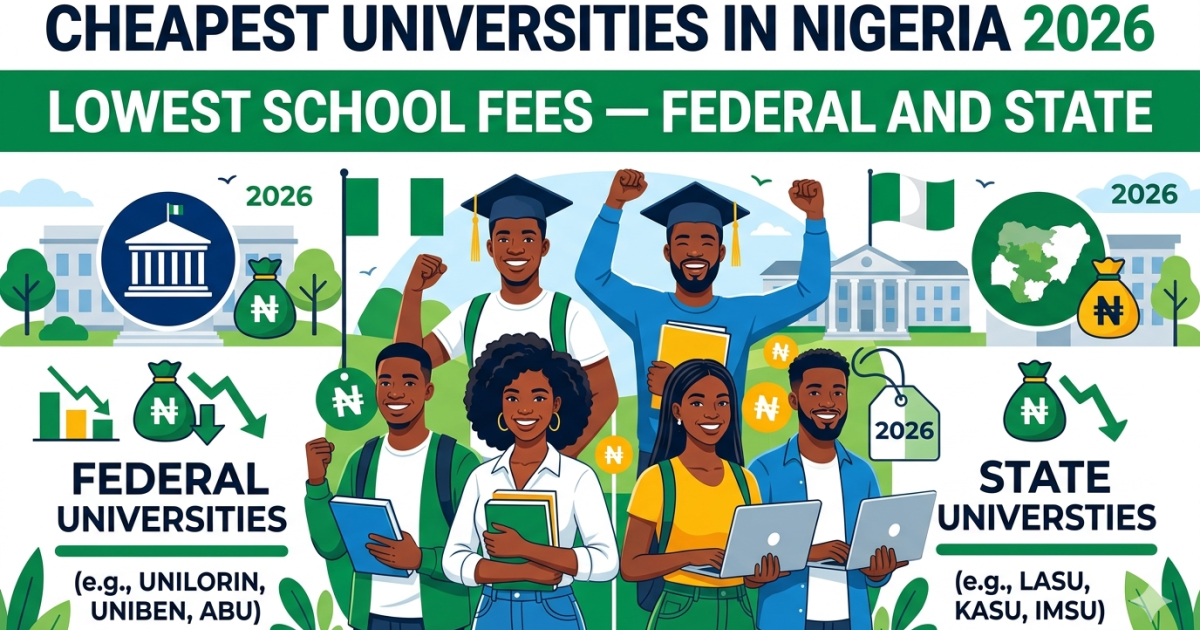
University education in Nigeria spans an enormous range of cost — from federal universities where annual school fees can be as low as ₦20,000–₦60,000 per year to private universities charging ₦500,000–₦3,000,000+ annually. For millions of Nigerian families, the difference between an affordable and an unaffordable university is the difference between a child going to university and not going at all. This guide gives you the most current and complete information on the cheapest universities in Nigeria in 2026 — federal and state — with actual fee figures, the full list of Nigeria’s most affordable degree options, and a clear explanation of what factors make some universities dramatically cheaper than others.
Why Federal Universities Are the Cheapest in Nigeria
Federal universities in Nigeria are funded primarily by the Federal Government through annual budget allocations. This federal subsidy means that students pay only a fraction of the actual cost of their education — the government subsidises the rest through academic staff salaries, infrastructure maintenance, and operational expenses paid directly to the universities from the federal budget. The fees students pay at federal universities are therefore not the true cost of education but rather a small contribution to a heavily subsidised system. This federal subsidy is why federal university school fees are dramatically lower than state universities (which receive less federal support and rely more on internally generated revenue) and private universities (which are entirely self-funding through tuition).
The Academic Staff Union of Universities (ASUU) has historically resisted significant fee increases at federal universities, arguing that Nigerian families cannot afford higher fees and that the government must fulfil its constitutional obligation to fund public education adequately. This ongoing tension between university funding needs and fee affordability has kept federal university fees very low in absolute terms — though ASUU has also periodically gone on strike demanding improved government funding, which ironically hurts the students both sides claim to be protecting.
Cheapest Federal Universities in Nigeria 2026 — School Fees
Federal universities in Nigeria are consistently the cheapest degree-granting institutions. School fees at federal universities range from approximately ₦20,000 to ₦60,000 per academic year for most undergraduate programmes. The exact fee varies by institution, faculty, and level — with Science, Engineering, Medical, and professional faculties typically charging slightly more than Arts and Social Science faculties due to laboratory and practical components.
| University | Annual School Fee Range | Location | Notable Strong Programmes |
|---|---|---|---|
| Ahmadu Bello University (ABU) Zaria | ₦20,000 – ₦35,000/year | Kaduna State | Medicine, Engineering, Law, Agriculture |
| University of Ibadan (UI) | ₦20,000 – ₦40,000/year | Oyo State | Medicine, Arts, Sciences, Agriculture |
| University of Nigeria Nsukka (UNN) | ₦20,000 – ₦45,000/year | Enugu State | Medicine, Law, Engineering, Pharmacy |
| Obafemi Awolowo University (OAU) | ₦20,000 – ₦45,000/year | Osun State | Medicine, Law, Sciences, Agriculture |
| University of Lagos (UNILAG) | ₦25,000 – ₦55,000/year | Lagos State | Law, Engineering, Medicine, Business |
| University of Benin (UNIBEN) | ₦25,000 – ₦50,000/year | Edo State | Medicine, Law, Engineering |
| University of Ilorin (UNILORIN) | ₦25,000 – ₦50,000/year | Kwara State | Medicine, Engineering, Law, Education |
| University of Calabar (UNICAL) | ₦20,000 – ₦45,000/year | Cross River State | Medicine, Law, Sciences |
| Bayero University Kano (BUK) | ₦20,000 – ₦40,000/year | Kano State | Sciences, Arts, Education, Agriculture |
| Federal University of Technology Akure (FUTA) | ₦20,000 – ₦45,000/year | Ondo State | Engineering, Science, Technology |
| Nnamdi Azikiwe University (UNIZIK) | ₦25,000 – ₦50,000/year | Anambra State | Medicine, Law, Engineering |
| University of Maiduguri (UNIMAID) | ₦20,000 – ₦40,000/year | Borno State | Sciences, Arts, Agriculture, Medicine |
| Federal University Oye-Ekiti (FUOYE) | ₦15,000 – ₦30,000/year | Ekiti State | Sciences, Education, Engineering |
| Federal University Dutse (FUD) | ₦15,000 – ₦30,000/year | Jigawa State | Sciences, Education, Agriculture |
| Federal University Kashere (FUKASHERE) | ₦15,000 – ₦30,000/year | Gombe State | Sciences, Agriculture, Social Sciences |
Note: These fee ranges reflect published or estimated 2026 academic session fees. Federal university fees are periodically reviewed and may differ slightly by faculty and level. Always verify current fees directly with the university’s bursary or student affairs office before payment. Medical, Pharmacy, Law, and Engineering programmes typically fall at the higher end of each university’s fee range due to additional laboratory and professional training costs.
NOUN: The Cheapest Degree in Nigeria 2026
The National Open University of Nigeria (NOUN) is arguably the cheapest route to an accredited Nigerian degree. NOUN uses a distance learning model — students study primarily through printed and digital course materials, supplemented by face-to-face tutorial sessions at study centres located in all 36 states and the FCT. There are no JAMB requirements for NOUN admission — you need only O’Level credits. This makes NOUN accessible to Nigerians who could not gain conventional university admission through the JAMB/Post-UTME route. NOUN course fees in 2026 start from approximately ₦33,000 per course per semester, and most programmes require between 120 and 180 credit units to complete — meaning total degree costs of approximately ₦400,000–₦800,000 spread across 4–5 years, dramatically lower than any residential university.
Cheapest State Universities in Nigeria 2026
State universities receive state government funding but typically charge higher fees than federal universities because state governments allocate less per-student funding than the federal government does. State university fees vary enormously between states — some northern states have kept fees very low to encourage university access, while some southern state universities charge fees approaching private university levels.
| University | Annual Fee Range | State | Notes |
|---|---|---|---|
| Kano State University of Technology (KUST) | ₦25,000 – ₦45,000 | Kano | Technical focus; science and engineering |
| Kaduna State University (KASU) | ₦25,000 – ₦50,000 | Kaduna | Multi-faculty; affordable northern fees |
| Benue State University (BSU) | ₦30,000 – ₦60,000 | Benue | North-Central; reasonable fees |
| Imo State University (IMSU) | ₦40,000 – ₦80,000 | Imo | South-East state university |
| Ekiti State University (EKSU) | ₦35,000 – ₦70,000 | Ekiti | South-West; moderate fees |
| Niger Delta University (NDU) | ₦40,000 – ₦80,000 | Bayelsa | Oil-producing state; some funding support |
| Lagos State University (LASU) | ₦80,000 – ₦250,000 | Lagos | Higher fees reflecting Lagos cost base |
| Rivers State University (RSU) | ₦60,000 – ₦150,000 | Rivers | Oil-belt fees; higher than most state unis |
Hidden Costs Beyond School Fees: The Full Cost of University in Nigeria
Focusing only on the annual school fee figure significantly underestimates the true cost of university education in Nigeria. Many additional costs — some official, some unofficial — accumulate over the course of a degree programme. Understanding the full cost picture helps families budget realistically.
Acceptance Fee
A one-time fee paid when you accept an offer of admission. At federal universities, acceptance fees range from ₦10,000–₦30,000. At state universities, ₦20,000–₦75,000. At private universities, ₦50,000–₦200,000.
Accommodation (Hostel Fees)
On-campus hostel accommodation at federal universities ranges from ₦20,000–₦80,000 per academic year for a bed space. Many students cannot secure on-campus accommodation (limited spaces relative to student population) and must rent off-campus — adding ₦100,000–₦400,000 per year in rent depending on the university town. Off-campus accommodation is often the single largest additional cost for university students beyond tuition.
Departmental Levies and Dues
Most university departments charge additional levies for: laboratory consumables, departmental association dues, departmental journal subscriptions, examination conduct fees, and various other departmental running costs. These levies are typically ₦5,000–₦30,000 per session in total and are rarely disclosed in the main school fees schedule — they are charged separately at departmental level and must be paid to complete registration.
Course Materials and Textbooks
Prescribed textbooks for university courses are often expensive — a single recommended textbook can cost ₦5,000–₦30,000 new, and some courses require multiple textbooks. Students who cannot afford to buy all recommended texts typically share with coursemates or rely on university library copies (which may have limited availability for high-demand texts). Digital alternatives (PDFs, Google Books, OpenLibrary, Project Gutenberg for public domain texts) significantly reduce this cost for students with reliable internet access.
Feeding and Personal Expenses
A university student’s monthly feeding budget in 2026 ranges from approximately ₦30,000–₦80,000 depending on location and lifestyle. At university town prices, eating two meals daily from campus canteens or nearby food stalls costs approximately ₦1,000–₦2,500 daily. Transport within and to/from campus adds ₦3,000–₦15,000 monthly. Personal care, mobile data, airtime, and social expenses add another ₦10,000–₦30,000 monthly. Total student living costs (accommodation, feeding, transport, personal) of ₦80,000–₦200,000 per month are realistic for most Nigerian university cities — dwarfing the annual school fee at federal universities.
Scholarships and Financial Aid for Nigerian University Students 2026
Despite the relatively low fees at federal universities, the total cost of attendance (including accommodation, feeding, and personal expenses) is still unaffordable for many Nigerian families. Several scholarship and financial aid programmes exist to support deserving students:
- Federal Government Scholarship Board (FGOSB): Offers scholarships to outstanding Nigerian students — undergraduate, postgraduate, and overseas. Apply at scholarship.gov.ng. Selection is competitive and based on academic excellence
- State Government Scholarships: Many state governments offer bursaries and scholarships to students from the state studying at any university. Contact your state’s scholarship board or ministry of education
- Niger Delta Development Commission (NDDC) Scholarship: For students from the nine oil-producing states of the Niger Delta — one of Nigeria’s most generous scholarship schemes, covering tuition and stipend
- MTN Nigeria Foundation Scholarship: Competitive merit-based scholarship for Nigerian undergraduates — apply at mtn.ng/foundation during announced application windows
- University-Specific Bursaries: Many universities have internally funded bursaries for financially disadvantaged students — enquire at your university’s student welfare or dean of student affairs office
- TETFUND Academic Staff Training and Research: For students pursuing postgraduate education — TETFUND funds academic staff development at Nigerian universities, creating a pipeline of funded postgraduate opportunities
Polytechnics and Colleges of Education: Even Cheaper Than Universities
For students who cannot gain university admission but still want a nationally recognised tertiary qualification, federal polytechnics and colleges of education offer programmes that are even cheaper than federal universities in many cases. Federal polytechnic HND (Higher National Diploma) fees typically range from ₦15,000–₦40,000 per year — comparable to or below the cheapest federal university fees. The HND is a legitimate professional qualification that many employers accept for entry-level professional positions, and HND holders can later convert to a degree through top-up degree programmes offered by universities. Federal colleges of education (offering the NCE — Nigeria Certificate in Education) are similarly priced at ₦15,000–₦40,000 per year and produce Nigeria’s primary and junior secondary school teachers — a critical and employment-secure profession.
Private Universities: What They Cost and When They’re Worth It
Private universities in Nigeria charge dramatically more than federal and state institutions — annual fees ranging from ₦300,000 to ₦3,000,000+ depending on the institution and programme. However, private universities offer specific advantages that make them rational choices for some students and families: guaranteed academic calendar (no ASUU strikes), better campus infrastructure at leading institutions, smaller class sizes and more individualised attention, and stronger alumni networks at prestigious private institutions. The question of whether a private university is “worth it” depends on the specific institution’s reputation, programme quality, and graduate employment outcomes relative to its cost premium over federal alternatives. Landmark University, Covenant University, American University of Nigeria, and a few others have built genuinely strong reputations — but the vast majority of Nigeria’s 70+ private universities do not offer programme quality sufficient to justify their premium over federal university education.
Frequently Asked Questions — Cheapest Universities Nigeria 2026
Which federal university has the lowest school fees in Nigeria?
Newer federal universities — Federal University Oye-Ekiti (FUOYE), Federal University Dutse (FUD), Federal University Kashere, Federal University Lafia, and similar institutions established after 2011 — typically charge the lowest fees among federal universities: ₦15,000–₦30,000 per year. Established federal universities like ABU, UI, and UNN charge ₦20,000–₦45,000 per year. All are dramatically cheaper than any state or private university.
Is NOUN degree accepted in Nigeria?
Yes — NOUN degrees are fully accredited by the National Universities Commission (NUC) and are legally equivalent to degrees from any other NUC-accredited Nigerian university. NOUN graduates can pursue postgraduate study, enter the civil service, register with professional bodies, and apply for jobs on an equal basis with graduates of conventional universities. The common misconception that NOUN degrees are inferior is unfounded in law and in most employers’ practice — though some specific professional registration bodies have historically had requirements that NOUN’s distance learning format did not fully meet for certain professional programmes.
How much is university school fee in Nigeria 2026?
Federal universities: ₦15,000–₦60,000 per year. State universities: ₦25,000–₦250,000 per year (varies enormously by state). Private universities: ₦300,000–₦3,000,000+ per year. NOUN (distance learning): approximately ₦33,000 per course per semester. These figures cover tuition only — accommodation, feeding, departmental levies, and materials add significantly to the total cost of attendance.
🎓 Cheapest Universities Nigeria 2026 — Quick Reference
- Cheapest overall: New federal universities (FUOYE, FUD, etc.) — ₦15,000–₦30,000/year
- Established federal unis (ABU, UI, OAU, UNN): ₦20,000–₦45,000/year
- UNILAG, UNIBEN, UNILORIN: ₦25,000–₦55,000/year
- State universities: ₦25,000–₦250,000/year (varies by state)
- NOUN (distance learning): ~₦33,000/course — no JAMB required
- Private universities: ₦300,000–₦3,000,000+/year
- Polytechnics (federal HND): ₦15,000–₦40,000/year — alternative to university
- Key hidden costs: Accommodation, departmental levies, textbooks, feeding
- Scholarships: FGOSB, NDDC, state scholarships, MTN Foundation, university bursaries
Also read: NOUN School Fees 2026 | JAMB Cut-Off Marks 2026 | NYSC Allowance 2026
What the Federal Government University Subsidy Actually Means for Students
To understand why federal universities are so dramatically cheaper than private ones, it helps to understand the real economics. The National Universities Commission (NUC) and independent analysts estimate that the true cost of educating a Nigerian university student for one year — accounting for academic staff salaries, non-academic staff, infrastructure maintenance, research funding, library resources, laboratory consumables, and utilities — ranges from ₦400,000 to ₦1,500,000+ per student per year depending on the programme (sciences and medicine are most expensive; arts least expensive). A student paying ₦25,000 per year at UI or ABU is paying roughly 2–5% of the actual cost of their education. The federal government covers the other 95–98% through budget allocations to these universities. This extraordinary subsidy — one of the most generous in Africa relative to GDP — is what makes the headline fee figures at Nigerian federal universities so startlingly low.
The flip side of this massive subsidy is that federal universities are chronically underfunded relative to their actual needs. When the government’s allocation falls short of what universities need to operate — as happens regularly given Nigeria’s revenue challenges — the result is poor infrastructure (leaking roofs, broken laboratory equipment, poor internet connectivity), inadequate library resources, delayed salary payments that trigger ASUU strikes, and generally substandard learning environments despite the nominal presence of qualified faculty. The low tuition fee is real — but so is the frequently disappointing quality of facilities and academic calendar stability that comes with it.
Federal University vs State University: Which Gives Better Value?
The comparison between federal and state universities is not always straightforward. Federal universities are cheaper in tuition and enjoy stronger federal funding — but state universities located in major cities (particularly LASU in Lagos) may offer better employment proximity, stronger alumni networks in local industries, and better accommodation options due to their city locations. Here is how the two types compare across key dimensions relevant to students choosing between them:
| Factor | Federal Universities | State Universities |
|---|---|---|
| Annual tuition | ₦15,000 – ₦60,000 | ₦25,000 – ₦250,000 (varies enormously) |
| Government funding stability | Federal allocation — more stable but subject to ASUU strikes | State government allocation — variable; some states chronically underfund |
| Academic calendar | Disrupted by ASUU strikes periodically | Generally less ASUU strike disruption; some have own unions |
| Prestige (employer perception) | Generally higher national prestige | Variable; some state unis (LASU, AAUA) well-regarded regionally |
| Infrastructure | Varies; older federal unis better-equipped | Newer state unis sometimes have more modern facilities |
| Admission competition | More competitive (JAMB + Post-UTME) | Less competitive in many states; wider access |
The ASUU Strike Problem: The Hidden Cost of Federal University Education
Anyone researching the cheapest universities in Nigeria must understand one significant hidden cost: lost time from ASUU strikes. The Academic Staff Union of Universities has conducted multiple extended strikes over the past decade — the most damaging being the 2022 strike that lasted approximately 8 months, adding the equivalent of one academic year to the duration of students’ programmes. A student who enrols in a federal university expecting to complete their degree in 4 years may spend 5 or 6 calendar years in the system due to strike-related delays.
This extended duration has real economic costs: additional years of accommodation expenses, opportunity cost of delayed entry into the workforce, and psychological stress. Many families and students who began federal university education specifically because of the low tuition end up spending more in total than they would have at a slightly more expensive private or state university with a more reliable academic calendar. The ASUU strike risk is a genuine factor to weigh when choosing between the cheapest-tuition federal university and a somewhat more expensive but more academically stable alternative.
Top 10 Strategies for Minimising University Costs in Nigeria 2026
- Choose federal over state: The tuition difference of ₦50,000–₦200,000 per year compounds significantly over 4–5 years
- Secure on-campus accommodation: Campus hostels at ₦20,000–₦80,000 per year are dramatically cheaper than off-campus renting at ₦150,000–₦400,000 per year — apply for hostel allocation as early as possible after admission
- Join a cooperative or catering group: Students who pool food costs by cooking together in groups consistently spend 30–50% less on feeding than those buying individually from canteens or restaurants daily
- Use the library: A student who uses the university library’s textbook and journal resources reduces textbook costs from ₦50,000–₦100,000 per year to near zero — particularly important in the first two years when core texts are heavily used
- Apply for every scholarship you qualify for: Many students leave scholarship money unclaimed simply because they don’t apply — dedicate time each semester to identifying and applying for available scholarships
- Consider NOUN for postgraduate study: If you have an undergraduate degree from a conventional university, NOUN’s MBA and MSc programmes allow you to earn a postgraduate qualification at a fraction of the cost of conventional university postgraduate programmes
- Reduce social spending: Social events, entertainment, and lifestyle spending are the most elastic component of student budgets — conscious reduction during the academic year frees funds for essentials
- Use student discounts consistently: Nigerian banks, transport services, and retailers offer student discounts with valid university ID — always present your student ID before paying for any service
- Consider distance learning for flexibility: If your circumstances allow earning while studying, NOUN’s flexible model generates simultaneous income that offsets the course fees
- Complete your programme efficiently: Every extra semester or year in university adds accommodation, feeding, and fees costs that are often larger than people calculate in advance — avoid carryover courses where possible and maintain the minimum GPA required for continuation
University Strike (ASUU) and How It Affects Fee-Value Calculation
Any honest assessment of the value of cheap federal university education in Nigeria must address the ASUU strike problem. The Academic Staff Union of Universities has gone on strike multiple times in recent years — the most devastating being the 2022 strike that lasted over 8 months, effectively halting an entire academic year for students at most federal universities. During strike periods, students who have paid fees and are enrolled in academic programmes sit idle — losing months of their lives and facing severe mental health impacts from the uncertainty. The cheap annual school fee at a federal university must therefore be weighed against the risk of one or more months of strike-related disruption per academic year. Parents and students who prioritise academic calendar certainty sometimes choose state universities (which rarely join ASUU strikes) or private universities (which never strike on ASUU grounds) over cheaper federal universities precisely to avoid this risk. The value calculation is personal: for families that can absorb the disruption, federal university fees remain unbeatable. For families where time and certainty are critical — for example, a student who must complete their degree by a certain date for employment or visa purposes — the strike risk may make a more expensive but strike-free institution better value overall.
How to Choose the Right Affordable University for Your Course
Beyond looking at the cheapest fees, choosing the right affordable university requires matching the institution’s strength in your chosen field with the fee you can afford. A cheap university with poor accreditation or weak programme ranking in your field may cost less annually but produce a degree that opens fewer doors than a slightly more expensive institution with strong programme accreditation and employer recognition. Here is a systematic approach to choosing the right affordable university for your specific situation:
Step 1: Confirm NUC Accreditation for Your Programme
Not all programmes at all Nigerian universities have current NUC accreditation. The National Universities Commission (NUC) accredits specific programmes at specific institutions — not the university as a whole. A university can be fully recognised by NUC but have specific departments whose programmes are conditionally accredited or pending full accreditation. Before accepting any university admission offer, verify that the specific programme (not just the university) has current, full NUC accreditation. Check at nuc.edu.ng — the NUC lists accreditation status for all programmes at all Nigerian universities. Studying an unaccredited or conditionally accredited programme means your degree may not be recognised for professional registration, civil service employment, or further academic study.
Step 2: Research Employer Perception
Some universities — though fully accredited — have reputations with Nigerian employers that affect their graduates’ employability. ABU, UI, OAU, UNILAG, UNN, and UNIBEN graduates are recognised and respected by most major Nigerian and international employers. Graduates of newer or lesser-known federal and state universities may face additional scrutiny or bias in competitive job markets — though this varies significantly by industry. Research your target industries’ hiring patterns: if you want to work in banking, finance, or consulting, the institution’s reputation matters more than in government employment or teaching, where NUC accreditation and NYSC discharge certificate are the primary criteria.
Step 3: Calculate Total Cost of Attendance, Not Just Fees
As demonstrated earlier in this guide, the annual school fee is only a fraction of total university cost. Before deciding that University A at ₦20,000/year is “cheaper” than University B at ₦80,000/year, calculate the full cost: accommodation (is University B in a cheaper town?), feeding, transport, and the time cost of any ASUU strikes at University A. A university with slightly higher fees but in a cheaper city, with better hostel availability, and without strike history may be genuinely cheaper in total cost of attendance than a university with lower fees but higher living costs and frequent academic disruptions.
Federal University Vs Private University: A Worked Cost Comparison
To make the cost difference concrete, here is a worked 4-year total cost comparison between a federal university and a mid-range private university for a student from Lagos studying a Business Administration programme:
| Cost Item | Federal University (ABU, OAU, UNN) | Mid-Range Private University |
|---|---|---|
| Annual tuition | ₦30,000 | ₦600,000 |
| Annual accommodation | ₦200,000 (off-campus est.) | ₦200,000 (often mandatory on-campus) |
| Annual feeding | ₦300,000 | ₦300,000 |
| Departmental levies | ₦20,000 | ₦50,000 |
| Annual transport (home visits) | ₦50,000 | ₦50,000 |
| Total annual cost | ₦600,000 | ₦1,200,000 |
| 4-year total cost | ₦2,400,000 | ₦4,800,000 |
| Strike risk additional time cost | Possible 6–18 months delay | None |
The ₦2,400,000 cost difference between a federal and a mid-range private university over 4 years is substantial — representing a genuine and significant financial decision. For families who can absorb the strike risk and the less certain academic calendar, federal universities remain exceptional value. For those who cannot, the private university premium buys certainty, infrastructure, and an uninterrupted academic experience.
The Real Reason Nigerian University Fees Have Risen
Federal university school fees in Nigeria appear remarkably low — ₦15,000–₦60,000 per year — when measured against the actual cost of delivering university education. The disconnect between fee levels and real costs has a long and politically charged history. For decades, ASUU consistently blocked fee increases by threatening and executing strikes, arguing that higher fees would exclude poor Nigerians from access to higher education. This position, while sympathetic in intent, created a structural funding crisis: universities received insufficient revenue to maintain infrastructure, hire qualified staff, equip laboratories, and run quality academic programmes. The resulting cycle — inadequate fees, inadequate funding, deteriorating infrastructure, ASUU strikes demanding more government funding, partial government response, repeat — has characterised Nigerian public university education for 30 years. The 2022–2023 ASUU strike (the longest in Nigerian history at over eight months) highlighted the urgency of resolving this funding model crisis. Some reform advocates argue that a cost-reflective fee increase (to ₦200,000–₦500,000 per year for federal universities) paired with a robust scholarship and student loan system would better serve Nigerian higher education than the current low-fee, low-quality model. The Nigerian Education Loan Fund (NELFUND), launched in 2024, represents a step toward making higher fees manageable through student loans repayable after graduation — though implementation and uptake are still developing in 2026.
Nigerian Education Loan Fund (NELFUND) 2026: How It Works
The Nigerian Education Loan Fund — launched by the Federal Government in 2024 — is a student loan scheme designed to help Nigerian students finance their university education and repay the loans after graduation. In 2026, NELFUND is operational and processing applications. Key features confirmed from NELFUND’s official communications:
- Eligibility: Nigerian students admitted to NUC-accredited universities, polytechnics, and colleges of education
- What is covered: School fees (tuition) and a living allowance component to help with accommodation and feeding
- Repayment: Begins 2 years after graduation, deducted from salary through the tax system. Repayment rate is 10% of income monthly until loan is cleared — income-contingent, meaning low earners pay less
- Interest rate: Government-subsidised — significantly below commercial loan rates
- How to apply: Through the NELFUND portal at nelfund.gov.ng, using your NIN and student ID after gaining university admission
- Coverage: All federal and state universities initially; expanding to polytechnics and colleges of education
NELFUND changes the affordability calculus for Nigerian university education significantly. A student who cannot afford ₦60,000 in annual federal university fees upfront can now access a loan covering those fees (and living expenses) and repay only after they are employed — eliminating the upfront financial barrier to university access. For students considering more expensive state or private universities, NELFUND potentially makes those options accessible for families that could not previously afford the fees upfront. Apply at nelfund.gov.ng immediately after receiving your university admission offer.
Cost Comparison: Federal University vs Private University — Is the Price Difference Worth It?
The most frequently asked question by Nigerian families choosing between a federal university (₦20,000–₦60,000/year) and a private university (₦500,000–₦3,000,000/year) is whether the private university’s much higher cost delivers correspondingly better outcomes. The honest answer, based on graduate employment data and academic quality assessments, is: it depends entirely on the specific private university.
A small number of Nigerian private universities — Covenant University (Ota), Landmark University (Omu-Aran), American University of Nigeria (AUN Yola), Afe Babalola University (ABUAD), and a few others — genuinely deliver better outcomes than average federal universities in their strong programme areas: better infrastructure, more stable academic calendars (no ASUU strikes), smaller class sizes, stronger industry connections, and demonstrably higher graduate employment rates. For these institutions, the fee premium can be justified for families who can afford it and whose children gain admission to strong programmes there.
However, the majority of Nigeria’s 70+ private universities — particularly the smaller, newer, or less well-resourced ones — do not deliver outcomes substantially better than federal universities, despite charging fees 10–50 times higher. A degree from ABU Zaria (₦30,000/year) or University of Ibadan (₦25,000/year) carries more employer recognition and academic credibility than degrees from most mid-tier private universities at ₦800,000+/year. The decision should be based on comparing the specific institution, specific programme, and specific career outcome data — not on the assumption that all private universities are uniformly better than all federal universities.
How to Minimise the Total Cost of University in Nigeria
Regardless of which university you attend, there are strategies that significantly reduce the total financial burden of a Nigerian university education:
- Apply for NELFUND loan: The student loan scheme covers tuition and living expenses — use it to avoid the immediate financial burden of fees
- Apply for every scholarship you qualify for: FGOSB, NDDC (for Niger Delta students), state government scholarships, MTN Foundation, and university internal bursaries — multiple simultaneous applications are allowed and encouraged
- Secure on-campus accommodation: Apply for hostel accommodation immediately upon admission — on-campus is significantly cheaper than off-campus renting in university towns
- Join a student cooperative for bulk buying: Food and essential items bought collectively with coursemates at wholesale markets are significantly cheaper than individual retail purchasing
- Use free digital learning resources: OpenLibrary, Google Scholar, ResearchGate, and university library digital portals provide access to academic texts that would otherwise cost thousands of naira per book
- Minimise course repetition: Failed courses mean repeated fees. Attend classes, study consistently, and seek tutorial support early rather than waiting for examination failures that add cost and time to your degree
- Consider NOUN if full-time residential study is not essential: For suitable programmes where distance learning is appropriate, NOUN’s dramatically lower total cost may be the most financially rational choice
How to Choose the Right Cheap University for You
Low fees are an important factor in choosing a university — but they should not be the only factor. A university that charges ₦20,000 per year but consistently produces graduates who struggle to find employment in their field, whose lecturers are perpetually on strike, or whose degree is not recognised by relevant professional bodies has a hidden cost that far exceeds the fee savings. Here is how to balance affordability with quality when selecting a Nigerian university in 2026:
NUC Accreditation: Non-Negotiable
All legitimate Nigerian universities must be accredited by the National Universities Commission (NUC). Programmes within universities must also be individually accredited for the degrees they offer to be recognised. Before enrolling at any university — regardless of how cheap its fees are — verify that: (a) the university itself is NUC-listed (check nuc.edu.ng for the full list of accredited institutions), and (b) your specific programme has NUC accreditation. Unaccredited programmes produce degrees that professional bodies will not accept for registration, employers may not recognise, and that are legally questionable. Some universities have overall NUC approval but have specific programmes that have lost accreditation or have never been accredited — this matters and must be verified for your specific course.
ASUU Strike History
Federal universities have collectively lost years of academic time to ASUU strikes — the most recent extended strike (2022) kept federal university students out of classrooms for over eight months. This is a real cost that doesn’t appear in the fee schedule: a degree programme nominally lasting 4 years may take 5–7 years to complete at a strike-prone institution, delaying your entry into the workforce and increasing total living costs substantially. When evaluating federal universities, consider their recent strike history, the length of time students have lost in recent years, and whether your personal circumstances can accommodate extended delays. Newer federal universities and some state universities have had less disruptive strike histories than the older, more politically charged institutions.
Location and Cost of Living
A university that charges ₦20,000 per year in a city where accommodation costs ₦300,000 per year and food is expensive may cost more total than a university charging ₦80,000 per year in a cheaper city. University of Lagos (UNILAG) has relatively higher fees among federal universities but is located in Lagos — where accommodation costs are extreme. Conversely, a university like ABU Zaria or Bayero University Kano charges very low fees in cities with significantly lower accommodation and food costs. Calculate total cost of attendance — not just tuition — for each university on your shortlist before making a final decision.
Programme Strength
The cheapest university is rarely the best choice if it does not have a strong programme in your specific field. For Medicine: University of Ibadan, ABU, OAU, UNILAG, and UNICAL have the strongest reputations and the best clinical training infrastructure. For Law: OAU, UNILAG, UNIBEN, and ABU are consistently the most competitive. For Engineering: ABU, OAU, UNILAG, and the Federal Universities of Technology (FUTA, FUT Minna, FUT Yola). For Computer Science: UNILAG, ABU, UNILORIN, and Federal University of Technology institutions. Identify where your specific programme has the strongest reputation, strongest industry connections, and best graduate employment outcomes — then assess whether the fee premium (if any) is justified by these advantages.
Fee Payment Methods at Nigerian Universities
All federal and state universities in Nigeria now process school fee payments exclusively through the Remita payment platform — cash payments at university bursaries are no longer accepted. Here is how the payment process works: visit your university’s student portal, log in with your student ID and password, navigate to “Fee Payment” or “Remita Payment,” generate your payment invoice (which includes a Remita Retrieval Reference — RRR number), pay through the Remita platform using your debit card or internet banking (all major Nigerian banks are supported), and download your payment receipt. The receipt is your proof of payment — keep it securely as evidence for any payment dispute. Never pay cash to any university official or intermediary claiming to handle school fee payments on behalf of the university — all legitimate payments go through Remita on the official university portal.
Nigerian University Fee Reforms: What’s Changing in 2026
The question of Nigerian university fees has become increasingly urgent in 2026. Federal universities have been pushing for significant fee increases — arguing that ₦20,000–₦60,000 per year is completely inadequate to fund modern university operations when the minimum wage is ₦70,000 monthly and university operational costs have escalated with inflation. ASUU and student bodies have historically resisted such increases, arguing that higher fees will exclude the poorest Nigerians from federal university education. The Federal Government has been exploring a means-tested approach — where wealthy families pay more and genuinely poor students receive subsidies — rather than a blanket fee increase that affects all students equally. No final policy has been implemented as of the time of writing, but the trajectory strongly suggests that federal university fees will increase substantially within the next 2–3 years. Students and families planning university attendance should factor this possibility into their financial planning — the ₦20,000–₦60,000 annual fee era at federal universities may be approaching its end.
Frequently Asked Questions — Cheapest Universities Nigeria 2026
What is the cheapest university in Nigeria in 2026?
Newer federal universities — including Federal University Oye-Ekiti (FUOYE), Federal University Dutse (FUD), Federal University Kashere, and Federal University Lafia — charge the lowest official annual fees among Nigerian universities, typically ₦15,000–₦30,000 per year. NOUN (distance learning) is even cheaper for those who qualify — approximately ₦33,000 per course with no residential costs. All federal universities are significantly cheaper than state or private universities.
Can you go to university for free in Nigeria?
Not entirely free, but scholarship holders at federal universities effectively pay nothing in tuition. The Federal Government Scholarship Board (FGOSB), state government scholarships, NDDC scholarships (for Niger Delta students), and various private scholarships cover tuition and sometimes accommodation and stipend for selected beneficiaries. Achieving a scholarship requires strong academic performance — typically top grades in O’Level, JAMB, and strong Post-UTME performance. For non-scholarship students, federal university fees of ₦15,000–₦60,000 per year are among the cheapest in the world for accredited degree programmes.
How to Choose Between Federal Universities: Beyond Just Fee Comparison
All federal universities are cheap — so when choosing among them, fee differences of ₦5,000–₦20,000 per year should not drive your decision. More important factors for long-term career outcomes include programme accreditation status, academic calendar stability, location relative to your state of origin, campus security and safety record, specific faculty and departmental reputation in your chosen field, alumni network strength, and proximity to relevant industry hubs. A student studying Mass Communication will benefit from UNILAG’s proximity to Lagos media companies. A student studying Agriculture benefits from ABU Zaria or University of Agriculture Makurdi’s farm infrastructure and agricultural industry connections. An Engineering student benefits from the established industry partnerships at universities like FUTA, ABU, and OAU. Research your specific programme’s ranking and employer preference at your shortlisted universities — not just the school fees. The NUC (National Universities Commission) accreditation status of your specific programme at your chosen institution is the most critical check: a programme that is not accredited by the NUC cannot legally issue a degree that is recognised for professional practice or public service employment. Verify NUC accreditation status at nuc.edu.ng before enrolling.
ASUU Strikes and Academic Calendar: The Hidden Cost of Federal Universities
Any honest guide to federal universities must acknowledge the elephant in the room: the Academic Staff Union of Universities (ASUU) and its history of industrial action. ASUU strikes have extended the nominal 4-year undergraduate programme to 5, 6, or even 7 years for students caught in multiple protracted strike actions. The longest recent ASUU strike — the 2022 strike that lasted 9 months — effectively added almost a full academic year to the programmes of all students enrolled during that period. This is a real, significant cost that rarely appears in fee comparison tables but is profoundly important: a student who spends 6 years completing a 4-year programme at a federal university loses 2 years of potential earnings from earlier graduate employment, 2 years of career development, and 2 years of life progression. The “cheap” federal university can become more expensive in real terms than a more expensive private university with a reliable 4-year calendar if strikes add 2 years to the programme. This is not an argument against federal universities — which remain the best value proposition for most Nigerian students — but an honest acknowledgement that the low fees must be weighed against academic calendar uncertainty. Students who enter federal universities should have a contingency plan for strike periods: productive use of strike time through online learning, certification courses, internships, or income-generating activities that keep career development moving even when the formal academic calendar is paused.
Student Loans for University in Nigeria 2026
In 2024, the Nigerian government launched the Students Loan Scheme through the Nigerian Education Loan Fund (NELFUND) — a major policy intervention designed to provide interest-free loans to Nigerian students who cannot afford university education. The scheme is intended to cover school fees and living expenses, with repayment beginning after graduation when the graduate is earning above a specified income threshold. In 2026, the scheme is in its operational phase — students can apply through nelfund.gov.ng. Key features confirmed for 2026: loans cover school fees and stipend for living expenses; repayment begins after graduation when earning begins; the loan is interest-free; application requires NIN, BVN, and proof of admission to an accredited Nigerian tertiary institution. The NELFUND student loan scheme has the potential to be transformative for Nigerian university access — if fully implemented at scale, it could enable students from very low-income backgrounds to attend even mid-cost state universities without family financial strain. Check nelfund.gov.ng for current application status, eligible institutions, and loan amounts available for your academic session.
New Federal Universities 2026: The Least Known Cheapest Options
Since 2011, the Federal Government has established 9 new federal universities — one in each previously underserved state. These newer institutions — Federal University Oye-Ekiti (Ekiti), Federal University Dutse (Jigawa), Federal University Kashere (Gombe), Federal University Lafia (Nasarawa), Federal University Lokoja (Kogi), Federal University Ndufu-Alike Ikwo (Ebonyi), Federal University Birnin-Kebbi (Kebbi), Federal University Gashua (Yobe), and Federal University Wukari (Taraba) — are among the cheapest universities in Nigeria with fees as low as ₦15,000–₦30,000 per year. They are also among the least competitive in terms of JAMB cut-off scores for many programmes — making them accessible options for candidates with JAMB scores of 150–180 who cannot gain admission to the more selective established universities. The trade-offs: these newer universities have smaller infrastructure, shorter institutional histories, and developing alumni networks compared to the established federal universities. However, their NUC-accredited programmes produce legally equivalent degrees, and a student who graduates from FUKASHERE with a strong academic record and relevant professional experience is a competitive candidate for employment on the same basis as graduates of older institutions. For budget-constrained families whose child has a moderate JAMB score, a newer federal university offers an accredited degree at the absolute lowest possible tuition cost in Nigeria.
Total Cost of Attendance: Federal University vs Private University Comparison
When Nigerian families evaluate university affordability, comparing only the official tuition fee misses most of the actual financial picture. The total cost of attendance — including tuition, accommodation, feeding, transport, books, and personal expenses — gives a more honest picture of what university actually costs per year. Here is a realistic full-year cost comparison across different university types for 2026:
| Expense | Federal University (e.g. UI, ABU) | State University (e.g. LASU) | Mid-Range Private (e.g. Landmark) |
|---|---|---|---|
| Annual tuition | ₦20,000 – ₦45,000 | ₦80,000 – ₦250,000 | ₦600,000 – ₦1,200,000 |
| Hostel / accommodation | ₦50,000 – ₦400,000 (on/off campus) | ₦60,000 – ₦350,000 | ₦200,000 – ₦500,000 (on campus compulsory at many private unis) |
| Feeding (annual) | ₦360,000 – ₦720,000 | ₦360,000 – ₦720,000 | ₦360,000 – ₦720,000 |
| Departmental levies | ₦10,000 – ₦40,000 | ₦15,000 – ₦60,000 | Typically included in high tuition |
| Textbooks and materials | ₦20,000 – ₦80,000 | ₦20,000 – ₦80,000 | ₦20,000 – ₦80,000 |
| Transport | ₦30,000 – ₦100,000 | ₦30,000 – ₦100,000 | ₦20,000 – ₦60,000 (smaller campuses) |
| Personal/social | ₦60,000 – ₦150,000 | ₦60,000 – ₦150,000 | ₦60,000 – ₦200,000 |
| Total annual cost estimate | ₦550,000 – ₦1,535,000 | ₦625,000 – ₦1,710,000 | ₦1,260,000 – ₦2,760,000 |
This table reveals something important: the gap between federal and state universities is narrower than tuition fees alone suggest — because accommodation, feeding, and personal expenses are broadly similar regardless of which university you attend. The biggest savings at federal universities come from the dramatically lower tuition, which saves ₦55,000–₦1,155,000 per year compared to private university tuition. Over a 4-year degree, this tuition saving alone amounts to ₦220,000–₦4,620,000 — a transformative financial difference for Nigerian families.
ASUU Strikes and What They Mean for Federal University Students
The elephant in the room when discussing federal universities is ASUU (Academic Staff Union of Universities) strikes — periodic work stoppages by academic staff demanding improved government funding, better salaries, and implementation of agreements with the government. ASUU strikes have disrupted federal university academic calendars multiple times in the past decade, with the most damaging being the 2022 strike that lasted 8 months — keeping students at home for most of the academic year before a court order and government negotiations resolved the impasse. For families considering the cheapest university option, ASUU strikes are a real cost factor: months of lost academic time, extended degree completion timelines, emotional stress on students, and the lost opportunity cost of students’ time during strike periods. Private universities — which have no ASUU affiliation — are entirely immune to these strikes, which is one of the primary reasons some families pay the premium for private university education despite the dramatically higher cost. The question “should we choose a cheaper federal university that may strike, or a more expensive private university with a guaranteed calendar?” is genuinely complex and the right answer depends on each family’s financial situation, risk tolerance, and the specific universities being compared.
How to Reduce the Cost of University Education in Nigeria
Even at the cheapest federal universities, the total cost of attendance can strain family finances. Here are proven strategies Nigerian students and families use to reduce the financial burden of university education:
- Apply for every available scholarship: Federal Government, state government, NDDC, MTN Foundation, and university-specific bursaries — apply for all that you qualify for simultaneously. Even partial scholarships of ₦50,000–₦150,000 per year make a meaningful difference
- Choose on-campus accommodation where available: On-campus hostel accommodation at federal universities costs ₦20,000–₦80,000 per year — a fraction of off-campus rents. Competition for campus accommodation is fierce, but winning a hostel space dramatically reduces accommodation costs
- Freelance and earn online during university: Students with skills in writing, graphic design, coding, or social media management can generate meaningful income online while studying — see our guide on How to Make Money Online Nigeria 2026
- Use the university library maximally: Prescribed textbooks are available for borrowing at the university library — visit early in the semester before popular copies are all reserved, and build relationships with departmental library staff who can notify you when copies are returned
- Cook rather than eating out: Campus cooking (where accommodated) or shared cooking with housemates can reduce monthly feeding costs by 30–50% versus buying all meals from campus canteens or nearby food vendors
- Choose a university in your home state: Studying in your home state often allows you to live with family during holidays and sometimes during term, dramatically reducing accommodation costs. Some students at federal universities in their home city commute from home rather than paying hostel fees
ASUU Strikes and Their Impact on Federal University Value
One factor that complicates the value proposition of cheap federal university education is the long history of Academic Staff Union of Universities (ASUU) strikes that have disrupted academic calendars at federal universities. Between 2009 and 2023, ASUU strikes at federal universities cumulatively added years to the time students spent completing their degrees — a student who enrolled expecting a 5-year medical programme might spend 7–8 years due to repeated strike-caused delays. The strikes arise from ASUU’s ongoing disputes with the Federal Government over funding, staff welfare, university infrastructure, and the University Transparency Accountability Solution (UTAS) payment system. While low fees are genuinely valuable, the risk of academic calendar disruption at federal universities is a real cost that should factor into any comparison with private universities (which are not subject to ASUU strikes) or NOUN (which has also experienced minimal strike disruption as a distance learning institution). Between 2023 and 2026, ASUU-federal government relations have been relatively more stable following some agreement implementations — but the underlying disputes remain and the strike risk, while currently lower, has not been eliminated.
How to Choose Between Federal Universities in Nigeria 2026
If you have a competitive JAMB score and your chosen course is available at multiple federal universities, how do you decide between them? Fee differences between federal universities are generally small — ₦5,000–₦20,000 per year. The more meaningful differentiators are: programme reputation and ranking, post-graduation employment outcomes, geographic location and cost of living in the university town, and the specific departmental strength for your course. Here is a programme-by-programme guide to which federal universities are strongest in key disciplines:
| Programme | Top Federal Universities | Strong Alternatives |
|---|---|---|
| Medicine and Surgery | UI (Ibadan), UNILAG, OAU, ABU, UNICAL | UNIBEN, UNILORIN, UNN, UNIMAID |
| Law | OAU, UNILAG, ABU, UNIBEN | UNN, UNILORIN, UNICAL |
| Pharmacy | OAU, UNILAG, UNILORIN | UNN, UNIZIK, UNIBEN |
| Engineering | UNILAG, OAU, ABU, FUTs (FUTA, FUTMINNA) | UNN, UNIBEN, FUOYE |
| Computer Science | UNILAG, UI, OAU | ABU, UNN, FUOYE, FUNAAB |
| Agriculture | FUNAAB (Federal University of Agriculture Abeokuta), UI, ABU | UNAAB, FUNAAB, MOUAU |
| Mass Communication | UNILAG, ABU | UNIJOS, EBSU |
| Education | UI, ABU, UNILORIN | Most federal universities with education faculties |
The True Cost of a University Education in Nigeria: A Five-Year Budget
To help families plan realistically, here is a five-year total cost of attendance estimate for a student studying at a federal university versus a private university versus NOUN in 2026, assuming the student is from outside the university’s state and must pay for accommodation:
| Cost Category | Federal University (5 years) | Private University (5 years) | NOUN (5 years, living at home) |
|---|---|---|---|
| Tuition/course fees | ₦125,000 – ₦275,000 | ₦1,500,000 – ₦15,000,000 | ₦1,320,000 – ₦1,980,000 |
| Accommodation | ₦500,000 – ₦2,000,000 | ₦500,000 – ₦2,500,000 | ₦0 (living at home) |
| Feeding | ₦1,800,000 – ₦4,800,000 | ₦1,800,000 – ₦4,800,000 | ₦600,000 – ₦1,500,000 (shared home) |
| Transport | ₦300,000 – ₦900,000 | ₦300,000 – ₦900,000 | ₦180,000 – ₦600,000 (to study centre) |
| Materials, levies, misc | ₦300,000 – ₦800,000 | ₦500,000 – ₦2,000,000 | ₦100,000 – ₦300,000 |
| Total (5 years) | ₦3,025,000 – ₦8,775,000 | ₦4,600,000 – ₦25,200,000 | ₦2,200,000 – ₦4,380,000 |
This comparison makes clear that NOUN — for a student who can manage the self-directed study requirements and who lives near a study centre — is genuinely the cheapest path to a Nigerian degree in total cost terms. Federal universities, while cheap on tuition, become significantly more expensive once accommodation and living costs in university towns are factored in. Private universities are dramatically more expensive across all cost categories. The federal university advantage is greatest for students who can live at home near the campus — which is the case for a minority of students at most universities given limited campus accommodation.
How ASUU Strikes Affect the Value of Cheap Federal University Education
Federal university education in Nigeria is extraordinarily affordable — but it comes with a well-documented hidden cost: Academic Staff Union of Universities (ASUU) strikes that periodically shut down all federal universities for months at a time. Nigeria’s most damaging ASUU strike lasted from February to December 2022 — a full ten months during which students could not attend lectures, write examinations, or make academic progress. The cumulative effect of ASUU strikes over a typical 4-year federal university degree programme has extended many students’ graduation timelines to 5, 6, or even 7 years. This extended timeline is its own cost — an extra year in university means another year of accommodation, feeding, and personal expenses, plus a year’s delay in entering the workforce and beginning to earn income.
The root cause of ASUU strikes is consistently the same: federal government failure to honour agreements on university funding, improved remuneration for academic staff, and development of university infrastructure. Until these structural issues are resolved — through sustained adequate funding of federal universities — the strike risk remains a permanent feature of federal university education that prospective students and their families must factor into their planning. Private universities, which are not unionised under ASUU, do not face this risk — their higher fees buy (among other things) calendar certainty. For students and families who need predictable academic timelines, this certainty has real financial value despite the higher cost.
Best Cheap Universities by Region — Nigeria 2026
For students who want to study close to home while accessing affordable federal university education, here is a breakdown of the best affordable options by geopolitical zone:
| Zone | Recommended Affordable Federal University | Annual Fee Range | Strong Areas |
|---|---|---|---|
| South-West | Obafemi Awolowo University (OAU); FUTA (Akure); University of Ibadan | ₦20,000 – ₦45,000 | Medicine, Law, Sciences, Engineering |
| South-East | University of Nigeria Nsukka (UNN); UNIZIK (Awka) | ₦20,000 – ₦50,000 | Medicine, Law, Engineering, Pharmacy |
| South-South | University of Benin (UNIBEN); University of Calabar (UNICAL); Federal University Otuoke | ₦20,000 – ₦50,000 | Medicine, Sciences, Law |
| North-West | Ahmadu Bello University (ABU); Bayero University Kano (BUK) | ₦20,000 – ₦40,000 | Medicine, Engineering, Agriculture, Law |
| North-Central | University of Ilorin (UNILORIN); Federal University of Agriculture Makurdi (FUAM) | ₦20,000 – ₦50,000 | Medicine, Agriculture, Engineering, Education |
| North-East | University of Maiduguri (UNIMAID); Abubakar Tafawa Balewa University (ATBU) | ₦20,000 – ₦45,000 | Sciences, Engineering, Agriculture, Medicine |
Calculating the True Annual Cost of Attending a Cheap Federal University
To help families plan accurately, here is a realistic total annual cost breakdown for a student attending a federal university in a mid-size university town (not Lagos or Abuja) in 2026:
| Expense Item | Low Estimate (₦/year) | Mid Estimate (₦/year) | High Estimate (₦/year) |
|---|---|---|---|
| School fees (official) | ₦20,000 | ₦40,000 | ₦60,000 |
| Acceptance fee (year 1 only) | ₦10,000 | ₦20,000 | ₦30,000 |
| Accommodation (on campus) | ₦30,000 | ₦60,000 | ₦120,000 |
| Accommodation (off campus if not on) | ₦120,000 | ₦200,000 | ₦360,000 |
| Feeding (₦1,000–₦2,500/day) | ₦300,000 | ₦480,000 | ₦720,000 |
| Transport (within campus/town) | ₦36,000 | ₦60,000 | ₦120,000 |
| Mobile data and airtime | ₦36,000 | ₦60,000 | ₦96,000 |
| Textbooks and materials | ₦20,000 | ₦50,000 | ₦100,000 |
| Departmental levies | ₦10,000 | ₦20,000 | ₦40,000 |
| Personal/social | ₦36,000 | ₦80,000 | ₦180,000 |
| Total annual (off-campus) | ₦568,000 | ₦1,010,000 | ₦1,706,000 |
This breakdown reveals why “the school fees are only ₦25,000 per year” is a misleading statement when advising families about the actual cost of university education. The school fees are just 3–5% of the real annual cost of attendance for many students. The major costs — accommodation (30–40%), feeding (40–50%), and personal expenses — dwarf the official tuition. Families should plan for total annual costs of ₦500,000–₦1,700,000 for a federal university student, not the headline school fee figure.
Part-Time and Sandwich Programmes: Another Affordable Route
Many Nigerian universities offer part-time (evening) and sandwich (weekend/holiday intensive) programmes in addition to full-time programmes. These programmes allow working adults to earn conventional university degrees while maintaining employment, which effectively subsidises the cost of education through continued salary income. Part-time programmes are offered at both federal and state universities — fees are typically slightly higher than full-time equivalent rates due to the additional administrative arrangements, but the ability to keep working more than compensates for the fee premium. If you are a working Nigerian considering a first or postgraduate degree, investigate the part-time and sandwich programme options at universities nearest to your workplace — this hybrid approach is often the most financially rational path to degree acquisition for adults already in employment.




0 Comments
No comments yet. Be the first to share your thoughts!