




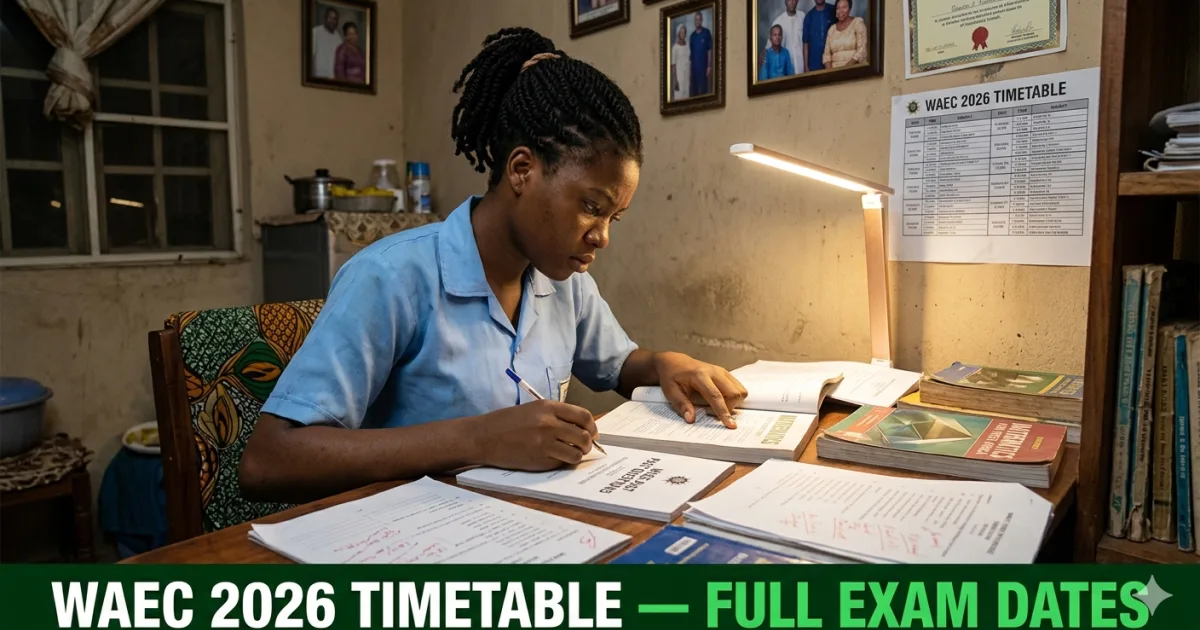
The West African Examinations Council (WAEC) has officially released the final international timetable for the 2026 May/June West African Senior School Certificate Examination (WASSCE). The exam is already underway — and if you are a candidate or a parent, everything you need to know about dates, subject schedules, and how to prepare is right here.
📅 WAEC 2026 WASSCE — At a Glance
| Exam Start Date | Tuesday, April 21, 2026 |
| Exam End Date | Friday, June 19, 2026 |
| Examination Type | WASSCE for School Candidates (May/June) |
| Countries Covered | Nigeria, Ghana, Sierra Leone, Liberia, The Gambia |
| Issuing Body | West African Examinations Council (WAEC) |
| Official Website | waecnigeria.org |
| PDF Timetable | Available at waecnigeria.org (Nigerian candidates version) |
According to the final international timetable published on WAEC’s official X handle (@waecnigeria) and confirmed by Punch Newspapers, the 2026 WASSCE for school candidates in Nigeria commenced on Tuesday, April 21, 2026, with practical planning sessions for Foods and Nutrition and Home Management, and runs through to Friday, June 19, 2026. The timetable was released following an extended registration period approved by the Minister of Education, Tunji Lausa.
Key Subject Dates — WAEC 2026 Nigeria
The dates below are drawn from the official WAEC Final International Timetable for Nigeria (WASSCE School Candidates 2026), published on waecnigeria.org. Always cross-check against the PDF on the official WAEC website, as the question paper takes precedence if there is any discrepancy in timing.
Core Subjects — Science Students
| Subject | Paper | Date | Time | Duration |
|---|---|---|---|---|
| English Language | Paper 2 (Essay) | Wednesday, June 10, 2026 | 9:30 am – 11:30 am | 2 hrs |
| English Language | Paper 1 (Objective) | Wednesday, June 10, 2026 | 11:30 am – 12:30 pm | 1 hr |
| English Language | Paper 3 (Test of Orals) | Wednesday, June 10, 2026 | 2:00 pm – 2:45 pm | 45 mins |
| General Mathematics | Paper 2 (Essay) | Wednesday, June 3, 2026 | 9:30 am – 11:30 am | 2 hrs |
| General Mathematics | Paper 1 (Objective) | Wednesday, June 3, 2026 | 11:30 am – 12:30 pm | 1 hr |
| Further Mathematics | Essay + Objective | Thursday, May 21, 2026 | Morning | 3 hrs total |
| Chemistry | Paper 2 (Essay) | Thursday, June 11, 2026 | 9:30 am – 11:30 am | 2 hrs |
| Chemistry | Paper 1 (Objective) | Thursday, June 11, 2026 | 11:30 am – 12:30 pm | 1 hr |
| Chemistry | Paper 3 Practical (Alt. A) | Scheduled by Council (May) | 9:30 am – 11:30 am | 2 hrs |
| Chemistry | Paper 3 Practical (Alt. B) | June 9, 2026 | 9:30 am – 11:30 am (1st set) | 2 hrs |
| Biology | Paper 2 (Essay) | Scheduled (May/June) | 9:30 am – 11:10 am | 1 hr 40 mins |
| Biology | Paper 1 (Objective) | Scheduled (May/June) | 11:10 am – 12:00 noon | 50 mins |
| Biology | Paper 3 Practical (Alt. A) | Scheduled by Council (May) | Two sets — 9:30 am & 12 noon | 2 hrs per set |
| Physics | Paper 3 Practical (Alt. A) | Scheduled by Council | 9:30 am – 12:15 pm (1st set) / 12:45 pm – 3:30 pm (2nd set) | 2 hrs 45 mins |
| Agricultural Science | Paper 3 (Practical) | Monday, May 13, 2026 | 9:30 am – 11:00 am / 11:30 am – 1:00 pm | 1 hr 30 mins per set |
Core Subjects — Arts and Commercial Students
| Subject | Paper | Date | Time | Duration |
|---|---|---|---|---|
| Economics | Essay + Objective | Wednesday, June 17, 2026 | Morning session | 3 hrs total |
| Accounting | Essay + Objective | Thursday, June 18, 2026 | Morning session | 3 hrs total |
| Literature-in-English | Paper 2 (Prose) | Thursday, June 11, 2026 | 2:00 pm – 3:15 pm | 1 hr 15 mins |
| Literature-in-English | Paper 1 (Objective) | Thursday, June 11, 2026 | 3:15 pm – 4:15 pm | 1 hr |
| Literature-in-English | Paper 3 (Drama & Poetry) | Scheduled | 2:00 pm session | 2 hrs 30 mins |
| Nigerian History | Essay + Objective | June 9, 2026 | 2:00 pm – 5:00 pm | 3 hrs total |
| Geography | Paper 3 (Practical & Physical) | Scheduled | 3:30 pm – 5:20 pm | 1 hr 50 mins |
| Marketing | Paper 2 (Essay) | Scheduled | 2:00 pm – 4:00 pm | 2 hrs |
| Marketing | Paper 1 (Objective) | Scheduled | 4:00 pm – 4:50 pm | 50 mins |
Practical and Oral Subjects — Scheduled Separately by WAEC
The following subjects have their dates and times arranged directly by the Council — they are NOT in the general timetable. Your school will receive specific instructions from WAEC usually two weeks before the session is due. Contact your school’s exam officer for confirmation:
- Arabic 3 (Oral) — 15 minutes
- French 3 (Oral) — 40 minutes
- Physical Education 3 (Performance Test) — 2 hours
- Foods and Nutrition 3 (Practical) — 3 hours
- Home Management 3 (Practical) — 3 hours
- Music 3B (Performance Test) — 30 minutes
⚠️ Important Notice for All Candidates: Where the duration indicated on the question paper differs from what is shown on the timetable, follow the time written on the question paper. Always arrive at least 30 minutes before your scheduled exam time. Latecomers may be denied entry after the question paper has been distributed.
What Is New About WAEC 2026?
CBT (Computer-Based Test) Transition — What Candidates Need to Know
One of the biggest developments around the 2026 WASSCE is WAEC’s announced transition toward Computer-Based Testing (CBT) for the objective papers. WAEC has been piloting this format since February 2024 for private candidates. However, the House of Representatives, citing concerns about infrastructure gaps — most Nigerian schools lack computers, reliable internet, and qualified ICT teachers — directed the federal government to suspend full CBT rollout for school candidates and mandated stakeholder engagement before any rollout. As of April 2026, the 2026 WASSCE for school candidates is still conducted in the traditional paper-and-pencil format. Legit.ng confirmed this in its coverage of the timetable release. Candidates should not be confused by online discussions about CBT — the 2026 exam you are sitting remains paper-based.
New Digital Certificate Platform
WAEC launched a new Digital Certificate Platform in Nigeria and four other member countries ahead of the 2026 examination cycle. This platform allows successful candidates to access and download verified digital copies of their certificates — reducing the long waiting periods and physical collection bottlenecks that have frustrated Nigerian candidates for years. After your results are released, you will be able to access your certificate through the official WAEC portal at waecnigeria.org.
Extended Registration Period
The registration deadline for the 2026 May/June WASSCE was extended, following approval from Education Minister Tunji Lausa, to give schools and candidates additional time to complete pending registrations. If you missed the original deadline but registered during the extension period, your candidacy is valid — confirm your examination number and centre with your school’s exam officer.
Special Accommodations for Candidates with Disabilities
WAEC has confirmed that blind, deaf, and dumb candidates will be allowed one and a half times the time allotted to other candidates for all papers where this is applicable. Schools with candidates requiring these accommodations should confirm the arrangements with their WAEC zonal office well before the examination date.
How to Download the Official WAEC 2026 Timetable PDF
- Visit the official WAEC Nigeria website: waecnigeria.org
- Navigate to the “Timetable” section in the main menu
- Select “WASSCE for School Candidates 2026 — Nigeria”
- Download the PDF version of the Final International Timetable (Nigerian candidates)
- Print a copy and pin it where you study — refer to it daily
Important warning: Many unofficial websites publish fake or outdated WAEC timetables — sometimes deliberately wrong to confuse candidates. Always download from waecnigeria.org (for Nigerian school candidates) or waecinternational.org (for private candidates). If a timetable is circulating on WhatsApp or Facebook but does not come from one of these official sources, do not trust it. MySchoolGist and Myschoolgist.com also republish the official timetable accurately and are generally reliable Nigerian education platforms.
How to Pass WAEC 2026 in One Sitting: Proven Study Strategy
The timetable is your most powerful planning tool — but only if you use it strategically. Here is the study approach that has helped Nigerian students pass WAEC in one sitting:
Step 1 — List Your Subjects in Exam Order Right Now
Open the timetable and write out your subjects in the order they appear — earliest date first. This creates your automatic study priority list. Whatever exam is coming up next is what you study first. This simple reordering keeps many students from making the fatal mistake of spending all their time on their favourite subject while neglecting the one coming up in four days.
Step 2 — Prioritise English Language and Mathematics Above All Others
English Language (June 10) and General Mathematics (June 3) are compulsory for university admission in Nigeria under JAMB and UTME requirements. You must pass both with at least a C6 (50 marks) to qualify for most tertiary institutions. These two subjects require the most consistent daily practice — not cramming. Start with them even if they appear later in the timetable. Mathematics requires at least one past question paper per day. English requires reading comprehension and essay practice — skills that cannot be crammed at the last minute.
Step 3 — Use Past Questions as Your Primary Study Tool
WAEC questions follow predictable patterns. The same topic areas come up year after year in Mathematics (indices, logarithms, probability, geometry), English (comprehension passages, letter writing, narrative essays), Physics (mechanics, waves, electricity), Chemistry (bonding, reactions, organic chemistry), and Biology (cell biology, genetics, ecology). Candidates who work through at least five years of past questions for each subject consistently outperform those who only read textbooks. Past questions are available on the official WAEC website (waecdirect.org) and through MySchoolGist’s past questions app.
Step 4 — Know the Exam Format Before You Enter the Hall
Every WAEC subject has a specific paper structure — Objective (multiple choice) and Essay/Theory components with specific time allocations. Knowing this in advance prevents wasting time during the exam. Here is the format for the most common subjects:
| Subject | Paper 1 (Objective) | Paper 2 (Essay/Theory) | Paper 3 (Practical/Oral) |
|---|---|---|---|
| English Language | 1 hour (80 questions) | 2 hours (Essay + Comprehension) | 45 mins (Test of Orals) |
| Mathematics | 1 hour (50 questions) | 2 hours (13 questions, answer 10) | N/A |
| Chemistry | 1 hour (60 questions) | 2 hours (Essay theory) | 2 hours Practical |
| Physics | 1 hour (50 questions) | 2 hours (Essay theory) | 2 hrs 45 mins Practical |
| Biology | 50 minutes (50 questions) | 1 hr 40 mins (Essay) | 2 hours Practical |
| Economics | 50 minutes | 2 hours (Essay) | N/A |
| Literature-in-English | 1 hour | 1 hr 15 mins (Prose) + 2 hrs 30 mins (Drama & Poetry) | N/A |
| Accounting | 50 minutes | 2 hours (Essay) | N/A |
Step 5 — Use the Timetable to Time Your Practice Sessions
When practising past questions at home, use a timer. If WAEC allocates 2 hours for the Mathematics essay, attempt the past question paper in exactly 2 hours. This builds both speed and the ability to manage exam-hall pressure. Most Nigerian students who fail WAEC do not fail because they do not know the content — they fail because they run out of time or cannot perform under pressure. Timed practice eliminates this.
Step 6 — Practical Papers Require Physical Practice, Not Just Reading
For Chemistry, Biology, and Physics practicals — do not rely on reading theory descriptions of experiments. Your school’s science laboratory should be accessible for preparation sessions. If your school laboratory is poorly equipped (a common problem in many Nigerian public schools), ask your teacher to at least walk you through diagrams, apparatus names, and experimental procedures verbally. WAEC practical examiners assess your ability to: set up apparatus correctly, take accurate readings, draw laboratory diagrams to scale, and write valid conclusions. These are skills that only come from actually doing the experiment, not reading about it.
What to Bring to the WAEC Exam Hall
| Item | Required? | Notes |
|---|---|---|
| WAEC Exam Slip / Candidate Card | ✅ Compulsory | Without this you may be denied entry. Keep it safe from day one |
| HB Pencil | ✅ Compulsory | For shading objective answer sheets — blue or black biro will be rejected by the optical scanner |
| Blue or Black Biro | ✅ Compulsory | For essay/theory papers |
| Mathematical Set (compass, ruler, protractor) | ✅ For Maths/Physics/Geography candidates | Bring your own — not shared in exam hall |
| Scientific Calculator | ✅ For Maths, Physics, Chemistry, Further Maths | Non-programmable only. Programmable calculators are banned |
| Eraser | ✅ For objective papers | Bring a good quality eraser — smudged corrections are not credited |
| School Uniform | ✅ Required in most centres | Confirm dress code with your school |
| Mobile Phone | ❌ Strictly Banned | Bringing a phone into the exam hall — even switched off — can result in immediate cancellation. Leave it at home or with a parent/guardian outside |
| Textbooks or Notes | ❌ Strictly Banned | Any materials found on a candidate constitute exam malpractice |
| Correction Fluid (Tipp-Ex) | ❌ Not Allowed | Use the scoring-out method for corrections — draw a single line through wrong answers |
WAEC 2026 for Private Candidates (GCE)
Private candidates who are not registered with a school write the WAEC GCE (General Certificate Examination), which has a different schedule from the school candidates’ WASSCE. The 2026 CB-WASSCE First Series for private candidates already ran from January 28 to February 14, 2026. Key dates from that series included:
- Biology: Thursday, January 29, 2026
- General Mathematics: Saturday, January 31, 2026
- English Language: Saturday, February 7, 2026
- Physics: Thursday, February 5, 2026
- Chemistry: Monday, February 9, 2026
If you missed the First Series, the Second Series (typically held around August/September) will be your next opportunity. Check waecinternational.org for the Second Series timetable when it is released. Results for the First Series CB-WASSCE 2026 have already been released — candidates can check at waecdirect.org.
Frequently Asked Questions
When does WAEC 2026 start and end for Nigerian school candidates?
The 2026 WASSCE for school candidates in Nigeria started on Tuesday, April 21, 2026 and ends on Friday, June 19, 2026. This was confirmed by the West African Examinations Council through their official X handle (@waecnigeria) and published on waecnigeria.org.
When is the WAEC 2026 Mathematics exam?
General Mathematics (Paper 2 — Essay) is scheduled for Wednesday, June 3, 2026 from 9:30 am to 11:30 am, followed immediately by Paper 1 (Objective) from 11:30 am to 12:30 pm. Further Mathematics is scheduled for Thursday, May 21, 2026. Confirm both dates on the official PDF timetable from waecnigeria.org.
When is the WAEC 2026 English Language exam?
English Language is scheduled for Wednesday, June 10, 2026. Paper 2 (Essay — including Comprehension and Summary) runs from 9:30 am to 11:30 am. Paper 1 (Objective) follows from 11:30 am to 12:30 pm. Paper 3 (Test of Orals) is in the afternoon: 2:00 pm to 2:45 pm. Note that English Language and Chemistry share June 10 and June 11 — ensure you are clear on which paper is on which day.
How many subjects can I combine for WAEC 2026?
WAEC candidates typically sit between 8 and 9 subjects — the two compulsory subjects (English Language and Mathematics) plus 6–7 elective subjects depending on their school’s approved combination. For most Nigerian university admissions, you need at least five credits (C6 or above) including English Language and Mathematics, obtained in not more than two sittings.
Is WAEC 2026 going to be CBT (Computer-Based)?
No — not for school candidates. The 2026 WASSCE for school candidates remains in the traditional paper-and-pencil format. The House of Representatives directed the federal government to suspend the CBT rollout for school candidates after lawmakers raised concerns about infrastructure gaps in Nigerian schools. WAEC’s CBT format currently applies only to the CB-WASSCE for private candidates. Legit.ng and Punch confirmed this in their coverage of the 2026 timetable release.
Where can I check my WAEC 2026 results?
WAEC results are checked through the official portal at waecdirect.org. You will need your examination number and the token (scratch card PIN) purchased from any bank or WAEC-approved vendor. Results are typically released 45–90 days after the final examination date. For 2026 school candidates, results are expected around August–September 2026. WAEC has also introduced a new Digital Certificate Platform for downloading verified certificates directly online.
How many credits do I need to pass WAEC?
To gain university admission in Nigeria (through JAMB/UTME), you typically need a minimum of five credits (grades A1, B2, B3, C4, C5, or C6) in relevant subjects, including compulsory credits in English Language and Mathematics for most courses. A “pass” (P7 or P8) does not count toward admission requirements — you need at least C6. Check your chosen university and course-specific requirements as these can vary.
WAEC 2026 Grading System
| Grade | Score Range | Meaning | Counts for Admission? |
|---|---|---|---|
| A1 | 75% – 100% | Excellent | ✅ Yes |
| B2 | 70% – 74% | Very Good | ✅ Yes |
| B3 | 65% – 69% | Good | ✅ Yes |
| C4 | 60% – 64% | Credit | ✅ Yes |
| C5 | 55% – 59% | Credit | ✅ Yes |
| C6 | 50% – 54% | Credit | ✅ Yes (minimum for most courses) |
| D7 | 45% – 49% | Pass | ❌ Not credited |
| E8 | 40% – 44% | Pass | ❌ Not credited |
| F9 | 0% – 39% | Fail | ❌ Fail |
📌 WAEC 2026 Summary — Everything You Need
- Start date: Tuesday, April 21, 2026
- End date: Friday, June 19, 2026
- Mathematics: Wednesday, June 3, 2026
- English Language: Wednesday, June 10, 2026
- Chemistry: Thursday, June 11, 2026
- Economics: Wednesday, June 17, 2026
- Accounting: Thursday, June 18, 2026
- Download official PDF: waecnigeria.org
- Check results: waecdirect.org
- Format: Paper-and-pencil (NOT CBT) for school candidates
- Most important tip: Past questions + timed practice = WAEC success
The WAEC examination is one of the most important milestones in any Nigerian student’s educational journey. It is not easy — and it is not meant to be. But with the right timetable, the right study plan, and daily consistent effort, passing in one sitting is absolutely achievable. Nigeria has produced millions of WAEC success stories across generations. Yours is next.
Are you writing WAEC 2026? Tell us which subject you are most nervous about in the comments — and we will share specific tips. Also check out our guide on Post-UTME 2026: Screening Dates and Requirements for All Universities and JAMB 2026 Registration Guide to plan your full tertiary admissions journey.




0 Comments
No comments yet. Be the first to share your thoughts!