


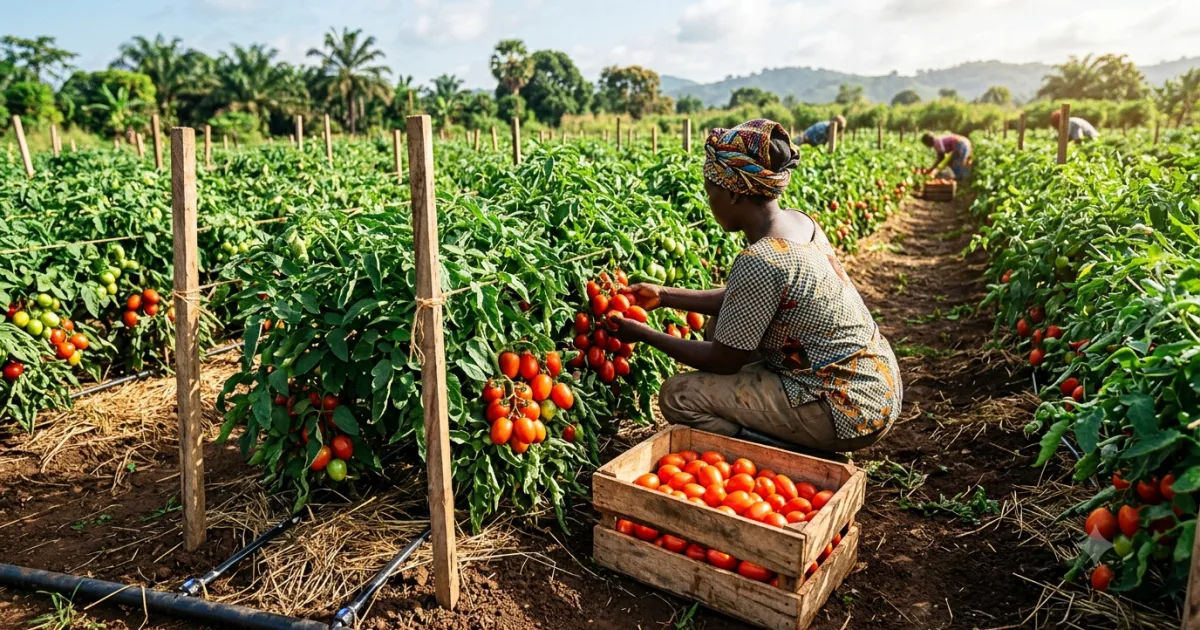
📌 Quick Summary: Tomato farming in Nigeria is one of the highest-revenue smallholder crops available — a 1-hectare tomato farm can produce 15 to 30 tonnes per harvest (2 to 3 harvests per year under irrigation), generating gross revenue of ₦3,000,000 to ₦9,000,000 per year on a production cost of approximately ₦800,000 to ₦1,500,000 per hectare per cycle. Nigeria is the third-largest tomato producer in Africa — yet imports 150,000 tonnes of tomato paste annually because domestic processing is inadequate. The biggest challenges: post-harvest losses (up to 50% without cold chain), tomato diseases (early and late blight, bacterial wilt), and market price crashes during peak harvest season. This guide covers varieties, planting calendar, production inputs, disease management, irrigation, and How to Sell your tomatoes profitably.
Nigeria produces approximately 1.8 million tonnes of fresh tomatoes annually — yet spends over $450 million per year importing tomato paste, concentrated tomato products, and processed tomato goods from China, Italy, and other countries. This paradox — large producer, massive importer of the processed form — is explained by the absence of adequate domestic processing infrastructure and the enormous post-harvest losses (estimated at 40 to 50 percent of production) that occur between farm and consumer. For the tomato farmer, this paradox is both the challenge and the opportunity. Fresh tomato prices in Nigeria are highly volatile — crashing during peak harvest season when supply floods the market, and spiking during the dry season when supply contracts. Navigating this volatility through the right variety selection, planting calendar, irrigation investment, and market relationships is what separates profitable Nigerian tomato farmers from those who farm at a loss despite producing high yields.
Tomato Varieties for Nigerian Farmers
| Variety | Type | Maturity | Yield Potential | Best Use |
| Roma VF | Determinate (bush type) | 70 to 80 days | 20 to 35 tonnes/ha | Fresh market and processing. Most widely grown in Nigeria. Disease resistance. |
| Tropimech | Determinate | 75 to 85 days | 25 to 40 tonnes/ha | Processing — thick flesh, concentrated paste yield. Recommended for farmers supplying processors. |
| UC82B | Determinate | 70 to 80 days | 20 to 30 tonnes/ha | Processing and fresh market. Disease-resistant. Widely available in Nigerian markets. |
| Beske | Determinate | 65 to 75 days | 15 to 25 tonnes/ha | Fresh market in northern Nigeria. Heat-tolerant. |
| Hybrid varieties (Cobra, Padma, Zara) | Determinate | 60 to 75 days | 40 to 70 tonnes/ha | High-input commercial farming. Higher seed cost but significantly higher yield. Require consistent irrigation and fertilisation to realise yield potential. |
Recommendation for Nigerian beginners: Start with Roma VF or UC82B — widely available, disease-resistant, well-adapted to Nigerian conditions, and accepted in both fresh markets and by processing companies.
Nigerian Tomato Planting Calendar
Timing your tomato planting correctly is the most important decision a Nigerian tomato farmer makes. The goal: bring your harvest to market when supply is LOW and prices are HIGH — not when every farmer in your region harvests simultaneously and prices collapse. Two productive tomato growing seasons in Nigeria:
| Season | Planting (Seedling Stage) | Transplanting | Harvest | Market Conditions at Harvest |
| First rainy season | February to March | March to April | June to July | Moderate supply; reasonable prices. Risk: high disease pressure from rain. |
| Second rainy season (recommended) | July to August | August to September | November to December | Good — most northern Nigerian farms have finished; pre-Christmas demand is high. Better price outlook. |
| Dry season (irrigation required) | October to November | November to December | February to March | Excellent — very low supply from rain-fed farms; highest market prices of the year. Best margin if irrigation available. |
The dry season irrigated crop consistently produces the highest market prices — because most Nigerian tomato farmers grow rain-fed and stop production during the dry season, the farmer with irrigation access supplies to a market with minimal competition. If irrigation is feasible on your land, the dry season crop is the most profitable planting window available in Nigerian tomato farming.
Land Preparation and Nursery
Tomato seedlings are raised in a nursery bed for 3 to 4 weeks before transplanting to the main field. Nursery: prepare a raised bed approximately 1m wide, any length. Mix topsoil with compost or well-composted poultry manure. Sow seeds thinly in rows 10cm apart at a depth of 0.5cm. Cover lightly and water twice daily. Provide shade from direct midday sun (nursery shade cloth or palm fronds work well). Main field: plough or dig the land to a depth of 25 to 30cm. Incorporate 10 to 15 tonnes of compost or well-composted poultry manure per hectare. Form raised beds (30cm high) or ridges to improve drainage — waterlogged tomato roots rapidly develop root rot diseases. Transplant seedlings when they are 15 to 20cm tall and have 4 to 6 true leaves — at a spacing of 60cm between plants within rows and 90cm to 1m between rows. This spacing allows adequate air circulation (reducing fungal disease risk) and sufficient root expansion for high yields.
Fertilisation Programme
| Stage | Fertiliser | Rate (per hectare) | Timing |
| Land preparation | Compost or poultry manure | 10 to 15 tonnes | 2 weeks before planting |
| 2 weeks after transplanting | NPK 15:15:15 | 150 to 200kg | Side-dress 10cm from plant base |
| 4 to 5 weeks after transplanting | Urea (46% N) or CAN | 100 to 150kg | Promotes vegetative growth before flowering |
| Flowering and fruit set stage | NPK 12:24:12 or similar high-P formula | 150kg | High phosphorus at flowering promotes fruit set and quality |
| Fruit development stage | Potassium sulphate or muriate of potash | 100 to 150kg | Potassium improves fruit size, colour, and shelf life |
Disease Management: The Biggest Threat to Nigerian Tomato Farms
Disease is the primary cause of yield loss in Nigerian tomato farming — outweighing insect pests, drought, or poor soil in most production environments. The three most destructive diseases:
Early Blight (Alternaria solani): Dark, concentric-ring lesions on older leaves; spreads upward as the season progresses. Prevention: crop rotation (do not plant tomato in the same field consecutively), remove infected plant material, use fungicides preventively before symptoms appear. Treatment: copper-based fungicides or Mancozeb every 7 to 10 days from early vegetative stage.
Late Blight (Phytophthora infestans): The most destructive tomato disease — water-soaked lesions on leaves and fruit that spread rapidly in wet, humid conditions. Can destroy an entire field within a week during rainy season. Prevention: plant resistant varieties; avoid overhead irrigation (use drip irrigation instead); space plants widely for air circulation. Treatment: Metalaxyl-based fungicides; spray preventively, not reactively — by the time symptoms are visible, significant damage has already occurred.
Bacterial Wilt (Ralstonia solanacearum): Sudden wilting of entire plants despite adequate water. Cut the stem — a milky bacterial ooze is visible. No chemical cure — infected plants must be removed and destroyed immediately. Prevention: use disease-free seedlings; avoid waterlogged conditions; practice crop rotation.
Irrigation: The Difference Between Profitable and Unprofitable
Nigerian tomato farming without irrigation is entirely rain-dependent and extremely high-risk — one dry spell during fruit development can destroy an otherwise healthy crop, and the inability to grow during the dry season excludes you from the highest-price market window. Drip irrigation is the most water-efficient and disease-minimising irrigation method for tomato — delivering water directly to the root zone without wetting foliage (which drives fungal disease development). A drip irrigation system for 1 hectare costs approximately ₦800,000 to ₦2,500,000 installed — a significant investment but one that typically pays back within 1 to 2 dry season cycles through the premium price received for off-season tomatoes.
Post-Harvest and Marketing
Post-harvest losses of 40 to 50 percent are the defining economic challenge of Nigerian tomato farming. Fresh tomatoes ripen quickly in Nigeria’s heat and have a very short shelf life without cold storage. The strategies that reduce losses and improve market returns. First: harvest in the morning when temperatures are lower and tomatoes are less stressed. Second: handle harvested tomatoes gently — bruised tomatoes rot within 24 hours in Nigerian temperatures. Third: sell as quickly as possible after harvest — negotiate buyers (market traders, processing companies, supermarkets) before you harvest, not after. Fourth: for farmers near major cities, direct supply to supermarkets (Shoprite, Spar, SPAR) or restaurants commands 20 to 40 percent premium over open market prices and provides more predictable demand. Fifth: explore contract farming with tomato paste processors — Dangote Agro, Erisco Foods, and other processors offer contract farming arrangements that guarantee a purchase price before planting, eliminating market price risk.
Profitability Summary: 1-Hectare Tomato Farm
| Production cost per cycle (seeds, fertiliser, labour, pesticides, irrigation) | ₦800,000 – ₦1,500,000 |
| Expected yield (Roma VF, good management) | 15 to 25 tonnes per hectare |
| Market price (rainy season, fresh market) | ₦80,000 – ₦150,000 per tonne |
| Market price (dry season, irrigated) | ₦200,000 – ₦500,000 per tonne |
| Gross revenue (rainy season, 20 tonnes) | ₦1,600,000 – ₦3,000,000 |
| Gross revenue (dry season, 20 tonnes) | ₦4,000,000 – ₦10,000,000 |
| Net profit per cycle (rainy season) | ₦100,000 – ₦1,500,000 |
| Net profit per cycle (dry season, irrigated) | ₦2,500,000 – ₦8,500,000 |
Frequently Asked Questions
How much does it cost to start tomato farming in Nigeria?
Rain-fed 1-hectare tomato farm: ₦500,000 to ₦1,000,000 per cycle for seeds, fertiliser, pesticides, and labour. Add ₦800,000 to ₦2,500,000 for drip irrigation installation for dry season production.
How many times can I harvest tomatoes per year in Nigeria?
2 to 3 times per year with irrigation — one or two rainy season crops and one dry season irrigated crop. Rain-fed farmers typically get 1 to 2 crops per year.
What is the best tomato variety for Nigeria?
Roma VF and UC82B are the most reliable for Nigerian beginners — disease-resistant, widely adapted, and accepted in both fresh markets and by processing companies. Hybrid varieties (Cobra, Padma) produce higher yields but require more intensive management and higher input costs. Nigerian tomato farmers who position themselves early as reliable processor suppliers — by investing in Brix testing, proper harvest handling, and consistent supply volume — will be well placed to benefit from the processing capacity that is being built across Nigeria in 2026 and 2027, including the expanded processing operations at the Dangote Agro-Industries complex that is expected to significantly increase Nigeria’s domestic tomato paste production capacity within the next two years. The tomato farmer of 2026 who understands the full value chain — from seed selection and nursery management through post-harvest handling and market positioning — operates a genuinely sophisticated agricultural business, not merely a seasonal crop growing exercise. Tomato is not a simple crop — it rewards knowledge, attention, and investment — but for the farmer who brings those qualities to its cultivation, it is among the most financially rewarding crops available in Nigeria today.
Sources
- FAO — Nigeria tomato production statistics — fao.org
- NIHORT (National Horticultural Research Institute) — tomato production guidelines Nigeria — nihort.gov.ng
- Original agricultural business guide — NaijaSabi Business Desk, September 2026
Last updated: 19 September 2026 · NaijaSabi Business Desk.
Tomato Farming and Nigeria’s Processing Gap: The Business Opportunity
Nigeria’s tomato paradox — third-largest African producer, yet massive importer of processed tomato products — represents a business opportunity that goes beyond primary farming. Every tonne of fresh tomatoes that Nigerian farmers produce but cannot sell before spoiling is a tonne that could have been turned into tomato paste, diced tomatoes, or tomato puree for domestic consumption and export. The gap between Nigerian fresh tomato production and domestic processing capacity is estimated at over 1 million tonnes annually. For the tomato farmer who wants to go beyond primary production, two adjacent opportunities exist. First: farm-level processing — investing in a small tomato processing unit (a tomato crusher, evaporator, and filling machine) to convert surplus or below-grade tomatoes into tomato paste or puree during peak harvest when fresh prices crash. Small-scale tomato paste production lines cost approximately ₦2,000,000 to ₦5,000,000 and can process 500 to 2,000 kg of fresh tomatoes per day. Second: supply chain for large processors — Dangote Agro, Erisco Foods, De Rica, and other Nigerian tomato paste producers actively seek reliable farm suppliers through contract farming arrangements. Getting onto a processor’s approved supplier list requires demonstrated production consistency, quality standards (specific Brix sugar content in the tomato is the key quality metric processors measure), and volume commitment. Both paths are viable extensions of the core tomato farming business — and both directly address the processing gap that is currently costing Nigeria hundreds of millions of dollars annually in unnecessary imports.



0 Comments
No comments yet. Be the first to share your thoughts!