


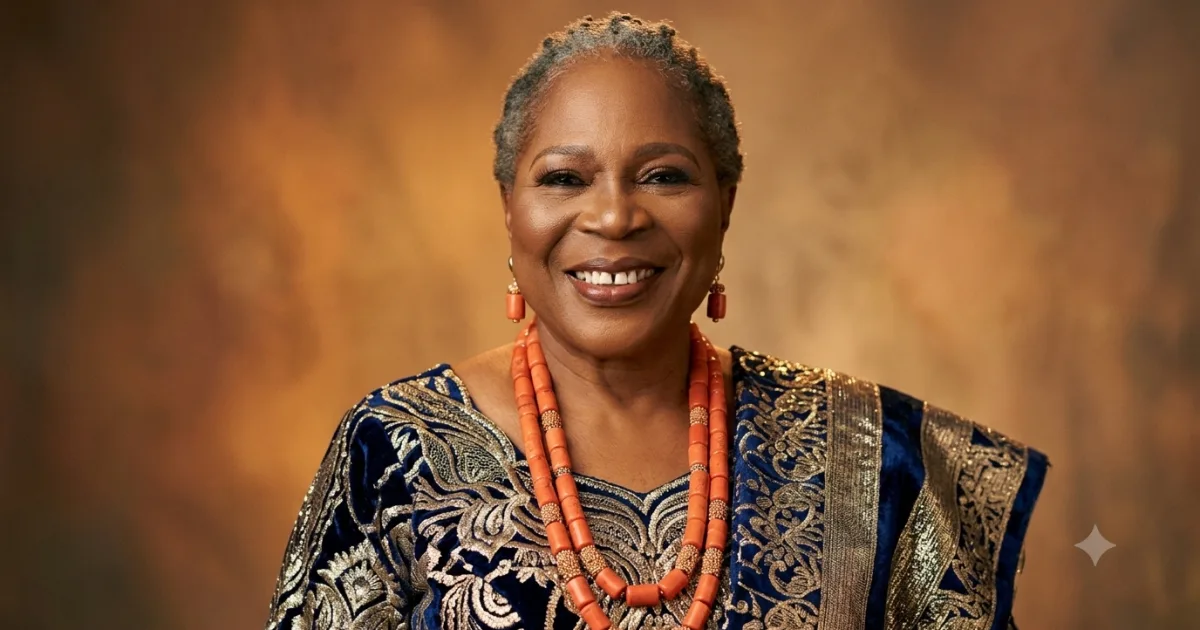
On the evening of July 30, 2024, Onyeka Onwenu performed at the birthday celebration of Mrs. Stella Chinyelu Okoli — the CEO of Emzor Pharmaceuticals — in Lagos. She sang, as she had always sung: with her whole body, her whole voice, and the total commitment of someone who had been performing for Nigeria for nearly five decades and had never once done it at half-measure. Moments after performing, she collapsed. She was rushed to Reddington Hospital in Lagos. The doctors fought. She did not survive. She was seventy-two years old.
Nigeria woke up the next morning to a grief that was both sharp and cumulative — the grief of a country that had lost not merely a singer but a presence. President Bola Tinubu mourned her from his official platform. Peter Obi — who had been at the hospital where she died — described watching the medical team fight for her life with the quiet devastation of a man who had lost someone important. Burna Boy, who had named one of his most celebrated songs after her — “Onyeka,” from his Grammy-winning album Twice as Tall — had already told the world, before her death, exactly what she meant to Nigerian music. Yemi Alade called her “my childhood hero.”
The Elegant Stallion was gone. But the voice — rich, disciplined, socially conscious, and entirely her own — was not going anywhere. This is her full biography.
Onyeka Onwenu Biography Facts at a Glance
| Full Name | Onyeka Onwenu MFR |
| Date of Birth | January 31, 1952 |
| Date of Death | July 30, 2024 (aged 72) |
| Place of Birth | Obosi, Anambra State, Nigeria |
| State of Origin | Imo State (Arondizuogu, Ideato North LGA) |
| Raised In | Port Harcourt, Rivers State, Nigeria |
| Ethnicity / Tribe | Igbo |
| Religion | Christianity |
| Father | D. K. Onwenu — Nigerian educationist and politician (died in auto crash when Onyeka was 4) |
| Mother | Hope Onwenu |
| Education | Wellesley College, Massachusetts (BA International Relations and Communication); The New School for Social Research, New York (MA Media Studies) |
| Occupation | Singer-Songwriter, Actress, Broadcaster, Journalist, Politician, Human Rights Activist |
| Nickname | The Elegant Stallion |
| Husband | Ogunlende (Yoruba Muslim; divorced) |
| Children | Two sons — Tijani Charles Ogunlende and Abraham Ogunlende (formerly Ibrahim) |
| Notable Songs | Ekwe; One Love; Iyogogo; Lied to Me; Endless Life; Tolotolo; Only You (with King Sunny Ade); Madawolohun (with King Sunny Ade) |
| Political Role | Chairperson, Imo State Council for Arts and Culture |
| Honour | MFR (Member of the Order of the Federal Republic) |
| Cause of Death | Cardiac arrest (collapsed after performing; confirmed dead at Reddington Hospital, Lagos) |
| Nationality | Nigerian |
Early Life: Loss, Resilience and a Port Harcourt Childhood
Onyeka Onwenu was born on January 31, 1952, in Obosi, in present-day Anambra State, Nigeria. She hails from Arondizuogu in Ideato North Local Government Area, Imo State — the town that gave her family its roots and that she carried in her identity throughout her life. She was raised primarily in Port Harcourt, Rivers State — the oil city that would later claim Burna Boy among its own and that gave Onyeka the culturally diverse, commercially energetic environment that shaped her early sensibility.
She was the youngest of five children born to D. K. Onwenu — a respected Nigerian educationist and politician whose life was cut short by an auto crash when Onyeka was just four years old. The tragedy was compounded by what followed: her father’s family denied her mother and siblings access to his property, leaving Hope Onwenu to raise five children alone, under circumstances of real financial difficulty.
This early experience of loss, material hardship, and the particular cruelty of patriarchal inheritance structures left a permanent mark on Onyeka’s character. The social consciousness that would animate her music, her journalism, her activism, and her public life — the insistence on justice for the marginalised, the willingness to speak against power, the identification with women who had been left to carry more than their share — all of it traces directly back to what she experienced as a fatherless child in Port Harcourt, raised by a mother who refused to let circumstances define the ceiling of her children’s ambitions.
Despite the difficulties, Onyeka received a strong education. She completed her schooling in Nigeria before receiving the opportunity that would define her intellectual and professional formation: admission to study in the United States.
Education: Wellesley College and The New School
Onyeka Onwenu studied at Wellesley College in Massachusetts, United States — one of America’s most prestigious women’s liberal arts colleges, whose alumnae include Secretary of State Hillary Clinton and former Secretary of State Madeleine Albright. She earned a Bachelor of Arts in International Relations and Communication from Wellesley — a degree whose dual focus on global affairs and mass communication turned out to be precisely the intellectual preparation her career required.
She subsequently earned a Master of Arts in Media Studies from The New School for Social Research in New York — an institution known for its progressive intellectual tradition and its engagement with the relationship between media, society, and political power. The combination of Wellesley’s international relations grounding and The New School’s media studies framework gave her the theoretical vocabulary to understand what broadcasting and journalism could do in a society like Nigeria’s — and the ambition to pursue that understanding practically.
She returned to Nigeria equipped with two American degrees, a clear sense of purpose, and a voice — both literally and figuratively — that she was ready to deploy in the service of her country.
Broadcasting Career: The NTA Years and the Hunger Strike That Made History
On her return to Nigeria, Onyeka Onwenu joined the Nigerian Television Authority (NTA) — becoming one of the first and most distinguished presenters in the institution’s history. Her television presence was immediately striking: articulate, composed, beautiful in the specific way that has depth rather than merely surface, and possessed of a broadcasting intelligence that her education had sharpened but that her personality had always contained.
At NTA, she presented programmes with a seriousness and a cultural ambition that distinguished her from the safer, more deferential broadcasting style that characterised much of Nigerian television in that era. Her journalism — including documentary work that took her into communities and stories that mainstream Nigerian media was not covering with the depth they deserved — confirmed that she was not merely a face on a screen but a journalist with genuine investigative instincts and a commitment to the public service function of broadcasting.
Her tenure at NTA also produced one of the most remarkable acts of individual professional courage in the history of Nigerian broadcasting. When NTA 2 used her song “Iyogogo” without her permission and without paying royalties, she did not merely complain through the appropriate channels and accept the institutional response. She went outside the NTA building and staged a hunger strike — a public, physical act of protest against an institution that was simultaneously her employer and a violator of her intellectual property rights. The protest attracted national attention, drew support from figures including Charly Boy, and generated important public debate about royalty rights for Nigerian musicians — a debate that was years ahead of its time.
The Director-General of NTA at the time, Ben Murray-Bruce, blacklisted her from transmission in response. She persisted. The story of that hunger strike — a young Nigerian woman taking on a federal broadcasting institution over a matter of principle — is one of the most instructive episodes in the history of Nigerian creative rights advocacy, and it is entirely consistent with the character that everything else in Onyeka Onwenu’s life confirms.
Music Career: The Voice That Defined a Generation
Onyeka Onwenu’s music career began in the late 1970s and reached its commercial and artistic peak through the 1980s and early 1990s — a period during which she became one of the most celebrated voices in Nigerian popular music. Her sound was distinctive: rooted in traditional African musical textures but shaped by her American education and her exposure to international music, it occupied a space between folk, soul, and contemporary African pop that was entirely her own.
Her voice was her most remarkable instrument. Rich, disciplined, capable of tenderness and power in equal measure, it conveyed a moral seriousness that her lyrics demanded and her audiences responded to with unusual loyalty. She was not merely a pop singer — she was a singer whose music carried weight, whose songs addressed social realities, and whose performances communicated a commitment that transcended entertainment.
Her most celebrated songs include:
- “Ekwe” — her breakthrough hit, a song with deep cultural roots in Igbo tradition that introduced her to a national audience
- “One Love” — one of her most beloved tracks, addressing themes of unity and human solidarity that resonated deeply in post-Civil War Nigeria
- “Iyogogo” — the song whose unauthorised use by NTA 2 triggered her famous hunger strike
- “Endless Life” — a deeply spiritual composition that became one of the defining recordings of her career
- “Lied to Me” and “Tolotolo” — commercial hits that demonstrated her range as a popular musician
Her most significant musical collaboration was with King Sunny Ade — one of Nigeria’s greatest musicians and one of Africa’s most internationally celebrated artists. Together they recorded “Only You” and “Madawolohun” — two tracks that brought together the distinct musical traditions they each represented (her Igbo-inflected highlife-soul style and his Yoruba jùjú mastery) in a way that demonstrated the cultural breadth of Nigerian music and generated enormous commercial success.
The collaboration with King Sunny Ade was not merely commercial. In a Nigeria still processing the traumas of the Civil War and the political volatility of the military era, two artists from different ethnic backgrounds — one Igbo, one Yoruba — making music together and making it beautifully was a statement about what the country could be when its cultural richness was celebrated rather than weaponised.
One of the most extraordinary posthumous tributes to her musical legacy came not at the time of her death but years before it, in 2020, when Burna Boy released a track simply titled “Onyeka” on his Grammy-winning album Twice as Tall. The song — an explicit, reverent tribute to her significance in Nigerian music history — introduced her name and her importance to an entire generation of Nigerian music fans who had grown up after her commercial peak. That a Grammy-winning artist at the height of his international career would name a song after her confirmed what those who had been paying attention had always known: Onyeka Onwenu was not merely a figure of historical interest but a genuine foundational presence in Nigerian music culture.
Acting Career: From Television to Nollywood
Alongside her music and broadcasting careers, Onyeka Onwenu built a substantial acting portfolio across Nigerian film and television. She featured in several significant Nollywood productions and television series that extended her public visibility beyond her music audience and confirmed her versatility as a performer.
Her most internationally noted acting credit was her appearance in Alex Haley’s Roots: The Next Generation — the sequel to the landmark American television series — in which she played a supporting role. This credit placed her in a production of genuine international significance and confirmed that her talents were marketable beyond Nigeria’s domestic entertainment industry.
She also served as a judge on the Nigerian X Factor — one of the country’s most-watched television talent competitions — bringing her decades of music industry experience to bear on the assessment and mentorship of a new generation of Nigerian performers.
Activism: Human Rights, Women’s Issues and HIV/AIDS
Onyeka Onwenu’s activism was not a sideline to her artistic career — it was woven into everything she did, from the social consciousness of her lyrics to the specific causes she championed publicly. She was a committed advocate for women’s rights in a country where the structural disadvantages facing women were enormous and frequently invisible to those with the power to address them.
Her work in the area of HIV/AIDS awareness was particularly significant. At a time when the stigma surrounding HIV/AIDS in Nigeria made open discussion of the epidemic difficult — when people who needed information could not easily access it without shame — she used her public platform to advocate for awareness, testing, and treatment. In a country with one of the largest HIV-positive populations in the world, that advocacy carried real public health significance.
Her hunger strike outside NTA was itself an act of activism — a demonstration that intellectual property rights were not merely a legal abstraction but a matter of economic justice for creative workers. Her willingness to deploy her own body and reputation in the service of a principle set a precedent that other Nigerian artists and advocates have cited as an influence on their own approach to public advocacy.
Politics and Public Service
Onyeka Onwenu’s engagement with Nigerian political life extended beyond commentary and advocacy into direct participation. She served as the Chairperson of the Imo State Council for Arts and Culture — a governmental role that allowed her to work on the preservation, promotion, and development of Imo State’s extraordinary cultural heritage from within the institutional structures that can make or break such efforts.
She was also involved in the political campaigns and civic activities of figures she believed represented a more constructive vision for Nigerian governance — making her political views and alignments visible without surrendering the independence of judgment that characterised her entire public life. She received the national honour of MFR (Member of the Order of the Federal Republic) — recognition from the Nigerian state of her contributions to national cultural and public life.
Personal Life: The Marriage, the Divorce and Two Sons
In 1984, Onyeka Onwenu married a Yoruba Muslim man named Ogunlende — a union that crossed the ethnic and religious lines that Nigerian social convention still often treats as barriers. The marriage produced two sons: Tijani Charles Ogunlende and Ibrahim Ogunlende — the latter subsequently changing his name to Abraham.
The marriage eventually ended in divorce. In a 2022 interview, Onyeka spoke about the decision with characteristic directness, explaining that she ended the marriage to preserve her “sanity and wellbeing” — despite her initial strong desire to keep the family intact for her children’s sake. She described the difficulty of that decision while making clear that she did not regret it — that her own psychological and emotional health was not something she was willing to sacrifice indefinitely for an institution that was no longer serving its stated purpose.
She raised her sons without the help of nannies — a point she made with evident pride in interviews, emphasising her personal commitment to their upbringing as a single mother. Both sons have maintained relatively private public profiles.
Death: The Last Performance and a Nation’s Grief
On July 30, 2024, Onyeka Onwenu performed at the 80th birthday celebration of Mrs. Stella Chinyelu Okoli — the founder and CEO of Emzor Pharmaceuticals — in Lagos. Shortly after performing, she collapsed. She was immediately rushed to Reddington Hospital in Lagos, where doctors and medical staff worked to revive her. They fought tirelessly and did everything possible, but could not bring her back. She was confirmed dead. She was 72 years old. Reports indicate she suffered a cardiac arrest.
Peter Obi, who ran for president against Tinubu in 2023, shared on X that he was at the hospital where Onwenu died and watched in pain as the doctors battled to save her life. President Tinubu released a formal statement of mourning. Tributes poured in from across the Nigerian entertainment industry and from international admirers. Nigerian singers Yemi Alade and Simi posted tributes, with Alade calling her “my childhood hero.”
She had written, in a 2021 essay criticising the extravagance of a prominent Nigerian funeral: “Do it quickly, quietly and privately. Celebrate me with prayers, lunch or dinner afterwards.” It was the instruction of a woman who understood the vanity of spectacle and the sufficiency of genuine love. In the event, Nigeria’s love for her was too large to be quiet — but it was genuine, and she had earned every expression of it across seven decades of exceptional living.
Legacy: What Onyeka Onwenu Left Behind
The legacy of Onyeka Onwenu operates on several registers simultaneously. As a musician, she left a catalogue of songs that defined the sonic landscape of Nigerian popular music for a generation — records that are still played, still loved, and still capable of moving listeners who encounter them for the first time decades after their recording. The collaboration with King Sunny Ade remains one of the most beautiful examples of cross-cultural musical partnership in Nigerian music history.
As a broadcaster and journalist, she established a standard of intelligence, independence, and public service commitment that too few of her successors in Nigerian television have matched. Her hunger strike over royalty rights — a fight she took on when there was no institutional framework to support her and personal risk was real — set a precedent for creative rights advocacy that continues to inform how Nigerian artists approach the protection of their intellectual property.
As an activist, she demonstrated that celebrity platforms in Nigeria could be used for genuine social purpose rather than merely commercial gain — that a famous face and a famous voice carried responsibilities as well as privileges, and that those responsibilities were worth honouring even when honouring them was uncomfortable or costly.
And as a woman who lived through the loss of her father at four, the material hardship of a widowed mother raising five children alone, a marriage that ended in divorce, and the decades of public scrutiny that come with being one of Nigeria’s most visible women — she demonstrated a personal resilience that her public achievements, impressive as they are, do not fully capture. She endured. She created. She advocated. She performed, on July 30, 2024, at a birthday party in Lagos, until her heart gave out.
Burna Boy named a song after her before she died. A generation of younger Nigerian artists calls her a hero. Her sons carry her name forward. The Elegant Stallion ran her full race.
Career Timeline
| Year | Milestone |
| 1952 | Born January 31 in Obosi, Anambra State; youngest of 5 children; family from Arondizuogu, Imo State |
| ~1956 | Father D. K. Onwenu dies in auto crash, aged 4; mother Hope raises 5 children alone after family denies access to his property |
| ~1956–1970 | Raised in Port Harcourt, Rivers State; completes primary and secondary education in Nigeria |
| ~1970–1974 | Wellesley College, Massachusetts — BA International Relations and Communication |
| ~1974–1976 | The New School for Social Research, New York — MA Media Studies |
| Late 1970s | Returns to Nigeria; joins NTA as one of first presenters; begins music career |
| 1980s | Music career peaks — releases Ekwe, One Love, Iyogogo, Endless Life; collaborates with King Sunny Ade on Only You and Madawolohun |
| ~Early 1980s | NTA 2 uses Iyogogo without permission; Onyeka stages hunger strike outside NTA building; blacklisted by DG Ben Murray-Bruce; precedent set for Nigerian creative rights advocacy |
| 1984 | Marries Ogunlende (Yoruba Muslim); sons Tijani and Ibrahim born |
| ~1985–1990s | Acting career develops; appears in Alex Haley’s Roots: The Next Generation; Nollywood and TV appearances |
| ~Late 1990s–2000s | Divorce from Ogunlende; serves as Chairperson, Imo State Council for Arts and Culture; HIV/AIDS and women’s rights advocacy |
| ~2000s–2010s | Continues music, acting, and public service; serves as X Factor Nigeria judge; receives MFR national honour |
| 2020 | Burna Boy releases “Onyeka” on Grammy-winning album Twice as Tall — tribute to her significance in Nigerian music |
| 2021 | Writes op-ed requesting a simple, private funeral — expressing philosophy about commemoration and ceremony |
| 2022 | Speaks publicly about her divorce in interview — explains decision to end marriage for her wellbeing |
| July 30, 2024 | Performs at birthday celebration of Mrs. Stella Okoli (Emzor Pharmaceuticals CEO) in Lagos; collapses after performance; confirmed dead at Reddington Hospital — cardiac arrest; aged 72 |
Frequently Asked Questions About Onyeka Onwenu
Who was Onyeka Onwenu?
Onyeka Onwenu (January 31, 1952 – July 30, 2024) was one of Nigeria’s most celebrated and beloved public figures — a singer-songwriter, actress, broadcaster, journalist, human rights activist, and politician. Known as the Elegant Stallion, she built one of the most distinguished and multifaceted careers in Nigerian entertainment history, spanning nearly five decades. She is particularly celebrated for her music — including collaborations with King Sunny Ade — her television broadcasting career at NTA, her hunger strike over creative rights, her HIV/AIDS advocacy, and her role as a consistent voice for women and marginalised communities in Nigerian public life.
How did Onyeka Onwenu die?
Onyeka Onwenu died on July 30, 2024, in Lagos, Nigeria, at the age of 72. She had performed at the 80th birthday celebration of Mrs. Stella Chinyelu Okoli — the CEO of Emzor Pharmaceuticals — and collapsed shortly after her performance. She was rushed to Reddington Hospital in Lagos, where medical staff fought to save her life. She was confirmed dead. Reports indicate she suffered a cardiac arrest. President Bola Tinubu and former presidential candidate Peter Obi were among the prominent Nigerians who publicly mourned her passing.
What state is Onyeka Onwenu from?
Onyeka Onwenu hails from Arondizuogu in Ideato North Local Government Area, Imo State, Nigeria. She was born in Obosi, Anambra State, and raised in Port Harcourt, Rivers State — but her family roots and state of origin are in Imo State. She served as Chairperson of the Imo State Council for Arts and Culture, maintaining a direct connection to her home state throughout her public career.
Who were Onyeka Onwenu’s children?
Onyeka Onwenu had two sons from her marriage to Ogunlende: Tijani Charles Ogunlende and Abraham Ogunlende (born Ibrahim Ogunlende; he later changed his name to Abraham). She raised both sons without the help of nannies — a point of personal pride she expressed in interviews — emphasising her hands-on commitment to their upbringing as a single mother following her divorce.
Who was Onyeka Onwenu’s husband?
Onyeka Onwenu married a Yoruba Muslim man named Ogunlende in 1984. The marriage produced two sons — Tijani and Ibrahim (Abraham). The union eventually ended in divorce. In a 2022 interview, Onyeka explained that she made the decision to end the marriage to preserve her sanity and wellbeing, despite her strong initial desire to keep the family together. She did not publicly name her ex-husband beyond his surname and did not publicly discuss the specifics of the divorce in detail.
What is Onyeka Onwenu’s most famous song?
“Ekwe” is widely regarded as her most iconic song — a cultural touchstone rooted in Igbo tradition that introduced her to a national Nigerian audience. Her collaborations with King Sunny Ade — particularly “Only You” and “Madawolohun” — are among the most celebrated recordings of her career and among the finest cross-cultural musical partnerships in Nigerian music history. “Iyogogo” is also highly significant — not only as a beloved song but as the composition whose unauthorised use by NTA 2 triggered her famous hunger strike over artists’ royalty rights.
Why did Burna Boy name a song “Onyeka”?
Burna Boy’s 2020 song “Onyeka” — from his Grammy-winning album Twice as Tall — is an explicit tribute to Onyeka Onwenu and her significance in Nigerian music. Burna Boy has spoken about his deep respect for the foundational generation of Nigerian musicians who built the cultural infrastructure that contemporary Afrobeats artists stand on, and Onyeka Onwenu is one of the most significant figures in that generation. The song introduced her name and her importance to a younger global audience who may not have grown up with her music, and represents one of the most touching intergenerational tributes in recent Nigerian music history.
What was Onyeka Onwenu’s hunger strike about?
Onyeka Onwenu staged a hunger strike outside the Nigerian Television Authority (NTA) building after NTA 2 used her song “Iyogogo” without her permission and without paying royalties. When she raised the issue, the NTA’s Director-General at the time, Ben Murray-Bruce, responded by blacklisting her from transmission rather than addressing the rights violation. Rather than accept this injustice, she escalated her protest publicly — attracting national attention and support from figures including Charly Boy. The episode generated important national conversation about royalty rights for Nigerian musicians and established her as one of the earliest and most courageous advocates for creative intellectual property rights in Nigeria.

0 Comments
No comments yet. Be the first to share your thoughts!