


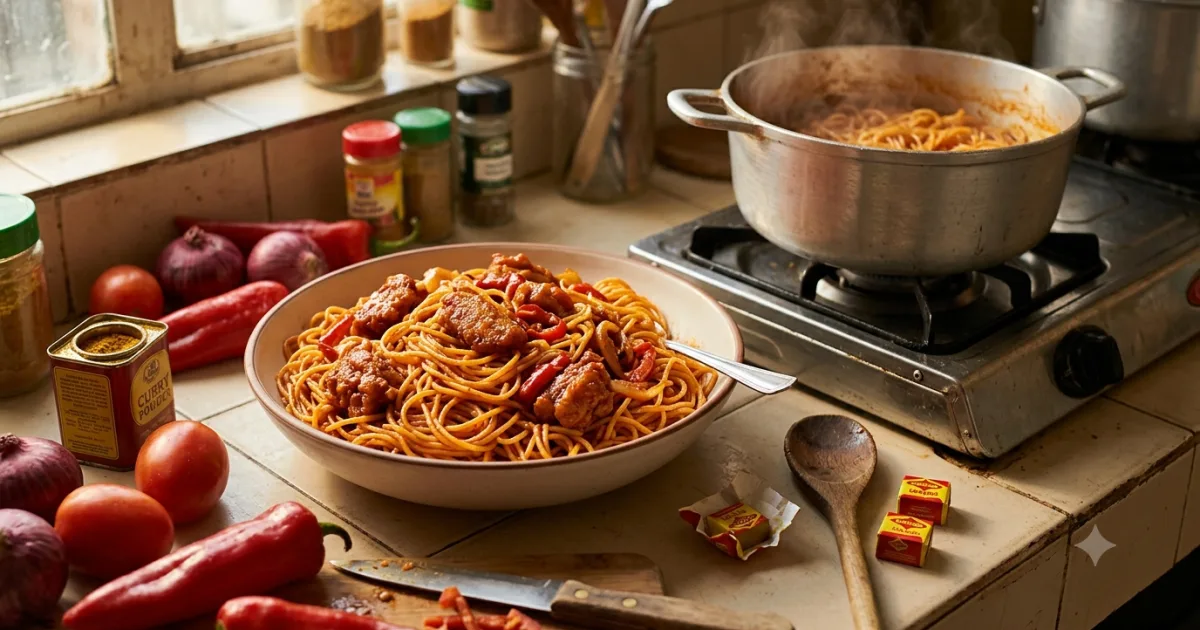
📌 Quick Summary: Nigerian jollof spaghetti is pasta cooked in a tomato-pepper-onion sauce with palm oil or vegetable oil, seasoning, curry, thyme, and protein — the same base as jollof rice but adapted for spaghetti. It uses 500g of spaghetti, 4 large tomatoes, 2 tatashe peppers, 1 to 2 scotch bonnet, and protein of your choice (chicken, beef, fish, or eggs). Cooking time: 30 to 40 minutes total. It is one of Nigeria’s most popular weekday meals — affordable, fast, filling, and deeply satisfying. This guide covers the complete recipe, how to get the correct spaghetti texture (not mushy), the protein options, variations, and how to cook jollof spaghetti for a crowd.
Nigerian jollof spaghetti occupies a unique position in the Nigerian food landscape — somewhere between the formal celebration dish (jollof rice) and the everyday comfort meal. It is the food Nigerian university students make in their hostels when rice would take too long. It is the quick dinner Nigerian parents serve on weeknight evenings when the kitchen time is short but the family’s hunger is real. It uses the same tomato-pepper base as jollof rice — the technique every Nigerian home cook already knows — but adapts it to pasta with specific adjustments that prevent the two most common failures: mushy spaghetti and a sauce that does not properly absorb into the pasta. This guide covers both the technique and the variations.
What Makes Nigerian Jollof Spaghetti Different From Italian Pasta
Italian pasta traditions emphasise a clean separation between pasta and sauce — the pasta is cooked al dente in salted boiling water, drained, then tossed briefly with a separately made sauce. Nigerian jollof spaghetti does something different: the pasta is partially cooked (not fully), then finished cooking directly in the tomato sauce — absorbing the sauce’s flavour as it completes its cooking. This method produces pasta that is uniformly coloured with the reddish-orange of the jollof base, infused throughout with the spice flavours, and considerably richer-tasting than pasta that is merely dressed with sauce after the fact. The trade-off: this method requires careful timing to prevent the pasta from going from perfectly cooked to mushy within a two-minute window. This guide explains exactly how to manage that timing.
Ingredients — Serves 4 to 6
| Ingredient | Quantity | Notes |
| Spaghetti or pasta of choice | 500g | Standard spaghetti, linguine, or penne all work. Spaghetti is most traditional for jollof spaghetti. |
| Fresh plum tomatoes | 4 large | Or substitute 2 tablespoons of tomato paste dissolved in ½ cup water for a shortcut |
| Red bell pepper (tatashe) | 2 large | Essential for the characteristic orange-red colour and body |
| Scotch bonnet pepper (atarodo) | 1 to 2 | Adjust to heat preference |
| Onion | 1 large | Half blended with tomatoes; half sliced for frying |
| Palm oil or vegetable oil | 3 to 4 tablespoons | Palm oil gives the deeper jollof colour; vegetable oil produces a lighter result |
| Curry powder | 1 teaspoon | Essential for the jollof flavour profile |
| Dried thyme | ½ teaspoon | |
| Seasoning cubes | 2 | |
| Salt | To taste | |
| Protein of choice | 300 to 500g | See protein options below |
| Water or chicken stock | 2 to 3 cups | Stock produces significantly better flavour than plain water |
Protein Options
| Protein | Preparation | Character of the Finished Dish |
| Chicken (pieces or boneless) | Season, parboil until cooked, add to sauce base | The classic Nigerian jollof spaghetti protein — rich and familiar |
| Beef (diced) | Season and boil until tender, add with the stock | Richer and more savoury — use the beef stock as the cooking liquid |
| Eggs (scrambled or whole) | Scramble separately and add at the end; or crack whole eggs into the sauce in the final 5 minutes | The student version — fast, affordable, protein-complete |
| Mixed vegetables (carrot, beans, corn) | Add with the sauce base — cook until just tender | Vegetarian version — colourful, nutritious, affordable |
| Tuna (canned) | Drain and add in the final 5 minutes | Fast, convenient — the weeknight working professional version |
| Prawns | Season and stir-fry briefly, add in the final 3 minutes | Premium version — excellent flavour combination with the tomato base |
Step-by-Step Recipe
Step 1: Blend and Pre-Cook the Pepper Base
Blend the tomatoes, tatashe, scotch bonnet, and half the onion until smooth. Pour into a pot and boil over medium heat for 10 to 15 minutes to reduce the water content. This pre-cooking step prevents the sauce from being too watery when combined with the pasta cooking water.
Step 2: Par-Cook the Spaghetti
Bring a large pot of lightly salted water to a rolling boil. Add the spaghetti and cook for exactly half the time stated on the packet — if the packet says 10 minutes, cook for 5 minutes. The spaghetti should be bendable but still have a hard white core at the centre when you bite it. Drain immediately and reserve 1 cup of the pasta cooking water — this starchy water helps the sauce bind to the pasta later.
Step 3: Build the Jollof Sauce
In a wide, deep pot or pan (wide enough to hold the spaghetti lying flat, or you can break the spaghetti in half before cooking), heat the oil over medium heat. Slice the remaining half of the onion and fry until golden — 3 to 4 minutes. Add the pre-cooked blended pepper mixture. Fry for 15 to 20 minutes, stirring frequently, until the oil separates and floats on top and all raw pepper sourness is gone. Add curry powder, thyme, crumbled seasoning cubes, and your pre-cooked protein. Add 2 cups of water, chicken stock, or beef stock. Stir well and bring to a simmer. Taste the sauce — it should be well-seasoned and slightly saltier than you would want the finished dish, because the unseasoned pasta will dilute the seasoning.
Step 4: Finish the Spaghetti in the Sauce — The Critical Step
Add the par-cooked spaghetti directly into the sauce. Toss to coat all strands in the sauce. Add a splash of the reserved pasta cooking water if the sauce seems too thick to coat the pasta evenly. Cover the pot and cook over medium-low heat for 5 to 8 minutes — the spaghetti will finish cooking in the sauce, absorbing the tomato and spice flavours as it does. Lift the lid and stir every 2 minutes to prevent the bottom from sticking and burning. The spaghetti is done when it is tender throughout with no raw core, uniformly coloured by the jollof sauce, and the sauce has been mostly absorbed — not soupy. Remove from heat immediately when the pasta reaches the correct texture.
Step 5: Rest and Serve
Allow to rest off heat for 2 to 3 minutes before serving. The spaghetti continues to absorb remaining liquid during this rest, producing a drier, more deeply flavoured finished dish. Serve in wide, shallow bowls. Garnish with sliced cucumber, diced tomato, or a fried egg on top for the classic Nigerian presentation.
How to Cook Jollof Spaghetti for a Crowd
For 10 to 15 people: double all quantities. The key adjustment at scale is using a very wide pot (or two medium pots rather than one very deep pot) — jollof spaghetti must be stirred frequently in the sauce-cooking phase, and a deep narrow pot makes this difficult and increases the risk of burning at the bottom. For events and catering, cook the jollof sauce base in full ahead of time and refrigerate; par-cook the spaghetti in batches; finish each batch in the sauce base just before service to maintain correct texture. Never attempt to cook jollof spaghetti for 50+ people as a single batch — the pasta will be inconsistently cooked. Work in batches of 500g to 1kg maximum per pot.
Common Mistakes
1. Fully Cooking the Spaghetti Before Adding to the Sauce
The most common jollof spaghetti mistake. Fully cooked pasta added to a hot sauce and cooked further for 5 to 8 minutes becomes mushy and falls apart. Always par-cook to exactly half the packet time.
2. Not Frying the Pepper Base Long Enough
Under-fried tomato sauce produces the same problem as under-fried jollof rice or Nigerian stew — raw, acidic, sharp flavour. The oil must separate and float before adding the pasta cooking liquid. Minimum 15 minutes frying for a standard batch.
3. Not Enough Liquid in the Sauce
The par-cooked spaghetti needs sufficient liquid in the sauce to finish cooking. If the sauce is too dry when you add the pasta, it will burn at the bottom before the pasta is cooked through. Add the reserved pasta water in ¼ cup increments if needed.
Frequently Asked Questions
How do I make jollof spaghetti not mushy?
Par-cook the spaghetti to exactly half the packet cooking time before adding to the sauce. The pasta finishes cooking in the sauce — adding it already fully cooked guarantees it will overcook into mush during the sauce-finishing stage.
Can I use tomato paste instead of fresh tomatoes?
Yes — dissolve 2 tablespoons of concentrated tomato paste in ½ cup of water and skip the blending step. The flavour is slightly less fresh but the technique works and significantly reduces preparation time. Add 1 extra tablespoon of palm oil to compensate for the reduced body that fresh tatashe would have provided.
What protein is best for jollof spaghetti?
Chicken is the most popular and works best with the jollof flavour base. Eggs are the fastest and most affordable. Tuna from a can is the working-professional weeknight option. All work — choose based on what you have available and how much time you have.
Sources
- Original recipe — NaijaSabi Lifestyle Desk, September 2026
- Nigerian culinary tradition — jollof pasta preparation documented across Nigerian home cooking and student culture
Last updated: 16 September 2026 · NaijaSabi Lifestyle Desk.
Nigerian Jollof Spaghetti for Students: The ₦1,500 Version
University students in Nigeria — cooking in hostels, bedsitters, and single-room apartments with minimal Equipment and tight budgets — have developed the most economical version of jollof spaghetti as a practical daily meal. The ₦1,500 version uses: 200g of spaghetti (approximately ₦300 to ₦500), 2 tomatoes and 1 scotch bonnet blended (₦200 to ₦300), 2 eggs cracked in at the end (₦200 to ₦300), 1 seasoning cube (₦50), curry powder (₦50), vegetable oil (₦100). Total ingredient cost: approximately ₦900 to ₦1,200. Cooking method: fry the blended pepper in oil for 10 minutes, add par-cooked spaghetti, cook in the sauce for 5 minutes, crack in eggs, stir and cook 2 more minutes. The result feeds one person for a complete meal. This is why jollof spaghetti became the defining meal of Nigerian university culture — it is faster than rice (no soaking, faster boiling), cheaper per serving, more filling than bread, and genuinely satisfying when made correctly. Any student reading this who has been making jollof spaghetti by throwing raw spaghetti directly into tomato sauce and stirring for 20 minutes: the par-cook method above will transform your result. Cook the spaghetti in boiling water first for half the time, then finish in the sauce. The texture difference is significant.
Jollof Spaghetti Variations Across Nigeria
Regional Nigerian cooking traditions have produced distinct variations on the basic jollof spaghetti recipe that reflect local ingredient preferences. The Yoruba version tends toward a palm oil base with iru (locust beans) added to the sauce — producing a deeper, more aromatic sauce with the characteristic umami depth of locust beans. The Igbo version often incorporates uziza leaves or bitter leaf added in the final 2 minutes, adding a herbal complexity that contrasts with the tomato base. The Hausa-influenced version uses groundnut oil instead of palm or vegetable oil, and adds a small quantity of groundnut paste to the sauce — creating a creamy, slightly nutty variation that reflects northern Nigerian cooking traditions. In Lagos, the fusion city, you encounter all of these plus the entirely Lagos-invented version: jollof spaghetti with diced suya added at the end — the tomato base and the yaji-spiced beef creating a combination that works far better than it has any right to on paper. The fundamental technique is the same across all regional versions: par-cook the pasta, build the sauce, finish the pasta in the sauce. What changes is what goes into the sauce — and that is where Nigerian regional food culture expresses itself most clearly even in a dish that began as an adaptation of an Italian import.

0 Comments
No comments yet. Be the first to share your thoughts!