




Key Takeaways: NCDC Ebola Containment, Diphtheria Alert & ₦10 Billion Health Security Fund
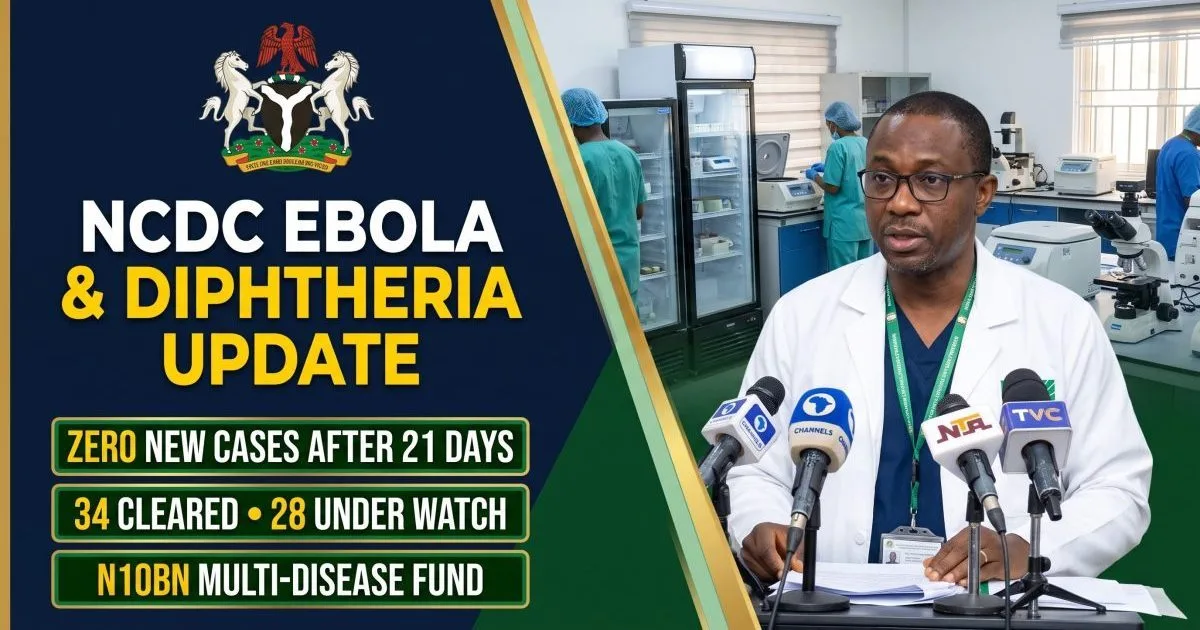
- Zero Secondary Ebola Cases After 21 Days: The Nigeria Centre for Disease Control and Prevention (NCDC), led by Director-General Dr. Jide Idris, has confirmed that Nigeria has recorded no new confirmed cases of Ebola (Bundibugyo virus disease) since the single imported index case was detected on October 20, 2026.
- 34 of 62 Contacts Cleared (28 Exiting Surveillance Nov 13): Out of the 62 contacts traced and monitored nationwide, 34 individuals have completed their mandatory 21-day incubation follow-up without symptoms, while the remaining 28 contacts are scheduled to complete surveillance by November 13, 2026.
- Urgent Diphtheria Immunisation Warning: The NCDC alerted Nigerian parents and caregivers that diphtheria remains a severe public health threat among children who missed routine pentavalent vaccinations, urging immediate catch-up immunisation at Primary Healthcare Centres (PHCs).
- Truth About the ₦10 Billion Intervention Fund: Dr. Idris clarified that the ₦10 billion federal intervention fund (approved in June 2026) was disbursed directly to the NCDC—not to the Presidential Task Force on Ebola chaired by Chief of Staff Femi Gbajabiamila—and funds multi-disease responses including Lassa fever, diphtheria, cholera, meningitis, and Ebola.
- 24/7 Toll-Free Emergency Helpline: Nigerians experiencing unexplained high fever, severe sore throat, or bleeding symptoms can call the NCDC Connect Centre toll-free on 6232 or message WhatsApp +234 708 711 0839.
Three weeks after Nigeria’s public health apparatus was placed on high alert following the confirmation of an imported case of Bundibugyo virus disease (an Ebola virus species) on October 20, 2026, the Nigeria Centre for Disease Control and Prevention (NCDC) has delivered a reassuring progress report to the nation. Briefing health correspondents in Abuja, NCDC Director-General Dr. Jide Idris announced that Nigeria has recorded zero additional confirmed Ebola cases after 21 days of intensive contact tracing, point-of-entry screening, and laboratory investigation.
According to the agency’s latest epidemiological update as of November 9–11, 2026, more than half of the individuals who came into direct or indirect contact with the imported index patient—specifically 34 out of the 62 identified contacts—have officially completed their mandatory 21-day medical follow-up without developing the virus. The remaining 28 contacts continue to undergo daily temperature and symptom checks and are scheduled to exit surveillance by Friday, November 13, 2026, provided no new symptoms emerge.
At the same time, Dr. Idris cautioned Nigerians against complacency, warning that the country is simultaneously battling active outbreaks of diphtheria (particularly among unimmunised children), Lassa fever, seasonal cholera, and cerebrospinal meningitis. To counter viral political rumours surrounding emergency funding, the NCDC chief also provided a full accounting of the ₦10 billion Federal Health Security Intervention Fund, explaining why Nigeria’s 5-year National Action Plan for Health Security (2025–2029) requires ₦522 billion in sustained investment. Here is the complete public health breakdown every Nigerian family, school, traveler, and healthcare worker needs to read.
Table of Contents
- Executive Summary Table: NCDC November 2026 Ebola, Diphtheria & Funding Metrics
- Inside the 21-Day Ebola Containment: 34 Contacts Cleared & 28 Under Watch Until November 13
- What Is Bundibugyo Virus Disease (BDBV) & Why Is Nigeria Still Under Heightened Surveillance?
- Fact-Checking the ₦10 Billion Fund: NCDC vs. Presidential Task Force (PTF) & ₦522B Health Plan
- NCDC Diphtheria Warning: Protecting Nigerian Children Who Missed Routine Immunisation
- Concurrent Outbreaks in 2026: Lassa Fever High-Burden States, Meningitis & Cholera
- Symptom Comparison Guide: How to Tell Ebola, Diphtheria, and Lassa Fever Apart
- Point-of-Entry Protocols at Nigerian Airports & Land Borders for International Travelers
- 6 Practical Prevention Steps for Nigerian Households, Schools & Healthcare Workers
- Official NCDC Emergency Directory: Toll-Free 6232 Shortcode, WhatsApp & State EOCs
- Frequently Asked Questions (FAQs)
1. Executive Summary Table: NCDC November 2026 Ebola, Diphtheria & Funding Metrics
Review the verified epidemiological figures and financial disclosures released by the Nigeria Centre for Disease Control and Prevention (NCDC) in November 2026:
| Public Health Parameter | Official Verified NCDC Status (November 2026) |
|---|---|
| Lead Public Health Agency | Nigeria Centre for Disease Control and Prevention (NCDC) — DG Dr. Jide Idris |
| Confirmed Imported Ebola Case | 1 Imported Case of Bundibugyo virus disease (Confirmed October 20, 2026; 0 secondary cases) |
| Total Identified Contacts | 62 Contacts placed under mandatory 21-day daily health follow-up |
| Contacts Cleared vs. Under Watch | 34 Contacts Cleared (Completed 21 days) | 28 Contacts Remaining Under Watch |
| Scheduled End of Contact Monitoring | Friday, November 13, 2026 (For all 62 identified contacts) |
| Federal Emergency Health Intervention | ₦10 Billion (Approved June 2026 and released directly to NCDC for multi-disease response) |
| NCDC Annual Budget Trajectory | ₦4 Billion (2024) → ₦7 Billion (2025) → ₦22 Billion (2026 Budget) |
| 5-Year National Health Security Plan | ₦522 Billion total for 2025–2029 (Requires ~₦104.4 Billion annually) |
| NCDC 24/7 Toll-Free Helpline | Dial 6232 (Toll-Free) | WhatsApp: +234 708 711 0839 | SMS: +234 809 955 5577 |
2. Inside the 21-Day Ebola Containment: 34 Contacts Cleared & 28 Under Watch Until November 13
When Nigeria confirmed an imported case of Bundibugyo virus disease on October 20, 2026, memories of the historic 2014 Ebola containment effort immediately resurfaced across the country. Epidemiology teams from the NCDC, working alongside Port Health Services and State Ministries of Health, immediately activated the national Incident Management System (IMS) and traced every person who had potential exposure to the patient.
In his national health security update covering progress through November 9–11, 2026, NCDC Director-General Dr. Jide Idris broke down the exact contact-tracing milestones:
- Total Contacts Identified (62 Individuals): Rapid response teams identified and line-listed 62 contacts linked to the imported case, placing each person under strict daily temperature and clinical symptom monitoring for the full 21-day maximum incubation period of the Ebola virus.
- 34 Contacts Officially Cleared: As of November 9, 2026, 34 out of the 62 contacts (nearly 55%) successfully completed their individual 21-day observation window without developing fever or viral haemorrhagic symptoms and have been discharged from active surveillance.
- 28 Contacts Completing Follow-Up by November 13, 2026: The remaining 28 contacts remain healthy and under close daily supervision, with the final cohort scheduled to complete their 21-day monitoring period on Friday, November 13, 2026.
- Zero Secondary Transmission Recorded: Every suspected alert investigated across states over the past three weeks tested negative, leaving Nigeria with only the single original imported case and zero community spread.
3. What Is Bundibugyo Virus Disease (BDBV) & Why Is Nigeria Still Under Heightened Surveillance?
During the briefing, Dr. Jide Idris emphasised a vital scientific caveat: “Although Nigeria has recorded no new case after 21 days, Nigeria is still not officially declared Ebola-free until all contacts complete their observation and international World Health Organization (WHO) countdown protocols are satisfied.”
What exactly is the Bundibugyo virus identified in the October 20 imported case?
- One of Four Human-Pathogenic Ebolaviruses: Within the Orthoebolavirus genus, scientists recognize four main species that cause disease in humans: Zaire ebolavirus (EBOV), Sudan ebolavirus (SUDV), Taï Forest ebolavirus (TAFV), and Bundibugyo ebolavirus (BDBV)—first discovered in western Uganda in 2007.
- Why the 21-Day Rule Is Mandatory: From the moment a person is exposed to body fluids of an infected individual, it can take anywhere from 2 to 21 days for symptoms to appear. If an exposed contact completes 21 full days without developing a fever or testing positive, they have not contracted the virus and cannot transmit it to others.
- Why WHO Requires a 42-Day Countdown: Under international health regulations, a country or region with a confirmed Ebola outbreak maintains heightened post-recovery surveillance for **42 days (twice the 21-day incubation period)** after the last confirmed case tests negative twice or is safely buried before declaring an event completely closed.
4. Fact-Checking the ₦10 Billion Fund: NCDC vs. Presidential Task Force (PTF) & ₦522B Health Plan
Over the past two weeks, social media commentators and partisan critics circulated claims questioning how a reported “₦10 billion Ebola fund” was being spent by the Presidential Task Force on Ebola. Dr. Jide Idris addressed the controversy head-on with verifiable budgetary figures:
3 Verified Facts About the ₦10 Billion Health Security Intervention Fund:
1. Approved in June 2026 (Months Before Ebola): The Federal Government approved the ₦10 billion emergency intervention fund in June 2026—four months before Nigeria confirmed the imported Bundibugyo Ebola case on October 20, 2026.
2. Released Directly to NCDC, NOT the PTF: Dr. Idris confirmed that the ₦10 billion was disbursed directly to the NCDC to fund nationwide multi-disease epidemic preparedness, laboratory reagents, vaccines, and rapid response teams—and was never paid to the Presidential Task Force on Ebola chaired by the Chief of Staff to the President, Hon. Femi Gbajabiamila (whose task force exists strictly for inter-ministerial coordination).
3. Covers Multiple Deadly Outbreaks simultaneously: The fund finances emergency operations across Ebola, diphtheria, Lassa fever, cholera, cerebrospinal meningitis, yellow fever, and Mpox.
To put Nigeria’s epidemic financing needs in perspective, the NCDC Director-General disclosed the statutory budget numbers behind Nigeria’s health security architecture:
- ₦522 Billion Required for the 5-Year National Action Plan for Health Security (2025–2029): Implementing Nigeria’s comprehensive health security roadmap requires approximately ₦104.4 billion every year across five years—meaning the ₦10 billion emergency intervention represents barely 2% of the total 5-year plan (or under 10% of a single year’s requirement).
- NCDC’s Rising Statutory Budget Allocation: Recognising the scale of biological threats, the Federal Government increased NCDC’s regular annual budget envelope from ₦4 billion in 2024 to ₦7 billion in 2025, and up to ₦22 billion in the 2026 fiscal budget.
5. NCDC Diphtheria Warning: Protecting Nigerian Children Who Missed Routine Immunisation
While public attention has focused heavily on the imported Ebola case, the NCDC warned that diphtheria is currently posing a much wider daily danger to Nigerian children across multiple states.
What is diphtheria, and why is it resurging among children?
- A Deadly Bacterial Infection of the Throat & Airway: Caused by toxin-producing strains of the bacterium Corynebacterium diphtheriae, diphtheria spreads easily from person to person through respiratory droplets (coughing or sneezing) and close physical contact. Within days, the bacterial toxin destroys healthy throat tissue, forming a thick, leathery grey-white coating (pseudomembrane) across the tonsils and windpipe that can suffocate a child or cause fatal heart and nerve damage.
- Zero-Dose & Under-Immunised Children Are Most Vulnerable: According to NCDC surveillance data, the vast majority of confirmed diphtheria hospitalizations and deaths in Nigeria occur in children aged 1 to 14 years who either received zero doses or failed to complete the mandatory **three doses of the Pentavalent vaccine** during infancy.
- Free Pentavalent & Td Vaccines at Primary Healthcare Centres: Under Nigeria’s National Programme on Immunisation (managed by NPHCDA), the Pentavalent vaccine is administered 100% free of charge to infants at 6 weeks, 10 weeks, and 14 weeks of age at government hospitals and Primary Healthcare Centres (PHCs) nationwide.
6. Concurrent Outbreaks in 2026: Lassa Fever High-Burden States, Meningitis & Cholera
As Nigeria transitions fully into the dry Harmattan season between November and March, the NCDC’s multi-disease Incident Management System is actively tracking endemic viral and bacterial threats that peak during dry weather:
- Lassa Fever (89% of Cases Concentrated in 4 States): According to NCDC 2026 epidemiological situation reports, Lassa fever remains an entrenched dry-season viral haemorrhagic threat transmitted primarily through food or household items contaminated by the urine or faeces of the multimammate rat (Mastomys natalensis). Nearly 89% of confirmed cases are concentrated across four high-burden states—Bauchi (38%), Taraba (22%), Ondo (20%), and Edo (9%)—alongside cases in Benue, Nasarawa, Kogi, and Ebonyi, with a Case Fatality Rate hovering around 21.3% when patients present late to hospitals.
- Cerebrospinal Meningitis (CSM): As dry, dusty Harmattan winds blow across northern Nigeria’s “Meningitis Belt,” the NCDC has pre-positioned vaccines, lumbar puncture kits, and antibiotics across high-risk states.
- Cholera & Acute Watery Diarrhoea: Surveillance and water-sanitation interventions remain active across flood-impacted and high-density urban communities.
7. Symptom Comparison Guide: How to Tell Ebola, Diphtheria, and Lassa Fever Apart
Because early treatment with Diphtheria Antitoxin (DAT), intravenous Ribavirin (for Lassa fever), or supportive isolation care saves lives—while wrongly treating these infections at home as “ordinary malaria or typhoid” is often fatal—every Nigerian household should know the warning signs in the comparison table below:
| Disease Threat | Early &Distinctive Warning Symptoms | How It Spreads & Immediate Medical Response |
|---|---|---|
| 1. Ebola / Bundibugyo Virus Disease (2–21 Day Incubation) |
Sudden high fever, intense weakness, muscle pain, headache, and sore throat, followed by vomiting, diarrhoea, rash, impaired kidney/liver function, and internal/external bleeding. | Direct contact with blood, vomit, sweat, or body fluids of a symptomatic patient. Dial 6232 immediately; avoid physical contact. |
| 2. Diphtheria (2–5 Day Incubation) |
Fever, painful sore throat, difficulty swallowing, hoarseness, swollen neck glands (“bull neck” appearance), and a thick grey-white patch covering the tonsils/throat. | Respiratory droplets (coughing/sneezing). Rush child to a designated hospital for Diphtheria Antitoxin (DAT) and antibiotics. |
| 3. Lassa Fever (6–21 Day Incubation) |
Gradual fever that does not respond to anti-malaria drugs after 48–72 hours, general weakness, chest/back pain, sore throat, vomiting, facial swelling, and bleeding from gums/eyes/nose. | Food/surfaces contaminated by Mastomys rat urine/droppings or body fluids. Early Ribavirin therapy within 6 days drastically improves survival. |
8. Point-of-Entry Protocols at Nigerian Airports & Land Borders for International Travelers
Because the October 20 Bundibugyo virus case entered Nigeria via international travel, the NCDC and Federal Ministry of Health’s Port Health Services have maintained strict screening protocols at Murtala Muhammed International Airport (Lagos), Nnamdi Azikiwe International Airport (Abuja), Mallam Aminu Kano International Airport (Kano), Port Harcourt International Airport, Enugu International Airport, and major land and sea borders:
- Mandatory Thermal Camera Screening: All arriving international passengers pass through automated non-contact infrared thermal scanners to detect elevated body temperatures.
- Health Declaration & Travel History Verification: Passengers arriving from or transiting through countries with active viral haemorrhagic fever alerts in East or Central Africa must complete accurate contact-tracing declarations and report any fever developing within 21 days of arrival by dialling
6232.
9. 6 Practical Prevention Steps for Nigerian Households, Schools & Healthcare Workers
NCDC Checklist to Protect Your Family During the 2026/2027 Dry Season
- Audit Your Children’s Immunisation Cards Today: Check every child’s vaccination card to confirm they received all 3 doses of the Pentavalent vaccine (at 6, 10, and 14 weeks) and childhood boosters against diphtheria. If any dose was missed, visit the nearest government Primary Healthcare Centre immediately for free catch-up vaccination.
- Stop Self-Medicating Persistent Fevers After 48 Hours: If you or a family member develop a high fever or severe sore throat that does not respond to a tested malaria treatment within 48 hours, go immediately to a qualified hospital rather than buying random antibiotics at a chemist.
- Store Garri, Rice & Grains in Rodent-Proof Containers: To prevent Lassa fever during Harmattan, never dry garri, cassava, or grains on open roadsides where rats run across them, and keep all kitchen food sealed in tight plastic or metal containers.
- Practice Regular Handwashing With Soap & Running Water: Maintain handwashing stations or alcohol-based hand sanitizers at home, schools, worship centres, and workplaces.
- Healthcare Workers Must Enforce Standard IPC Precautions: Doctors, nurses, and lab scientists in both public and private clinics must maintain a high index of suspicion and wear appropriate Personal Protective Equipment (gloves, masks, gowns) before handling any patient with unexplained fever or sore throat.
- Reject Unverified WhatsApp Remedies: Never consume salt-water baths, bitter kola concoctions, or unverified herbal mixtures claimed to prevent Ebola or diphtheria.
10. Official NCDC Emergency Directory: Toll-Free 6232 Shortcode, WhatsApp & State EOCs
Save these verified 24-hour NCDC Connect Centre emergency contacts on your mobile phone to report suspected cases or request urgent medical guidance anywhere in Nigeria:
| NCDC Emergency Channel | Official Verified Contact / Number | Availability & Cost |
|---|---|---|
| NCDC Toll-Free Shortcode | 6232 | 24/7 Toll-Free across MTN, Airtel, Glo & 9mobile (Zero airtime required) |
| NCDC Official WhatsApp | +234 708 711 0839 (0708 711 0839) |
Direct WhatsApp reporting & verified public health advisories |
| NCDC Dedicated SMS Line | +234 809 955 5577 (0809 955 5577) |
Text alerts and community surveillance reporting |
| Official Portal & Email | ncdc.gov.ng | info@ncdc.gov.ng |
Weekly Epidemiological Situation Reports (SitReps) & clinical guidelines |
| National Headquarters | Plot 801, Ebitu Ukiwe Street, Jabi, Abuja, FCT | National Reference Laboratory & Emergency Operations Centre (EOC) |
11. Frequently Asked Questions (FAQs) About the NCDC Ebola & Diphtheria Update
1. Has Nigeria recorded any new Ebola cases since the October 20, 2026 imported case?
No. According to NCDC Director-General Dr. Jide Idris, Nigeria has recorded zero additional confirmed cases of Bundibugyo virus disease (Ebola) 21 days after the single imported case was identified on October 20, 2026.
2. How many of the 62 Ebola contacts in Nigeria have been cleared?
Out of the 62 contacts traced and monitored by the NCDC, 34 contacts completed their mandatory 21-day follow-up period as of November 9, 2026, without developing any symptoms. The remaining 28 contacts remain under active daily monitoring and are scheduled to exit surveillance by November 13, 2026.
3. Was the ₦10 billion health intervention fund given only for Ebola or to the Presidential Task Force?
Neither. Dr. Jide Idris clarified that the ₦10 billion intervention fund was approved by the Federal Government in June 2026 (months before the October 20 imported Ebola case) and was released directly to the NCDC—not to the Presidential Task Force on Ebola—to fund multi-disease responses including diphtheria, Lassa fever, cholera, meningitis, and Ebola.
4. What did the NCDC warn parents about regarding diphtheria in November 2026?
The NCDC warned that diphtheria remains a serious public health concern in Nigeria, especially among children who missed routine childhood vaccinations. Parents and caregivers are urged to check their children’s immunisation cards and visit the nearest Primary Healthcare Centre for free Pentavalent catch-up vaccines.
5. What is the NCDC toll-free emergency number to report suspected Ebola, diphtheria, or Lassa fever cases?
You can call the NCDC Connect Centre toll-free 24 hours a day by dialling 6232 from any Nigerian mobile network, send a WhatsApp message to +234 708 711 0839, or send an SMS to +234 809 955 5577.
Get the NaijaSabi Morning Brief
Verified daily Naira FX rates, fuel & food prices, and open Nigerian job portals — zero spam, unsubscribe anytime.



0 Comments
No comments yet. Be the first to share your thoughts!