



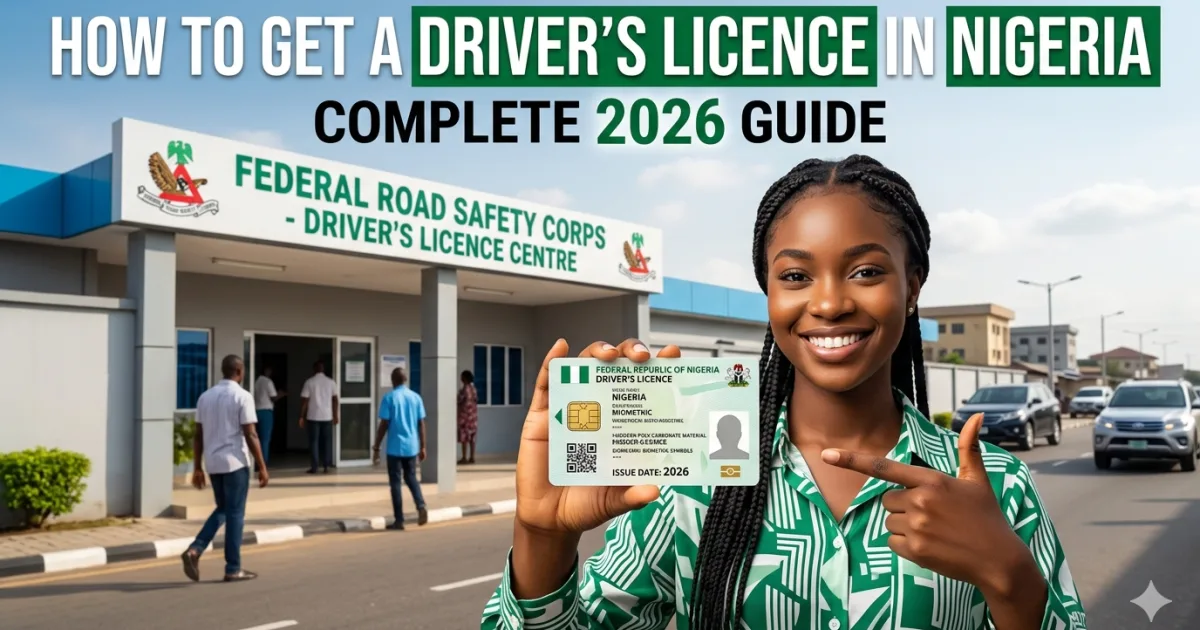
A Nigerian driver’s licence is a compulsory requirement for anyone who drives a motor vehicle on Nigerian roads. In 2026, the Federal Road Safety Corps (FRSC) handles all driver’s licence production and management through a centralised digital system — and the application process has been significantly modernised, with online registration through the FRSC portal and biometric data capture at FRSC offices. This guide covers everything: the types of driver’s licences available, the requirements for a first-time licence, the step-by-step application process, current fees, processing time, and how to renew an existing licence.
Types of Nigerian Driver’s Licence 2026
| Class | Vehicle Type | Who Needs It |
|---|---|---|
| Class A | Motorcycles (all sizes) | Motorcycle riders (okada) |
| Class B | Vehicles up to 3.5 tonnes (cars, SUVs, small vans) | Most private car owners — this is the standard licence |
| Class C | Vehicles above 3.5 tonnes (trucks, large buses) | Commercial truck and heavy vehicle drivers |
| Class D | Articulated vehicles (trailers, tankers) | Long-haul trailer and tanker drivers |
| Class E | Tricycles (Keke NAPEP/Marwa) | Commercial tricycle operators |
Requirements for a New Nigerian Driver’s Licence 2026
- Age: Minimum 18 years old
- Valid NIN: Your National Identification Number — compulsory; all FRSC applications now require NIN
- Valid means of identification: International passport, national ID card, voter’s card, or NIN slip
- Proof of address: Utility bill, bank statement, or tenancy agreement not older than 3 months
- Passport photograph: Recent, white background — 2 copies
- Learner’s permit: You must first obtain a learner’s permit and hold it for a minimum period before applying for the full licence
- Medical fitness: Basic eye test and medical assessment conducted at the FRSC office during application
How to Apply for a Nigerian Driver’s Licence — Step by Step
- Register online at the FRSC portal: Visit dlms.frsc.gov.ng (Driver’s Licence Management System) and create an account with your email, phone number, and NIN
- Complete the application form online: Fill in your personal details, select the licence class you need, choose your nearest FRSC licensing office, and select a preferred appointment date
- Pay the application fee online: Payment is made through the portal using debit card or bank transfer via Remita. Keep the payment receipt
- Attend your FRSC appointment: Visit the selected FRSC Licensing Office on your appointment date with all original documents
- Biometric capture: At the FRSC office, your photograph, fingerprints, and signature are captured digitally using FRSC’s biometric system
- Vision test: A basic eye test is conducted to confirm you can see adequately to drive safely
- Written test (for new applicants): First-time licence applicants take a Highway Code knowledge test at the FRSC office — study the Nigerian Highway Code before your appointment
- Driving test (practical): A practical driving test may be conducted at some FRSC offices for first-time applicants — bring the vehicle you plan to drive
- Collect temporary licence: A temporary licence is issued at the office on the same day pending production of your permanent card
- Collect permanent card: Your permanent driver’s licence card (smart card) is printed centrally and delivered to your FRSC office — typically within 4–6 weeks of your application
FRSC Driver’s Licence Fees 2026
| Service | Fee | Validity |
|---|---|---|
| Learner’s permit (first-time) | ₦2,750 – ₦3,500 | 3 months (provisional) |
| New driver’s licence (3-year) | ₦6,350 – ₦6,875 | 3 years from issue date |
| Driver’s licence renewal (3-year) | ₦6,350 – ₦6,875 | 3 years from expiry date |
| Driver’s licence replacement (lost) | ₦10,000 – ₦15,000 | Remainder of original licence period |
Note: FRSC fees are set by the FRSC Act and updated periodically. Always verify current fees at dlms.frsc.gov.ng or your nearest FRSC office before payment. Pay only through official channels — never pay cash to FRSC staff directly outside official cashier processes.
How to Renew an Expired Driver’s Licence
Driver’s licences in Nigeria are valid for 3 years. Renewal follows the same online portal process as a new application: register or log in at dlms.frsc.gov.ng, select “Renewal” rather than “New Application,” pay the renewal fee, attend your appointment for biometric update, and collect your renewed card within 4–6 weeks. Driving with an expired licence is an offence under the Highway Code and FRSC officers at checkpoints will flag expired cards — renew before the expiry date shown on your current licence. FRSC sends SMS reminders to the phone number registered on your licence record as expiry approaches — ensure your registered phone number is current and active.
Driver’s Licence Corruption: Avoiding Touts and Unofficial Agents
Driver’s licence processing in Nigeria has historically been plagued by touts — unofficial agents who loiter outside FRSC offices offering to “fast-track” applications for fees of ₦20,000–₦80,000. These payments are entirely unnecessary, potentially illegal, and often do not deliver the promised speed. The FRSC’s online portal system was specifically designed to eliminate the need for physical queuing and tout dependence — applicants who book their appointment online and arrive prepared with all documents typically complete their FRSC visit within 1–3 hours without paying any unofficial fees. Pay only through the official online payment gateway on dlms.frsc.gov.ng. Report any FRSC staff soliciting unofficial payments to the FRSC Anti-Corruption desk or the ICPC at icpc.gov.ng.
Nigerian Highway Code: What You Must Know Before Your Test
First-time driver’s licence applicants must pass a Highway Code knowledge test at the FRSC office. Key topics covered in the Nigerian Highway Code test include: road signs and their meanings (mandatory, warning, and informational signs); right-of-way rules at intersections and roundabouts; speed limits by road type and zone; safe following distances; overtaking rules; pedestrian right of way; use of headlights, indicators, and hazard lights; parking regulations; load limits for commercial vehicles; blood alcohol limits for drivers; and penalties for traffic offences. The Nigerian Highway Code is available from bookshops and the FRSC website — study it seriously before your appointment. The test is multiple-choice and typically 20–30 questions. A passing score is required to proceed to the practical driving test and licence issuance.
Frequently Asked Questions — Driver’s Licence Nigeria 2026
How do I get a driver’s licence in Nigeria 2026?
Register online at dlms.frsc.gov.ng, pay the application fee, book an appointment at your nearest FRSC licensing office, attend with original documents (NIN, ID, proof of address, photographs), complete biometric capture, vision test, and written/practical tests, receive temporary licence on the day, and collect your permanent smart card within 4–6 weeks.
How much is driver’s licence in Nigeria 2026?
A new 3-year driver’s licence costs approximately ₦6,350–₦6,875 in official FRSC fees. Learner’s permit costs approximately ₦2,750–₦3,500. Pay only through the official dlms.frsc.gov.ng portal — never pay unofficial agents or FRSC staff directly.
How long does a Nigerian driver’s licence last?
A Nigerian driver’s licence is valid for 3 years from the issue date. Renew before expiry at dlms.frsc.gov.ng to avoid driving with an expired licence, which is a traffic offence.
🚗 Driver’s Licence Nigeria 2026 — Quick Reference
- FRSC portal: dlms.frsc.gov.ng — online application and payment
- Minimum age: 18 years
- What you need: NIN + valid ID + proof of address + passport photos + payment
- New licence fee: ₦6,350–₦6,875 (3-year validity)
- Learner’s permit: ₦2,750–₦3,500 (required before full licence)
- Processing time: Temporary licence same day; permanent card 4–6 weeks
- Tests required: Vision test + Highway Code written test + practical driving test
- Renewal: Every 3 years at dlms.frsc.gov.ng — same process as new application
- Avoid touts: Never pay unofficial agents — apply online directly
- FRSC contact: frsc.gov.ng | 0700-CALL-FRSC
Also read: TIN Registration Nigeria 2026 | NIN Modification Nigeria 2026 | NYSC Allowance 2026
Requirements for a New Nigerian Driver’s Licence 2026
- Age: Minimum 18 years old
- Valid NIN: National Identification Number — compulsory for all FRSC applications in 2026
- Valid government ID: International passport, national ID card, voter’s card, or NIN slip
- Proof of address: Utility bill, bank statement, or tenancy agreement not older than 3 months
- Passport photographs: 2 recent passport-size photos, white background
- Learner’s permit: Must obtain a learner’s permit first; hold it for minimum period before applying for full licence
- Medical fitness: Vision test and basic health check conducted at FRSC office during biometric capture
Step-by-Step: How to Get Your Driver’s Licence at FRSC
- Visit dlms.frsc.gov.ng and create an account with your email, phone, and NIN
- Complete the online application form — select licence class, nearest FRSC office, and preferred appointment date
- Pay the application fee online via Remita — print the payment receipt
- Attend your scheduled appointment at the FRSC Licensing Office with all original documents
- Biometric capture: photo, fingerprints, and signature digitally captured by FRSC officer
- Vision test: basic eyesight check to confirm you can see adequately to drive
- Written Highway Code test: 20–30 multiple-choice questions — study the Nigerian Highway Code book before your appointment
- Practical driving test (for first-time applicants at most offices): bring the class of vehicle you plan to drive
- Temporary licence issued on the same day — valid until your permanent card is ready
- Permanent smart card collected from FRSC office 4–6 weeks after application, or delivered by courier if requested
Driver’s Licence Fees 2026
| Service | Official Fee | Validity |
|---|---|---|
| Learner’s permit | ₦2,750 – ₦3,500 | 3 months provisional |
| New driver’s licence | ₦6,350 – ₦6,875 | 3 years |
| Licence renewal | ₦6,350 – ₦6,875 | 3 years from expiry |
| Replacement (lost/damaged) | ₦10,000 – ₦15,000 | Remainder of original period |
Pay only through the official dlms.frsc.gov.ng online portal — never pay cash directly to FRSC staff outside the official cashier process. Touts at FRSC offices offer to “fast-track” applications for ₦20,000–₦80,000 — these payments are unnecessary and potentially criminal. The online booking system eliminates the need for physical queueing; applicants who arrive on time with complete documents complete the visit in 1–3 hours without paying anyone.
Types of Nigerian Driver’s Licence
| Class | Vehicle | Typical User |
|---|---|---|
| Class A | Motorcycles | Motorcycle riders and couriers |
| Class B | Cars and light vehicles up to 3.5 tonnes | Most private car owners — standard licence |
| Class C | Heavy vehicles above 3.5 tonnes | Truck and large bus drivers |
| Class D | Articulated vehicles and tankers | Trailer and tanker operators |
| Class E | Tricycles (Keke NAPEP) | Commercial tricycle operators |
Nigerian Highway Code: Key Topics for the Written Test
The Highway Code knowledge test covers: road signs (mandatory, warning, informational); right-of-way rules at junctions and roundabouts; speed limits by road type (urban 50km/h, highway 100km/h, expressway 120km/h general limits); safe following distances; overtaking rules; pedestrian right-of-way; correct use of headlights, indicators, and hazard lights; parking regulations; alcohol limits for drivers (blood alcohol concentration must be zero for commercial drivers under FRSC regulation); and penalties for speeding, reckless driving, and vehicle document offences. The Nigerian Highway Code book is available from bookshops and the FRSC website. Study it at least one week before your appointment. The test is typically 20–30 multiple-choice questions and a passing score is required to proceed to licence issuance.
Renewing an Expired Driver’s Licence
Nigerian driver’s licences are valid for 3 years. Driving with an expired licence is a traffic offence — FRSC officers at checkpoints and roadblocks will flag expired cards. Renewal follows the same online process: log into dlms.frsc.gov.ng, select Renewal, pay the renewal fee, book an appointment for biometric update, attend the FRSC office, and collect your renewed card within 4–6 weeks. FRSC sends SMS reminders to your registered phone number as your licence expiry date approaches — ensure your phone number is current in the FRSC system. Renew before the expiry date shown on your current licence to avoid the lapse in coverage and the potential complications of driving without a valid licence.
Driver’s Licence for Commercial Drivers: Additional Requirements
Commercial drivers — those operating vehicles for hire or reward including taxis, Uber/Bolt drivers, bus drivers, truck drivers, and tanker operators — face additional licensing and documentation requirements beyond the standard private driver’s licence. In addition to the relevant class driver’s licence (Class B for taxis and ride-hailing, Class C for trucks, Class D for articulated vehicles), commercial drivers need: a valid Vehicle Inspection Office (VIO) certificate for their vehicle; a hackney carriage permit or route licence from the relevant state transport authority for commercial operations; proof of vehicle insurance (third-party minimum, comprehensive recommended); and a valid FRSC-issued road worthiness certificate. Uber and Bolt drivers additionally need to meet the ride-hailing platform’s specific vehicle age, condition, and documentation requirements displayed in their respective driver apps. Driving commercially without all required documentation exposes drivers to significant fines, vehicle impoundment, and licence suspension at FRSC checkpoints.
Frequently Asked Questions — Driver’s Licence Nigeria 2026
How do I get a driver’s licence in Nigeria 2026?
Register at dlms.frsc.gov.ng, pay the application fee, book an appointment, attend with your NIN and other documents, complete biometric capture and tests, receive a temporary licence same day, and collect your permanent smart card in 4–6 weeks. The process is entirely managed online at dlms.frsc.gov.ng.
How much is driver’s licence in Nigeria 2026?
New 3-year driver’s licence: ₦6,350–₦6,875 official FRSC fee. Learner’s permit: ₦2,750–₦3,500. Replacement (lost/damaged): ₦10,000–₦15,000. Pay only through dlms.frsc.gov.ng.
How long is Nigerian driver’s licence valid?
3 years from the date of issue. Renew before expiry at dlms.frsc.gov.ng. Driving with an expired licence is a traffic offence under Nigerian law.
Driver’s Licence Full Guide: Requirements, Process and Fees Nigeria 2026
A Nigerian driver’s licence is mandatory for all drivers on Nigerian roads and is managed by the Federal Road Safety Corps (FRSC). In 2026, the application process is online-first through the FRSC Driver’s Licence Management System at dlms.frsc.gov.ng. This guide covers everything: types of licences, full requirements, the complete application process, current fees, processing times, renewal, replacement, and how to avoid the touts that still plague FRSC offices despite the online system.
Types of Nigerian Driver’s Licence
Nigeria’s driver’s licence system has five classes corresponding to vehicle types. Class A covers motorcycles of all engine sizes — required for okada riders and motorcycle enthusiasts. Class B is the standard private car licence — covering all vehicles up to 3.5 tonnes including cars, SUVs, pickup trucks, and minibuses. This is the licence most Nigerians need. Class C covers heavy commercial vehicles above 3.5 tonnes including trucks and large buses. Class D covers articulated vehicles — trailers, tankers, and semi-trucks requiring the most advanced driving qualification. Class E covers tricycles — the keke NAPEP and Marwa commercial tricycles that are a primary transport mode in many Nigerian cities and towns.
Full Requirements for a New Licence
To apply for a new Nigerian driver’s licence in 2026 you need: a minimum age of 18 years; your National Identification Number (NIN) — compulsory for all FRSC applications since 2024; a valid government-issued identity document (international passport, national ID card, or voter’s card); proof of address in the form of a recent utility bill, bank statement, or tenancy agreement not older than three months; two recent passport photographs with white background; successful completion of the learner’s permit stage (typically held for at least one month before a full licence is issued); and passing the FRSC’s mandatory vision test, written Highway Code test, and practical driving test conducted at your chosen licensing office.
Step-by-Step Application Process 2026
Step 1: Register at dlms.frsc.gov.ng — create an account with your email, phone number, and NIN. Step 2: Fill in the online application form completely — personal details, licence class required, nearest FRSC office, and preferred appointment date. Step 3: Pay the application fee online through the portal via Remita — keep your payment confirmation receipt. Step 4: Attend your booked appointment at the chosen FRSC Licensing Office with all original documents listed above. Step 5: Complete biometric capture on-site — photograph, fingerprints, and signature are captured digitally by FRSC staff using the DLMS system. Step 6: Pass the vision test conducted by FRSC medical staff — if you wear glasses or contact lenses, declare this at registration and bring them to the test. Step 7: Pass the Highway Code written test — 20–30 multiple choice questions on road signs, traffic rules, and safe driving practices. Study the Nigerian Highway Code booklet available from FRSC offices and bookshops. Step 8: Pass the practical driving test — conducted in the vehicle you intend to drive, at or near the FRSC office. Demonstrate basic manoeuvres: starting, stopping, reversing, three-point turn, hill start, and road awareness. Step 9: Receive your temporary driver’s licence — issued on the same day as your appointment, valid for driving while your permanent card is being produced. Step 10: Collect your permanent smart card — produced centrally by FRSC and returned to your chosen licensing office within 4–6 weeks. You receive an SMS when it is ready for collection.
FRSC Fees 2026 — Official Schedule
| Service | Official Fee | Validity |
|---|---|---|
| Learner’s permit | ₦2,750 – ₦3,500 | 3 months |
| New driver’s licence (3-year) | ₦6,350 – ₦6,875 | 3 years |
| Renewal (3-year) | ₦6,350 – ₦6,875 | 3 years from expiry |
| Replacement (lost/damaged) | ₦10,000 – ₦15,000 | Balance of original period |
Pay only through dlms.frsc.gov.ng official payment gateway. Never pay cash to any FRSC officer or agent directly outside the official cashier process. FRSC has a zero-tolerance policy on unofficial payments — report any solicitation to the FRSC Anti-Corruption desk or ICPC at icpc.gov.ng.
Renewing Your Nigerian Driver’s Licence
Driver’s licences expire every 3 years. Renewal follows the same online process: log into dlms.frsc.gov.ng, select Renewal, pay the renewal fee, book your biometric update appointment, attend the FRSC office, and collect your renewed card within 4–6 weeks. Begin renewal at least 4–6 weeks before expiry — driving with an expired licence is a traffic offence under the Highway Code and is penalised at FRSC checkpoints. FRSC sends SMS reminders to your registered number as your expiry date approaches. If your registered number has changed, update it at any FRSC office to ensure you receive these reminders.
Replacing a Lost or Damaged Licence
If your driver’s licence is lost or damaged, apply for replacement through dlms.frsc.gov.ng — the process is the same as renewal but select “Replacement” rather than “Renewal.” You will need to provide a sworn affidavit from a court of competent jurisdiction confirming the loss (for lost licences) or present the damaged card (for damaged licences). The replacement fee of ₦10,000–₦15,000 is higher than the standard renewal fee. Your replacement card retains the expiry date of the original — replacement does not extend your licence validity period.
Driving Without a Valid Licence: Consequences
Driving without a valid driver’s licence or with an expired licence carries significant consequences under Nigerian law and FRSC enforcement. A first offence typically results in: vehicle impoundment; payment of a fine ranging from ₦3,000–₦10,000 at FRSC Marshal checkpoints; and compulsory traffic education at the FRSC checkpoint before release. For repeat offences or if other violations are also present (no insurance, overloading, etc.), the consequences escalate to court summons and heavier fines. Vehicle insurance claims can also be voided by insurers if the driver is found to have been driving without a valid licence at the time of an accident — meaning you bear the full cost of any damage or injury claim personally. The cost of maintaining a valid licence (₦6,350–₦6,875 every 3 years) is negligible compared to the risks and costs of driving without one.
Driving Schools in Nigeria: Preparing for Your Practical Test
First-time drivers who have not previously been taught to drive by a family member or self-taught should consider enrolling in a registered driving school before their FRSC practical test. Registered driving schools provide structured lessons covering the FRSC’s test requirements — basic vehicle controls, clutch management (for manual vehicles), road positioning, mirror usage, safe speed selection, and hazard awareness. A typical driving school course costs ₦30,000–₦80,000 for 10–20 lessons, depending on location and the school’s reputation. FRSC-recognised driving schools provide a certificate of completion that may be presented at your licence application to demonstrate formal training. Ensure any driving school you use is registered with FRSC — unregistered schools’ certificates are not valid for licence applications. Ask to see the school’s FRSC registration certificate before enrolling.
Foreign Licence Conversion: Using an International Licence in Nigeria
Nigerians returning from abroad who hold a foreign driver’s licence can drive in Nigeria for a limited period on their foreign licence — typically up to three months for visitors. For returning Nigerians taking up residency, converting a foreign licence to a Nigerian one is required. The conversion process at FRSC involves: presenting your original valid foreign licence with a certified translation if not in English; providing your Nigerian identification documents (NIN, national ID or passport); completing the FRSC registration and biometric capture process; and in most cases passing an abridged rather than full written and practical test (since you have already demonstrated driving competence in another jurisdiction). Confirm the current conversion requirements at dlms.frsc.gov.ng or your nearest FRSC office, as specific requirements for licence conversion may vary based on the country of original issue and reciprocal recognition agreements.
FRSC Contact Information 2026
For all driver’s licence queries, application status checks, or complaints about FRSC service quality: visit dlms.frsc.gov.ng for the online portal and application tracking; call the FRSC toll-free line at 0700-CALL-FRSC (0700-2255-3772); email enquiries@frsc.gov.ng for written queries; or visit the FRSC headquarters at Apir, Markurdi, Benue State, or any of the FRSC sector commands located in state capitals across Nigeria. For anti-corruption complaints specifically — reporting officers who solicit unofficial payments or agents claiming to facilitate faster processing for cash — use the FRSC Anti-Corruption reporting line or file directly with the ICPC at icpc.gov.ng with all available evidence including any payment receipts, phone numbers used, and descriptions of the individuals involved.
Common Myths About Nigerian Driver’s Licences
Several persistent myths about Nigerian driver’s licences cause unnecessary confusion and expense. First myth: “You need to pay an agent to get your licence faster.” False — the FRSC online booking system gives all applicants equal access to available appointment slots. No agent can move you to the front of the queue through unofficial payments — and if they claim to, they are either misrepresenting their influence or their payment is going into their own pocket rather than accelerating any official process. Second myth: “A photocopy of your licence is acceptable at FRSC checkpoints.” False — FRSC officers require the original licence card or a valid temporary licence at checkpoints. A photocopy is not a valid substitute. Third myth: “You can renew your licence at any time after expiry without penalty.” Partially false — while FRSC does not typically charge a late renewal penalty fee, driving between your expiry date and your renewal date is technically a traffic offence that could result in a fine at a checkpoint. Renew before expiry. Fourth myth: “A foreign licence is valid indefinitely in Nigeria.” False — foreign licences are recognised for short stays only; permanent residents must convert to a Nigerian licence through FRSC.
Getting your Nigerian driver’s licence in 2026 is more straightforward than at any previous point in FRSC’s history thanks to the online DLMS portal. Apply at dlms.frsc.gov.ng, prepare your documents thoroughly, study the Highway Code before your written test, arrive at your appointment on time with all originals, and collect your permanent smart card within 4–6 weeks. Avoid any tout or unofficial agent. Renew every 3 years before expiry. The ₦6,350–₦6,875 cost every three years is among the best-value government services available to Nigerian citizens — providing legal authorisation to operate a motor vehicle across the entire federation.
Road safety is a shared responsibility. Every driver who holds a valid licence has demonstrated to FRSC the minimum required knowledge of road rules and driving competence. Reducing Nigeria’s devastating road accident toll — one of the highest per capita in the world — depends on every driver taking this responsibility seriously, not just on passing the licence test once and forgetting everything learned. Refresh your Highway Code knowledge regularly, stay current on any changes to traffic regulations, and drive at all times as though FRSC Marshal officers are watching — because on Nigeria’s roads, the greatest danger is rarely the officer at the checkpoint but the unqualified, reckless driver who never bothered to get a licence at all.
In 2026 Nigeria, holding a valid driver licence is not optional — it is a legal requirement, a safety credential, and increasingly a prerequisite for vehicle insurance claims. Apply at dlms.frsc.gov.ng today and join the millions of Nigerians who drive legally and confidently on the nation’s roads.

0 Comments
No comments yet. Be the first to share your thoughts!