


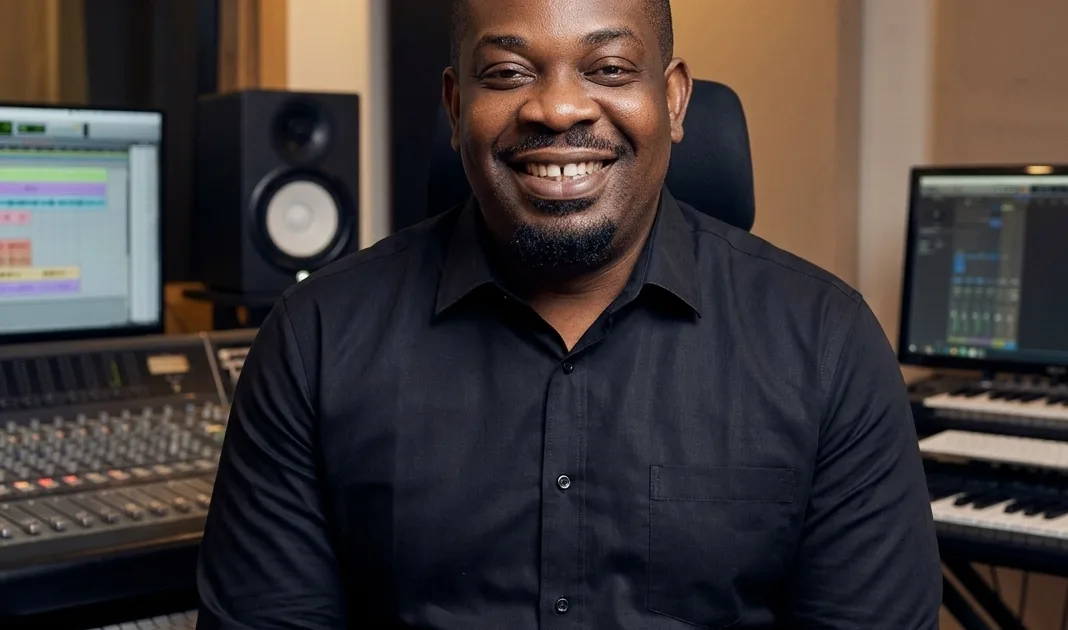
He was four years old when he started learning the drums. By twelve, he could play the bass guitar, the keyboard, and several other instruments with a fluency that most conservatory-trained musicians do not achieve until adulthood. He grew up in Ajegunle — the densely packed waterfront neighbourhood of Lagos that has produced more Nigerian musical talent per square kilometre than any other postcode on earth — in a household where his father’s love of music was so deeply embedded in the family’s daily life that the question was never whether Michael Collins Ajereh would pursue music but only which part of it he would make his life’s work.
The answer, it turned out, was all of it. The producing. The A&R. The label-building. The artist development. The talent-spotting that has identified, over the course of two decades, an almost unbroken string of artists who became major stars: D’banj, Wande Coal, Dr SID, Tiwa Savage, Korede Bello, Reekado Banks, Rema, Ayra Starr, Johnny Drille, Crayon, Ladipoe — a roster so consistently excellent that it begins to feel less like luck and more like a diagnostic gift: the ability to hear, in a rough recording or a social media cover video, the specific quality that distinguishes an artist who will matter from one who will not.
He is Don Jazzy. He is 43 years old. He runs Mavin Records — the most consistently productive and creatively significant record label in Nigerian music history — which sold a majority stake to Universal Music Group in 2024, in a deal that confirmed Mavin’s standing as the African music business’s most globally credible institutional infrastructure. He is divorced. He has no publicly confirmed children. He has 15 million Instagram followers, earns nearly a million dollars annually from YouTube alone, and is worth an estimated $15–20 million by the most credible assessments — making him one of the wealthiest music industry figures in Africa.
This is his full biography.
Don Jazzy Biography Facts at a Glance
| Full Name | Michael Collins Ajereh |
| Stage Name | Don Jazzy |
| Date of Birth | November 26, 1982 |
| Age | 43 years old (as of 2026) |
| Place of Birth | Umuahia, Abia State, Nigeria |
| Raised In | Ajegunle, Lagos State, Nigeria |
| State of Origin | Delta State (Isoko; paternal) / Abia State (maternal) |
| Ethnicity | Mixed — Isoko (Delta State; father) and Igbo (Abia State; mother) |
| Religion | Christianity |
| Father | Collins Enebeli Ajereh (Isoko, Delta State) |
| Mother | Mrs Ajereh (Igbo princess, Abia State) |
| Siblings | D’Prince (brother and Mavin artist); General Jay Mavin (brother); Joy Solano (sister); first of four children |
| Education | Federal Government College, Lagos; Ambrose Ali University, Ekpoma (Business Management; did not complete) |
| Occupation | Record Producer, Music Executive, Singer, Songwriter, Businessman, Philanthropist |
| Labels Founded | Mo’ Hits Records (2004, with D’banj); Mavin Records (2012) |
| Ex-Wife | Michelle Jackson (m. 2003; div. 2005) |
| Children | None publicly confirmed |
| Major Collaborations | D’banj, Wande Coal, Kanye West, Jay-Z, Beyoncé, Tiwa Savage, Rema, Ayra Starr |
| Net Worth (Estimated) | $15 million – $20 million USD (2026) |
| @donjazzy (15 million followers) | |
| Nationality | Nigerian |
Early Life: Born in Umuahia, Raised in Ajegunle — Music From the Age of Four
Michael Collins Ajereh was born on November 26, 1982, in Umuahia, Abia State — a city in southeastern Nigeria — but grew up primarily in Ajegunle, Lagos State: the legendary waterfront neighbourhood on the Lagos mainland that has been the city’s most fertile music-producing community for generations. His background is mixed in a way that is both unusual and formative: (cite index=”21-1″>his father is from Isoko in Delta State, while his mother is an Igbo princess from Abia State. He is neither straightforwardly Yoruba nor Igbo nor Isoko — a mixed-heritage identity that may partly explain the cultural fluency across ethnic and regional musical traditions that makes his productions feel universally Nigerian rather than regionally specific.
From his earliest years, music was not a hobby or a future aspiration but a present-tense reality in the Ajereh household. His father’s deep love of music gave the home a sonic environment in which instruments were not decorative objects but everyday tools. At four years old, Michael began learning the drums. By twelve, (cite index=”22-1″>he was already proficient in playing several musical instruments, including the bass guitar, as well as the keyboard, piano, and various percussion instruments. The range and depth of his instrumental training at such a young age gave him a musicological foundation that most producers — who typically develop their skills through digital audio workstations — simply do not have. He understands music from the inside: from the physics of the drum hit, the harmonic logic of the keyboard, the rhythmic relationship between instruments that makes a track feel alive rather than constructed.
His secondary education was at the prestigious Federal Government College in Lagos — one of Nigeria’s elite unity schools — where his musical reputation preceded him enough that his schoolmates gave him the nickname “Don Jazzy”: a name he eventually adopted as his permanent professional identity. He subsequently enrolled at Ambrose Ali University in Ekpoma, Edo State to study Business Management — a choice that reflects the pragmatic intelligence that would later make him as effective a businessman as he is a music producer. He did not complete the degree, leaving university to pursue music full-time — a decision whose wisdom the subsequent twenty years have comprehensively vindicated.
London: The UK Years and the Partnership That Would Define Nigerian Music
Don Jazzy’s professional music career began not in Lagos but in London, where he relocated in the early 2000s. In London, he began working with an assortment of Nigerian and British musicians — including JJC Skillz (later Funke Akindele’s ex-husband), Jesse Jagz, and D’banj — developing his production skills in the real-world laboratory of the UK’s Nigerian diaspora music scene.
His collaboration with D’banj — the Oyo State-born singer and performer whose charisma and commercial instincts were a perfect complement to Don Jazzy’s production genius — began in London and quickly crystallised into one of the most commercially potent creative partnerships in the history of Nigerian music. The two men recognised in each other something they could not replicate alone: D’banj had the star power, the stage presence, and the crowd-reading instincts of a born frontman; Don Jazzy had the production intelligence, the melodic invention, and the business acumen to package and deliver that star power at scale. Together, they decided to return to Nigeria and build something.
Mo’ Hits Records: The Label That Defined 2000s Nigerian Music
In 2004, Don Jazzy and D’banj co-founded Mo’ Hits Records — a name that combined Mo Abudu (media personality) and the English word “hits” into a declaration of commercial intent. (cite index=”19-1″>Don Jazzy was the CEO/President of the label and D’banj was its co-owner and first signed artist. The label was home to other artists such as Wande Coal, Dr SID, D’Prince, and K-Switch.
The label’s debut production — D’banj’s first album No Long Thing (2005) — was an immediate commercial success. The subsequent D’banj albums Rundown/Funk You Up (2006) and The Entertainer (2008) produced hit after hit — “Why Me,” “Bumper to Bumper,” “Oliver Twist,” “Fall in Love” — that collectively defined the sound of Nigerian pop music in the late 2000s. (cite index=”18-1″>With him at the helm, Mo’ Hits created the popular ethos of Afropop in the 2000s with smash hits like “Why Me”, “Bumper to Bumper”, “Over the Moon” and “Oliver Twist.”
The Mo’ Hits era also produced Wande Coal — widely regarded as one of the finest pure vocalists in Nigerian music history — whose album Mushin 2 Mo’ Hits (2008) was described by many at the time as the best album produced by a Nigerian artist to that point. Don Jazzy’s production on that album — the harmonic sophistication, the melodic intelligence, the way the arrangements served Coal’s extraordinary voice — established him as the most technically accomplished record producer in Nigeria and one of the finest in Africa.
In 2011, Mo’ Hits made its most significant international connection. (cite index=”25-1″>Mo’ Hits locked hands with Kanye West’s G.O.O.D Music in 2011. Don Jazzy worked as an in-house producer for Kanye’s label from 2011 to 2015 — a period during which he (cite index=”25-1″>co-produced American rapper Kanye West’s song “Lift Off” which had music heavyweights Beyoncé and Jay-Z on it. The Kanye/GOOD Music connection gave Don Jazzy direct experience of the highest level of American music production infrastructure and confirmed his standing as a producer of genuine international calibre.
Then, in early 2012, the partnership ended. (cite index=”19-1″>In March 2012, Don Jazzy confirmed using his Twitter account to announce that D’banj had left the group. D’Banj’s reason for leaving was cited as difference in interests. The split between Don Jazzy and D’banj was one of the most significant events in the history of Nigerian music — ending the most commercially successful creative partnership the industry had produced and leaving both men to forge separate paths. The public received the news with genuine shock and genuine sadness, and the question of what had actually caused the split has never been comprehensively answered.
Mavin Records: The Rebirth and the Building of a Dynasty
Don Jazzy’s response to the Mo’ Hits dissolution was characteristically decisive. On May 8, 2012 — less than two months after announcing the split — he launched Mavin Records: a new label, a new roster, a new identity. (cite index=”20-1″>Mavin Records is a Nigerian corporation and record label founded by record producer Don Jazzy on 8 May 2012.
The launch was marked by the compilation album Solar Plexus — a statement-of-intent project that introduced Mavin’s founding roster: Tiwa Savage, Wande Coal, D’Prince, Dr SID, Reekado Banks, Korede Bello, Di’Ja, and others. The album announced that Don Jazzy’s talent-identification instincts were intact, that his production standards had not diminished, and that Mavin Records was going to be at least as significant as Mo’ Hits had been — perhaps more so.
What followed over the next decade was an almost unbroken succession of correct creative decisions. Tiwa Savage became the most commercially successful female artist in Nigerian music history under Mavin. Wande Coal deepened his career with some of his finest work. Reekado Banks and Korede Bello established themselves as significant commercial voices. And then, in 2019, Don Jazzy made the two signing decisions that would define the second chapter of Mavin’s story.
Rema — born Divine Ikubor, from Benin City — was signed to Mavin in 2019 at age nineteen after Don Jazzy discovered his music. His debut single “Dumebi” generated immediate international attention, including a public co-sign from former US President Barack Obama when Obama included it on his annual summer playlist. Rema’s subsequent commercial trajectory — including the global megahit “Calm Down”, which surpassed one billion streams on Spotify and reached the top ten in over forty countries — represents the most internationally successful commercial moment in Mavin Records’ history.
Ayra Starr — born Oyinkansola Sarah Aderibigbe — was discovered in 2019 when Don Jazzy came across one of her song covers on Instagram. (cite index=”32-1″>She signed her first recording contract with Mavin Records and began working on the EP in January 2020. (cite index=”32-1″>Her self-titled debut EP was released in January 2021 through Mavin Records and became the number-one album on Nigeria iTunes and Apple Music. Her subsequent albums — 19 & Dangerous (2021), The Year I Turned 21 (2024), and Starr Girl (August 2026) through Mavin and Republic Records — have made her one of the most internationally celebrated Nigerian female artists of her generation.
The Universal Music Group Deal: Mavin Goes Global
In 2019, Mavin Records received a significant equity investment from Kupanda Capital and TPG Growth — a pan-African investment partnership that valued the label’s artist roster and catalogue at a figure that confirmed its status as a genuinely valuable media asset. (cite index=”28-1″>This infusion of capital allowed Mavin to scale up its operations and focus on international expansion.
The most consequential institutional development in Mavin’s history came in 2024, when (cite index=”31-1″>Mavin Records entered a strategic partnership with UMG, expanding its global reach. The Universal Music Group majority stake acquisition — which gave UMG controlling interest in Mavin while Don Jazzy retained a significant equity position and operational role — was the largest transaction in the history of African independent music labels. It valued Mavin at a figure that has not been publicly disclosed but that industry analysts estimate in the hundreds of millions of dollars, and it gave Mavin’s artists access to UMG’s global distribution, marketing, and promotional infrastructure — the same infrastructure that handles Taylor Swift, Drake, and The Weeknd.
The deal also confirmed something that Don Jazzy had been building toward for two decades: that a Nigerian record label founded by a boy from Ajegunle, with nothing but an ear for talent and a set of instruments he taught himself to play by age twelve, could become a business of sufficient scale and quality to attract the attention of the world’s largest music company as a strategic partner.
Don Jazzy as an Artist: Producing From Behind the Console
It would be easy, given the magnitude of his label and business achievements, to understate Don Jazzy’s contribution as a musician and producer in his own right. But the body of production work he has created across two decades — the arrangements, the beats, the sonic signatures that define the Mo’ Hits and Mavin catalogues — represents one of the most significant individual contributions to Nigerian music in the modern era.
He has sung on his own records — releasing singles including “Dorobucci,” “Cheche,” “Laye,” “Champagne Showers,” and others — demonstrating a vocal capability that his identity as a behind-the-scenes figure often causes people to overlook. He has produced tracks for international artists of the calibre of Kanye West, Jay-Z, and Beyoncé. He has co-written songs that have been performed at the Super Bowl, on Saturday Night Live, and at the Grammys.
His production style is immediately recognisable: a preference for melodic basslines that carry as much emotional weight as the vocal melody, harmonic richness that gives his tracks a warmth and depth that purely drum-machine-driven Afrobeats productions often lack, and an instinct for the specific sonic texture that will make a particular artist’s voice sound most like itself. That last quality — the ability to frame a voice rather than dominate it — is the rarest and most valuable attribute a producer can possess, and it is the quality that has made artist after artist credit Don Jazzy for making them sound better than they knew they could.
Personal Life: The Secret Marriage, the Divorce and No Children
Don Jazzy disclosed, in April 2021, that he had been secretly married while living in London — revealing the existence of a marriage that he had not previously discussed publicly. His wife was Michelle Jackson — a British woman — whom he married in 2003 when he was just twenty years old. (cite index=”22-1″>He was more married to his music than his wife, which caused a total breakdown in their marriage. The couple divorced in 2005 after approximately two years.
He revealed the marriage and divorce in 2021 with characteristic candour and a mixture of humour and genuine reflection — acknowledging that he had prioritised his career over his relationship in a way that, with hindsight, cost him something real. The revelation generated enormous public attention in Nigeria, where the question of why Don Jazzy had never married or had children had been a subject of public curiosity for years.
As of 2026, he has no publicly confirmed children and has not remarried. He has spoken in interviews about his desire for a family and his recognition that his intense focus on work has historically made sustained personal relationships difficult. His social media presence — characterised by humour, self-deprecation, musical enthusiasm, and genuine warmth toward his followers — gives him one of the most likeable public personalities in Nigerian entertainment, and his engagement with his audience is genuine rather than performed.
He is the older brother of D’Prince — the Mavin Records artist and executive — who is himself a significant figure in the Nigerian music business. His other siblings include General Jay Mavin and Joy Solano.
Don Jazzy’s Net Worth in 2026
Don Jazzy’s estimated net worth in 2026 is between $15 million and $20 million USD — with some estimates running higher based on different approaches to valuing his Mavin Records equity position following the UMG deal. (cite index=”28-1″>Don Jazzy is widely regarded as one of the most influential figures in the African music industry.
His wealth is generated across a remarkably diversified set of income streams:
- Mavin Records equity: His retained equity stake in Mavin Records following the UMG majority acquisition represents his largest single asset — a share in a label whose valuation is substantially higher post-deal than any public net worth estimate captures
- Music production royalties: Two decades of production credits on some of Nigeria’s biggest songs generate ongoing royalty income — from Mo’ Hits catalogue tracks that remain heavily streamed, to current Mavin releases
- YouTube: (cite index=”31-1″>Mavin Records’ YouTube channel boasts over 2.52 million subscribers and nearly 1 billion views. With an average CPM of $1.21, estimated annual earnings from the platform are approximately $886,000.
- Social media: (cite index=”31-1″>His robust social media presence includes 15 million Instagram followers. Mega-influencers with over 1 million followers can earn around $15,356 per month through sponsored posts and collaborations.
- Brand endorsements: Partnerships with Samsung, Konga.com, Loya Milk, and other Nigerian and international brands
- Business ventures: (cite index=”31-1″>He has branched out into ventures like Flobyt’s free public Wi-Fi network, the diesel-supply firm Mavin Energy, and angel investing in Nigerian tech startups.
- Philanthropy platform: As one of Nigeria’s most followed social media personalities, his philanthropic initiatives — including cash giveaways to followers in financial difficulty — have generated enormous goodwill and platform engagement that reinforces his brand value
Career Timeline
| Year | Milestone |
| 1982 | Born November 26 in Umuahia, Abia State; family moves to Ajegunle, Lagos; first of four children |
| ~1986 | Aged 4 — begins learning drums under father’s guidance |
| ~1994 | Aged 12 — proficient in bass guitar, keyboard, piano, and multiple percussion instruments |
| ~1994–2000 | Secondary education at Federal Government College, Lagos; earns nickname “Don Jazzy” from schoolmates |
| ~2000–2001 | Enrolls at Ambrose Ali University, Ekpoma — Business Management; drops out to pursue music |
| ~2001–2003 | Relocates to London; works with JJC Skillz, Jesse Jagz, and D’banj; develops production career |
| 2003 | Marries Michelle Jackson in London aged 20 |
| 2004 | Returns to Nigeria with D’banj; co-founds Mo’ Hits Records; D’banj’s No Long Thing produced |
| 2005 | Divorces Michelle Jackson; No Long Thing released — debut Mo’ Hits album becomes national hit |
| 2006 | D’banj’s RunDown/Funk You Up produced; “Why Me” becomes massive hit; wins Nigerian Music Awards Producer of the Year |
| 2008 | Wande Coal’s Mushin 2 Mo’ Hits produced — described as best Nigerian album of era; D’banj’s The Entertainer released |
| 2011 | Mo’ Hits partners with Kanye West’s G.O.O.D Music; Don Jazzy co-produces “Lift Off” featuring Beyoncé and Jay-Z |
| March 2012 | D’banj publicly leaves Mo’ Hits; split announced; Mo’ Hits effectively dissolves |
| May 8, 2012 | Founds Mavin Records; Solar Plexus compilation released — introduces Tiwa Savage, Wande Coal, D’Prince roster |
| 2013–2016 | Mavin 2.0 era — Tiwa Savage, Korede Bello, Reekado Banks, Di’Ja; multiple national chart hits |
| 2017 | Mavin Records activates LadiPoe and DNA Twins; continues label expansion |
| 2019 | Kupanda Capital / TPG Growth investment in Mavin; signs Rema (19) and Crayon |
| 2019 | Discovers Ayra Starr on Instagram; begins developing her for Mavin |
| January 2021 | Ayra Starr self-titled debut EP released — #1 Nigeria iTunes and Apple Music immediately |
| April 2021 | Publicly reveals secret London marriage to Michelle Jackson (2003–2005) for first time |
| 2022 | Rema’s “Calm Down” becomes global megahit; passes 1 billion Spotify streams; Barack Obama playlist co-sign |
| 2024 | Universal Music Group acquires majority stake in Mavin Records — largest deal in African independent label history; Ayra Starr’s The Year I Turned 21 released |
| August 2026 | Ayra Starr’s Starrgirl released via Mavin and Republic Records; Mavin continues as Nigeria’s premier label |
| 2026 | Continues as CEO of Mavin Records under UMG partnership; net worth $15–20 million; 43 years old; no children or new marriage confirmed |
What Don Jazzy Means: The Kingmaker Who Built Two Empires
The question of Don Jazzy’s place in Nigerian music history is, in some ways, easier to answer than the equivalent question for most artists — because his contribution is not primarily in a body of recordings but in a body of institutions. Two record labels. Two generations of superstars. A production catalogue that spans a thousand credits and two decades. A business that attracted Universal Music Group as a majority partner. A social media presence that has made him as personally beloved as any artist he has ever signed.
He has made careers. Not one career — dozens. D’banj would not have been D’banj without Don Jazzy’s production. Wande Coal would not have found the setting that made his voice sound the way it sounds on Mushin 2 Mo’ Hits. Tiwa Savage would have returned to Nigeria without Mavin’s platform and possibly without her dominance of the 2010s. Rema might have remained an underground figure from Benin City without the institutional infrastructure and global attention Mavin brought to his first recordings. Ayra Starr might have kept posting covers on Instagram without the specific attention of a man who heard something in those videos that told him exactly what she could become.
None of that is an accident. It is the result of a specific, reproducible gift: the ability to hear potential before it has fully formed, and to provide the environment in which that potential can find its shape. He has done it consistently, across two labels, three generations of artists, and twenty-plus years. That consistency is not luck. That is craft.
He is 43 years old. He started playing drums at four. He built two empires from Ajegunle. And the music is still playing.
Frequently Asked Questions About Don Jazzy
What is Don Jazzy’s real name?
Don Jazzy’s real name is Michael Collins Ajereh. He was born on November 26, 1982, in Umuahia, Abia State, Nigeria, and raised in Ajegunle, Lagos. His father is from the Isoko ethnic group in Delta State, and his mother is an Igbo woman from Abia State — making him of mixed Delta State/Abia State heritage. He adopted the nickname “Don Jazzy” as his permanent professional name after it was given to him by schoolmates at Federal Government College, Lagos, in recognition of his exceptional musical abilities.
How old is Don Jazzy?
Don Jazzy is 43 years old as of 2026. He was born on November 26, 1982, in Umuahia, Abia State. He celebrated his 43rd birthday on November 26, 2025. He has been professionally active in the Nigerian music industry since 2004 — a career spanning over two decades.
Was Don Jazzy ever married?
Yes. Don Jazzy was married to Michelle Jackson — a British woman — in 2003, when he was twenty years old and living in London. The marriage lasted approximately two years and ended in divorce in 2005. Don Jazzy kept the marriage private for many years, only revealing it publicly in April 2021 — eighteen years after the wedding. He has explained that his total dedication to music left insufficient space for the marriage to survive. He has not remarried as of 2026, and has no publicly confirmed children.
What is Don Jazzy’s net worth in 2026?
Don Jazzy’s estimated net worth in 2026 is between $15 million and $20 million USD. His wealth comes from his retained equity stake in Mavin Records following the UMG majority acquisition (2024), music production royalties from two decades of credits on Nigerian chart hits, YouTube revenue (Mavin Records channel generates approximately $886,000 annually), social media sponsorships (15 million Instagram followers), brand endorsements including Samsung and Konga.com, and business ventures including Mavin Energy (diesel supply) and tech startup investments. Some estimates place his net worth significantly higher based on the Mavin Records equity valuation post-UMG deal.
Who are the biggest artists Don Jazzy has signed?
Don Jazzy’s most significant artist signings across Mo’ Hits Records and Mavin Records include: D’banj (Mo’ Hits co-founder; “Oliver Twist,” “Fall in Love”), Wande Coal (Mushin 2 Mo’ Hits), Dr SID, D’Prince (his own brother), Tiwa Savage (Nigeria’s most commercially successful female artist), Korede Bello, Reekado Banks, Di’Ja, Rema (“Calm Down” — 1 billion Spotify streams; Obama playlist), Ayra Starr (debut EP #1 Nigeria; multiple international hits), Johnny Drille, Crayon, Ladipoe, and others. The breadth and consistency of this roster is unmatched by any other Nigerian label.
What happened between Don Jazzy and D’banj?
Don Jazzy and D’banj co-founded Mo’ Hits Records in 2004 and built it into the most commercially successful Nigerian record label of the late 2000s. In March 2012, D’banj announced his departure from Mo’ Hits via Don Jazzy’s Twitter account — citing “differences in interests.” The specific nature of those differences has never been fully disclosed publicly. Industry speculation has included disagreements over D’banj’s Kanye West/GOOD Music deal, differences over the direction of the label, and personal tensions accumulated over nearly a decade of intense creative partnership. Both men have spoken about the split with varying degrees of candour over the years. They have performed together at selected events since 2017 but have not re-established a business partnership.
Did Don Jazzy work with Kanye West?
Yes. (cite index=”25-1″>Mo’ Hits locked hands with Kanye West’s G.O.O.D Music in 2011, and Don Jazzy worked as an in-house producer for GOOD Music from 2011 to 2015. During this period, (cite index=”25-1″>he co-produced Kanye West’s song “Lift Off” which featured Beyoncé and Jay-Z. The collaboration with Kanye West’s label gave Don Jazzy direct experience of the highest level of American music production and confirmed his standing as a producer of genuine international calibre — an experience that informed his approach to Mavin Records’ subsequent international expansion and the eventual UMG partnership.
Who sold Mavin Records to Universal Music Group?
Don Jazzy, as founder and CEO of Mavin Records, led the negotiations that resulted in Universal Music Group (UMG) acquiring a majority stake in Mavin Records in 2024. The deal — the largest transaction in the history of African independent music labels — gave UMG controlling interest in Mavin while Don Jazzy retained a significant equity position and continued operational role. The partnership gives Mavin’s artists — including Rema, Ayra Starr, and others — access to UMG’s global distribution and promotional infrastructure, and values the label at a figure that industry analysts estimate in the hundreds of millions of dollars.
0 Comments
No comments yet. Be the first to share your thoughts!